About two weeks ago I started watching another show, as I am wont to do, mostly because my schoolwork was piling up and I needed a reason not to do it. The show was CBS’s 2 Broke Girls, and after catching up on the first eight episodes I was linked to this article via a review on the A.V. Club’s TV Club.
The article discusses 1/2 of the show’s creative duo Michael Patrick King, who was an executive producer on Sex in the City, and his reasons for disregarding critics who are calling him out on perpetuating racial stereotypes. I’m going to present his quote first, then the alleged racist portrayals.
“I’m not going to change. No, absolutely not.”
“I believe that anybody, when you see them for the first time, you judge them based on the surface.”
First (and foremost) on the docket is Asian-American actor Matthew Moy, who plays Han (Bryce) Lee, the owner of the diner where the two leading ladies work. To be fair to King and CBS, a lot of the racial idiosyncrasies described here in the casting sides were toned down a lot in the actual airing of the show. Yes, Han still speaks terrible English, has a very poor understanding of holidays and anything else American (“And the Very Christmas Thanksgiving”), and makes an obvious reference to William Hung (“And the Rich People Problems), but it’s all in good fun.
The following are two clips. The first from Moy’s appearance on Criminal Minds, and the second of his character on 2 Broke Girls.
Well, you may be asking, has the show deepened Moy’s character? Maybe all we’re seeing is this surface King was describing. To answer your question, not really. Moy continues to speak hilariously broken English, but has since become more of a nerdy stereotype than anything. His accent has become distracting at best, and continues to baffle me since Koreans are good at English. It’s like Han was raised in a remote village or much further North.
I’m going to list off the other racial stereotypes in a huge list, because going through them one at a time would be exhausting: the in-your-face Puerto Rican (“And Strokes of Goodwill”), the obnoxious Italian women (“And the Pretty Problem), the Mexican men who help with manual labour (“And the Disappearing Bed”), the wealthy, Middle Eastern women speaking very heavily accented English (“And the Pop-Up Sale”). All of these appear only once, and don’t include principal cast members Oleg, the salacious Russian fry cook, and Earl, the aging African-American hepcat.With the exceptions of Han, Oleg, and Earl, none of these other characters have a chance to redeem themselves, to give you a chance to do anything but “judge them based on the surface.” The three aforementioned characters, however, have been resigned to the sidelines, not really moving forward at all.Michael Patrick King also said in the article that “Anyone who’s ever lived in New York has walked through an enormous melting pot of people. So for me, to do a show where you’re not exploring race would be absurd in Brooklyn, N.Y.” I can agree with the statement, but believe that only half applies to King. This is a man who has “walked through an enormous melting pot of people,” and gleaned what little he could from short glimpses as he passed them by.
Cue gasps of disbelief, wide-eyed incredulity, readers swooning in their seats. You read that right, this is a post that has the audacity to imply that there are aspects of the show Community that could be improved.
Before I begin, I sincerely hope that there are at least a few die-hard fans reading this. I realize that the show not being slotted for next year definitely has you in more sensitive a state than you normally would be, especially when shows of lesser quality (we’re all looking at you, Big Bang Theory) continue to stay on the air. I believe, however, that just because Community is a good show does not mean that it couldn’t be better (Dan Harmon forgive me).
A friend and I have been discussing the present season (which we are enjoying), and the news that NBC has announced about the show’s future has gotten us talking about what could make a good show even better. The list is as follows:
1)Bring Them Back to School
Let me be the first to say that I loved “Remedial Chaos Theory,” the episode with the seven alternate timelines. That being said, it also served as the third season’s segue to bring the study group out of Greendale.
Since then the episodes have been, at most, only loosely set at the college. “Horror Fiction In Seven Spooky Steps” had them telling tales à la The Simpsons Treehouse of Horror, the episode taking place more in their stories than in the study room they were actually in. “Advanced Gay” did a better job with Troy in the cafeteria and later in the bathroom with Jerry, the plumber, as well as having Pierce’s “Gay Bash” take place in the auditorium. “Documentary Filmmaking: Redux” is the Dean’s story, so while it took place in the college, it wasn’t ultimately about the group.
Of the nine episodes I’ve seen so far (being posted this morning, I haven’t yet seen tonight’s) a third of them take place largely outside of Greendale. Of the other six, there’s surprisingly little time devoted to actual schoolwork, which leads me to my next point:
2) Have a Little Class
As a college student I may have a slight bias towards the show to begin with. The show taking place in a college, and having its cast deal with assignments and projects and so on creates a lot of relatability which I’ve really appreciated in the past. “Remedial Chaos Theory” may have been my favourite episode, but by taking the study group out of the college it lost of of that familiarity I had with their lives.
Season 1 of Community is notable for Spanish 101, and the mystery and inscrutability of its Chinese professor, Señor Chang. Season 2 brought in Betty White as the Anthropology 101 professor (name on the show not included since no one remembers/cares). Both seasons had the characters being active within their respective classes well the halfway mark.
Season 3 didn’t beat around the bush and got right to it with “Biology 101,” introducing Michael K. Williams as Professor Marshall Kane. His being an ex-convict makes him a teacher who don’t take none, and it means Biology is a big contrast to classes the group has taken in the past.
Also, he’s really, really funny.
Ever since “Competitive Ecology,” the second episode of the season, we haven’t seen him, or his class again. If Community wants to introduce a new character (and one that has so much potential) it would be great to see them appear past the first two episodes.
3) Have Mercy on Ben Chang
For the majority of season 2 Community floundered with what exactly to do with Ben, no longer “señor,” Chang. He had sex with Shirley, squatted at Jeff’s apartment for a little while, and eventually began living at the college. Oh, and he was trying so, so hard to join the study group.
This season has him acting as a college security guard and, well, that’s about it. “Geography of Global Conflict” and “Competitive Ecology” are where we see him own his role as security enforcer, but after the second and third seasons he’s been making courtesy appearances at most.
I don’t know whether the show has gotten to the point where they can’t afford Ken Jeong any more, since he was in a few movies this year and maybe his pay rate rose a little. The fact is that he went from “What’s the show doing with him?” to “Where is he?” this season, and I think most Community members think back and miss the time when he was in a position of power above the group, and the ways he abused that power.
4) Where Are We Going?
Season 1 was about Jeff. He was the ex-lawyer and the tenuous glue of the group and we all knew him and Britta were going to shack up eventually. Season 2 had a pregnant Shirley and a strangely Bond-villainous Pierce.
Season 3, thus far, is about them moving out (and, consequently, on). Troy and Abed’s apartment has taken up two solid episodes (and a half) of this season, and while we all knew that if Community passed Season 4 that would be it for Greendale, I personally didn’t think this transition period would be so quick in coming. Dan Harmon has plans for the show post-college, but he’s moving his characters out a little too quickly. It would be nice if they could slow down a little, and explore the dark recesses of their campus before escaping into the real world.
Beyond that, I’m not really sure what this season is going for. There hasn’t really been a focus on any one character (though Troy’s plot between the forces of plumbing and air conditioner repair is riveting, to say the least). I love that the study group spends time together both in and out of campus, but we’re lacking that conflict that seemed pretty apparent in the past couple of seasons.
5) We Should See Other People
There’s a bit of overlap here with my first and second points, but here goes. The show has given us characters like Fat Neil, Vicky, Quendra, Leonard, Britta’s boyfriend with the tiny nipples, and, of course, Starburns. While they’ve been relegated to the backseat of the show for the most part, they’re a familiar cast in their own right and always a treat when given a bit of screentime.
The study group is what’s endeared us to Community, but their supporting cast is what’s added that extra dose of absurdity to their world, adding that surrealism that’s so characteristic of the show.
Closing Points
Community is a fantastic show, and easily one of my favourites on TV, NBC or otherwise. My worry is that the show is moving too quickly out of the college when there’s so much, still, that could be done. I’m as afraid of it not getting to its fourth season as anyone, but I don’t think that means it should be treating this season like its last.
Keep calm and carry on, is what I’d tell the writers. We’re all in it for the long haul, even if most of America isn’t. Give us the Season 3 you’d planned and live in the moment. I’d rather the perfect third season than one that steps around awkwardly, unsure if and when it’s getting pulled off the air.
Film franchise reboots are certainly nothing new, and next summer’s The Amazing Spider-Man is sure to bring with it a certain amount of new flair to a familiar super-hero. More than just showing us a different kid in red and blue tights, this film is also an opportunity for us to see yet another (less well-known) Spidey villain: The Lizard.
Way back in July of this year io9 reported on a surprise viewing of the first Lizard clip, describing the character they saw:
…a giant beast, green with oversized arms, and a proportionally smaller head and enormous yellow eyes. He doesn’t have a crocodile head — more of a cross between a lizard and a human’s, with a flat nose, but a grotesque curled mouth.
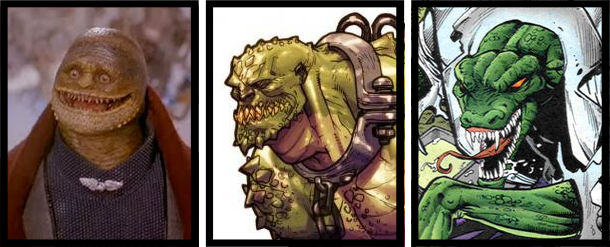
This instantly drew criticism, and created the unanimous viewpoint that this sounded much more like a Goomba from the 1993 film Super Mario Bros. Yet another observation was that the design was much more reminiscent of the Batman villain Killer Croc.
As you can see in the image above, The Lizard has always had a more pointed snout, and looked generally more like, well, a lizard. The torn lab coat is also a trademark for the character, as well as purple pants [apparently he and The Hulk buy their clothes at the same place].
Yesterday the website spiderman.ru released concept art of the film’s Lizard, creating an uproar in internet comic circles. This is not at all what fans were expecting (even after the aforementioned description of the clip), and debates were sparked between Lizard apologists and Lizard die-hards.
I began sifting through the comments sections of blogs, as I am wont to do, and found an interesting disputation between two commenters on this article, with one commenter, Kitradu, stressing that actors wearing masks “should be able to act THROUGH their limitations, physical or mental.” He referenced Willem Defoe’s performance as the Green Goblin in the first Spider-Man movie as being captivating in spite of the helmet he wore which fully obscured his face.
His opponent, storymark, began the debate with the comment:
One of the big complaints about the Raimi movies, the first in particular, was that all the masks prevented any emoting. And very few actors would be interested in a role where their actual performance is obscured.
Personally, I think an expressionless face is boring as hell.
As far as evidence goes, I tend to side with Kitradu. He references V from V for Vendetta as well as Darth Vader in the original Star Wars films as characters that held our attention without us ever seeing their faces (save for that one scene in Return of the Jedi). Emotion is more easily portrayed through a humanoid face, but what does the design change mean as far as the abilities of the actor and our viewing abilities as an audience?
To be fair to storymark, The Lizard is a very different character from either of the examples he provided. He’s far more bestial, and, from what I remember, not particularly articulate. The motion capture that Rhys Ifans is doing may not allow him the freedom Hugo Weaving had behind the Guy Fawkes mask. Though, to refute my own point, this is something Andy Serkis had no problem doing in King Kong, or Rise of the Planet of the Apes. To counter that point, both Kong and Caesar have faces more similar to humans than reptiles.
All debate aside, it should be noted, as a potential last point for this post, that the character design for The Lizard is extremely similar to his original design by Steve Ditko. But maybe there’s a reason his look has changed in the comics we read today.
The first thing you may notice from the cover, after the ridiculous length of the title, is that the book can’t be attributed to any specific author. Instead, the only evidence of there being an origin for the book are the words “Hephaestus Books,” centred and in small print at the bottom of the cover.
Fully intrigued at that point, I checked to see what else Barnes and Noble had to say about this publishing company, and was aghast at my findings. There were tens of thousands of books attributed to Hephaestus Books, each featuring a title just as [if not more] lengthy and list-like as the first I found. They covered topics ranging from Judy Blume novels to the 1950s in British television. It seemed that Barnes and Noble could show me more, but not explain, and so began my investigation.
A social reading site of sorts, Goodreads ‘ page on Hephaestus Books featured a description about the “author” that goes as follows:
“Hephaestus Books represents a new publishing paradigm, allowing disparate content sources to be curated into cohesive, relevant, and informative books. To date, this content has been curated from Wikipedia articles and images under Creative Commons licensing, although as Hephaestus Books continues to increase in scope and dimension, more licensed and public domain content is being added. We believe books such as this represent a new and exciting lexicon in the sharing of human knowledge.”
In other words it publishes print-on-demand compilations of Wikipedia articles not original works. Caveat Emptor
Author Robin Hobb wrote about the series of books on her website early this month, stating that the concept of Hephaestus Books is one that “offends [her] mightily.” Science fiction writer Jerry Pournelle wrote on his own site that he was concerned in that he had “never authorized ANYONE to make a compilation of a lot of [his] books and sell them in a single volume.” His confusion is well-founded, but in reality what appears to be a single book containing multiple novels is nothing more than, as mentioned above, Wikipedia articles.
Hephaestus isn’t even the only malefactor out there. Fonte Wikipedia and Book LLC are both “publishing companies” that do the exact same thing. A blog post I found entitled Beware the Wikipedia Scrapers exposed both of those examples, and also has a helpful list on how to “avoid this junk.”
I’m not altogether surprised by this scam; it’s one I stumbled upon years ago but have only recently found again. It sadden me, however, that it’s ongoing, and that there have been people who have fallen for it, as evidenced by the used books on sale on these sites.
As writers have said before me, watch out. Caveat emptor. Let the buyer beware. Be on your guard. Please mind the gap. This is a swindle that has befallen others, and as much as a book titled “Novels By R. A. Salvatore, including: Vector Prime, The Dark Elf Trilogy, Legacy Of The Drow, The Woods Out Back, The Icewind Dale Trilogy, The Hunter’s Blades Trilogy, Paths Of Darkness, The Cleric Quintet, The Dragon’s Dagger, Dragonslayer’s Return” might catch your eye, it might be better to stop and think about what you’re doing.
If you consider yourself someone who is quite partial to NBC’s Community, then the following is probably not news to you. Earlier this week the network released their midseason schedule, revealing that the sitcom had been pulled.
For all of the Community-enthusiasts that hadn’t heard, this does not mean that the show is cancelled. thefutoncritic, on Twitter, reported that all 22 episodes of the 3rd season will still be shot and aired. What it does mean, however, is that the returning 30 Rock will own the 8:00 Thursday timeslot at the beginning of next year, with no indication of when Community will be shown.
The question I pose to you, then, is why? Community is one of the hottest new sitcoms out there, with a following that I can only describe as borderline fanatical, so why is it being taken off the air?
I mean, just look at these good lookin’ kids!
There are a variety of reasons, each of which raise its own sets of questions.
The most important, from what I could tell, was ratings. Community‘s first season was ranked #97 in the ’09-’10 Broadcast Primetime Show Average Viewership with 5 million viewers. It dropped 18 places its second season, down to #115, losing half a million views in the process. Suffice to say, the show is not doing well.
“Community, unlike, say, Parks And Recreation, is in a format that seems to be deliberately polarizing. If you can’t get on its particular wavelength, it’s going to seem a little cold and clinical to you, and the fact that its fanbase can be a little … relentless certainly doesn’t help matters.”
Basically, it’s a show that not everyone can get into. I’ve certainly talked to a fair amount of people who have tried to get into it and reported back that they just couldn’t. This is a phenomenon I can only explain by comparing the show to the study group itself. Being a part of it is fantastic, something that every member can attest to. Trying to become a part of it, however, is a truly daunting challenge [one that character Ben Chang has not yet completed].
Another comparison [apparently the last one wasn’t the only one] can be made between Community and the film Scott Pilgrim Vs. The World. Both are loved and have large fanbases, yet one is floundering in rating and the other made only a little over half its budget. These are both works that clearly have a set audience, so maybe therein lies the problem.
Their audiences are too small. Yes, there are thousands of TV watchers who adore [worship] Dan Harmon and his show. A quick perusal of any episode’s review on The A.V. Club’s TV Club is evidence of this. These are fans who are so ardently loyal that they harangue the comments section of The Big Bang Theory (though to be fair, TBBT is not a good show). There are people who are all about this show but maybe there are not enough of them.
Perhaps in this case what Community really needs is a shift from quality to quantity in regards to its fans. If the show drops any lower in ratings you can be sure we won’t be watching the study group graduate from Greendale.
Part of this post hinges on you having read the last one I did, Aaron Diaz: Has a Lot of Opinions About DC. In it I wrote about webcomicker Diaz, his redesigns of DC characters [and his reasons for doing so] in particular. Where that post and this one overlap is that Diaz wrote new origin stories for his reboots, and these have been the subjects of replete praise.
Christopher Bird, creator [and namesake] of the blog Mightygodking, is another man with ideas that involve the intellectual property of others. A man who knows [and loves] comics, he’s written his fair share of postsaboutthem, and demonstrates an impressive knowledge of the work of both Marvel and DC. We would expect someone in his position to have strong opinions about the direction both companies are going with their comics, maybe even implying that either company would do well to hire him to write for one of their properties.
MGK should write Marvel’s Doctor Strange. And he has reasons.
Eight days ago MGK released the 42nd of his “I Should Write Dr. Strange” posts. That’s 42 reasons why Marvel certainly wouldn’t suffer by putting him in charge of writing about the Sorcerer Supreme himself.
The reasons, however, are never directed at his own qualifications. From the very first post, in which he creates a scenario where the colour blue has been magically leached from our existence, he presents stories. There’s little to no explanation whatsoever before he starts it off with the sentence, “One day, you wake up, and blue is gone.” From then on it’s a description of an eerie, uncomfortable scene right up until the last two paragraphs. The last one is but a single sentence, “And that’s why this is a job for Dr. Strange.”
I read through all 42 of his reasons this week, and was thoroughly engrossed and enchanted by every one. As someone who loves comics but isn’t terribly familiar with Dr. Stephen Vincent Strange, I found myself garnering an appreciation for the character and wishing that these stories, all hypothetical, were a reality.
Where MGK really excels in his knowledge of the lore behind it all. Whereas Diaz took and remade characters, creating an entirely new universe for them, MGK makes his narratives fit in Marvel continuity and acknowledges the world he’s writing in even though he has no obligation to do so. When he writes about Dracula he mentions Blade, and when writing about the death of Cytorrak [picture shown above] he makes sure to hint that there’s a chance not all is well with the Juggernaut. He even justifies his entire act of writing these reasons by explaining how it all continues to work even when Doctor Strange was no longer Sorcerer Supreme.
When it comes to writing about comics, especially Marvel and DC, it’s easy to criticize. While Diaz provided an alternative of sorts there’s a sense, in his redesigns, that he rejects a great deal of the characters’ original origins and histories. I enjoyed a few of his takes on a few heroes, but ultimately wasn’t convinced that this was an entire world worth creating.
MGK, Christopher Bird, on the other hand has won me over with his tremendous tales of superheroism and magic. He tips his hat at every turn to the ones who came before him, even though he technically does not come after them. He doesn’t disparage current writers [which isn’t to say that he’s never criticized any aspect of the industry], but instead provides stories, dozens of them, to prove that he knows the character and what he’s doing.
And, if after all of that, he hasn’t proved that he should write Doctor Strange, maybe he can convince you that he should write The Legion.