StarCraft, undoubtedly one of the best and most important games of all time, at least according to Wikipedia. This is an RTS [real time strategy game] that commands legions of fans, and its sequel, which launched in 2010, now commands many of the same legion of fans.
But the competitive online scene for any game is not an exceptionally friendly place. There’s the stress and pressure of playing against other players to achieve ranks, and that’s not at all helped by players who are BM (bad manner[ed]). This rudeness can even be found among pro-gamers themselves (see: many of IdrA’s interactions with other players).
Enter Jonathan Burton, also known as “Carbot” and the creator of the YouTube StarCrafts. Set entirely in the world of StarCraft II each episode presents various units from the Terran, Protoss, and Zerg races engaging in a battle that is, in a word, adorable.
Here is an artist’s rendition of the Zergling as it appears in-game:
And this is a gif of what the Zerglings look like in StarCrafts:
And they’re more than just heartwarmingly lovable, they’re also hilarious. Anyone with even the slightest familiarity with the game will lose it when they see a Zealot dancing from side to side to defend a choke, and people who didn’t understand what any of those words meant are still going to chuckle when they see the baby-like Marines running [almost always away from something]. Add to that the fact that almost all of the soundbites used are from the game itself and you have a very impressive piece of work on your hands.
The following is probably the best entry into the series, and it showcases the dangers of letting yourself get . . . overzealous. Cue classic CSI scream.
I strongly encourage all of you to check out a few episodes. Even if StarCraft II isn’t your thing [and really, it’s not for everybody] maybe this can help you relate just a little to all the die-hards out there. At the very least, you’ll have spent a few minutes watching an excellently produced video by a very talented man.
DISCLAIMER: This week we kind of dropped the ball, so our discussion on the topic is short and then turns to how WE can write this feature a little better. Our apologies.
And now back to the subject of the night: Is there artistic merit in Adventure Time?
EVAN: Whoa. You’re gonna shameless-plug your friend and then let me discuss the topic? Say something about it, haha.
GORDON: Is there artistic merit in beloved Cartoon Network show Adventure Time? Well, let’s break down what we mean by “artistic merit.” Evan?
EVAN: Is it worthy or deserving of being called art? Alternatively, does the show have the admirable qualities or attribute that art has? I guess a question to answer your question is: What is art?
GORDON: Well, let’s not try defining “art”. We’ve been trying to do that ever since we first started scratching pictures of fat ponies onto cave walls, and I doubt we’re gonna solve it in the next half hour or so. Let’s instead focus on the “merit”- what is it that makes ANY show good?
EVAN: Here’s a factor that relates directly to Adventure Time: Accessibility. How accessible does a show have to be to be good? Does it have to be accessible to be good?
GORDON: Are we talking about mass appeal here?
EVAN: Eh, sure, why not.
GORDON: Well, we gotta address that then. I mean, Twilight and the work of Michael Bay are popular, but they aren’t good. At the same time, you can’t just have a show that only you find funny, and then still call it good, right?
EVAN: You’re right. So is there a magic number of people we have to reach when it comes to a show being good? I shudder to remember Tim and Eric Awesome Show, Great Job! and how much our one friend used to love it.
GORDON: What’s worse is that my dad is into that show for some unfathomable reason. But the point is, a good thing ought to be popular to some degree, but popularity can’t be the sole element.
EVAN: Okay, so how about execution? How well the show pulls off whatever it’s supposed to be doing. Adventure Time is a show about a boy and his magical dog that is also his brother adventuring in a colourful post-apocalyptic fantasy world, but it works. They pull it off. I personally think this has a little something to do with its easy-to-digest ten minute segments.
GORDON: And there’s really no way of arguing with that- the story-telling is spot-on, but there’s gotta be more than that. The same can be said (and this is gonna give Evan an aneurysm), to some degree, of the copy-paste work of Seth McFarlane.
GORDON: What I’m saying is that McFarlane’s shows are both popular and (for what they are) well-executed, and yet we can both agree that his shows aren’t really “good,” at least, not anymore than a bag of chips is “good” food.
Therefore, there’s got to be another element at play, right?
EVAN: Ugh. I can’t even look at the chat window I’m so offended you would say something like that. I wish he would be “well-executed.” Share your other element if you must.
GORDON: Uniqueness. The show has to be unique. It’s not enough to go through the motions (as McFarlane’s shows do), you have to actually be able to make your show something that can’t be seen anywhere else.
EVAN: Something to make your stuff stand out of the crowd, okay, that’s fair. So I guess we can see how Adventure Time stands up to the criteria we’ve come up with.
Accessible? Eh, I’d say so, for its demographic and older.
Popular? Yeah, again for who I’ve stated.
You want to let these nice people know if it’s unique?
GORDON: Soooo Unique. If you can find anything remotely similar to it made in the past decade, I will slap Evan on the ears and vote for taxing the homeless.
EVAN: I mean, like I said: Boy. Magical Dog. Colourful fantasy world that is also post-apocalyptic.
EVAN: What more could you want?
GORDON: Vampire rocker girls?
EVAN: I would not mind.
GORDON: Oh wait, we’ve got that too.
You want D&D references spliced in with Science Fiction and elements of Gothic Horror?
EVAN: I think we could go for some.
GORDON: WELL WE’VE GOT IT!
EVAN: I think it’s clear that we think Adventure Time is a good show, but one thing that’s been painfully clear with this entry of E> is how much trouble it’s been doing this. Might I suggest a little something?
GORDON: Go for it.
EVAN: Let’s just choose our own topics for a little while, just to really get back into the swing of things. Keep things casual, going back and forth, avoid the heavy questions. And then we can ease our way back into all this.
GORDON: I am inclined to agree with you on this one.
EVAN: Yeah? Awesome. Anything in particular you wanted to casually discourse about next time?
GORDON: Well, I don’t think my suggestion about the Disney takeover of the Star Wars franchise was all that bad, even if Adventure Time did win by a landslide…
EVAN: I kinda wanted to talk about Deadliest Warrior.
GORDON: That would be likewise awesome. Let’s do that.
EVAN: Yes. Awesome. I’m going to post this because we are men true to our word and we promise an E> every Wednesday. We shall discuss Deadliest Warrior in a week. Or this weekend, maybe, just to get ahead. I mean, whatever.
GORDON: Good night, everyone.
EVAN: Yep, sorry this wasn’t as awesome or decent as usual. But we will be back! With a vengeance. And remember:
There’s a stark difference between what’s on children’s programming now and what there was when I was younger. I’m not here to critique the quality of the shows, because stuff like The Regular Show and The Amazing World of Gumball are really good; I’m here to comment on the content.
Cartoons used to be about kids. At the youngest end of the scale you had Rugrats, which was literally about babies. Moving up you went through Hey Arnold!, The Weekenders, all the way up to the aptly named 6teen. These were kids who went to school, who had sleepovers, who hung out with their friends. They were relatable.
The following is the opening theme from The Weekenders [1999-2004]:
This is the opening theme from Sidekick [2010-present]:
Both of these shows are, at their core, about the same thing. The difference is the gimmick present in the latter. Sidekick is about kids, sure, but it’s about kids who are training at the Academy for Aspiring Sidekicks. To contrast, The Weekenders is about kids who enjoy hanging out with each other on weekends.
That’s not to say genre-mixing in kids’ shows hasn’t been around for ages, and that I don’t enjoy them. Programs about kids who are also spies have been around since Kim Possible and Totally Spies. One of my all-time favourite shows, Fillmore!, is a shameless parody of hard-boiled police dramas, with its characters often acting more like tiny adults than children.
The fact is, I miss shows without gimmicks. When all you have to deal with is a football-headed kid and his pals, that forces you as a writer to be creative, to make the ordinary extraordinary but still relatable. Stuff can get weird, like the barbarically tribal kindergarteners in Recess, but for the most part you’re sticking to real life stuff. Honestly, being a kid is a bizarre enough experience as it is.
I love Adventure Time and its protagonist, Finn the Human. He’s a fourteen-year-old kid, and his escapades are all kinds of awesome. The thing is, I’m never going to be best friends/brothers with a magical talking dog, or date a girl who is literally on fire. I get escapism, I know why it’s important, but I also can’t feel the same way about Adventure Time as I do The Weekenders. I could have been Tino or Carver, but there’s no way I can ever be Finn.
Imagine that you haven’t had pizza in a while, and have a hankering for a slice. As luck would have it, your friend is bringing some over as he promised a few days ago. As you sit there in eager anticipation you receive a call, and he lets you know that there’s going to be some delay. Disappointed, you ask him how long it’ll be. He tells you that you should be getting your pizza sometime in 2013.
Angry? You should be.
If you are one of the many, near-rabid Community fans out there, you were probably disappointed when you found out that the fourth season would only be 13 episodes. That being said, you were probably even more distraught to find out that it won’t be actually be airing this Friday.
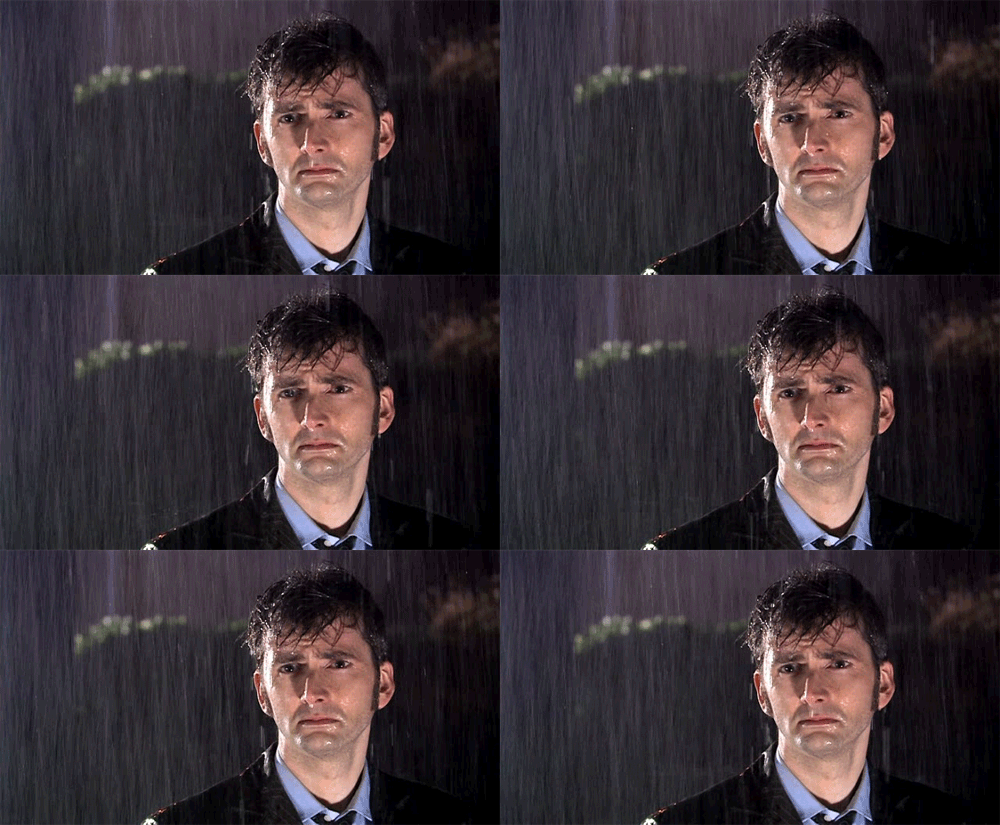
That’s right, NBC has decided to remove Community completely from its 2012 Fall lineup. It’s unknown when the show will return, but the best guess is sometime during the Spring of 2013. I have attached a gif because Gordon is rubbing off on me, and because Troy crying is always funny. Look at him, the dude is sad. To be fair, so are a lot of people. I’m a little disappointed myself.
But not near as disappointed to see that Cartoon Network has pushed all of its DC Nation programming back until January 2013. It’s understandable that room had to be made to celebrate the network’s 20th anniversary, which is definitely something special. The main issue I have is that this decision was made after two weeks of programming had already been aired.
This means that after two episodes of Young Justice and two episodes of Green Lantern: The Animated Series it’s three months before we can get any more. If we can go back to my pizza analogy, that’s like someone letting you take a few bites and then telling you that you can have the rest. In three months.
Quality programming can be hard to come by [see: any episode of 2 Broke Girls], and news that your favourite shows won’t be around until after the predicted apocalypse is sombre news indeed. While Cartoon Network’s reasoning makes some sense, to air a few episodes and then push the rest back is insensitive at best. As for NBC, they seem committed to letting Community fans know that they are really not all that important.
Over the past couple days, actors Donald Faison and Zach Braff have been campaigning for Obama here in Vegas. While I’m not a fan of their political stance, I freaking love Scrubs and have been re-watching the show for what must now be about the ninety-billionth time.
It got me thinking about a discussion Evan and I had a while back, in which we concluded after some debate that Scrubs is the best show of all time.
Ok, that’s not going to mean anything to you if you haven’t actually seen Scrubs. If you haven’t, go watch it now.
Now think about it- has there been a bad episode of Scrubs? Has there ever been an even sub-par episode of Scrubs?
There really hasn’t. Not every episode is fun to watch (it’s a hospital- you can’t expect them not to deal with mortality and whatnot)- some episodes are downright depressing and tragic. Even so, there show never fails to have some substance to it and (and this is the big thing) never really diminishes in quality despite having been on air for eight seasons (nobody counts the ninth as cannon).
But more on that in a minute…
See, what makes Scrubs so consistently good isn’t that it’s funny- it is funny, but not every episode, and not every joke in the funny episodes will have you on the floor.
Though most will…
It’s that it’s consistent all the way through. The characters develop, certainly, but they never really shift dramatically or break away from who they were a season ago. JD is always JD, Turk is always Turk, and so on. The wacky, exaggerated universe of the show never strays too much into total realism or too far off into surrealism. In short, and episode seen in the last season of Scrubs is about the same (extremely high) quality that the initial episodes are.
Now I know you’re all saying, “But Gordon, you ruggedly handsome bastion of logic and truth, surely consistency isn’t all there is to it!”, and yes, it’s not just consistency that makes a show good. Comedies need to be funny, dramas need to be agonizing, and so on- nevertheless, these things are dwarfed when it comes to consistency- let me give you an example of this done wrong.
Community. I remember seeing ads for it in my first year of college and thinking “Neat- a show about college. Something I and my demographic can all relate to and get a kick out of. This looks like it’s gonna be good”.
And it was.
(Barring that they had an Indian guy playing an Arab kid because apparently all brown people are the same…)
Really good. In fact, the first season of Community is probably one of the funniest things I’ve ever seen in the couple decades I’ve been alive. But what proceeded the glorious first season was one of the fastest and ugliest burnouts in television history.
You remember how Abed was socially-challenged but ultimately human in his attempts to relate to people and make is father (also played by an Indian actor) proud? Remember how Jeff wanted to get his degree and regain control over his life? Remember how Troy was trying to deal with the loss of his status? How Annie was trying to reinvent herself?
Yeah, all of that went down the toilet in the subsequent season. The motivations that gave the episodes conflict and helped progress the characters and the story as a whole were more or less dropped, and the little quirks that made the characters funny and interested got so blown up that they became the only aspect of the characters. Abed went from movie-geek to schizoid mess, Jeff became charming (and nothing else), Troy became just Abed’s buddy, and Annie was just the sweet naive straight-man (more or less) to the rest of the group. On top of becoming gross caricatures of their former selves, the show stopped dealing with college (which you might recall as being the reason so many people started watching the first place) and became centered entirely on the clownish escapades of the group. Granted, every once in a while you got good episodes, but never on the same level as the first season. Every time I sat down to watch Community the smile faded from my face and I could react in no other way but this:
“But Gordon, you roguish fountain of delight, isn’t this more a warning against being madcap than straying from the characters and story?”
I’d have to concede that, if it weren’t for such shows asSouth Park and American Dad. Both of these shows have been from their inception pretty surreal, nonsensical, and all-around crazy. Yet both shows have maintained that same level of craziness and remain (more or less) as popular now as when they started.
I admit, these shows are not for everyone…
Again, an excellent example of how shows drifting away from their original material kills them would perhaps the most iconic animated show of all time: The Simpsons.
My old roommate never saw the early Simpsons, and is to this day convinced that the show is side-splitting in its hilarity. And he’s probably right- I stopped watching the Simpsons after my first year of college- I got tired of having my heart broken.
Perhaps it’s best encapsulated in this quote by Lisa Simpson back in Season 2:
I heard you last night, Bart. You prayed for this. Now your prayers have been answered. I’m no theologian. I don’t know who or what God is exactly. All I know is he’s a force more powerful than Mom and Dad put together and you owe him big.
Would you ever hear that from Lisa in one of the later seasons? You would not. Why? Because Lisa has moved from being a brilliantly smart little girl to a pointy-haired midget channeling the whiny liberal indignation of Bill Maher.
Is there anything wrong with Lisa as she is today? Not really, no. If that’s who her character is, then that’s who her character is- only the hitch here is that’s not who Lisa started off as. Had Lisa started off as the yellow counterpart of Brian Griffin, then I wouldn’t have any problem. Had Homer started off as a food-crazed buffoon or Marge as a simple housewife, I’d probably still watch the show. Again, it’s the gradual change from one thing to another that’s responsible for people drifting away from the series. It’s not that shows go stale (not that staleness can’t be a problem- just look at the Gilligan’s Island episode where they’re almost rescued), it’s that they change too much.
And hey, with our ever-shortening attention spans and our rapidly changing culture, maybe that’s not such a bad thing.
Cartoons are a complicated thing. For example, children’s cartoon characters are required, in general, to always be wearing a seatbelt when in a vehicle. British TV character Peppa Pig was forced to wear one in all future episodes once parents raised concern about safety [the first few episodes would also be reanimated to reflect the change].
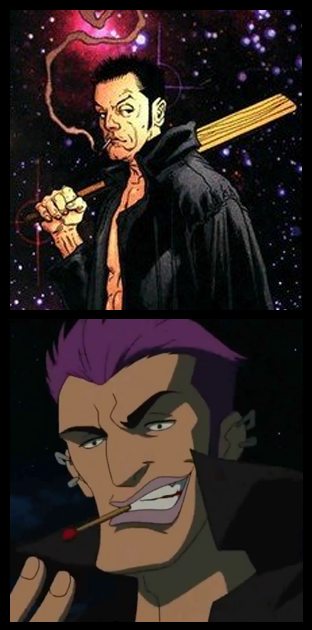
The presence of tobacco is yet another issue. In the upcoming DC animated movie “Superman vs. The Elite” British antihero Manchester Black is portrayed without his customary cigarette hanging from his lips. As you can see by the images to the right, it has been replaced by a matchstick.
What I’m slowly trying to get to is death in cartoons, and how it’s handled. The reason that this post didn’t go up yesterday was that I was powering through an entire season of “The Avengers: Earth’s Mightiest Heroes.” While I was watching the show, however, the same thought kept running through my mind: so many people just died.
Large fight scenes abound in the show as the Avengers battle to save New York City and the world, and collateral damage abounds. Skyscrapers fall and cars are thrown around, often with the implication that there are indeed people inside. A movie can be rated PG-13 for “sci-fi destruction and violence,” and I wonder how the show would stand up to the MPAA’s standards.
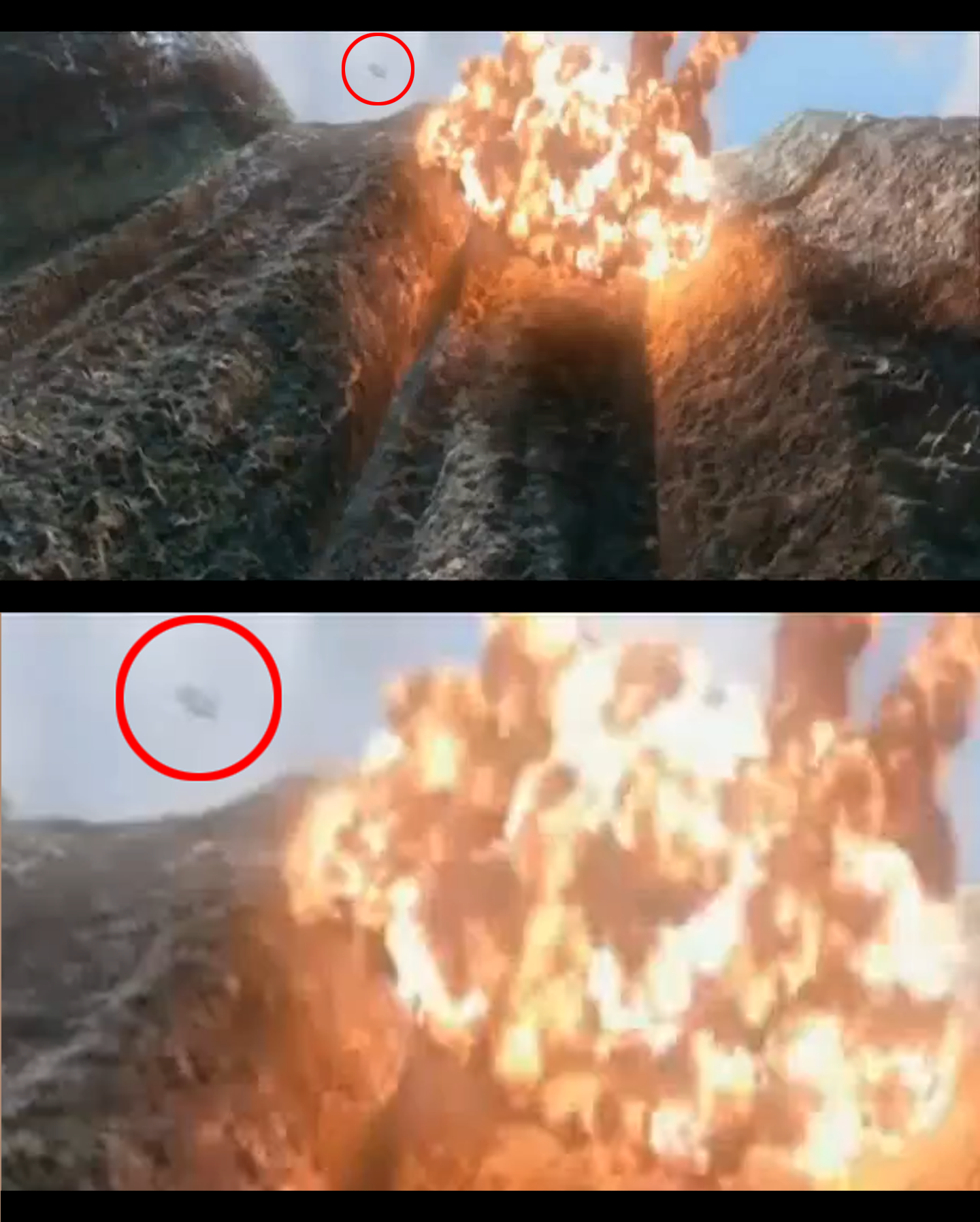
Similarly, in Pixar’s “The Incredibles” it is very strongly implied [though never outright seen/stated] that people, specifically Syndrome’s henchmen, die. There is a scene where Dash fights one of these goons and causes him to crash his vehicle into a cliffside. The result is a fiery explosion. From what I could tell the first few times I saw the movie, the man had definitely perished in the blast. Out of curiosity, however, I watched it again yesterday at half the speed.
As you can see, there is a brief second where a piece of debris can be glimpsed that could maybe be interpreted as some sort of escape pod. I sincerely doubt it, though. And this causes me to wonder how Pixar managed to get away with it, and how exactly the rules can be bent. In the scene pictured above a ten-year-old boy is the cause of a man’s death. Is that something worth considering, would children even notice or be bothered by it?
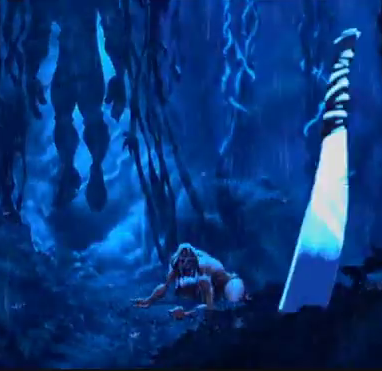
Death in cartoons has always been a very important event. Primary antagonists are normally relegated to some sort of dramatic end, and Disney movies are a fine example of this. Gaston [Beauty and the Beast] plummets to his death in a gorge, Clayton [Tarzan] ends up hanging himself from vines, and Commander Rourke [Atlantis: The Lost Empire] is turned into crystal and ends up shattering after hitting the fan of a hot air balloon. Their henchmen are, by and large, simply knocked out, oftentimes in a comical manner.
The question I’m trying to ask is whether or not we should continue to uphold the concept of death as this sacred thing in cartoons. Does a henchman’s demise deserve any kind of gravitas, or should he die in the first place? How much credit do we give children to understand what is happening when a character dies on screen? I can’t say that I have the answers, but becoming a parent will probably force me to find out.

 StarCraft, undoubtedly one of the best and most important games of all time, at least according to Wikipedia. This is an RTS [real time strategy game] that commands legions of fans, and its sequel, which launched in 2010, now commands many of the same legion of fans.

 DISCLAIMER: This week we kind of dropped the ball, so our discussion on the topic is short and then turns to how WE can write this feature a little better. Our apologies.


 That’s right, NBC has decided to remove Community completely from its 2012 Fall lineup. It’s unknown when the show will return, but the best guess is sometime during the Spring of 2013. I have attached a gif because Gordon is rubbing off on me, and because Troy crying is always funny. Look at him, the dude is sad. To be fair, so are a lot of people. I’m a little disappointed myself.




 Culture War Reporters