Category Archives: television

In Defense of This Generation

Don’t get me wrong, there’s a lot- a lot– to criticize about the millennial generation. There’s creative bankruptcy (see Evan’s post), “slacktivism” and general laziness, ever-shortening attention spans, and of course, loud, obnoxious repetitive music without any discernible beginning, end, or climax.

I cannot state enough how much I hate techno…

Now with all that stated, I do want to address some of the criticisms thrown at Generation Y by our elders and (as they see it, anyways) betters.

Late last year, I came across this article, titled “5 Ways We Ruined the Occupy Wall Street Generation“. In his defense, the author emphatically states at the beginning of the piece that “This is not a sarcastic apology, I’m not a big enough dick to write all of this as a backhanded insult about how lazy and entitled you are. Because you’re not…”. Even so, it’s tough to read the article and not feel frustrated at some of the more glaring errors, or condescended to by false conclusions drawn from them. Despite the author’s best intentions, you can’t really walk away from the piece without imagining him to look something like this:

I’ll get right into things here with his first point “#5. Making You Ashamed to Take Manual Labor Jobs“. The author opens by offering the example of a piece of dialogue that went viral about a year ago.
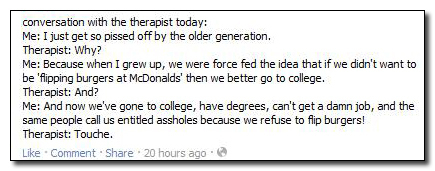
It’s a great little bit, but I still have to stop things right there. We’re not ashamed to take manual labor jobs. We never have been. In this economy more than ever, there are college graduates willing, ready, and even eager to take jobs sweeping floors, unloading crates, answering phones, or stocking shelves. We’re not ashamed of flipping burgers, we just can’t afford to flip burgers. See, we have this funky little thing called “debt”, and not just any debt, the one kind of debt we, by law, cannot have discharged. To clarify- if I went bankrupt, if fire burned down my house and destroyed each and every last earthly possession I had, the only thing I would have left would be tens of thousands of dollars of debt I still need to pay.

The appropriate reaction…

All that’s to say we can’t take jobs flipping burgers because the $7.25 an hour you get for being abused by the customers and/or inhaling carcinogenic fumes just isn’t enough us to live independently and pay off our various mountains of inescapable debt.  Even if we move back in with our parents (more on that in a minute) things will still be tight- and God forbid we should even think about getting married or having kids until we’re in our mid-30’s. Which brings us to our next point- “extension of adolescence”.
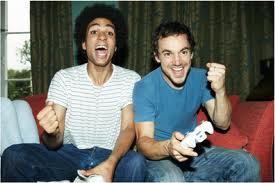
This is a psychologically documented phenomena, and something that’s rather throwing the combined worlds of sociology and psychology. Ever since the line between childhood and manhood ceased to be set at bringing down an elk and bathing in its blood, figuring out exactly when a person ceases to become a kid and becomes an adult is tough. It’s certainly not something new, but it is currently far more pronounced than with previous generations. Take that picture up there for example. Two guys, looking to be in their mid or even late twenties, playing X-Box. There’s the clincher there- the X-Box. The older generations, having had really nothing quite on the level of video games (pac-man doesn’t really count), labeled them as “kids’ stuff” from their inception, and the fact that we still play video games well into our twenties is seen as us extending our teen years, rather than shifting over to being an adult. The author of the article has this as his third point “Adding Seven More Years to Being a Teenager”.

Of course, it’s absolute nonsense once you think about it. What did our grandparents or even our parents do for fun when they were kids? They played cards, board games, hunted, fished, went to the movies, and beat up minorities.
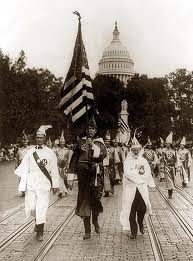
KKK Rally, or as they called it in the 30s, “Wednesday”…

And what do our grandparents and parents do today when they want to have fun? They play cards, board games, go hunting, fishing, and go to the movies (hopefully they’ll have dropped “Harassing Pollacks” from the daily planner by this point). You never hear anyone accuse them of extending their teen years. My grandfather and his friend have been playing cribbage together for over half a century, does anyone tell them that they need to start acting like adults? Let’s face it, when it comes to what this generation does for fun, we really don’t differ from anyone in a previous generation, it’s just that what we do is so radically different, we have the appearance of being immature.

And what about responsibility? Is this generation really lazy and wussy compared to the generation who worked in the mill, took a break to fight Hitler, and went back to working in the mill and raising a family? Last time I checked, we’re in the worst depression since the 1930s (a crisis which we, incidentally, had nothing to do with but still have to pay for) and on top of this we’ve been locked in the longest war in American history- nearly twice as long as the entirety of WWII, just for some perspective. You can say a lot of things about this generation, but you can’t try to claim that we’re somehow just a bunch of young adults still trying to drag out our years as kids.

“Just look at that entitled, lazy kid. No concept of hard work or adult responsibility.”

Of course, we do tend to party, and while I could point to this being true of pretty much every young generation since a Cro-Magnon named Thruk invented partying roughly 43,000 years ago, I’m going to take a different approach.
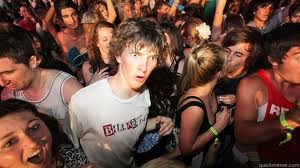
This might come as a shock to some, but young people don’t want to spend their twenties partying because they’re afraid of turning into soulless corporate drones- it’s because we’re enjoying, often for the first time, full independence. Believe it or not, we don’t want to move back in with our parents and spend our youth still under their watchful gaze. We want our own place, our own job, our own car. We want responsibility, and as strange as it sounds, the partying is simply an extension of our attempts to explore our new found freedom.

As for us being entitled, there is something to be said for that. I recall once riding the subway with this blog’s regular contributor Evan and overhearing two youths snivel that the computer they were getting wasn’t quite as advanced as it could be. That said, there’s plenty of so-called “entitlement” that get’s unfairly pinned on us. The Occupy Movement, for example, was criticized by some as being a bunch of lazy kids that expected everything to be handed to them. I mentioned above that the current economic crises responsible for so many of our problems was- and this is key here- not started by us. What was I doing when the economy started to tank? Nothing. I was consuming the food put before me, buying as much stuff as could be expected from a teenager, and working summer jobs when I could. What did I do wrong? Why am I getting stuck with the economic crises I had nothing to do with? If you want to talk about entitlement, let’s talk about the generation who gambled with our collective futures and expects us to clean up the mess. Same goes for the wars we’re currently locked into.

As for our “armchair-activism”, again, there’s plenty wrong with this, and you could spend plenty of time going through what makes it such a pointless endeavor. Nevertheless, I can’t help but feel irked when someone from an older generation- specifically my parent’s generation (who would’ve been my age in the 80s and early 90s). Say what you will about people who mass-forward e-mails about signing petitions or demanding you like a cause on Facebook, there’s at least a level of interest. Barring the grossly simplistic anti-drug movement of the 80s, I can’t exactly recall the major moral movements of that generation. In short, the whole that this generation might be shallow isn’t without merit, but the people who point the finger ought to be awful careful that they pick the log out of their own eye first.

“What do we want?”
“Fluffy hair!”
“When do we want it?”
“After we’re done snorting crack!”

I’m going to finish up here with this last point- addressing the author of the article’s claim that the number one reason “We’ve ruined the occupy wall street generation” is that “we’ve taken away every reason to go outside”.
Am I the only one here who sees a staggering paradox? Am I the only one struggling to resolve how the “Occupy Wall Street People” need to “Get Outside More”? Last time I checked, the protestors at Occupy Wall Street were literally occupying Wall Street.
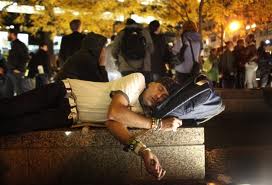
“Look at how pale you are! When’s the last time you went outside? Besides yesterday, and the day before that, and the day before that, and the day before that, and…”

Now do we get outside as much as previous generations. Not really no. But then again, I don’t really see masses of the elderly roaming the streets either. Look, the reason we don’t “go out” is because many of us (who would, by the way, love to go out) are living in cities or urbanized areas. Short of just “walking around”, any major outdoor activity costs us money, which in case you haven’t picked up on by now, isn’t something we have just lying around. Between gas, food, entry fees, and other costs, I’d have to spend nearly a monthly payment to my college debt getting forty-eight hours in the great outdoors. That’s the reason we don’t like paying for entertainment (the author’s fourth point), only it’s not because we expect our entertainment to be free (just ask anyone who’s paid upwards of 60 bucks for a new X-Box game), it’s because we’re trying to be thrifty. If we want to get our own car and our own house to avoid the sneers of our elders, we have to pinch every penny until it slaps us with a sexual harassment lawsuit- entertainment is simply a major way we can save money and not go postal.
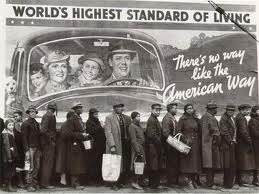
Look at those people trying to get food for free instead of paying for it! Lazy, entitled bunch of bums expecting everything to be handed to ’em, that’s what they are!

So in sum total, that’s my defense of my generation. It’s not a great generation- certainly not yet, anyways. It’s not the worst generation either, though, and before anyone- anyone– wants to label us as lazy or entitled or juvenile; please, look at us in the bigger scheme of things, and better still, look at yourselves. Would you want the standards you place on us applied to you?

The Problem With Protest

I thought today I might address the subject of protest.

At the tail end of last year, I came across this picture posted on Reddit:

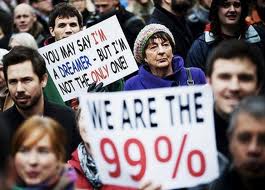
Despite an overall positive response to the message, one of the highest ranked comments was a person arguing that the Klansmen, unlike the protestors, had permits to march, while the OWS movements across the nation were illegally squatting. Because they are on private property, it is only right that the police should respond in the ways they do.

I wonder if that person would’ve reacted the same way fifty years ago, when these young men and women were illegally occupying private property.

That’s the Greensboro Four, occupying private property in 1960 in protest of racial segregation. Ought the police to have pepper sprayed them for refusing to leave? The problem with attempting to make out the OWS protestors as criminals who are attacking social order is that this same reasoning has to be applied to criticize the women’s rights movement, the civil rights movement, the abolitionist movement, and so on. Even the men and women of the American revolution would, under this blind obedience to the law, be considered criminals and rioters- even traitors. Trying to pretend that the OWS protestors are nothing but vagrants and lawbreakers simply doesn’t work.

However, even if you can’t call them criminals, you can at least call them crazy.

I’m not going to lie, I’m not always a big fan of the crazy outfits some people will wear to protests to make a point. I don’t think dressing up as the Monopoly guy is really all that effective at communicating the messages you want to make.

You’re already protesting en-masse, the satire might be a little overkill…

I’m not saying that I’m right, maybe a couple zombie-protestors is just what you need to drive home a point of mindless consumerism. And I’m not against people wearing what they want to wear- I think the Guy Fawkes masks a la V for Vendetta are actually pretty effective at empowering people and creating a sense of unity. Nevertheless, you still hear people trying to discredit the movement because they don’t like the way the protestors look.

Is this what we’ve really come to? Because the OWS protestors aren’t clean shaven or wearing suits and ties (zombie bankers excluded), they’re just a bunch of moochers? Since when does nonconformity to a social “norm” suddenly create grounds for disproving someone’s views? You could take Jesus, drop him the middle of Times Sqaure, and if he’s dressed in the same clothes he would’ve worn two thousand years ago, then he’d be written off as some hobo or crazy ex-hippie.

But of course, not all the protestors are dressed like something you’d encounter in a post-apocalyptic carnival. You will find protestors cleanly shaven and dressed in suits and ties (who aren’t zombie bankers). What do we call these people?

Hypocrites- or at the very best, spoiled and privileged college kids. That’s right, dress shabbily, and you’re a bum, dress sharply, and you’re a naive idealist completely detached from reality. That’s not to say that such people don’t exist- I have a tough time accepting “revolutionaries” wearing Nike or buying from Starbucks, but to attempt to label the occupy movement as a bunch of hypocrites because they aren’t living in poverty is crazy. No matter what you do, you’re either an outcast of society or from the cream of society- either way, you’re message isn’t worth hearing. Perhaps the best mockery of this line of thought is this picture here:

This seems to be part of a greater issue with protest that people have- a vicious antipathy towards protest regardless of the content or the method. Let me explain.

A criticism a friend of mine once hurled at the OWS movement was that they “Just don’t do anything. They came, they complained, and now they should go home.” Now you might point out that many of the protestors are at the Occupy camps because they have no homes anymore, or even that one of the actions of OWS protestors is helping evicted families reclaim their homes, but let’s just focus on the protest itself. To some degree he- he and others like him- have a point; there’s only so much marching, chanting, and picketing can do. Take this guy for example:

I’m going to go out on a limb here and say that the Knesset isn’t going to rip down the barrier-walls in the West Bank or put a moratorium on new settlements because this guy demands it. There are very definite limitations to what this kind of protest can do, and as much as it is decried as pointless, do these critics really want to see the alternatives?


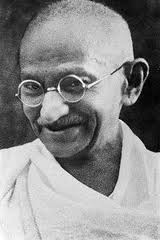
Let’s talk about civil disobedience hear- still (typically) non-violent, but certainly a step up from rallying. We’re talking about sit-ins, human walls, trespassing, and a host of other activities typically leading to charges of disturbing the peace and disrupting productivity. The kind of actions generally associated with MLK Jr., and his inspiration, Gandhi.

Seductive Gandhi is Seductive…

Of course, there are limits on this as well. For all the disruption a group may cause, there’s always the authorities to contend with- you might recall this particular photo:

There’s a case to be made for civil disobedience, but this does really lead back to the original problem of legality. Even if you want to argue for nonviolent actions against the law, one might point out that this is only effective in a situation where there’s a limit on how much you’ll be beaten, imprisoned, or in cases, even killed. I’m guessing that most people wouldn’t have told Jews, Gypsies, Gays, Socialists, and Jehovah’s Witnesses that civil disobedience would have been the best tactic against the Nazis. Considering that the OWS movement is a form of civil disobedience, one might also simply comment that no effective action is being taken by the protesters.

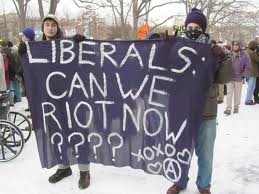
So what about “direct action”, as certain protestors affectionately call it? Black Bloc tactics. The smashing of windows, the overturning of cars, the setting fire to of public decorations (see the Greek anti-austerity protests), and so forth?

While without a doubt the most confrontational of all the protest methods available to the angry and the frustrated, this is nevertheless the single most universally condemned tactic, even by those who are supportive of the goals in question. “The Black Bloc protestors discredit the movement!” you hear over and over. From the latest NATO or G20 conference clear back to the so-called “Battle in Seattle”, you can hear the authorities railing against these “hooligans” and “rioters” and even the major figures of the protest pleading for non-violence.


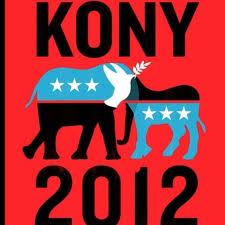
And while the destructive methods employed by the more extreme elements of any protest are attacked, ranking in a close second in ridicule is on-line petitioning, Facebook sharing, and a host of other activities shoved under the umbrella pejorative of “Slacktivism”. The past “Kony 2012” campaign, while certainly questionable in its content, seemed to receive the majority of criticism by those who viewed the young people involved as arm-chair activists; at best, misled college kids caught up in the latest cause célèbre; at worst, lazy and entitled brats on a tier lower than the Occupy hipsters.

Now let’s take a step back and look at all of this. Marching- doesn’t work. Civil disobedience- either illegal or still ineffective. Violence- something to be avoided at all cost. Petitions- worse than marching. Added all together, the only acceptable option for people who believe that the system no longer works seems to be abandoning that belief. At this point, we really have to consider the idea that the issue isn’t with how people protest, but with protest itself. That these criticisms are all just rooted in the deeper reaction against public disturbance. There is an element of society who, when asked what action we should take, simply respond “don’t take action!”. Regardless of how you present yourself, or what you do, or to what extremes you do or do not go to- they will always be opposed.

And as disheartening as that might seem- there is positive flip-side to this.

If you just can’t please these people, why bother trying? With the fact in mind that there’s always going to be someone scowling from the sidelines, you’re free to do whatever you want to convince those who are actually willing to listen. If that’s not comforting, I don’t know what is.

Coping with Cartoon Death

Cartoons are a complicated thing. For example, children’s cartoon characters are required, in general, to always be wearing a seatbelt when in a vehicle. British TV character Peppa Pig was forced to wear one in all future episodes once parents raised concern about safety [the first few episodes would also be reanimated to reflect the change].

The presence of tobacco is yet another issue. In the upcoming DC animated movie “Superman vs. The Elite” British antihero Manchester Black is portrayed without his customary cigarette hanging from his lips. As you can see by the images to the right, it has been replaced by a matchstick.

What I’m slowly trying to get to is death in cartoons, and how it’s handled. The reason that this post didn’t go up yesterday was that I was powering through an entire season of “The Avengers: Earth’s Mightiest Heroes.” While I was watching the show, however, the same thought kept running through my mind: so many people just died.

Large fight scenes abound in the show as the Avengers battle to save New York City and the world, and collateral damage abounds. Skyscrapers fall and cars are thrown around, often with the implication that there are indeed people inside. A movie can be rated PG-13 for “sci-fi destruction and violence,” and I wonder how the show would stand up to the MPAA’s standards.

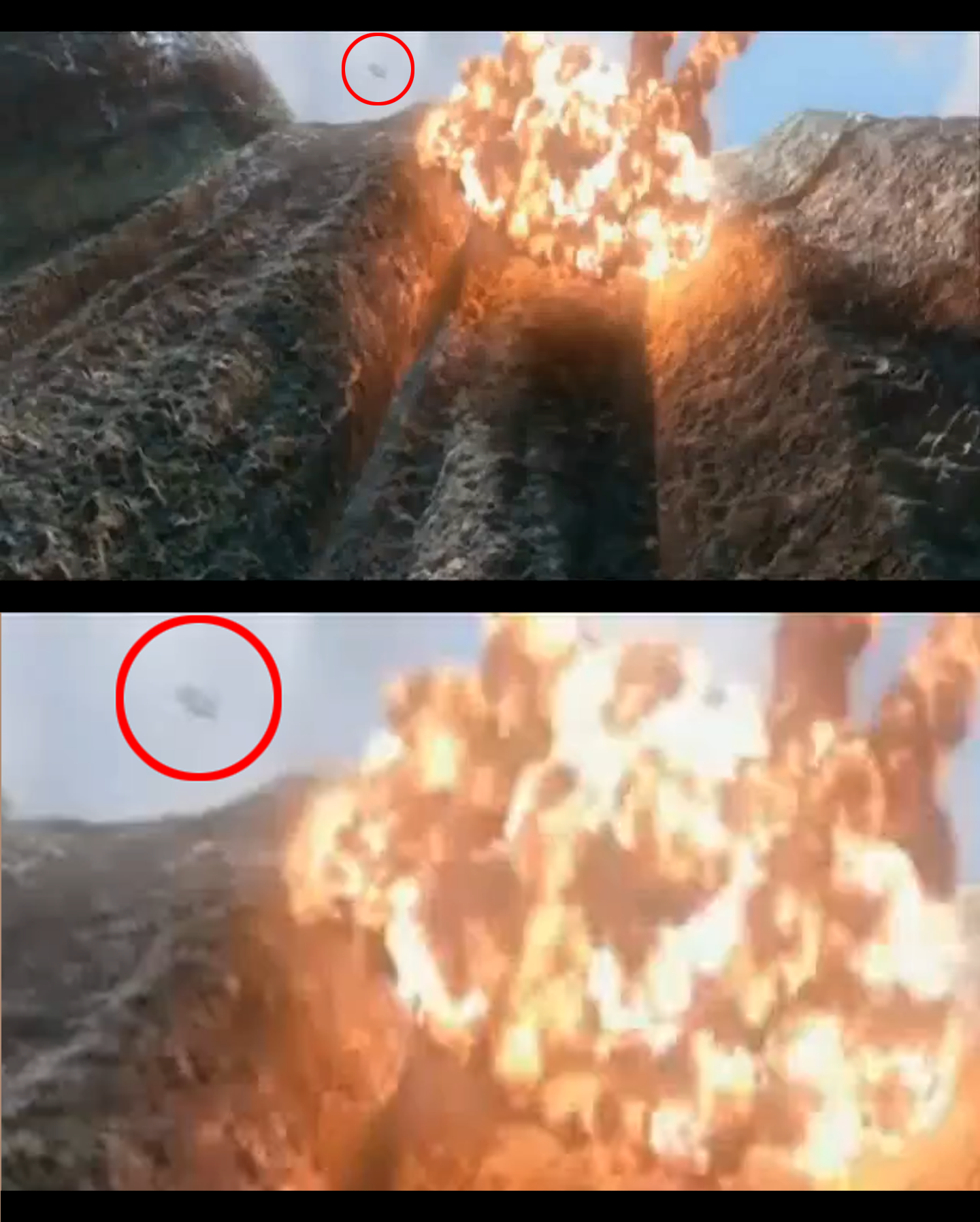
Similarly, in Pixar’s “The Incredibles” it is very strongly implied [though never outright seen/stated] that people, specifically Syndrome’s henchmen, die. There is a scene where Dash fights one of these goons and causes him to crash his vehicle into a cliffside. The result is a fiery explosion. From what I could tell the first few times I saw the movie, the man had definitely perished in the blast. Out of curiosity, however, I watched it again yesterday at half the speed.

As you can see, there is a brief second where a piece of debris can be glimpsed that could maybe be interpreted as some sort of escape pod. I sincerely doubt it, though. And this causes me to wonder how Pixar managed to get away with it, and how exactly the rules can be bent. In the scene pictured above a ten-year-old boy is the cause of a man’s death. Is that something worth considering, would children even notice or be bothered by it?

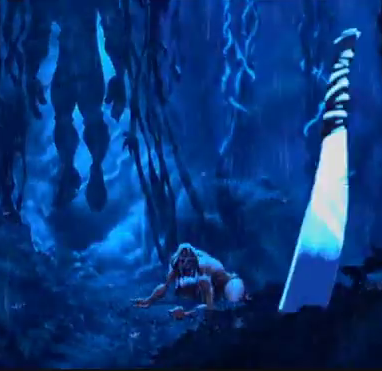
Death in cartoons has always been a very important event. Primary antagonists are normally relegated to some sort of dramatic end, and Disney movies are a fine example of this. Gaston [Beauty and the Beast] plummets to his death in a gorge, Clayton [Tarzan] ends up hanging himself from vines, and Commander Rourke [Atlantis: The Lost Empire] is turned into crystal and ends up shattering after hitting the fan of a hot air balloon. Their henchmen are, by and large, simply knocked out, oftentimes in a comical manner.

The question I’m trying to ask is whether or not we should continue to uphold the concept of death as this sacred thing in cartoons. Does a henchman’s demise deserve any kind of gravitas, or should he die in the first place? How much credit do we give children to understand what is happening when a character dies on screen? I can’t say that I have the answers, but becoming a parent will probably force me to find out.

[Very] Brief Thoughts On Entertainment

A bitter, angry old man once said:

There’s been a growing dissatisfaction and distrust with the conventional publishing industry, in that you tend to have a lot of formerly reputable imprints now owned by big conglomerates. As a result, there’s a growing number of professional writers now going to small presses, self-publishing, or trying other kinds of [distribution] strategies. The same is true of music and cinema. It seems that every movie is a remake of something that was better when it was first released in a foreign language, as a 1960s TV show, or even as a comic book. Now you’ve got theme park rides as the source material of movies. The only things left are breakfast cereal mascots. In our lifetime, we will see Johnny Depp playing Captain Crunch.

That same man wrote The League of Extraordinary GentlemenV for Vendetta, and one of Time Magazine’s All-Time 100 Novels, Watchmen. Alan Moore certainly has the writing credentials, but is he accurate in his assessment of the future of entertainment?

The truth is, as you’re probably well-aware, that the publishing industry is an ever-changing thing. ComicsAlliance writer Chris Sims has called for the “big two” [Marvel and DC Comics] to get serious about webcomics. In other words, for the two publishers to release content for free to compete in an age where people just aren’t buying print anymore. It would work as a way to increase and maintain interest in their product, and would even help sales; people who like reading something online will typically buy it if they like it enough.

As for creativity, I wrote in a post earlier this month [Mashin’ It Up] about people who are seemingly just reaching into a bucket of tropes and smashing them together at high speeds. Cowboys and Aliens was a movie that came out last year, and it wasn’t even original; it was an adaptation of a [honestly, not very good] webcomic. Not only that, but by next year Gore Verbinski will have directed Lone Ranger, with Johnny Depp as Tonto. That could be considered one step closer to Captain Crunch, I suppose.

At the same time adaptations are being made of novels. They may not be original screenplays, but the original work is nothing like a TV show from the 80s, it’s not built on nostalgia. Audrey Niffenegger’s The Time Traveler’s Wife was adapted for the big screen, and although it didn’t do great with the critics it still stands as evidence that books will do well; and they’ll do well enough to warrant films. This could lead into the conversation about how some books receive film opportunities before they’re even published, but that’s for another time.

The “conventional publishing industry” will continue to change; it has and it will continue to. Alan Moore is a cynical miser of a man [subjective], but he has a point that shouldn’t be ignored. We’re not doing great in regards to creativity, and it’s an area we should expect more from. Cynicism may appear to be the logical place to turn to, but looking for media worthy of attention is the more worthy activity.

The Avengers and New Footage Fatigue

Mild spoilers, if you’re not constantly watching for comic book movie news [like I do].
                                                                                                                                                                      

Don’t get me wrong, I’m still going to see The Avengers this summer. The thing is, I may as well be watching it for the second time.

Joss Whedon’s biggest directorial experience to date will hit in a little under three weeks with a running time of 155 minutes. After all of the trailers, previews, and TV spots I’ve seen I think that only leaves me about half an hour of footage to experience in the theatre for the first time.

Seriously, though, today I found out that Maria Hill and Nick Fury will have an argument of some sort. I don’t know exactly what it’s going to be about, but I know that it will happen because of an interview Cobie Smulders [playing Hill] did with David Letterman. I also know that Captain America will tell the Gamma-Powered Goliath to smash something. At some point in the film I know that Black Widow will soundly thrash a general and his cronies, because a 43-second clip was released by Marvel.

I don’t mind that Marvel has been advertising this film with everything from Dr. Pepper to Wyndham Hotels. Pixar’s Cars made something like $462 million in the box office, which isn’t bad. What’s even better, though, is the $5 billion they made in merchandise. Movie tie-ins that include toys and such are not at all what worry me. What worries me is knowing too much about the movie before I see it on the big screen.

StarCraft II: Wings of Liberty was what the summer of 2010 held for me, and while waiting for in the ’09-10 academic year I spent a great deal of my free time trying to find out more about the game. In the process I became privy to information on seven or eight missions. That’s about a third of the game. Not only that, but I also perused a site that had posted unit models, robbing myself of experiencing them in the game first-hand.

We live in a world where information is at our fingertips, and leaks and spoilers of any kind can be found within seconds. At this point in time I have no idea what the image on the right is of, only that they are part of Loki’s army and the primary antagonists in The Avengers. I don’t want to know what they are until I see the movie, and it’s getting harder and harder to when I daily visit sites such as ComicBookMovie.com, ComicsAlliance, and io9 [the latter even has a daily feature called Early Morning Spoilers].

From this point on I refuse to watch another TV spot for The Avengers. There’s only so many seconds of new footage they can cram in there before I’ve seen more of the movie than I wanted to. I’m going to see if I can hold out until May 4, and I hope that when I finally see it in theatres I’ll be able to enjoy every second of those 155 minutes like I’m watching them for the first time.

A Look at The Walking Dead‘s Theodore Douglas

Season 2 of AMC’s The Walking Dead wrapped up this past Sunday, kind of a big deal when you take into consideration the fact that the show was pulling in roughly 10 million viewers every time it aired. There are blogs all over the place discussing the big reveal, so feel free to head over there if you’re wondering what all the fuss is about. This post is meant to take a good hard look at character Theodore “T-Dog” Douglas.

AMC’s The Walking Dead is based on an immensely well-received comic book series of the same name written by Robert Kirkman. While it has, for the most part, stuck with the comics’ general plot progression, there have been a large amount of changes made. The addition of T-Dog as a member of the group in the first season was one of them.

As this season has progressed the internet has taken a lot of interest in T-Dog, for the most part discussing how little a role he actually has to play in the show. The following are his biggest moments listed in chronological order:

S1E1, Guts: T-Dog is one of the group members. He is savagely beaten by a racist among them and is almost killed.  The character who beat him is handcuffed to a roof as punishment. Later, when sent to free him, T-Dog drops the keys down a drain.

S2E1, What Lies Ahead: The survivors are scavenging an abandoned
highway for supplies. T-Dog doesn’t hear Rick, their leader, tell everyone to hide under cars due to zombies. He cuts his arm open on a car door. His life is saved when another survivor covers him with a dead zombie.

S2E2, Bloodletting: T-Dog is upset because the group is leaving him behind with an old man. He thinks it is because he is black. It turns out that he has blood poisoning and is weak and might die.

S2E4, Cherokee Rose: T-Dog almost drinks water from a well that had a big fat zombie in it.

S2E6, Secrets: They’re at a farm, and one of the farmer’s kids turns his pistol sideways during shooting practice. T-Dog tells him not to “give [him] any of that gangster sh-t.”

S2E12, Better Angels: T-dog sees that a prisoner has escaped and exclaims “Aw hell no!”

S2E13, Beside the Dying Fire: Zombies attack the farm and everyone scatters. T-Dog is driving himself and two others to the coast. One of them, Rick’s wife, tells him to turn around or she’ll jump out of the truck. He does so, performing a particularly ugly U-turn.

As the second season progressed, the conversation about T-Dog and what he has to do with anything grew immensely. In the last few episodes many were wondering if he was ever going to get past more than one or two lines per episode. Some have theorized [and by some I mean me] that he shares the same affliction as Eddie Murphy’s character in the universally panned A Thousand Words.

Thankfully, an interview with showrunner Glen Mazzara hopes to answer all of your questions about this enigma of a man. Entertainment Weekly asked if we would be seeing more of T-Dog next season, and the answer was as follows:

There is a plan for T-Dog. Given all of the things that I had to focus on to develop the show in a way that I felt was best, I will say that T-Dog got short shrift. We took care of business, and now we can delve into [SPOILERS] and T-Dog and all these other characters. T-Dog fans will be happy. We’re no longer interested in having a character in the background only saying one line per episode. We’re done with that. But again, we only had so much real estate, and it was very important for me to tell Rick’s story.

Which is great, really, except that I don’t see him having much more to offer the show. As far as what his role is it’s difficult to look any further than token black character. Glenn, a Korean-American character, was present in the comics and as a result has a pretty well-defined personality and storyline. In other words, Glenn has a foundation that extends beyond diversity for diversity’s sake. At this point in the series, T-Dog is actually the only character [save for a girl whose name was changed] not found in the original comics, and this really stands out.

It’s great that Mazzara was able to address, in a straightforward manner, that they did have a character who was “only saying one line per episode.” What remains to be seen is whether or not the writers for The Walking Dead can add any sort of complexity to T-Dog in this upcoming season. It’s been amusing watching and waiting to see if he does, well, anything, but while that may be enjoyable it doesn’t make it good television.