David Foster Wallace, Virginia Woolf, and Author Necromancy

Sorry this is late, ye millions of people. I am [still!] traveling through places barren of the internet, but I’m returning to the land of milk and honey soon (or whatever) and will have wireless all the time again.

source: electricliterature.com

I came across this blog on The Outlet that “revisits letters from prominent writers and other artists to revive the dying art of letter writing.” They posted a postcard from David Foster Wallace to Don Delillo (a famous person I haven’t read who seems to have won many awards for books called White Noise and Underworld and Mao II, among others).

First, the phrase “revive the dying art of letter writing” caught my attention. References to “reviving the dying art of [blank]” always have about them a sort of nobility – like when someone tells you that they work for the Peace Corps or rescue puppies for a living. But how does a note from a brilliant man help revive the dying art of letter-writing? The text is a clever note – another person defending the “art of letter[-]writing” might not even recognize it as anything more than an e-mail text.

And then I want to know why we publish and discuss the letters of famous people. David Foster Wallace was particularly brilliant, it’s true, but the post-mortem ransacking of his library was unsettling to hear about. Maybe a year ago I’d think differently, but now reading writers’ letters and diaries (like Virginia Woolf’s) seems me to me a rude, fetishistic, and sort of useless thing to do.

Virginia Woolf's diary, published post-mortem

And yes, the writing is going to be good – but many people can write witty and clever letters. Writers’ letters might be constructed, but they’re only constructed for one person and in that context. Books and published works are written in an entirely different context, for public consumption and enjoyment. Looking for writers’ letters seems to me the equivalent of wanting to hear Beyonce humming while she pees.

In David Foster Wallace‘s letter to DeLillo, he talks about a large palm tree, a book they exchanged, and how Wallace recently got his license in California. The writing is quite witty to read, because Wallace was good at words. But it is saying nothing and communicates nothing but what Wallace wanted to say to DeLillo on the 1st of September of some indiscriminate year. Why do we like reading this? How would this contribute to maintaining the art of letter writing?

Looking for every word on every grocery list scratched out by an author sounds painfully like something that I would have done a few years ago, which might be why I react so strongly against it now.

Knoebel (the blogger) calls the postcard “a prose index of cultural references,” which is pretty characteristic, I think, of the annoying self-effacement with which writers’ personal and accidental writings are usually treated: something must have been so special about these holy people that it is more worth our time to read their private, unrelated writings than it would be to develop our own. And that, I think, is my main problem with this practice – if we really want to appreciate prose, or to revive the art of letter writing, we should probably start working on writing some letters ourselves.

Mashin’ It Up

Outrage doesn’t even begin to describe what fans of Teenage Mutant Ninja
Turtles felt when Michael Bay, producer of the franchise’s next live-action film,  announced that the quartet would be aliens. This was coupled with the news that Leonardo, Raphael, Michaelangelo, and Donatello would not only lose their alien status, but would not be teenagers either.

Ninja Turtles aside [that’s the working film title, folks], why should this matter to non-fans? From an objective perspective, this is simply taking two modifiers, “mutant” and “ninja,” and replacing them with another, “alien.” The original thing idea was already a conglomeration of extremely dissimilar parts. The seemingly mindless melding of genres.

Take the past decade in film for example. Jon Favreau’s Cowboys and Aliens hit theatres in 2011, and Abraham Lincoln, Vampire Hunter, premiering this summer, causes us to branch out further still. The film is based on a book by Seth Grahame-Smith, the same person who authored Pride and Prejudice and Zombies. Taking zombies into account, they’ve terrorized everyone and everything from strippers to ninjas to plants to the entire Marvel universe.

So where does it stop, and should it? Grant Morrison will be writing Dinosaurs Vs. Aliens, both a graphic novel and a feature film that will pit highly evolved dinosaurs against extraterrestrial invaders. This sounds utterly ridiculous, but if anyone can do it, it’s Morrison. His miniseries We3 features three mech-clad house pets and their escape from a government facility, and he finds a way to embody these animals and their experiences with more depth than you would think possible.

So clearly this can be done well. 2009’s Sherlock Holmes mixed detective work, martial arts, and some steampunk elements. Joss Whedon’s short-lived series Firely was a space western, meaning that it melded both the futuristic and the American Western. Genre mashups can and have worked.

At this point in time I think that we’ve oversaturated media with these films, books, shows, et cetera. In light of the fact that this summer’s The Avengers is essentially a gigantic hodgepodge of genres I’m postponing my embargo on such works for the time of being. Until then, please, for the sake of good entertainment, enough with the zombies.

Thoughts on Racism, Cultural Evolution, and Neurology.

I am on choir tour and have limited internet. Thus, this post is a day late. Apologies to the world.

I took Harvard’s Implicit Association Test. I’m a racist.

Well, I guess more specifically, I show “a strong preference for European-American faces over African-American faces.” More more specifically, I associate negative words (like Agony, Hurt, Evil) more quickly with African-American faces and positive words (Peace, Wonderful, Laughter) with European-American faces. What’s more…most everybody does. Take it yourself.

There’s a lot of criticism of the IAT. I, personally, think it’s absolutely brilliantly designed – no, you can’t derive claims from it that aren’t there (everybody hates everybody but while people), but as someone trying to put together experiments, the design is really quite elegant. One of the more interesting things is the discussion of race discrimination and outgroup discrimination – is the association with negative words in reaction to African-American faces, or is it just due to the tendency (of babies, even) to prefer faces similar to our own and our families? Are my results indicative of deep-seated and individual subconscious racism or just an awareness of a cultural stereotype? One interesting report is that while self-described white people prefer white faces over black faces almost universally, self-descried black test-takers show about an even split between white-preference, black-preference, and neutrality. We could take this to mean that somehow black people are excluded from the universal tendency (observed in infants) to overwhelmingly prefer images of one’s ingroup, which seems unlikely and illogical to me, or we could take it to indicate (as I do, admittedly) that black Americans are affected by a widespread cultural stereotype and pattern negative associations. Also, Asian-Americans who took the test (to whom neither African-American nor European-American faces are an ingroup) showed preference for white faces.

Whatever the assessment of the test itself, it at the very least indicates the presence – somewhere – of the association of black faces with negative adjectives. Even just taking the test I could tell how difficult it was to not put the negative words on the side to which the black faces were assigned.

Last Sunday on Meet the Press, David Brooks referred to the IAT in reference to the Trayvon Martin case. As sticky as the case is, with the battle of media-bias accusations and omg-racist accusations fluttering around Facebook, I’m not going to touch it as I am not informed in the last. But the results of the IAT in reference to much of the discussion is fascinating. How are Americans – of any background – supposed to respond to our own natural ingroup-preferring tendencies? Humans are wired to prefer those who look like them and their families and, what’s more, mistrust those who are different from us. When nation-states were defined and connected by similar genetic background, this worked great. But in an experiment like the US, where we’re defined by our lack of ethnic connection, how are we supposed to counterbalance these neurological preferences?

The frontal cortex does a good job most of the time – we consciously suppress our negative reactions to different people groups. One study found that white subjects, when they looked at black faces, showed more action in their frontal cortex (the part of the brain associated with active thought and consciousness. It’s the part of the brain you’re reading this with right now, and the part of the brain with which you decide what to say and what to wear today.) than when they looked at faces similar to theirs. But then the researchers started flashing pictures of black faces too quickly for the subjects to consciously notice – but enough for their subconscious to be aware of the photo. When they were shown these pictures for only a few millionths of a second, subjects showed no frontal cortex response and a new response in the amygdala – which is the part of the brain (deeper inside, sort of in the middle, above your ears) that indicates fear, hatred, and feelings associated with negative stereotypes.

The point of this is that while a huge amount of people have an implicit association of negativity with outgroup faces, most people consciously suppress their negative stereotypes. This is a good thing, if it is depressing to know that it’s a necessary task for us. The more we are educated about our tendency to prefer familiar-looking people – and the more society becomes mixed, in terms of genetic background – the more we’ll be likely to suppress, if not conquer, the suspicion of difference which originally helped humans survive in an unkind environment.

Missing: Non-White Actors

This past weekend I asked my friends over lunch who the new generation of actors are. Who are this decade’s Julia Roberts and Tom Hanks? Who are the actors who will be representative of these years?

We came to a few conclusions. Nostalgia is a powerful force, and that’s why our Bruce Willis is still Bruce Willis. Leonardo DiCaprio has been acting since Romeo + Juliet in the mid-90s and has continued to go strong with 2010’s Shutter Island and Inception. Newer stars such as Michael Fassbender and Sam Worthington have only really begun gaining recognition in the past five or so years. Name recognition is what matters, and they’re still earning theirs.

Having answered that question, I posed yet another one: Where are all the new non-white actors?

There are actors [using the gender-neutral version of the word] making a reputation for themselves, but they’re men and women like Emma Stone and Andrew Garfield [yes, the leads of this summer’s The Amazing Spider-Man, I think in comic book movies, okay?]. But where are their non-white counterparts? The following are short lists I’ve made categorized by ethnicity-

AFRICAN-AMERICAN/BLACK
Donald Glover tops the list. NBC’s Community has done a lot to get him out there, and he’s beginning to become a household name. Idris Elba will be in this year’s sci-fi epic Prometheus and in Guillermo del Toro giant mech vs. alien action flick Pacific Rim. Anthony Mackie took a backseat to Matt Damon and Emily Blunt in The Adjustment Bureau, but will be starring in a number of films both this year and the next.

HISPANIC
Édgar Ramirez starred in 2008’s Ché, and will be in this summer’s Wrath of the Titans as the Greek god of war Ares. Javier Bardem has been in show business for quite a while, but will be the primary antagonist [okay, villain] of the next Bond film, Skyfall. Gael García Bernal starred opposite Will Ferrel in Casa de Mi Padre, and will be appearing alongside acting greats Pacino and Daniel Day Lewis in the upcoming years.

EAST INDIAN
Similar to Donald Glover television is where Aziz Ansarfi thrives and he’s gained the most recognition for his role on Parks and Recreation.  Russell Peters was in last year’s star-studded New Year’s Eve, and primarily works as a stand-up comedian. Kal Penn [Kumar, of Harold and Kumar fame] will be in the yet to-be-announced Bhopal: Prayer for Rain.

CHINESE, KOREAN, JAPANESE
Ken Jeong has been running around screaming ever since The Hangover; he’s going to keep finding work. John Cho  will be in the Star Trek sequel reprising his role as Hikaru Sulu. Daniel Dae Kim continues to be ridiculously good-looking on CBS’ Hawaii Five-0. Really, all of these actors are Korean.

As far as Asian actors go martial-arts movies are not as popular as they once were. In fact, the two most recent listed on Wikipedia are MMA [mixed martial arts] films, starring White leads. Actors of Asian descent must find work elsewhere, and normally this means in comedy movies.

In general non-white actors find themselves relegated to supporting roles, most lacking the clout in the industry that heavyweights like Will Smith have. There’s an immense multiethnic audience out there but few studios willing to cast actors of different ethnicities in roles where names mean everything.

Actors like Morgan Freeman, Denzel Washington, Chow Yun-fat, and Jackie Chan aren’t getting any younger. These are all names that once were, and still are, recognizable by most. One day, however, they will inevitably retire, and once that happens who will be there to take their place?

Sexism, Reductionism, and Stepping on Women’s Heads

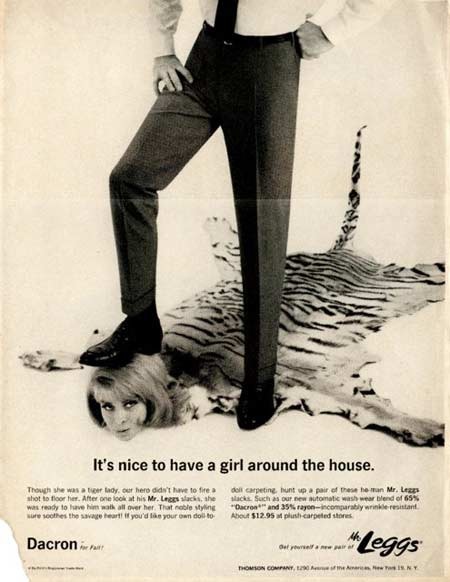
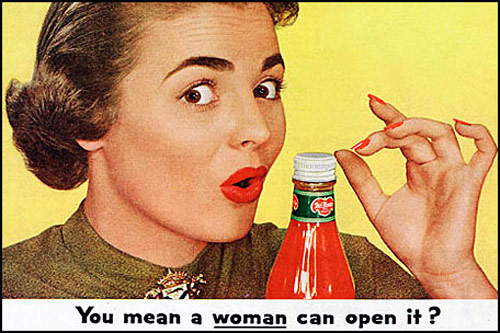
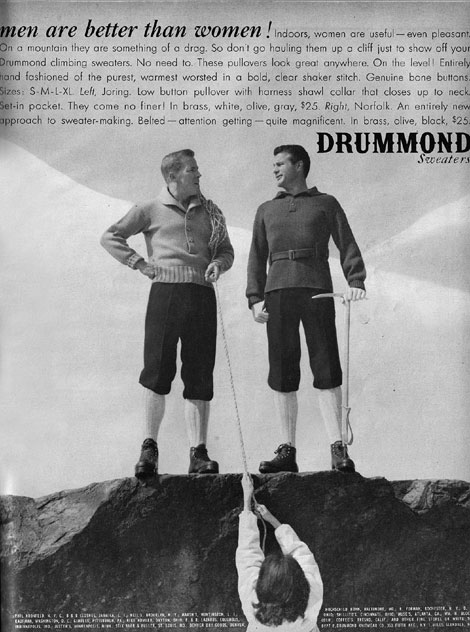
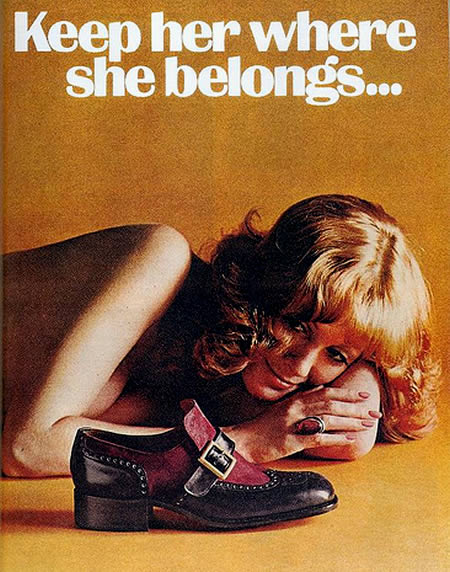
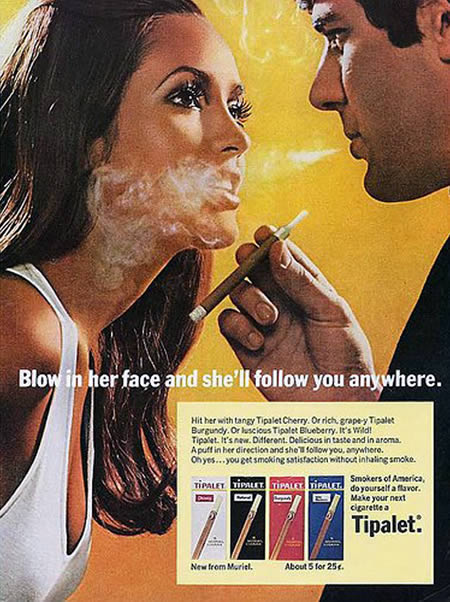
So Retronaut has a page of “Vintage Ad Sexism” – hilariously sexist ads, many of them aimed at men’s pride (“brand new man-talking, power packed patterns that tell her it’s a man’s world”) or women’s insecurities (“Would YOUR husband marry you again?”). There are some gems in there, like these:

source: retronaut.co

I'm just gonna let these speak for themselves.

source: retronaut.co

source: retronaut.co

Read some of this one for the full effect

source: retronaut.co

And this one might be my favorite…source: retronaut.co

Aren’t some of them kind of frighteningly recent-looking?

So yeah, we remember sexism, 1919 and women’s suffrage and bra-burning and all that. Being shocked that women couldn’t vote, etc. But seeing advertisements make it more harrowing. Serious political oppression at least treats women with enough dignity to be oppressed – advertisements make light of women as entities. I am less concerned with the essential sexism in these than I am the reduction.

Violence and political oppression are horrid, yes, but reduction is more insidious because it tends to keep hanging around long after voting rights have been own and salaries have been evened out.

The advertisements here, of course, appear ludicrous to us. “Is a wife to blame if she doesn’t know [to use a douche]? Yes! She’s decidedly to blame.” The one with the rug with a woman’s head, the man standing with one foot on her head Captain-Morgan-style. Some of them are just ridiculous.

But it is good to remember that as insane as they may seem, these are real, and they are recent. People who saw these ads and accepted them as a relevant way to advertise a product – people who made the ads, laughed at them, nodded in agreement – still make up a large part of our society today. Even after that generation dies, the fact is that American culture (it’s what I’m talking about here; can’t speak to other places) has been steeped in the reduction of women – and this is not an influence easily shed.

Now, establishing a double standard to “make up” for lost time is not the answer. Ensuring that all males are instilled with a sense of guilt about the past will not help society. Only by awareness of our ideological roots, and the flaws and violence therein, can we stay – or at least slow – regression.

A Look at The Walking Dead‘s Theodore Douglas

Season 2 of AMC’s The Walking Dead wrapped up this past Sunday, kind of a big deal when you take into consideration the fact that the show was pulling in roughly 10 million viewers every time it aired. There are blogs all over the place discussing the big reveal, so feel free to head over there if you’re wondering what all the fuss is about. This post is meant to take a good hard look at character Theodore “T-Dog” Douglas.

AMC’s The Walking Dead is based on an immensely well-received comic book series of the same name written by Robert Kirkman. While it has, for the most part, stuck with the comics’ general plot progression, there have been a large amount of changes made. The addition of T-Dog as a member of the group in the first season was one of them.

As this season has progressed the internet has taken a lot of interest in T-Dog, for the most part discussing how little a role he actually has to play in the show. The following are his biggest moments listed in chronological order:

S1E1, Guts: T-Dog is one of the group members. He is savagely beaten by a racist among them and is almost killed.  The character who beat him is handcuffed to a roof as punishment. Later, when sent to free him, T-Dog drops the keys down a drain.

S2E1, What Lies Ahead: The survivors are scavenging an abandoned
highway for supplies. T-Dog doesn’t hear Rick, their leader, tell everyone to hide under cars due to zombies. He cuts his arm open on a car door. His life is saved when another survivor covers him with a dead zombie.

S2E2, Bloodletting: T-Dog is upset because the group is leaving him behind with an old man. He thinks it is because he is black. It turns out that he has blood poisoning and is weak and might die.

S2E4, Cherokee Rose: T-Dog almost drinks water from a well that had a big fat zombie in it.

S2E6, Secrets: They’re at a farm, and one of the farmer’s kids turns his pistol sideways during shooting practice. T-Dog tells him not to “give [him] any of that gangster sh-t.”

S2E12, Better Angels: T-dog sees that a prisoner has escaped and exclaims “Aw hell no!”

S2E13, Beside the Dying Fire: Zombies attack the farm and everyone scatters. T-Dog is driving himself and two others to the coast. One of them, Rick’s wife, tells him to turn around or she’ll jump out of the truck. He does so, performing a particularly ugly U-turn.

As the second season progressed, the conversation about T-Dog and what he has to do with anything grew immensely. In the last few episodes many were wondering if he was ever going to get past more than one or two lines per episode. Some have theorized [and by some I mean me] that he shares the same affliction as Eddie Murphy’s character in the universally panned A Thousand Words.

Thankfully, an interview with showrunner Glen Mazzara hopes to answer all of your questions about this enigma of a man. Entertainment Weekly asked if we would be seeing more of T-Dog next season, and the answer was as follows:

There is a plan for T-Dog. Given all of the things that I had to focus on to develop the show in a way that I felt was best, I will say that T-Dog got short shrift. We took care of business, and now we can delve into [SPOILERS] and T-Dog and all these other characters. T-Dog fans will be happy. We’re no longer interested in having a character in the background only saying one line per episode. We’re done with that. But again, we only had so much real estate, and it was very important for me to tell Rick’s story.

Which is great, really, except that I don’t see him having much more to offer the show. As far as what his role is it’s difficult to look any further than token black character. Glenn, a Korean-American character, was present in the comics and as a result has a pretty well-defined personality and storyline. In other words, Glenn has a foundation that extends beyond diversity for diversity’s sake. At this point in the series, T-Dog is actually the only character [save for a girl whose name was changed] not found in the original comics, and this really stands out.

It’s great that Mazzara was able to address, in a straightforward manner, that they did have a character who was “only saying one line per episode.” What remains to be seen is whether or not the writers for The Walking Dead can add any sort of complexity to T-Dog in this upcoming season. It’s been amusing watching and waiting to see if he does, well, anything, but while that may be enjoyable it doesn’t make it good television.