Archetypes: Why Wizardry Triumphed Over Mythology

Harry Potter and the Philosopher’s Stone [marketed that way everywhere but in the States and India] was released in 2001. Nine years later Percy Jackson & the Olympians: The Lightning Thief, the first film adaptation of Rick Riordan’s series of young adult novels, hit the big screen. One went on to spawn a sequel the following year, while the other is taking as long as three. One of the reasons for this, I think, lies in the studio’s portrayals of the characters in their respective works.

I’m not going to go into a great deal about the Harry Potter franchise. The first book was released in 1997, and since then the films have swept up Western culture [and others] up into a wonderful world of witchcraft and wizardry. This post is written under the assumption that you have at least some familiarity with the works.
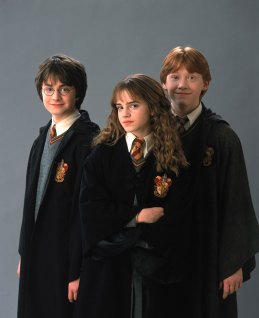
I opted for an image of them really young, since the majority appear to be just shots of good-looking young people staring somewhat broodily at the camera.

At their foundation, Rowling’s novels are built on a trio. Harry Potter is the chosen one, the courageous hero, the primary protagonist. Second is Ron Weasley, redhead, best friend, basically a wimp [for a lot of the series]. Last, but certainly not least, is Hermione Granger, the girl, the genius, the level-headed one. Clearly this is a team with some kind of equilibrium to it and a formula that works, and this is definitely evidenced in Riordan’s pentalogy.

The Lightning Thief, the book the film was based on, stars Percy Jackson, son of Poseidon, talented swordsman, fearless warrior, and new to being a halfblood. Second is his best friend, Grover Underwood, a satyr, kind of a cowardly kid [goat jokes, everyone]. Topping this all off is Annabeth Chase, Athena’s daughter, meaning that she’s definitely got the wisdom thing going on. Clearly if it ain’t broke, don’t fix it. Before you go to assuming that Riordan’s books are a cheap knock-off, don’t; the series is a well-written take on both Greek mythology and the young adult genre as a whole.
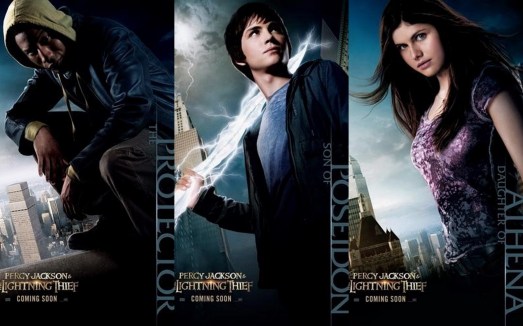
From left to right: Grover, Percy, and Annabeth.

The problem isn’t that the characters appear to mirror those in the Harry Potter books. If anything, this is a strength of sorts, as they’re both familiar and effective. The issue is that the film adaptation of the novel takes these archetypes and throws them out the window. The result is this: three badasses.

In Percy Jackson & the Olympians: The Lightning Thief, Percy, Grover, and Annabeth are all depicted as being a) brave, and b) proficient at fighting, making them essentially slightly different facets of the same archetype. Yes, Annabeth is the one knows more about mythology and magic, et cetera, but she still wields a sword along with the best of them, transforming her from a cold, sharp-tongued girl to an athletic tomboy.

The irony is that Chris Columbus directed both films [as well as Academy Award winning The Help], choosing to faithfully adapt one and tailor the other for a specific audience, going so far as to significantly age the characters. Percy Jackson & the Olympians: The Lightning Thief has all the signs of a movie meant to catch the world’s attention with action, special effects, and good-looking teenagers. Three traditionally heroic characters are three times as entertaining, or at least that’s what a certain type of logic would dictate.

The film did well regardless, pulling in $225 million and with the sequel supposedly [I reserve the right to express some doubts] dropping sometime next year. Fans of the book, however, are hoping that Sea of Monsters is a much better installment than the first. Full character rewrites are rare, so the best they can expect is a film that respects the narrative of the series, and strives to fit their characters into that.

Facebook Censorship: A Sign of the Times?

source: serc.net The internet was recently given a leak of Facebook’s censorship standards. Amine Derkaoui, a previous “employee” of Facebook (employee is in quotes here because he was paid $1 an hour plus commission, which is, in a word, horrid) was so disgruntled that he gave Gawker the handbook used by Derkaoui and other assumedly disgruntled workers to know which photographs and comments to censor on Facebook, which ones to send upwards for decision by an administrator, and which ones were ok. Gawker published the one-page “cheat sheet” summarizing the standards on their website.

source: gawker.com

A summary of Facebook's censorship standards, leaked to Gawker

This gives an interesting perspective of what is considered “acceptable” and tasteful by popular consensus. Ear wax is censored, snot is not? (I guess if it was, millions of baby pictures would have to be deleted). For example, the “cheat sheet” says that “Digital/cartoon nudity” should be censored, but “Art nudity ok”, excluding all digitally created images from “art”, which is sort of a surprisingly passe way for Facebook to define things.

Something interesting about the released standard is the fact that it is clearly representing three categories of social unacceptability. The first, the depiction, commitment, planning, or lauding of criminal activity, is expected in a list like this – sexual assault, organized crime, nudity, and hard drugs are pretty normal in a “delete this” list for any censorship website.

The second category is more nuanced – I can only describe this second category as anything which debases humanity. This includes more obvious things like human organs, mutilation, violent speech, or anything encouraging or lauding mutilation or defacement of the human body (and, in some cases, animals). This also applies to willing defacement: threats of suicide, self-harm, and anything promoting eating disorders – this is interesting in light of the fact that pro-ana groups are still on Facebook. Maybe closed groups are immune to censorship – or the people getting paid next to nothing in other countries just haven’t caught them yet.

Another example of the censorship of non-illegal debasement of humanity: the prohibition of any photoshopped pictures of humans, “whether negative, positive, or neutral.” This is interesting; perhaps it is simply the case that it’s too hard to gauge the positive or negative spin of a photoshopped picture, but I think this rule isn’t just about bullying – it’s about the fact that Facebook doesn’t want to turn into Reddit (if they don’t, then they should stop trying to be Tumblr and take away the “follow” option). Their prohibition of any “versus” photo – any image grafting two photographs of people side by side in comparison – would be for the similar reason of “trying to keep Facebook untacky”. This rule is especially ironic considering Mark Zuckerberg’s famous-now-that-we’ve-all-seen-The-Social-Network first project facemash.com. Prohibitions of holocaust denial fall under the goal of no human debasement – but they apply to the third category as well.

The third and final category I’ll call “Nobody Get Mad At Us Please.” The most interesting rule in this one is the censorship of any maps of a part of Turkey (Kurdistan) and the prohibition of language or images against Mustafa Kemal Ataturk, as those laws seem suspiciously anti-free-speech-ish, and Turkey is a part of the UN.

The internet as it is currently developing has been compared to the semimythical Wild West of early American history – looking back in 50 years on this time, we’ll probably be astonished at how unregulated everything was. Governments just don’t have a good enough grasp on this new platform for data and information to be able to figure out how to effectively and efficiently (and ethically) regulate it – yet. This conversation applies to file sharing and copyright infringement as well, but Facebook’s censorship guidelines illuminate a more necessarily practical standard – things made up by businesses and not government are almost always more necessarily practical, if perhaps less ethically consistent.

Girls: 2 Broke and One New [Pt. 3] – Race

As you may have guessed by the title, this is the third and final part of my observations about the relatively new shows 2 Broke Girls and New Girl. To read the first two posts about cast and humour click on the respective words, or just scroll down if you’re already on the front page.

RACE

For the most part, I’ve already gone into great deal about this topic and 2 Broke Girls in my post titled “Michael Patrick King, Definitely Not Being Racist.” To summarize a lot of what I’ve already written in a few words, the show is not great when it comes to boiling people of different ethnicities down to their bare bones stereotypes. Or they’re really great at it, depending on your point of view.

Per episode the show has a much greater number of new characters as its stars find themselves stumbling into such locales as a thrift store and a pharmacy in a Jewish neighbourhood. With that being said, they’re given countless opportunities to put different spins on people from different cultures and backgrounds, but fall flat again and again. I’d recommend that you turn to the post I linked to in the paragraph above to get a more in-depth look on the matter.

The show’s approach to race has made it the recipient of a lot of flak, and their most recent decision to alleviate said criticism is to bring in a “hot Asian guy.” A casting call was put out last month which sought to find an attractive male of Asian descent to act as a love interest to Beth Behr’s Caroline Channing. While this may seem to be a dictionary definition for “affirmative action,” it may be a step in the right direction.

On the other hand, we have New Girl, a show whose approach to race is summed up quite nicely in the following video clip:


Just like Morgan Freeman and his approach to Black History Month, New Girl tackles race by not making it a big deal. And it does so flawlessly in the first few episodes. The pilot has Zooey Deschanel’s Jess meet a perfectly nice Asian guy who later stands her up on their date. Yes, he’s made out to be a douchebag, and no, that’s not particularly flattering, but you know what else it’s not? A stereotype.

Similarly, in the third episode, “Wedding,” the newlyweds are an interracial couple, with an Asian groom and a Caucasian  bride. There is not a single character who makes a big deal out of it, and everyone on the show takes it as completely normal. Because it is. This is not a situation I can see the writers of 2 Broke Girls passing up for comedy, and the fact that I’m 100 percent certain of that is a sad thing.

Since it’s not plumbing the depths of New York City for people from different ethnicities and the like, New Girl has less diversity than 2 Broke Girls. That being said, its treatment of nonwhite characters is, well, nothing special, which is great. A mixed race group of students might show up, or an Asian judge [“Bells” and “Jess  & Julia” respectively], but no one makes jabs or even hints at ethnic stereotypes. The closest thing the show gets to a joke about race is Winston’s one-liner about Black Friday [I had a YouTube clip but it doesn’t work now; sory].

I’d seen that video of Morgan Freeman years ago, but it never struck me until recently how true it is. If the media simply acknowledges that we live in an incredibly diverse world and stops calling attention to details as nongermane as ethnicity, then we can live in a world where racism truly ends.

Girls: 2 Broke and One New [Pt. 2] – Humour

This is the second part of a three-part series on CBS’ 2 Broke Girls and Fox’s New Girl, both shows that premiered in the fall of 2011. In yesterday’s post I went into some detail about the cast of both shows, and this time I’m going to address the element of both that, hopefully, helps them put the “com” in sitcom.

HUMOUR

2 Broke Girls was created by Michael Patrick King, the openly gay writer whose claim to fame is HBO’s Sex and the City [he wrote all of the season premieres and finales, and was responsible for its adaptation to the big screen], and Whitney Cummings, comedian and star of her own NBC sitcom, Whitney.

Cummings has, for the most part, been preoccupied with her show, and because of that it’s King who takes the onus for much of the show’s writing. Now I do want to save a lot of potential content for tomorrow and the final part of this series, so what I’m going to share are a few of his words about where the show is coming from:

I think our show is a big, ballsy comedy, but it has a bigger heart than it has balls.

I feel that it is broad and brash and very current.

I consider our jokes really “classy-dirty.” They’re high low-brow. I think they’re fun and sophisticated and naughty and I think everybody likes a good naughty joke.

“Ballsy” is a pretty accurate statement for a show on a broadcast network that has, by my count, averaged nearly two rape jokes per episode. It also describes well the decision to include in this week’s episode, “And The Kosher Cupcakes,” a 13-year-old Jewish boy implying he’d soon be receiving oral sex from one of the show’s female leads.

Edginess aside, do I think it’s funny? As evidenced by the video proceeding this paragraph Kat Dennings has her tone down when it comes to delivering dry, deadpan lines. Beth Behrs’ Caroline has a knack for visual humour [see last week’s: “And The Broken Hearts”] and even Oleg, the lascivious fry cook, has his moments where you can’t help but grin at his audacity. Whether it’s funny throughout, however, is a different story.


Continuity and pacing aside, a lot of the times lines fall flat. “And The Broken Hearts” featured a joke between Jennifer Coolidge’s Sophie and Jonathan Kite’s Oleg where the two riffed on the variations on the word “come,” a scene so horrid that I’m cringing as I rewatch it. The show may not shy away from dealing with topics like masturbation and drug abuse, but “shock and awe” doesn’t always equal “amuse” or even “entertain.”

New Girl was and is created, produced, and written by Elizabeth Meriwether; her largest claim to fame is the 2011 Natalie Portman and Ashton Kutcher-driven comedy No Strings Attached.

Now I don’t have the public uproar that surrounds 2 Broke Girls available to create articles about New Girl, so I’m going to have to address its humour with largely my own words. Though the show began with the passable premise that a quirky female teacher moving in with three men was going to create conflict, the show has since moved beyond that in leaps and bounds.

Zooey Deschanel was, without question, the reason many tuned in, but I don’t believe it’s why they return. Jake Johnson’s Nick and Max Greenfield’s Schmidt both own their roles, and are arguably even funnier when clashing with each other. Case in point:


Where King’s show relies on a lot of wordplay and snarky jabs, courtesy of Kat Dennings, Meriwether’s is one that puts the “domestic” and the “comedic” in “dom com.” In addition, the characters all bring their own brand of humour to the table, with Schmidt’s douchiness, Nick’s freakouts [see above], or Jess’, well, Zooey-ness.

It’s not even that the show shies away from sex and the like. An entire episode revolved around Jess seeing Nick’s penis [much to Schmidt’s curiosity], and her willingness to have a threesome is strangely adorable. The difference is that it’s not overly-raunchy or in-your-face; for the show sex is another part of life, and one that’s plainly funny as opposed to darkly so.

I realize that there are significantly more clips from New Girl, but the fact is that I think the show is funnier overall, and you can always look for more stuff from 2 Broke Girls on YouTube if you’d like. As the head writer, King has a pretty decent cast of characters [again, see last post] available to him, and if he wants to give them lots of sarcasm and whatnot that’s entirely up to him. It’s fine to be “ballsy” or “classy-dirty” but the intention should be to have your audience laughing, not shaking their heads and saying “I can’t believe they just said that.”

Girls: 2 Broke and One New [Pt. 1] – Cast

This academic year has been the beginning of many new shows for me, with 2 Broke Girls and New Girl topping the list. I say “topping” of course to mean the most recent televisual acquisitions, as opposed to the highest quality among programs that I watch.

To be honest, this post has been a long time in coming due to the fact that a) I can’t resist the fact that the shows have such similar titles, and b) I’ve been comparing them ever since they both premiered last fall. With that in mind, I will be writing a total of three posts, Tuesday to Thursday, with each concentrating on a particular aspect of the two shows.

So, without further ado:

CAST

2 Broke Girls stars Kat Dennings and Beth Behr as Max and Caroline respectively, the former a jaded city girl and the latter a penniless heiress. The two work at a diner, accompanied by owner Han Lee, fry cook Oleg, and cashier Earl. Recently Sophie, the Polish owner of a house cleaning business, has become a recurring cast member.

In spite of the seemingly large main cast, the focus is primarily on the titular characters [if anyone jokes in the comments about a particular character I suppose I could’ve chosen my wording better]. The show mainly revolves around Max and Caroline, regulating everyone else to the sidelines at best.

New Girl stars, of course, the ever-cheery Zooey Deschanel as the titular [there’s that word again] character Jess. Alongside her are her roommates Nick, Schmidt, and Winston. Joining them is her model friend of indeterminate ethnicity Cece. I’m not counting Lizzy Caplan because, well, she’s going to leave the show eventually [a thought which makes me cry].

From left to right: Cece, Winston, Nick, Jess, and Schmidt.

It would be near impossible for the show to solely follow the Jess’ zany antics, and thankfully, it doesn’t try to. Her three roommates have more than once carried their own B and C plots, with Nick even competing for the central storyline in the episode “Jess & Julia.”

At first glance the two casts may appear shockingly similar: two females, three males, a single black man in both groups. As mentioned earlier, however, the difference begins in who the camera focuses on. 2 Broke Girls is very much a show about two girls in New York trying to make a living, and their exploits specifically. New Girl is about four [sorry, Cece, but you’re not always around] people and their lives, regardless of whether or not they’re with each other. A subplot in the latter could be all about Schmidt and his attempts to sleep with his boss, but there are no opportunities in the former for an episode that switches back and forth between Max and Caroline trying to make money and Earl, sitting behind his desk at the diner.

The reasons for this could vary pretty greatly. 2 Broke Girls has a traditional three-camera setup, and as a result is filmed on sets resembling a diner, apartment, et cetera. This gives New Girl an upper hand in featuring its various characters being in different locales given its single camera format. The real reason, however, is the amount of characterization given to each cast member. We know that Max is street smart and snarky and kind of bitter, Caroline is naive yet strong and persistent. The characters on the edges, though, are a lot more two-dimensional. Early is a father figure of sorts. Oleg is a womanizer. Han is . . . Asian. I would go into what the characters of New Girl are all about, but I don’t have room. It’s not to say that they’re immensely deep, multi-faceted character, but compared to much of the cast of 2 Broke Girls, yes. Basically, yes.

Not to deride the acting talents of Kat Dennings or Beth Behrs. The two have great comedic chemistry and, when given the right lines, are very funny. And that’s not to say that Jonathan Kite as Oleg and Garret Morris as Earl don’t have their moments; there have been episodes where I regard the Ukrainian fry cook with something akin to warmth. The fact is that these are talented actors who have been relegated to supporting roles, taking up ten to fifteen percent of screentime per episode.

These three posts weren’t meant to be a competition, but New Girl definitely wins in terms of cast. This also isn’t meant to go into how funny the characters or writing are [that’s for tomorrow], but simply an observation of how a full cast can be well utilized. Come back tomorrow afternoon for Part 2!

New Update Schedule

For all of you regular readers out there, you may have noticed a number of things.

1) That there was no new post on Monday.

2) That beneath the title of our blog it now reads “Evan Tuesdays. Elisa Fridays. Other Posts When Needed.”

3) That it’s Tuesday and there’s still no new post.

Basically what happened was that Elisa and I decided last week that our update schedule wasn’t working alongside classes and things, so we changed things up. Then this week came around and I completely forgot/though she was up first.

I’ll have something up later tonight. Apologies, everyone.