When I first heard the term doula, I literally spoke the words: “a what-nah?” Fast forward two years and here I am: a practicing doula. The term ‘doula’ is ancient Greek and roughly translates as “a woman who serves.” For a professional movement that aims to empower, advocate and offer caring, non-judgemental support during pregnancy, birth, and the postpartum period, this definition, while providing the gist, falls short. (Oh, and there’s no rule that men can’t be doulas.) If you don’t know about doulas, or if what you do know makes you scratch your head in confusion or suspicion, do me this favour and bear with me as I hopefully debunk some common myths and share what I know to be true about the doula role.
A common doula image has been the hippy-dippy, placenta eating type (while the healing benefits of this practice can be argued) the bottom line is that doulas do not force-feed their clients placentas, a myth that can create real barriers to doulas being taken seriously in broader systems of care – someone who wafts into a room ripe with patchouli oil and is dismissive of doctor’s orders.
Art courtesy of the author, Rachel.
Here are some frank but concise things to know: 1) if a doula has been trained well, they will know the role is not a clinical one, and 2) that while a ‘hippy-dippy’ approach is often scoffed at, it seems clear that our culture is starved for what might better be termed ‘holistic care.’ I feel lucky to have attended births where medical staff and holistic practitioners worked symbiotically. The outcome was stunning. Our mutual respect and willingness to complement each other’s roles disproved the notion that ‘medical births’ and ‘natural births’ must be separate entities. This type of bridging is one of a doula’s most astonishing tasks and achievements. The doula’s role is that of an impartial diplomat, offering translations, support and conflict resolution if tensions may be running high. A doula also runs interference between expectant parents and well-meaning but occasionally overbearing family members.Continue reading →
My name is Jonathan. I am 26 years old and living a typical Canadian life. I can honestly say that I spent the majority of my life wanting “the dream”: money, fame, and fortune. I believed that everyone had a chance to get that dream, especially living in a Country like Canada.
After I graduated from high school, I moved to the city. I learned about myself and experienced new people and cultures. I partied, shopped, and socialized, then went to work so that I could go out and spend more money and time with people. I was living the life but something seemed empty about it all. Everything in my life felt like it revolved around spending money.
We may talk about things like homelessness, world hunger, climate change, environmental pollution, wars, and diseases, but as a whole, my society isn’t worried about this. We are concerned about making and spending money, we feel obligated to go out and work those 40 hours every week so that we could have the means to pay for our consumer lifestyles.
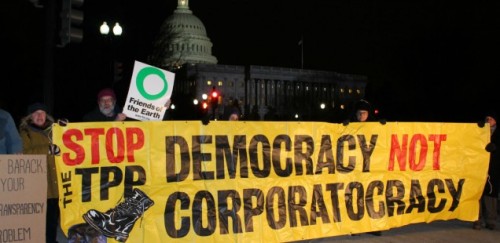
Currently, Canada is looking to introduce a bill that could have just as wide flung effects as the NAFTA agreement: The Trans Pacific Partnership (TPP).
What is the TPP?
Right now our nation is at a crossroads. Recently, our government signed onto the The Trans Pacific Partnership. This agreement threatens many of our rights and freedoms. If it is ratified, we will be allowing corporations to make decisions for us, but with the priority of profit over the welfare of people.
This agreement is quite a bit like the North American Free Trade Agreement that Canada signed in 1994. NAFTA allowed a lot of wealth to be made, but by corporations, and not the people of the countries involved. The new Trans Pacific Partnership may have even worse consequences than NAFTA, as the video below highlights.
While the video explains the general problematic aspects of the TPP, I’ve addressed several aspects below that will directly affect us in Canada.
1. Canadian tax dollars are being spent paying lawsuits to Corporations
Policies that are meant to protect Canadians are being challenged just to boost profits. The health and job security of Canadians are not a corporate priority, and the TPP will only further threaten their safety. Canadian policies or decisions can be legal, fair and designed to effectively protect the environment or public health, yet they can still face corporate lawsuits demanding hundreds of millions of dollars in compensation. A powerful tool of corporate rule is already undermining our democracy. Why would Canada want to willfully sign up for more of that?
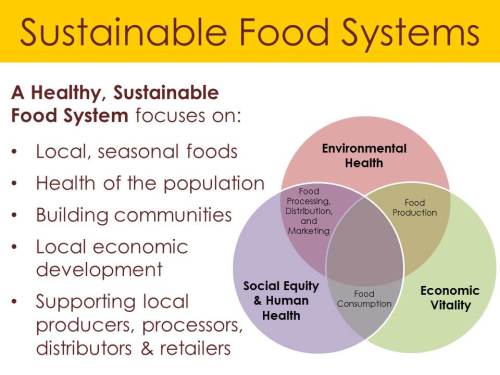
2. It threatens Canadian Food Security and Health Security
We live in a globalized world. We have a constant supply of food, a wide variety of options, and goods are cheap. The often overlooked problem with this system is that our world is not a stable one, there are wars, famines, droughts, floods. The Climate is changing dramatically and fast.
We are almost completely dependent on imports for many food and goods that could instead be grown and produced in Canada. At the same time we are exporting our natural resources. If global trade were to stop, Canadians would be ill-prepared to deal with the food and goods shortages.
The TPP also opens up opportunities for companies to challenge food labeling. Since labeling where food comes from, or how the produce was grown (i.e. GMO) could affect profits, companies could sue Canada for requiring labels.
Personally, I want my food to be labeled so I can know where my garlic is grown and whether my tuna was caught without killings thousands of dolphins. Consumers should have the right to know where and how food is produced. Cost shouldn’t be the only deciding factor.
3. It Threatens Canadian Socialism
Canadians think that we live in a socialist country. We have free health care, employment insurance, and we would like to think it’s a fairly even playing field when it comes to finding a rewarding career. We are told that we have opportunities to become successful, that there’s a piece of pie for everyone. We are told that our lives are best.
Canada, with countless resources, should be a country of bounty. We shouldn’t have widespread homelessness and poverty shouldn’t be such a problem. People shouldn’t have to decide between supporting themselves and receiving a post-secondary education.
Canadians pride ourselves on universal healthcare, but many medical services and products aren’t actually included under that coverage. This could get even worse if the TPP is passed, since it includes excessive patent protections and other intellectual property rights that are guaranteed to make medication much more expensive in Canada. Call me a socialist, but I believe medicine should not be a profit-focused industry. I think pharmaceuticals should be heavily regulated by the governments, with the goal of bettering mankind, not just the stockholders. The health and wellbeing of humans should not just be seen as an opportunity for profit. Unfortunately, Global News has already reported on certain Pharmaceutical companies dramatically increasing drug prices.
Canadians need to decide what we want our future to be like.
We can allow the TPP to be signed and continue the corporate and banking invasion of our country, allowing rich corporations to benefit at the expense of the rest of the population.
Or we could stand up to the corporate world and demand that our country protect our rights and freedoms. We could see our governments take down economy-destroying banking systems and regulate corporations to once again benefit humans before profits. We could work towards health and food security, only selling or sharing surpluses with other countries. With less focus on profits, we might be able to solve many of the problems plaguing our world.
It is not too late to challenge the TPP. It may have been signed, but it is not yet ratified. The recent election was a political shakeup; it could allow Canada to rewrite our embarrassing trade, environment, and social policies.
So what will you do? Say nothing, and allow the TPP to pass? Or stand up and contact your MP to let them know that you care about Canada’s future. You can tell Ottawa that Corporations have no right to rule Canadians. We are a free country, we are a democracy, and we will not go down without a fight.
The time to decide is now. You have everything to lose.
Courtesy of The Council of Canadians acting for Social Justice
JON Marks is a 26-years-young, flamboyant, micro-writer who works in the garden and irrigation industry. He is a hobbit at heart and loves a good cup of tea. He is often a quiet fellow, but some situations can cause him to voice his opinions. He has no problem dishing the T.
This is a weird, random, and controversial thought, but….
I wonder if this consistent pattern of replacing Asian characters with White actors (even with more and more Asian actors getting more screen time [at least on TV] and all these articles highlighting whitewashing) is a subtle and unconscious battle of cultural and racial dominance? If it stems from a fear-based place of “if you put more Asians as leads in mainstream, worldwide entertainment, then it removes some of the cultural dominance of the status quo”.
I’m really not trying to bash White people, but you really can’t argue that White people overall have more privileges than any other race. And White men are the heads and execs at basically every major company in Europe and North America. And in entertainment, which has major worldwide influence, White people and predominately men are the execs, directors, writers, producers, and agents. Ironically, they welcome foreign money with open arms from Chinese to Middle Eastern investors.
Asians, population-wise, are more than 50% of the world; China and India have enormous populations with a lot of spending power. Asian countries have created very popular forms of entertainment with anime, manga, and video games. They frequently feature characters of Asian descent. Japan has always been a powerhouse country, but their status as an Axis power in World War II has set them up historically as a bad guy. Then their strength in electronics and cars in the 90’s set them up as the “competition” (i.e. not American and not us). And Chinese is ALWAYS the bad guy in the news. “We can’t have factories in China. The Chinese are gonna take over.” There’s a history of US vs THEM. Besides the military, the only industry of world dominance that White America has complete control over is the entertainment industry. American movies make so much internationally. Ironically, the US entertainment industry depends on the income from the foreign markets, but cater very little to their populations by representing them on screen. They know that the foreign populations will come see their movies no matter what, because they aren’t doing huge budget CGI movies where they are. Continue reading →
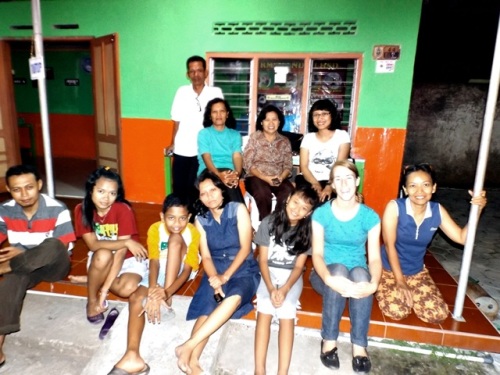
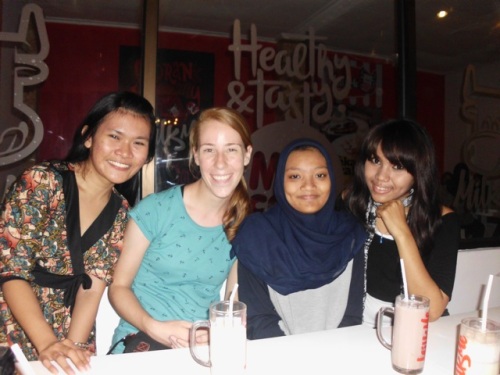
A little over a year ago I spent four months in Indonesia. I didn’t really travel across the country, at least not in the way you would expect during that much time abroad. Instead I had the great privilege to live in Indonesia, and see it from the inside. It’s hard to put to words all that I learned, and impossible to do justice to the people I met and the experiences I had. Here is my attempt to share are a few things I learned while I was travelling.
1) Hospitality
The first notable quality of almost every Indonesian I encountered, and especially of my host family, was their hospitality. Within 12 hours of arriving my concept of generosity and hospitality had been put to shame. My hosts not only shared their home, they shared their family, lives, and friends with me. I was adopted into their social circle, taken for day- or week-long trips by their friends while I was there. I was honoured to be one of the first people to greet the family’s first grandson alongside the immediate family.
2) Hijabs aren’t scary
This is a fairly potent topic these days so I won’t comment too much. Over half the women on Java wear hijabs, a head covering worn by Muslim women. When I asked why they wore them, all the women I asked answered with “I wear it because I choose to.” I began to recognize beauty and comfort in these headdresses, as well as freedom of expression. These women were neither ashamed nor pious in their religion, it was simply a part of their life.
Disney’s Mulan came out when I was 12, and you’d better believe I was excited about it. I was the girl who reacted to dresses and stockings with outrage and got big heart eyes at the sight of swords, so a girl dressing up as a guy and going to war was exactly my jam. Shortly after watching it, I remember climbing on a playground after church with a friend, while my brothers and I quoted the funny parts at each other. I asked her if she’d seen it yet.
“No…” she replied. “I heard it promotes ancestor worship and stuff.”
This caught me up. Yes, in the movie Mulan prays to her ancestors for help and protection, and in true Disney fashion, the ghostly ancestors are seen discussing her plight. 12-year-old-me wasn’t sure how to respond. It did…but it hadn’t occurred to me that it did.
“I guess…” I said. “Kind of.”
I’ll convert for the parties.
I found myself thinking about this exchange recently, while my husband and I watched through Avatar: The Last Airbender on Netflix. I realize we are WAY behind the times, but wow did we enjoy it, despite neither of us really being anime fans. It was such a great story, with excellent characters, and it was deeply refreshing to see a fantasy series that wasn’t set in pseudo-medieval or pseudo-viking times. The show also depicts a variety of ethnicities and cultures, most of which are based on eastern civilizations. It’s great.
Of course, there are references to various elements of eastern spiritualities… reincarnation, qi energy, a spirit world, and – featuring heavily in one episode of season two and recurrently through season three – chakras.
During that chakra-heavy episode, I couldn’t help but hear my friend’s voice “No… I heard it promotes eastern mysticism.”Continue reading →







 Culture War Reporters