Evan and Gordon Talk: Django Unchained

GORDON: You know what they call a quarter pounder with cheese in France?

EVAN: What?

GORDON: A poor attempt at distracting our readers from the fact that we ain’t gonna be talking about drugs like we said we would.

EVAN: I have seen very few Tarantino films, and only barely recognize the references.

GORDON: You make me sad.

EVAN: I know.

That aside, what we’re going to be talking about today is Django Unchained, a movie I finished watching less than an hour ago and the subject of this Monday’s post [written by Gordon].

GORDON: So what did you think?

EVAN: Initial thoughts are: Very long. Not what I expected. Apparently in Django’s world everyone is a skinbag filled to bursting with blood.

GORDON: Speaking as someone who’s fired black-powder guns, I can actually kinda see something like that happening.

EVAN: That is ridiculous, but interesting to know.

Now if you don’t have anything in particular you wanted to talk about, did you want to maybe address Spike Lee’s reaction to this film really quick?

GORDON: The Lee-Tarantino feud has been going on for a long time now, so I really wasn’t surprised that Lee reacted the way he did. I naturally wish he had at least seen the movie, but I don’t think it would’ve made a difference in his mind.
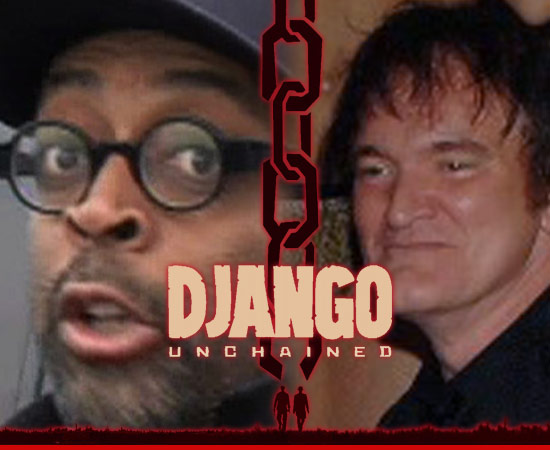
EVAN: To give readers a little context, director Spike Lee tweeted:

American Slavery Was Not A Sergio Leone Spaghetti Western. It Was A Holocaust. My Ancestors Are Slaves. Stolen From Africa. I Will Honor Them.

He also straight-up said “I cant speak on it ’cause I’m not gonna see it. All I’m going to say is that it’s disrespectful to my ancestors. That’s just me…I’m not speaking on behalf of anybody else.”

GORDON: I get where he’s coming from, but (1) I don’t think the movie dishonors the slaves and (2) I don’t think that there should be any time period off-limits for telling stories.

EVAN: I definitely agree with both points. Tarantino does not disrespect the plight of slaves during the time period, and there are really no eras of history that we shouldn’t be allowed to explore through various media. How it’s done is what matters.

GORDON: It’s Tarantino; you either love him or you hate him. He does a spastic, scatterbrained style of movie which is two parts tense dialogue and three parts references to obscure exploitation flicks. It is what it is.

EVAN: So did you like it?

GORDON: I did, but not as much as his other movies. And not for the subject matter, simply for the storytelling. I felt it was anticlimatic. Especially compared to his second latest, Inglourious Basterds.

EVAN: Very much agreed. You expect [SPOILER ALERT YOU’VE BEEN WARNED] Monsieur Candy to be killed by Django, or at least in a big way, but instead he’s just shot by Dr. Schultz with his sleeve-Deringer.

GORDON: And there’s still plenty left in the film, we just kinda trudge through it. I simply wasn’t impressed. I mean- I ain’t asking for a John Wu fightscene, but something more than [SERIOUSLY YOU GUYS, SPOILERS] Django shooting unarmed people from the top of the plantation stairs.

But as far as the whole thing goes, relatively amusing and a major stepping stone in addressing the subject of slavery.

EVAN: I mean, sort of going back to where Lee was coming from, it’s not a very realistic depiction by any means, a revenge story of this fashion can’t be. That being said, isn’t it the same sort of concept as Inglourious Basterds? Revenge enacted by the persecuted?

GORDON: That’s exactly what it is. A revenge fantasy. Bad guys being killed by the people who they oppressed. It gives us a feeling of divine judgment upon the wicked. Which is a theme a lot of westerns have.

REVENGE.

EVAN: I have seen at least one, and you are not wrong.

GORDON: I think what Lee needs to get is this:

This was not a movie about slavery, this was a movie about revenge set in the world of slavery. This wasn’t- and shouldn’t be- taken as a commentary of any kind about African-Americans anymore than Kill Bill should be taken as a commentary on women.

You wanna pick a fight with Tarantino, do it over something that’s actually there. (And just so everyone knows, I really like Spike Lee’s work and admire the guy as an individual)

EVAN: So you’re saying that slavery must be viewed as a backdrop, and not the subject matter? I know that you wrote your Monday post on this, but we can go over it just a little.

GORDON: That’s exactly it. It’s not a history film, it’s a Tarantino film. Don’t look for realism there, and don’t look for buoyancy in a nightstand; it’s not what either of them are for.

EVAN: I agree with you to a point, in that the exploration of slavery was in no means Tarantino’s intent. It’s just difficult to look past that as subject matter when it permeates the film [what with it opening up on a slave’s scarred back, etc].

GORDON: That is true, and you can question whether or not it’s right for Tarantino to use the subject matter to shock and horrify people and draw in crowds, but from what I saw and understood of the film the scenes of horror inflicted upon the slaves were, what’s the word for this, “respectful?” enough to indicate that even blood-and-guts Quentin wasn’t unaware of what he was dealing with.

EVAN: I can accept that. Two more thoughts as we wrap up this talk: the soundtrack and Samuel L. Jackson as a real life Uncle Ruckus.

GORDON: The soundtrack sucked. We can all agree on this. Usually he can make it work- this time he didn’t.

EVAN: My cousin and I actually really liked it.

GORDON: Really? I couldn’t disagree more. I felt it lacked cohesion, which the soundtracks in his other works normally have. Heck, more often than not it’s the commonalities in the soundtracks trying the whole thing together.

EVAN: I felt like the more contemporary hip-hop rap tracks were a little bit jarring, but thought the other songs overall were good picks.

GORDON: We’ll have to agree to disagree on that one. Let’s move on.

EVAN: Samuel L. Jackson’s character.

If you don’t know who that is on the right you need to start watching The Boondocks right now. Finish this post first, then immediately go find an episode online or something.

GORDON: I thought he knocked it out of the park. Didn’t have any problem with him whatsoever.

EVAN: 1) Did not know Samuel L. Jackson could play such a convincing old man. 2) Sycophants in films are normally played up for comedic value, and that is no less the case here.

GORDON: Let’s not forget that Jackson was not only an active member of the civil rights movement, but even associated with some of its more radical leaders.

EVAN: That is something that I, and presumably our readers, did not know.

To end this off, did you have a favourite moment in the film? [I SHOULDN’T HAVE TO WARN ABOUT SPOILERS, BUT I AM ANYWAY]

GORDON: For me, it would have to be the scene where Christoph Waltz (who really stole the show) was explaining bounty-hunting the Django in the bar. The dude is awesome to watch.

EVAN: Christoph Waltz’s accent was amazing. I could listen to him talk all day.

My personal favourite was the posse getting ready to go kill Django and Schultz and arguing about the masks. The dialogue was hilarious, and Jonah Hill was a nice surprise, too.

GORDON: That was awesome. And speaking of awesome stuff, our discussion topic for next week:

EVAN: Ah man, I kind of just want to talk about movies. Could we somehow generally address the trend towards big budget sci-fi flicks that’s coming about in Hollywood?

GORDON: No. No more movies. We do ’em too much already.

EVAN: Fine, fine. Suggestions?

GORDON: College: what should its purpose be? Careers or Well-Rounded Individuals?

EVAN: Or just in general, I’m not sure it has to go one of two ways. But that’s a good one. I’m on board.

Thanks everyone for reading, and for continuing to unwittingly stumble upon our blog in 2013! Evan and Gordon out.


Shame Day: The Body Positive Movement

I was recently listening to a stand-up routine by British comedian Robert Newman, who in the course of an Iraq War joke stated something I thought was pretty dang profound.

“Just because you’re fighting the bad guys doesn’t mean that you’re the good guys.”

I really can’t think of anyone this statement applies better to than the adherents of the rising “Body Positive Movement.”

You hear that, starving kids in Sudan?

Who are these people? Well, the the “body positive” movement is the result of a reaction against the air-brushed, Photoshopped, and ultimately anorexic presentation of beauty offered by mainstream culture. It’s given us Dove’s “True Beauty Campaign” in which “real” women were used as models (hoping you’ll forget that the same people who run Dove run Axe).

It’s given us memes like this:

And it’s given us a host of philosophical epitaphs on how the size of your brain or heart are vastly more important than the size of your waistline.

“Buuuut we’re gonna use a skinny model anyways…”

And it all has a certain logic to it. Forget society’s standards! Be comfortable with who you are! Your insides are all that should count! Reject anorexic beauty standards! Enough making yourself sick trying to pursue unrealistic and unattainable goals! Only you can make you feel inferior!

And so on.

Now I know that it must sound pretty weird that these people would wind up being the subject of a Shame Day. After all, what’s wrong with rejecting the media’s unattainable and anorexic standard of beauty and embracing your body for what it is?

Well, suppose your body looked something like this:

Sure, I could say this guy is “husky” or “bigger” or “shaped differently” or use any other paper-thin euphemism for fat. Doesn’t change a thing. I could name the asteroid about the hit the earth Friendly Ed and there’d still be as much devastation when Edward hits New York. We can call it anything we want- we’re still not changing the fact that being fat isn’t any more healthy than being stick-thin.

“But Gordon, you incandescent beacon of enlightenment, surely these people aren’t advocating anything like that!

And no, not all of them are- but enough of the big players are endorsing pretty much this philosophy. Let me offer this post from The Body Positive’s website as an example. In her article “‘Tis the Season to be Squishy”, Connie Sobczak asserts that there’s really nothing wrong with gaining weight during winter months, as this is simply the body’s natural reaction the cold as a result of evolutionary adaption. And that is true- only Sobczak goes on to use that factual statement to prop up some far more dubious claims.

“So, the next time you ‘feel like a steak’ or ‘need a cookie’ it could be your brain and not your stomach talking.” Out of the mouths of doctors!”

**** That.

What Sobczak is doing here is attempting to twist evolutionary biology into an excuse for lack of self-control. There’s nothing wrong with wanting to eat a bag of chips. There’s nothing wrong with wanting to eat a bag of chips in winter when you need more calories. There’s nothing wrong with stating that as your reason for eating more chips. But taking all of that and coming away with the conclusion that eating chips (or anything else) is retroactively sanctioned by biology and stating that this conclusion is supported by medical professionals is as dishonest as it is deluded.

Case and point.

Look, it’s true that who you are on the inside is vastly more important than who you are on the outside, no one is going to argue that. But let’s talk about excess, people. Let’s talk about gluttony. Aren’t these realities? Let’s compare the number of people who have had become ill or died as a result of being overweight and contrast it to the number who have become ill or died as a result of being underweight in this country. Which side is gonna have claimed more?

Now that ain’t an endorsement of anorexia or our twisted standards by any means, it’s simply a counter-point.

But hey- maybe it’s not a health thing. Maybe it’s just about being comfortable with who you are regardless of your size. That’s the line taken up by comedian Gabriel Iglesias in his stand-up routine.

Towards the end of one of his acts he states that he wouldn’t want to live to be a hundred if it means he couldn’t eat cake. He asserts that working out doesn’t ensure you’ll live long- why not enjoy life while you have it?

Why not indeed?

So if that’s the case, why are we jumping on the bulimic and anorexic members of society in the fist place? Hey- if health isn’t an issue and happiness is, why is a a girl weighing less than seventy five pounds any worse than a girl weighing three hundred? Why is it “Body Positive” for a woman to expand her waistline and self-loathing when she expands her bust line? It just doesn’t pan out.

Look, I’m not here to offer any solutions. I’m six feet tall (when I’m not slouching, which is always) and skinny. I smoke a little bit, drink a little more, and could stand to cut down on the meat and up my intake of fruits and vegetables considerably. I don’t work out, but then again, if wolves were to be introduced to my city, I’d probably be ok. Despite my extreme examples, the vast majority of us are neither morbidly obese or carried off by strong winds. All that’s to say that I’m in no place to pass judgment on anyone, nor is it my intention to do so. I’m simply here to point out the hypocritical and seemingly self-serving logic being employed by the group in question.

Body Positive, shame on you.

Django and the N-Word

Let me begin by explaining that this is not a review of the simultaneously acclaimed and decried 2012 Tarantino blood-fest. You want to hear one of those, I’d recommend clicking over to Spill or The Escapist’s “Escape to the Movies.” No, what I want to talk about are some specific elements and segments of the film which have become points of contention, controversy, and debate in the past weeks.

Let’s start with the most obvious:

I. Saying “Nigger” Every Other Word

I won’t claim to know your stance on the word “Nigger”- heck, I’m not even sure of my own stance. Perhaps you view the term as so degrading and reprehensible as to merit burning it from spoken language. Perhaps you believe that appropriating and using the word strips it of its power to even be used as an insult. Maybe you see it as being purely contextual- a term of address with audience and a terrible insult with another.

It’s all Elmo ever thinks about

There are probably strong points to be made on all sides, but perhaps the stance you cannot take is that the use of the word “nigger” was inappropriate for the movie.

Now before you take up the battle-cry of “Tarantino is just trying to shock us!” or “Tarantino uses the word excessively in his other movies!” I have to say this.

You’re right.

It’s Tarantino; that’s not an excuse, that’s a fact. You wanna take up his use of the word in other films, then that’s part of the whole debate mentioned above. Simple truth of the matter is that this use of the word “nigger” would still be controversial if the film had been made by anyone else. So let’s talk about it.

Let’s assume that this movie, with selfish or noble intent, is trying to demonstrate a glimpse of the world in question; the use of that word is almost bound to come up. I might throw out the example of Mark Twain’s classic novel Huckleberry Finn, and while by sheer volume Django probably has Huck beat for use of the word, by percentage I’d posit the two are pretty evenly matched. The escaped slave Jim is repeatedly and almost exclusively referred to as “Nigger Jim,” as are the other black characters in the book. Now Twain was anti-slavery and used that word to demonstrate the dehumanization of African Americans (which is why taking the word out of versions of the book is so dumb), as well as reflect the general use of the word. Now I’m admittedly no historian, but if the writings of Twain and other authors are any indication of the times, I wouldn’t say the film is quite so far off as some critics might suggest.

And speaking of historical accuracy…

II. The KKK, or Lack Thereof

There is a scene in the film during which a group of men wearing white sacks over their heads attempt to stage an attack on Django and Schultz. New Yorker contributor Jelani Cobb writes “Tarantino depicts the K.K.K. a decade prior to its actual formation in order to thoroughly ridicule its members’ (literally) veiled racism.” While that scene was (in my own opinion) side-splittingly hilarious, Jelani, and many others, are dead wrong in assuming that this scene depicted historical inaccuracy.

Take this section from Huckleberry Finn:

Why don’t your juries hang murderers? Because they’re afraid the man’s friends will shoot them in the back, in the dark — and it’s just what they WOULD do.

“So they always acquit; and then a MAN goes in the night, with a hundred masked cowards at his back and lynches the rascal. Your mistake is, that you didn’t bring a man with you; that’s one mistake, and the other is that you didn’t come in the dark and fetch your masks.

Again, this is a Tarantino movie set in a Tarantino universe. That’s not a defense, simply, as I’ve already stated, a fact. If you’re looking for a historical account of the pre-war South, a spaghetti-western revenge flick probably ain’t the best place to look for it. There are going to be certain inaccuracies, and there are going to be things the filmmaker has to get right- but all of that is beside the point (which we’ll get to in a minute). All of that’s to say if you’re gonna try to criticize (or praise) the movie’s deviation from historical truth, make sure you’re (1) doing it for the right reason and (2) that you’re critique is actually right.

III. Samuel L. Jackson as Uncle Tom

In Django, Samuel L. Jackson plays the role of the villain’s head-slave Stephen, who isn’t so much a character as a caricature of the most groveling, snivelling Uncle Tom you will ever see or even imagine. This guy makes Uncle Ruckus look like Eldridge Cleaver.

You are guaranteed one genuine Gordon hug if you know who Eldridge Cleaver is.

I’ve heard people call this portrayal offensive, bordering on “black-face” in its depiction of stereotypical “black” mannerisms. It’s exactly for that reason that I didn’t have a problem with the character.

I really have no reason for putting this gif in here…

See, the entire point is to make fun of the guy- and not just him, but the quisling slaves that did indeed exist. I don’t think that this portrayal robbed the film of the gravity of slavery anymore than Bugs Bunny foiling a cartoonized Hitler robbed WWII of it’s gravity.

Now let’s get right to it-

IV. The Horror, The Horror

LA Times journalist Erin Aubry Kaplan said this of Django’s depiction of slavery: “It is an institution whose horrors need no exaggerating, yet Django does exactly that…”

This is a flat-out falsehood.

If Django Unchained exaggerated the horrors of the slavery, if the film depicted one one-hundredth of the horrors of slavery, I will never write again. Despite the allegations of this critic, the truth of the matter is that we could depict the institution of slavery for a century and be no closer to depicting an ounce the inhumanity of it all than when we first started. Does the film exaggerate slavery? Absolutely not. Does it make light of it? Certainly this was a concern of mine going into the movie, but having seen it, I really don’t think it can be faulted there either. The film does, I believe, make a distinct effort to show slavery as brutish and ugly as possible. Or, at the very least, the slavery scenes; this is, after all, a revenge movie first and foremost.

V. The Point

That’s the thing I feel most people are missing here. This ins’t a movie about slavery, this is a movie with slavery in it. It’s a revenge film in which one sorely persecuted character dispenses well-deserved justice upon his persecutors and we all nod our heads in approval and feel a sense of pride and joy well up as we look into this fantasy where the bad guy does get what’s coming to him. Slavery is the backdrop, not the subject, of the movie, but it’s just such a major issue that most of us are getting hung up on it. The equivalent might be bashing a western on the basis that the actual “wild west” was pretty peaceful- factually true, but still missing the goal of the story.

No, this is not a historically accurate film. No, it doesn’t capture the horror of slavery. No, it doesn’t even try to wrestle with it. No, it’s not a discussion of our checkered heritage. No, it’s not the film to drag that dark, bloody history out into the light of day.

But damn it, it’s a start.

2012 In Review [This Is The Last Post]

The WordPress.com stats helper monkeys prepared a 2012 annual report for this blog.

Here’s an excerpt:

4,329 films were submitted to the 2012 Cannes Film Festival. This blog had 46,000 views in 2012. If each view were a film, this blog would power 11 Film Festivals

Click here to see the complete report.

2012: The End

Not of the blog, of the year. Or posts for the year, to be more specific. I just got back from two days camping to see that the world had not ended, which was marvelous news. Life, and the internet, as we knows it moves on, and so does Culture War Reporters.
As I am currently in Thailand for the holidays, and both Gordon and I are sorely in need of a break, this will be the last post of 2012. A lot has happened, but I’m going to leave that up to my co-writer, as he’s responsible for a lot of them. As I said in the last post, thanks for reading, and here’s to an even better year.

-Evan. 

Ladies and gentlemen, boys and girls (who really shouldn’t have any reason to read this post), welcome to Culture War Reporters’ year in review.

Thanks to your fanatical devotion, we here at CWR have completely and utterlysmashed our previous goal of a daily viewer average of 150, and currently have a total number of views exceeding 51,000.

While this is doubtlessly a result of our combined awesomeness, I’d like to also imagine that our host of new installments has something to do with it- this past Fall having seen the advent of “Fame Days”, “Shame Days”, and “Evan and Gordon Talk”– all of which have been resounding successes.

Frankly, I feel we deserve a round of applause.

On top of that, we’ll be taking a well deserved break here at CWR- but don’t worry, we’ll be back the second week of January.

See you then.

-Gordon.

Shame Day: Yours Truly

First thing’s first: I’m currently paying $0.19 a minute for internet right now, so I don’t have a lot of time. Secondly, I’m writing this from the floor of the Suvarnabhumi Airport in Bangkok, Thailand. I’m waiting for my flight to Chiang Mai, in the north, where I will be spending Christmas with my family.

Due to these developments there will probably not be an “Evan and Gordon Talk” for tomorrow, or at least not one that will be on time. I will also be posting an official update as to when Culture War Reporters as a whole will be taking a break, because I think we both deserve one.

Thanks for now for all of the readership we’ve been getting, especially the traffic that’s gotten my post on Aveline de Grandpré to number three on Google. That’s pretty amazing, and I’m glad I was able to write something that can reach so many.

That’s it for now, guys and girls. Time [and money] is a’ wasting.