Tag Archives: comics

Fame Day: Matt Fraction and Hawkeye #7

Imagine my joy when I found out that Hawkeye #7 is being released on January 30th, making this post both contemporary and relevant. Redundancies aside, Matt Fraction is a man who’s worthy of a fair amount of praise.

First of all, he’s a man who clearly loves comics. Secondly, as the current writer of Fantastic Four he’s basing the Reed family on his own wife and two children. Thirdly, he’s married to extremely talented comics scribe Kelly Sue Deconnick, who has revitalized Captain Marvel in a huge way. Fourthly, he is also the writer of Marvel’s new-ish Hawkeye title, and it is fantastic.

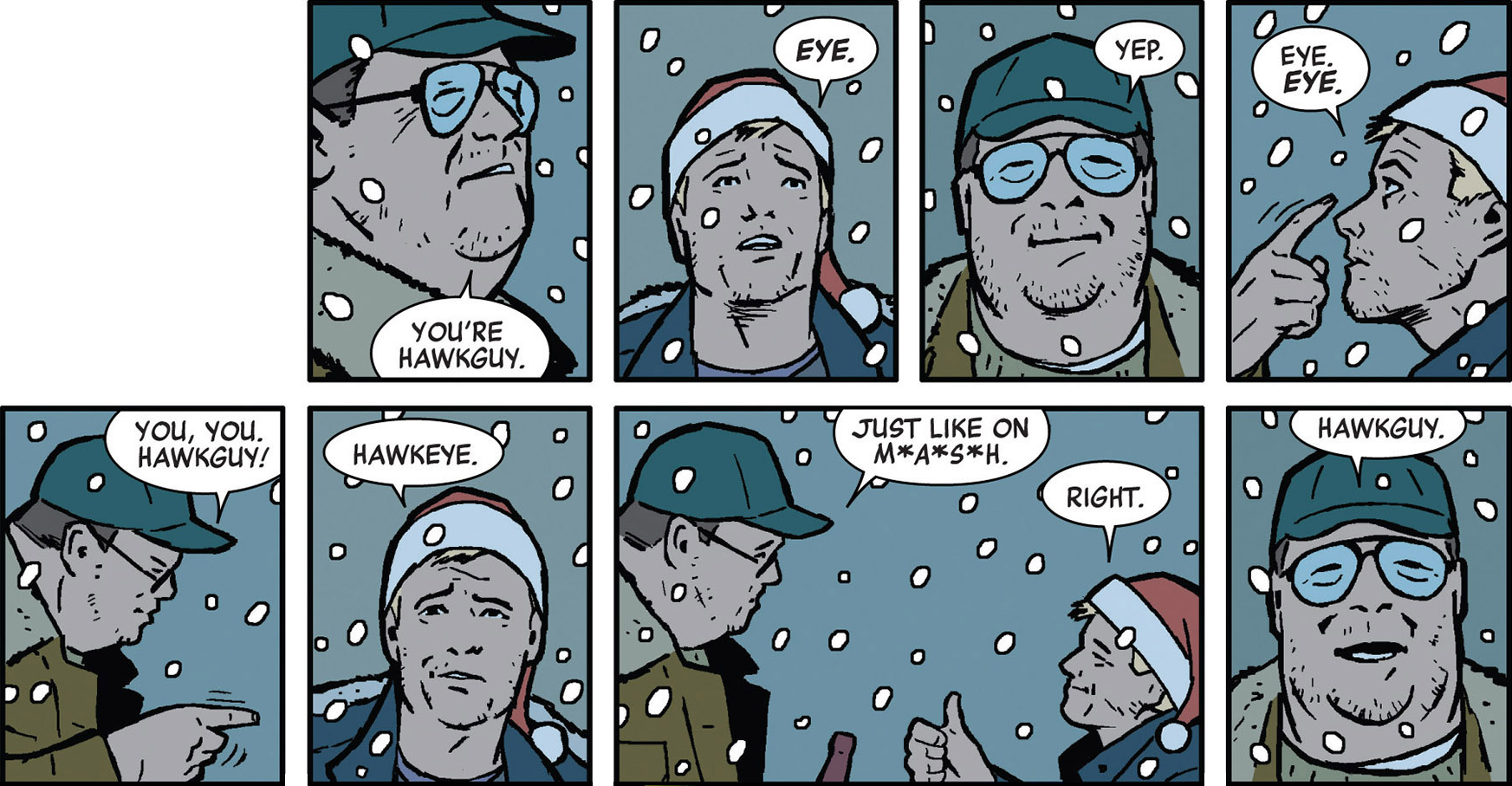
Fraction’s take on the character is through the lens of a man who, when not rubbing elbows with super soldiers and Norse gods, is just a guy. Take the following panels into account:

Okay, that about just sums up what I said. Check this one out, too:

hawkeye

So now, we’ve established that Matt Fraction’s writing is great. David Aja, who illustrates the title, is also great [at drawing]. Greatness all across the board, you guys [and girls], this is a comic that you should be rolling your eyeballs across.

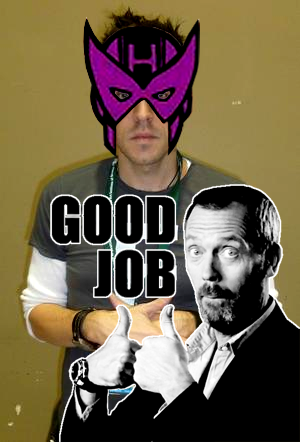
That’s worth a Fame Day. But you know what’s even more worth that? The cover on the left. It’s for, and the title of this blog post is pretty self-explanatory, Issue #7 of Hawkeye. Why is this a big deal?

For one thing, Fraction is taking time off of his current storyline to explore what happens when Hurricane Sandy hits Clint Barton’s neighbourhood. The real world affects Marvel’s that’s pretty neat.

Here’s something else that’s neat: Matt Fraction will be donating all of his royalties from the issue to Red Cross, which will work towards relief efforts for Sandy’s Victims. 

That’s right, ladies and gentlemen, this man will not be making a cent off of the issue. It’s the story about “a girl trapped at a function that she can’t get out of when the hurricane comes, and about a guy helping his buddy move his infirm dad to safe ground” [check the above link]. It’s a story that, for every issue it sells, will benefit those who lost their homes due to a tragic natural disaster. 

If you are a person who thinks they might want to get into comics, this would be a great place to start. It’s a smart, funny title written by a talented man, and it’ll be $2.99, a fraction [pun not intended] of which will go towards people that genuinely need it. Think about it. And at the very least, give the man some credit.

A Comic Lover’s Opinion on “The Bakersfield Expedition” [Last Night’s Episode of The Big Bang Theory]

I love comics. In no way should this be a surprise to anyone who’s given this blog more than a passing glance. I also love television a lot, and when the two happen to overlap you can be assured that you have my undivided attention.

Yesterday I wrote a little bit about Bleeding Cool’s response to The Big Bang Theory episode “The Bakersfield Expedition”, half of which revolved around the premise that the show’s female cast would be entering a place traditionally closed off to their gender. I was able to catch the show last night and have many thoughts, but my ultimate conclusion is this: It really wasn’t that bad.

The guys, Sheldon, Leonard, Raj, and Howard are all off to the Bakersfield Comic-Con, so the girls enjoy their weekend alone by having brunch [an idea celebrated by the character we all know is an alcoholic, Penny].  While sitting around and enjoying their croissants and mimosas, Amy states that she doesn’t get why the guys go to these conventions. To which Penny responds:

“The four of them work at a major university, they’re all super smart, how can they still be into something made for 12-year-olds?”

Which did not please me. Having given it a second viewing, however, I realize that it’s a believable response and the perspective many people still have on the medium today. Bernadette suggests that they try to become a part of their significant others’ lives by seeing what the big deal with comics is, and soon they’re all off to their LCS [local comic store].

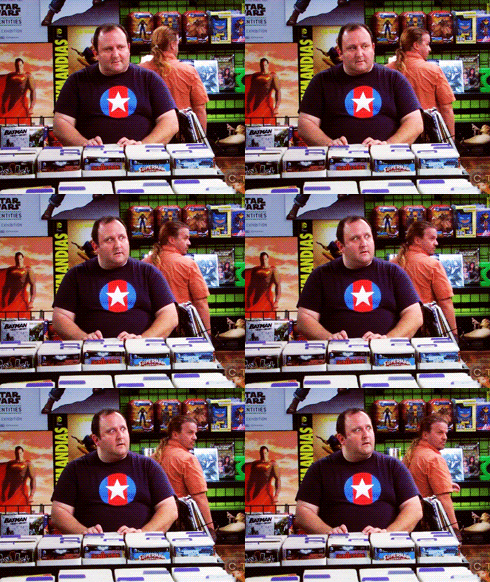
As the promo advertised, the following does indeed happen:


But it’s a quick gag that thankfully doesn’t overstay its welcome. Owner of the store and new series-regular Stuart is quick to chastise his socially awkward clientele and is soon talking to the girls about comic book recommendations.

Amy’s direct approach of asking “Alright, well who’s the best super hero?” and Stuart’s haste to nip that line of questioning in the bud was fantastic. There isn’t really any media that’s cut and dry as far as what “the best” is, and his whispered “What do you want to do, start a riot?” communicated well that this is a pretty contentious topic in certain circles.

Stuart also does a great job in saying that there are many different kinds of comics, and a little later on that there are different types of super heroes as well. The character really shines when he recommends to the ladies the incredible Fables #1, about which he says:

“The artwork is sophisticated, it’s intelligently written and it doesn’t objectify or stereotype women.”

Unfortunately Penny ultimately chooses for the group when she looks over and sees an issue of Thor and notes that:

Back at the apartment Amy and Bernadette sit quietly as they wait for Penny to finish the twenty-or-so-page issue. The following exchange occurs:

Amy: “There was a lot of action, the story moved along at a brisk pace, it was overall, what’s the word I’m looking for?”

Penny: “Stupid”

Amy: “So stupid.”

This upset me when I first watched it, but upon finding out the title was Thor, God of Thunder #2, written by Jason Aaron and illustrated by Esad Ribic I was dumbfounded. The Big Bang Theory has always been really good about keeping their comics contemporary, and the stock in Stuart’s shop actively changes to keep up with what’s new on the stands, but this was something else entirely. Aaron’s new Marvel NOW! title follows the character as he grows from a young, brash god to the hero we all know today and then further on to his role as the future king of Asgard. It’s masterfully written, and features artwork like this jaw-dropping splash page [which also happens to be my current desktop wallpaper.

I’m willing to assume, probably correctly so, that the show was in no way actually referring to anything in the actual book [though it would not surprise me to have an entire page featuring the single word “Krakka-DOOM” in a Thor title].

Then, as the three gripe about the waste of time that is their boyfriends’ [and husband’s] pastime, Bernadette notes that “It’s crazy, they spend hours arguing about things that don’t even exist!” And then things get interesting. Penny mocks the idea of a “hammer so heavy that no one else can pick it up” and then before you know it the girls are deeply debating the fundamentals of who or what can wield Mjolnir.

A lot of good points are bandied back and forth, but the best is easily Penny’s observation that:

“If we were in outer space, anyone could pick up the hammer  because it would be floating around in a weightless environment that’s right the slow reader used science suck on that.”

Wonderful. I say that without a trace of sarcasm.

After a fairly unenjoyable pan back to whatever it is the guys are doing we return to see that the girls are in Sheldon and Leonard’s apartment, eating takeout with comics strewn all around them. They are still talking about Thor’s hammer. Then the following exchange happens [and this is my last quote, I promise]:

Bernadette: Red Hulk must be worthy.

Penny: How can Red Hulk be worthy?

Bernadette: You don’t know his life!

If there was any laugh-out-loud moment of this entire episode that was it.

Coming away from watching “The Bakersfield Expedition” for the second time [which I did to write this post] I have to say that I quite enjoyed exactly half of it. Absolutely no part of me was invested in the guys trekking [ah ha] around the desert as a Federation landing party. What I was interested in was watching three characters, formerly wholly unfamiliar with comic books, arguing intensely about a matter which, and I’ll be honest, is not important in most senses of the word.

While The Big Bang Theory has often taken the nerdier passions and portrayed them in a fairly mockable light, it was certainly not so in this episode. Yes, comic books were referred to as something for twelve-year-olds, but Stuart does a great job in telling both the girls and the audience that it’s a broad, diverse medium that has beautiful illustrations and excellent writing, as well as a little eye candy for the ladies.

Rich Johnston at Bleeding Cool thinks they did a passable job at addressing comics, but continues to assert that it’s still The Television Show That Hates [Comic Book Fans]. The episode review over at The A.V. Club’s TV Club actually referenced the Bleeding Cool movement [which you again read about in yesterday’s Fame Day post] and similar to what I did focused mainly on the girls’ plot for this episode. The comments section of that review go over the age old conversation of how the show treats its subject material and its potential audience, but that is another post for another day.

All I have to say is that I was pleasantly surprised by the episode, and enjoyed it much more than I thought I would. I also finally received the second volume of Mark Waid’s Daredevil, so this is not a day on which I can feel unhappy. Here’s another picture of Thor from Issue #4 of Aaron and Ribic’s title for all you lovely people.

Fame Day: Bleeding Cool and The Big Bang Theory

It all started with this teaser for tonight’s episode of The Big Bang Theory:

“The girls go . . . WHERE NO WOMAN HAS GONE BEFORE.”

This prompted the writing a post two days ago by Rich Johnston on his comics website Bleeding Cool, entitled “Are You A Woman, Have You Actually Been Inside A Comic Shop?” This in turn prompted another post by the name of “Disproving The Big Bang Theory” in which Johnston received feedback from numerous individuals on what they thought of this premise.

A few response tweets:

Untitled-1

Untitled-1

And one of the longer email responses, this one from Susanna Baird:

I started reading comic books about a year ago. I’m a middle-aged mom and the first few times I walked to the “New Comics” back wall at Harrison’s in Salem, MA, I felt like I was walking the halls of my junior high school with a new haircut. But after a few weeks, I realized that feeling was entirely my own.

Everyone wanted to talk comics, and no one cared that I was the only middle-aged housewife in the store. Now it’s like all the enthusiastic geekery of junior high minus the mean girls. I love it. Love comics, love Harrison’s – the staff, the clientele – and I love being in a room full of metal shelves lined with three-dollar art.

I love Harrison’s.

Finally, one last post just today revealed that even an editorial staffer at one of the Big Two [Marvel/DC] had things to say about, which I won’t quote here since I don’t want this to just be links to Bleeding Cool articles. You can read that here, though.

Is all of this attention warranted? Should The Big Bang Theory really be criticized for depicting comic book stores as havens for uncomfortably staring virgins?

The fact of the matter is this: it’s the perpetuation of a stereotype that simply isn’t true. More than that, it’s based on the sexist assumption that some forms of media [in this case, comics] are closed off to women. I know for a fact that there are members of the finer sex who appreciate a good comic book, and saying that no woman has ever stepped foot in a comic book store straight-up denies this.

As someone who loves comic books, and wishes more people did, it’s a huge
encouragement to me that so many women are speaking out on this topic. They’re asserting that they appreciate good art and storylines too, and I am immensely pleased that this is happening.

asdgasdgasgd

It’s unfortunate, as well, since The Big Bang Theory has actually been really great this season. They’ve started giving the female cast members equal screentime, and it’s refreshing and creates a lot of immensely funny situations. It’s a shame that tonight’s episode turns to relying on such tired material, but it is definitely worth giving kudos to those who are doing their best to prove its premise false.

Evan and Gordon Talk: Nerd Culture

EVAN: To start this off by ignoring our readership and addressing you, this week’s topic is a weird sort of continuation of the various posts on culture you’ve written, such as “manly culture,” “science culture,” etc. And similar to these other groups of people, “nerd culture” is a pretty nebulous sort of thing to define.

GORDON: No argument there. After all, even the “nerds” insist on calling out “fake nerds”- especially in regards to women/girls. But what is a nerd anyways?

EVAN: See, now I’m torn, because we do need to define it, but you’ve also directly referenced an issue I wanted to discuss in depth this week.

GORDON: How about we abandon our previous track record, and just plunge recklessly ahead and hope the issue resolves itself?

EVAN: Well, let me throw this image out there:

And then hope that suffices for now.

GORDON: Works for me. So what was it that you wanted to address specifically?

EVAN: Well, just last month there was this guy, a comic artist, named Tony Harris. And he wrote this post on his Facebook page that was essentially a tirade against “faux nerd” women, and how they are whores, and so on.

To break it down further, these are women who dress up as superheroes and what have you without knowing about the actual characters themselves. He is upset because, to quote him:

BECAUSE YOU DONT KNOW SH-T ABOUT COMICS, BEYOND WHATEVER GOOGLE IMAGE SEARCH YOU DID TO GET REF ON THE MOST MAINSTREAM CHARACTER WITH THE MOST REVEALING COSTUME EVER.

Also that they attend to essentially just tease the regular con-goers and are actually not even hot, just “con-hot.” So yeah, he said a lot.

GORDON: Ah yes, I recall reading about this. And while I think we can all agree Harris went too far, is a bit hypocritical (seeing how most comic women ain’t exactly average looking), and probably getting too emotional, I can’t help but wonder if he has, somewhere in there, a point.

I mean, imagine if all of a sudden, something that you had been stigmatized for became popular, and people started trying to co-opt your identity knowing nearly nothing about it. I’d be ticked off too.

EVAN: That’s definitely something I’ve read people write about, that this used to be an exclusive club and that it took years to build up this knowledge and become, well, a nerd, and here are these noobs and they want in and it’s not that easy.

And I can see where they’re coming from as well.

But if you really love something, shouldn’t you want others to as well? The Avengers has an enormous following on tumblr these days [because of the movie], and these are people who are actually going out and starting to buy comics. They are helping sales, aiding the industry, etc.

GORDON: That’s true, and something I’ve considered, but there’s probably also an argument to be made for the other side. That something precious to you is being watered down and diluted for profit. I don’t believe that nerds (comic book nerds, anyways) can necessarily make this argument, but the line of logic is there.

Let’s try to come up with an example of this happening somewhere else, especially in regards to persecution.

EVAN: Mmk, go ahead-

GORDON: “Black culture” (or what was passed off as black culture) might be an example. Can you state that you’re not driven nuts by wealthy, comfortable suburban kids fronting like they’re from the streets of Oakland?

EVAN: Yeah, people are upset about it, sure, but there’s not this immense outcry over it. There are comic-con enthusiasts that are genuinely incensed that all of this is happening-

I doubt that an actual thug or gangbanger or whatever these rich White kids are playing at imitating is going to start freaking out that he’s getting ripped off. He’s going to laugh or shrug it off, because it hardly matters.

GORDON: I’d argue that the reason for this has more to do with the change in venue. It’s easy for the major players of the comic book industry to voice their opinions than, say, a Wu-Tang Clan fan in the late 90s. But maybe I’m wrong.

EVAN: For the most part, I see this as a mindset that is the foundation or core of hipsterism, and that we all feel to some extent, however minor. That we found something and we love it and there is a pride in joy in being one of the original fans.

And this outpouring of others somehow cheapens things. And all of a sudden we’re trying to assert how we’re better than them in some way.

“You chose to dress up as Spider-Woman? Do you even know who her alter-ego is, or what her powers are? Etc.”

GORDON: Again, do we not sympathize? Do we not feel frustrated with people who have more or less jumped on the bandwagon now that it’s all safe and socially acceptable to do so? Heck, just imagine if someone tried listing themselves as a fan of fine cooking, having only eaten sushi once- would you be ticked?

EVAN: If I equated sushi with fine cooking I guess I would, yeah. But just because we can understand someone’s anger and frustration doesn’t make it logical.

GORDON: I wouldn’t say that there’s not a logic to it. I mean, a major part of being a nerd is, and always has been, the social pariah element. All of the sudden you have these people trying to claim to be on the fringes of society? It’s condescending and insulting.

EVAN: I think that’s the issue- They’re not trying to “claim to be on the fringes of society.”

GORDON: I disagree- I feel this is a coward’s way of feigning rebelliousness and all that.

EVAN: Sometimes people who haven’t been exposed to comics for much of their lives see a movie, or read a trade, and go to a con. Maybe they wear a costume. That doesn’t mean they’re going into this thinking, in any way, that they’re suddenly a part of this group of outcasts.

Comics are popular now. I mean, more than they’ve ever been. To say “I like comics” is no longer the sort of thing that’s going to get you shunned. People are going to raise their eyebrows and wonder why you think that’s a big deal.

GORDON: Comics yes, no one is gonna argue that. The title of “nerd” however, that’s different. And after all, “nerd” is a much larger term. It applies to gamers, to film, and so on.

EVAN: So how does one become a “fake nerd”?

GORDON: Therein lies the rub- there’s always gonna be more obsessive nerds out there. People higher up and lower down the hierarchy. But for the most part, I think we can agree that a “false” nerd is one who does not meet the criteria in that diagram you posted.

The “social ineptitude”, the “obsessiveness”- if it’s not actually there (no matter how much the person or persons might insist otherwise) then that person is a “fake” nerd.

EVAN: So am I a “fake nerd”?

GORDON: Do you call yourself a nerd?

EVAN: I don’t really call myself anything. But I’d also say that many of the girls who go to cons and find themselves attacked by Harris don’t refer to themselves as anything in particular either.

GORDON: Then no, I wouldn’t define you or them as fitting this category. Like I said- Harris went overboard.

EVAN: I just don’t think social ineptitude needs to be a requirement in this. I think you could be a nerd and still have friends, and achieve some level of popularity. The diagram above really shoehorns the definition. I mean, what if I did call myself a nerd?

I’m fairly smart, about 80% of the time I’m thinking about comics, or comics-related media. At the same time, I’m a fairly social guy. What does that mean?

GORDON: You think about comics 80% of the time?

EVAN: I think about comics a lot.

GORDON: 80% of your waking thoughts is a craaaaaazy lot, though I’d say your self-identification as a nerd is flawed. Serial-killer in the making would be more accurate. But we begin to split hairs at this point.

EVAN: I guess it’s like, does Hugh Laurie have the right to play the blues?

GORDON: Hugh Laurie can do whatever the **** he wants. As does anyone. With everything he does, can he identify himself first and foremost as a blues musician? Not really. At least, that ain’t how we’re all gonna think of him, or remember him.

EVAN: Does it matter that it’s what you identify as first and foremost? I am positive that at some level, yes, he does identify as a blues musician.

GORDON: It does matter how you identify yourself first and foremost. I’ve eaten bugs on multiple occasions- I don’t declare myself “Gordon Brown: Bug Eater.” The rest of the stuff I do outweighs it by far.

EVAN: You’re missing my point. You’ve eaten bugs, so on some level you can identify as a bug-eater.

If he identifies as a blues artist less than he does as an actor, that doesn’t negate the fact that he identifies as a blues artist, and what we’re talking about is people being able to say that they can and do relate to a culture, and that doesn’t make them fake adherents of that.

GORDON: Let me offer another example: I’ve been camping, and I occasionally read survivalist pamphlets. For me to call myself a “survivalist” would nevertheless be inaccurate and misleading. That’s the crux of the matter, I believe.

A nerd is someone who is in this for the long haul- a person who enjoys The Avengers or Nolan’s Batman trilogy isn’t. At least, not necessarily.

EVAN: I’m not saying that a person who enjoyed The Avengers equates being a nerd. That’s like, half the Earth’s population, if the box office is any indicator.

I’m saying that a person who saw The Avengers, and then heads over to their local comics store to check some out, and gets really into it, has the potential to become a “comics nerd” of sorts. And people who see them and scorn them for not being there from the beginning should be ashamed of themselves.

If we’re sticking with the example of film and comics and so-on.

GORDON: And I agree- those people should not be viewed with derision. But that’s not who we’re talking about here.

We’re talking about ****ing hipsters, about people who have just enough knowledge of a culture to give themselves the veneer or adopting it. People who wear glasses as a ****ing fashion statement. You know the kind.

It’s about motives. The noob who is just now getting into the culture isn’t a “false” nerd- just a young one. The person who call himself or herself a nerd to co-opt the social stigma (now that it’s all but gone) deserves contempt.

EVAN: I honestly don’t think that what these people are trying to co-opt is the social stigma.

GORDON: My poor choice of words. I mean the false sense of rebellion. Like people who post pro-gay Facebook statements simply to draw attention and applause to themselves. Fake-rebels. Fair-weather activists.

EVAN: That’s fine, and I agree that these people are not to be applauded.

I just think that for the most part, people are realizing that there is a lot in the “nerd culture” that they find interesting and accessible, and are gravitating towards it. Not out of some misguided attempt to be on the edge of society, but because they legitimately enjoy whatever it is they’re trying to engage with.

GORDON: I agree- I simply don’t think it’s these people most old-guard nerds are angry at.

EVAN: But how can they differentiate? That’s a huge issue. It’s this reaction of the community against anyone that’s not legit, but without any way of truly being able to tell how people feel-

A person can go to comic-con in an elaborate costume simply because they enjoy the aesthetics and design of the character. They’re not required to know everything about them, and shouldn’t be hissed and booed at when they don’t.

GORDON: That in and of itself is another issue. If I showed up to the social justice convention dressed as Che Guevara  you’d best believe I’d better know a thing or two about the guy who I’m completely dressed up as- but we’re moving off track.

EVAN: But the point of social justice conventions isn’t to dress up as your favourite revolutionary- that’s entirely besides the point. I bring it up because it’s completely cogent to our topic, because it’s exactly what Tony Harris was railing against.

GORDON: Tony Harris ran his mouth and made a fool of himself, I ain’t trying to defend a word of what he said or wrote, only the general perspective he seems to be coming from.

EVAN: What I’m saying, without negating your points is this, and I’m going to try to wrap up since we’re 15 minutes past our cut-off, is this:

I’m someone says “LOL im such a nerd” and they wear glasses with big frames and have a Green Lantern patch on their backpack, yeah, I’d say that’s not okay. But a large issue is being able to, as a community, acknowledge when “outsiders” try to access what it is that we love so dearly.

We like comic books and Star Trek and Dungeons and Dragons, and if other people might as well, that’s fine. Just because others weren’t always welcoming of us in the past doesn’t mean we should do the same to others. Especially when there’s some likelihood, even a little, that they could one day be as big a fan as you [as hard as that may be to believe].

GORDON: Well put. Be sure to stop by next time for our discussion of . . .

EVAN: Of . . . uh . . . I threw out this topic last week, what’ve you got?

GORDON: Let’s address the portrayal of drugs- weed in particular- in media and popular culture.

EVAN: That’s a pretty contemporary topic too, because of the legalization in Washington and all that. Sounds good to me.

GORDON: Let it be so then. Merry Wednesday to all, and to all a good night!

Evan and Gordon Talk: The Walking Dead

GORDON: Ladies and gentlemen  devoted readers and people who found our blog by googling “dokata fanning playboy.” We’re were to have a frank and open discussion about “The Walking Dead,” both the critically acclaimed television series and Robert Kirkman comic books of the same name.

EVAN: I’d like to issue a fair warning to those who haven’t read the comic series or caught up on the show that there will be SPOILERS. You have been duly warned.

GORDON: Indeed. I’d like to kick things off by talking a bit about how the books and the television series differ, and whether or not that’s a good thing.

EVAN: I think there’s a firm answer there. The show differs a lot from the books, and that’s definitely a good thing.

GORDON: How so?

EVAN: Sticking to the book means that there aren’t any surprises for loyal fans of the series, and keeps them guessing. Furthermore, it allows AMC and others involved to play a little bit more loosely with the way the show is going, without feeling too tied down.

GORDON: I thought about that.

EVAN: And?

GORDON: At the same time, I feel there’s definitely a lot lacking from the series as a result of their pretty strong (and ever increasing) departure from the source material. Take some of the deaths, like Dale’s and Shane’s, for example. It’s like knowing you’re gonna go get Chinese food versus being surprised that you get some potato chips with your nasty sandwich.

EVAN: I agree. Both deaths were undeniably very well-written and powerful moments. I just think there’s something to be said for not being slavishly dedicated to one vision of the show.

And as far as Dale’s death is concerned, I can easily see his key line being spoken by some other character some ways down the road.

GORDON: I guess my point is that while the show does keep you on your toes, the changes it makes are typically just less impressive than the story itself. I think loyal fans of the series would be just as cool seeing a faithful show as one that goes its own way.

I mean, look at it this way: The books are dark. Really dark. I’m talking Laurie’s comic-book ending dark. It pushed the envelope in ways I just have yet to see the show do. That was a lot of the charm of the books- how unflinching it was. I’m just not getting that same power with the show’s spin.

EVAN: It’s obvious that fans are going to want a show that is as close to what they originally experienced in the comics as possible. I also agree that the comics are undeniably better than the show.

My point is that I think the deviation is good and realistic. Having the Governor both physically and sexually assault Michonne is probably not something we’re going to see. Neither did I think we were going to be witness to a woman and her baby being brutally gunned down.

The writing is weaker, but I don’t think that faults the direction to not stick to the book, it faults the current writers.

GORDON: Interesting, but it seems that the logical solution to that is to try to get closer to the hard-hitting story the books gave us. Here’s what I’m hearing from you:

“The books are objectively better, but the fault is with the show’s poor writing.”

Seems like you either just start trying to write a better zombie story while trying to stay within sight of the original material and characters (which kind of kills the point), or just stick to the material to begin with.

EVAN: I don’t think they’re not trying to write better stories. I’m saying they’re not succeeding. I don’t think they set out to do a bad job.

GORDON: Fair enough. So what needs to be done then?

EVAN: As with most forms of media taking into account constant feedback from fans and acknowledging their mistakes. Season 2 at the farm really dragged on, and was low on the zombie killing. At the very least, this season has given us plenty of “walker”-eviscerating action.

GORDON: No argument there . . . no complaint either. But I don’t think it’s a solution; just something to help ease the need for something more.

EVAN: You do get that not everything in the comics can make it on TV, though, right?

GORDON: Of course. And I wasn’t going to say that. I mean, ever since the season began, I’ve been like: “How the **** are they going to show a baby being shot on national television?”

The rest I could imagine, but not that.

EVAN: Okay, how about we move on to something most fans of the AMC show can relate to: How horrible Andrea is all the time always.

GORDON: That bugs me. I like Andrea. Andrea gets it.

EVAN: Andrea is horrible. Andrea almost shot Daryl in the face. Because she couldn’t listen to people telling her to hold the **** up.

GORDON: That was messed up. But otherwise, I think the criticism of her is all just BS.

I mean, everyone’s like, “Gah- I hate Andrea! Why can’t she see that the Governor is evil?”

And I’m like: “Please. If you had survived as long as she had, which you wouldn’t, you would be groveling at the man’s feet for a bowl of warm soup, let alone a flippin’ suburban paradise free from living corpses.”

Relatively, anyways.

EVAN: She only survived because of Michonne, who I don’t like all that much at the moment. And for the most part, I agree with you about the Governor not being a bad dude.

GORDON: Let’s not turn this into my twisted/completely reasonable sense of morality. What I think the show is really lacking is the eeriness. You got that in the first season, when Rick was on his own, that feeling of isolation. Upping the action doesn’t solve that problem, especially as more an more characters come in.

EVAN: What I really want to see is the whole idea, which has been communicated but could be better, that it’s not the zombies you’re afraid of, it’s the people. Two kids die, and everyone things it’s the huge black dude who did it. Turns out it’s the mild-mannered white guy who decapitated these two little girls.

GORDON: Very unexpected. Dang, there was so much good stuff there that we’ll never get to see. . .

EVAN: The theme of the books, if I could sum it up in three words, is “People Are Monsters.” I think that’s really what needs to come out of AMC’s Sunday evenings.

GORDON: I agree completely.

EVAN: We’ve got a little bit of time, do you want to share with the nice people why, barring slaughtering a few US Army men, the Governor’s not such a mustachio-twirling villain?

GORDON: In their defense, that version was pretty over-the-top; like a living Snidely Whiplash.

EVAN: In the books, you mean?

GORDON: Yeah.

EVAN: What I meant, though, is that as you said people are yelling at their screens, crying “Andrea you dumb blonde, can’t you see you’re making out with the devil?”

GORDON: They are, and without cause (barring knowledge from the book). I mean, people suspect because they’re the audience and can see the big picture. But if we’re talking realistically, they would be more eager than Andrea. I’m just saying the criticism of Andrea as being blind is utter nonsense.

EVAN: And furthermore, what has he done to have anyone assume he’s a bad dude? Taken away their weapons in a peaceful town. Shown them tons of hospitality. If anything, we’d all be telling Michonne to chill the eff out and stop glaring at everyone/thing.

GORDON: Exactly. People need to chill out.

EVAN: And, even though I’m sure we could’ve gone on for another hour, that just about concludes our time. Any topics you have in mind for next week? Probably not something television-related, to avoid the hat trick.

GORDON: True. Let’s talk about food. Let’s hypothesize the greatest food show of all time.

EVAN: Yes. Agreed. EVAN AND GORDON OUT.

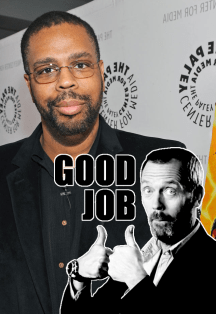
Fame Day: Dwayne McDuffie

This post is one that I write with both deep respect for its subject, as well as a great sense of loss. His impact on the world of comics is greater than many realize, and it was a truly tragic event when he passed away on February 21st of last year due to complications from emergency heart surgery.

While I didn’t know it at the time, McDuffie had a huge influence on my becoming a fan of comic books. Growing up in the Philippines, my dad got his hands on a bunch of trade paperbacks, one of which was Static [now Static Shock]. The series was one of many that was published my Milestone Media, a comic company co-founded by McDuffie and three others. Their aim was to “express a multicultural sensibility” that he felt was missing from the industry, and they succeeded.

The titular Static was the electric alter-ego of African American teen Virgil Ovid Hawkins, and continues to be one of my favourite comic characters ever. One of the many created by McDuffie for Milestone, he embodied the awkwardness of adolescence and the effects of vigilantism on one’s personal life. His world was realistic and gritty without succumbing to the darkness that other such worlds do. Static was well-written, action-packed, and, most importantly, relatable.

After Milestone had stopped publishing new companies, McDuffie went on to enter the world of television. He was hired as a staff writer for the Justice League animated series, and was promoted to both story editor and producer as the show became Justice League Unlimited. Of the show’s 91 total episodes McDuffie wrote, produced, or story-edited 69. McDuffie also did extensive work on continuing the Ben 10 series, wrote for the Teen Titans show, and scripted a number of DC’s direct-to-DVD animated films.

Dwayne McDuffie also had an extensive career working for both DC and Marvel, and earned three Eisner Awards. In addition he was awarded many others, including Comic Con International’s Inkpot Award. Above all, he was able to affect the entire industry for the better. It’s just a tragedy that he left us as soon as he did.