Tag Archives: comics

Nolan, Jefferson, and The Batman

Keep on reading, this’ll make sense.

In the year 1820 Thomas Jefferson shared with a number of his friends a book
he had put together entitled The Life and Morals of Jesus of Nazareth. It was, in essence, the four gospels [Matthew, Mark, Luke, and John] in chronological order. What truly differentiated it from the Bible was the omission of all references to angels, prophecy, references to Jesus divinity and resurrection, and miracles.

In the year 2005 Christopher Nolan’s film Batman Begins made its way into theatres, spawning a trilogy and getting the ball rolling for dozens of “grim and gritty” remakes. In an interview with The Guardian the director said that he “[tried] to do it in a more realistic fashion than anyone had ever tried to [do] a superhero film before.”

The parallel I’m trying to make should be obvious to any Batman fan, either of the comics or the animated series. Having finally seen The Dark Knight Rises this Tuesday and finishing the trilogy, I can finally say this with confidence that Nolan has done to the Batman canon what Jefferson did to the Bible.
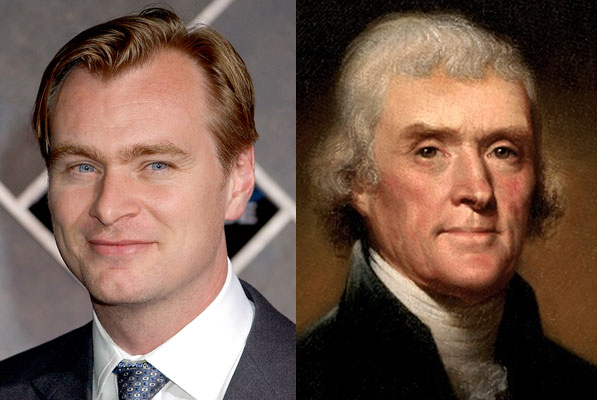
These two men have something against the improbable.

To make things clear, I like Nolan’s Batman movies. He took a concept as seemingly ridiculous as a vigilante crimefighter who dresses up like a bat and somehow grounded it. On top of that he forced us to accept the fact that comic book movies can be more than entertaining, they can be awe-inspiring as well.

An issue that I had with Christopher Nolan and his films was the staunch inability to embrace anything even vaguely fantastical. The problem with that being that the concept is, as I just mentioned, a vigilante crimefighter who dresses up as a bat. With that in mind, maybe the imagination can be stretched just a little more to accommodate a psychopath whose makeup can’t wash off, or a badly scarred man with a deeply split-personality.

Furthermore, by thinning the line between reality [that of the audience] and art [the film being watched] questions are forced to arise. If this is the real world, why didn’t the kidnapping of a Chinese national from his homeland spark an international debacle [The Dark Knight], and <SPOILERS> how is Bruce able to make the jump to escape the prison given the damage in his legs [The Dark Knight Rises]? The films lower our suspension of disbelief, and with our guard down we become quick to ask why.
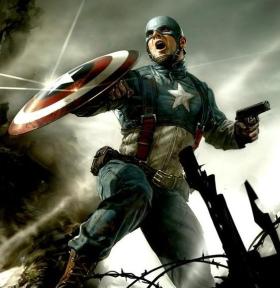
In his film Captain America fought pseudo-Nazis with energy weapons and tanks as large as houses. The audience never questioned this because although the film had some sort of anchor in a real-life event [World War II], we still understood that this was a world with one foot in the fantastic. If we can believe that a scrawny kid from Brooklyn ingesting a “super solider serum” can help the Allies win the war then we can just as easily believe that Hitler’s “deep science division” is led by a man whose face looks like a red skull.

Taking the “magic” out of the Batman mythos was no easy task, and Nolan threw a lot out when he decided what his approach to the canon would be. Scarecrow’s fear gas got the go-ahead, but not the Joker’s laughing gas, or the Venom that Bane uses to grow stronger. Batman could be called by name, but not Catwoman. Batarangs can be seen, and used, but the Batmobile must be free of any visual associations with the character.

Nolan was free to pick and choose what he wanted, and in many ways simply used Batman and his world to tell the stories that he wanted to tell. This is somewhat lost in the third film due to its connections to actual events in the comics [Knightfall and No Man’s Land, though that’s a post for another time], but for the most part he co-wrote the stories and screenplays for all three films. In another interview he states that “I don’t think our Batman, our Gotham, lends itself to that kind of cross-fertilization,” in response to a question about heroes co-existing between films akin to the Marvel Cinematic Universe.

Having stated that, I must admit that I have to view Christopher Nolan’s trilogy of Batman films as- something else. Something not Batman. Batman would never kill purposefully [letting someone die, Batman Begins], accidentally [tackling Harvey Dent, The Dark Knight], or not react to the deaths of others [all throughout The Dark Knight Rises]. I guess I view them as Batman movies about as much as I view the apocrypha part of the Bible. They can be good, and even beneficial, but ultimately miss the mark somehow.
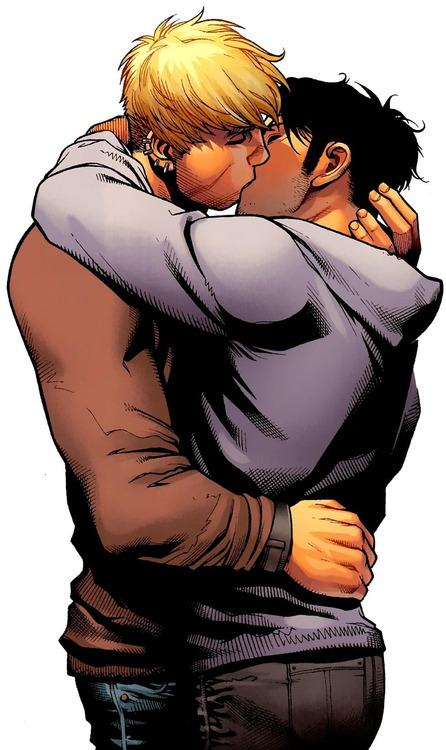
Homosexuality In Comics As Of May 20th

hulklingwiccankissIn the series following superhero team The Authority Batman/Superman analogues Midnighter and Apollo shared a kiss in 2000. A decade later Kevin Keller premiered in an issue of Veronica, the first openly gay character in Archie Comics history; he meets his future husband in a military hospital after being wounded in action. This year Young Avengers Hulking and Wiccan shared their first kiss, the result of the former proposing to the latter. Not to be outdone, fellow Marvel character Northstar will actually be beating the couple to the altar with his fiance this June.

Two days ago, May 20th, DC Senior VP Publicity Courtney Simmons announced that “One of the major iconic DC characters will reveal that he is gay in a storyline in June.”

As far as the Big Two go, Marvel’s ahead of the game. In this case, “the game” refers to “positive representations of homosexuals in comics.” Northstar announced “I am gay” in 1992, and since then has been followed by characters such as X-Man Graymalkin, Avengers Academy member Striker, and alternate-universe versions of many, many characters. In comparison, “new” Batwoman Katherine Kane is a lesbian, and is currently heading her own ongoing series, something Marvel can’t claim.

To be more specific, DC is going to reintroduce a previously existing character (previously straight) as “one of [their] most prominent gay characters.” This means that the character will not be Batman or Superman. As someone who can’t really get behind the company’s New 52 2011 relaunch I cannot speculate on what remaining characters may be coming out as gay. What I can state, however, is why other “major, iconic” characters could never be rebooted in this way.

It’s not because of fan outrage, though that’s a factor. So many of the really iconic DC characters have rich histories which involve their heterosexual love interests. It’s difficult to imagine Clark Kent without Lois Lane and her reporting on the Big Blue Boy Scout, and basically every male hero has a girlfriend who has played a significant part in their formation as a character. Batman is a character whose sexuality defines him almost not at all, though in his case his long-questioned relationship with the Boy Wonder may prove iffy.

That being said, I don’t see how major and/or iconic this gay DC character can be. To be that said character will have to have been around for a number of years. Fans are always complaining about something, but to retcon years of history will be a very messy process. I’m looking forward to finding out who it is, but am skeptical about how much clout the person will really have in the grand scheme of things.

[Very] Brief Thoughts On Entertainment

A bitter, angry old man once said:

There’s been a growing dissatisfaction and distrust with the conventional publishing industry, in that you tend to have a lot of formerly reputable imprints now owned by big conglomerates. As a result, there’s a growing number of professional writers now going to small presses, self-publishing, or trying other kinds of [distribution] strategies. The same is true of music and cinema. It seems that every movie is a remake of something that was better when it was first released in a foreign language, as a 1960s TV show, or even as a comic book. Now you’ve got theme park rides as the source material of movies. The only things left are breakfast cereal mascots. In our lifetime, we will see Johnny Depp playing Captain Crunch.

That same man wrote The League of Extraordinary GentlemenV for Vendetta, and one of Time Magazine’s All-Time 100 Novels, Watchmen. Alan Moore certainly has the writing credentials, but is he accurate in his assessment of the future of entertainment?

The truth is, as you’re probably well-aware, that the publishing industry is an ever-changing thing. ComicsAlliance writer Chris Sims has called for the “big two” [Marvel and DC Comics] to get serious about webcomics. In other words, for the two publishers to release content for free to compete in an age where people just aren’t buying print anymore. It would work as a way to increase and maintain interest in their product, and would even help sales; people who like reading something online will typically buy it if they like it enough.

As for creativity, I wrote in a post earlier this month [Mashin’ It Up] about people who are seemingly just reaching into a bucket of tropes and smashing them together at high speeds. Cowboys and Aliens was a movie that came out last year, and it wasn’t even original; it was an adaptation of a [honestly, not very good] webcomic. Not only that, but by next year Gore Verbinski will have directed Lone Ranger, with Johnny Depp as Tonto. That could be considered one step closer to Captain Crunch, I suppose.

At the same time adaptations are being made of novels. They may not be original screenplays, but the original work is nothing like a TV show from the 80s, it’s not built on nostalgia. Audrey Niffenegger’s The Time Traveler’s Wife was adapted for the big screen, and although it didn’t do great with the critics it still stands as evidence that books will do well; and they’ll do well enough to warrant films. This could lead into the conversation about how some books receive film opportunities before they’re even published, but that’s for another time.

The “conventional publishing industry” will continue to change; it has and it will continue to. Alan Moore is a cynical miser of a man [subjective], but he has a point that shouldn’t be ignored. We’re not doing great in regards to creativity, and it’s an area we should expect more from. Cynicism may appear to be the logical place to turn to, but looking for media worthy of attention is the more worthy activity.

A Look at The Walking Dead‘s Theodore Douglas

Season 2 of AMC’s The Walking Dead wrapped up this past Sunday, kind of a big deal when you take into consideration the fact that the show was pulling in roughly 10 million viewers every time it aired. There are blogs all over the place discussing the big reveal, so feel free to head over there if you’re wondering what all the fuss is about. This post is meant to take a good hard look at character Theodore “T-Dog” Douglas.

AMC’s The Walking Dead is based on an immensely well-received comic book series of the same name written by Robert Kirkman. While it has, for the most part, stuck with the comics’ general plot progression, there have been a large amount of changes made. The addition of T-Dog as a member of the group in the first season was one of them.

As this season has progressed the internet has taken a lot of interest in T-Dog, for the most part discussing how little a role he actually has to play in the show. The following are his biggest moments listed in chronological order:

S1E1, Guts: T-Dog is one of the group members. He is savagely beaten by a racist among them and is almost killed.  The character who beat him is handcuffed to a roof as punishment. Later, when sent to free him, T-Dog drops the keys down a drain.

S2E1, What Lies Ahead: The survivors are scavenging an abandoned
highway for supplies. T-Dog doesn’t hear Rick, their leader, tell everyone to hide under cars due to zombies. He cuts his arm open on a car door. His life is saved when another survivor covers him with a dead zombie.

S2E2, Bloodletting: T-Dog is upset because the group is leaving him behind with an old man. He thinks it is because he is black. It turns out that he has blood poisoning and is weak and might die.

S2E4, Cherokee Rose: T-Dog almost drinks water from a well that had a big fat zombie in it.

S2E6, Secrets: They’re at a farm, and one of the farmer’s kids turns his pistol sideways during shooting practice. T-Dog tells him not to “give [him] any of that gangster sh-t.”

S2E12, Better Angels: T-dog sees that a prisoner has escaped and exclaims “Aw hell no!”

S2E13, Beside the Dying Fire: Zombies attack the farm and everyone scatters. T-Dog is driving himself and two others to the coast. One of them, Rick’s wife, tells him to turn around or she’ll jump out of the truck. He does so, performing a particularly ugly U-turn.

As the second season progressed, the conversation about T-Dog and what he has to do with anything grew immensely. In the last few episodes many were wondering if he was ever going to get past more than one or two lines per episode. Some have theorized [and by some I mean me] that he shares the same affliction as Eddie Murphy’s character in the universally panned A Thousand Words.

Thankfully, an interview with showrunner Glen Mazzara hopes to answer all of your questions about this enigma of a man. Entertainment Weekly asked if we would be seeing more of T-Dog next season, and the answer was as follows:

There is a plan for T-Dog. Given all of the things that I had to focus on to develop the show in a way that I felt was best, I will say that T-Dog got short shrift. We took care of business, and now we can delve into [SPOILERS] and T-Dog and all these other characters. T-Dog fans will be happy. We’re no longer interested in having a character in the background only saying one line per episode. We’re done with that. But again, we only had so much real estate, and it was very important for me to tell Rick’s story.

Which is great, really, except that I don’t see him having much more to offer the show. As far as what his role is it’s difficult to look any further than token black character. Glenn, a Korean-American character, was present in the comics and as a result has a pretty well-defined personality and storyline. In other words, Glenn has a foundation that extends beyond diversity for diversity’s sake. At this point in the series, T-Dog is actually the only character [save for a girl whose name was changed] not found in the original comics, and this really stands out.

It’s great that Mazzara was able to address, in a straightforward manner, that they did have a character who was “only saying one line per episode.” What remains to be seen is whether or not the writers for The Walking Dead can add any sort of complexity to T-Dog in this upcoming season. It’s been amusing watching and waiting to see if he does, well, anything, but while that may be enjoyable it doesn’t make it good television.


Christopher Bird: Should Be Writing For Comics

Part of this post hinges on you having read the last one I did, Aaron Diaz: Has a Lot of Opinions About DC. In it I wrote about webcomicker Diaz, his redesigns of DC characters [and his reasons for doing so] in particular. Where that post and this one overlap is that Diaz wrote new origin stories for his reboots, and these have been the subjects of replete praise.

Christopher Bird, creator [and namesake] of the blog Mightygodking, is another man with ideas that involve the intellectual property of others. A man who knows [and loves] comics, he’s written his fair share of posts about them, and demonstrates an impressive knowledge of the work of both Marvel and DC. We would expect someone in his position to have strong opinions about the direction both companies are going with their comics, maybe even implying that either company would do well to hire him to write for one of their properties.

MGK should write Marvel’s Doctor Strange. And he has reasons.

Eight days ago MGK released the 42nd of his “I Should Write Dr. Strange” posts. That’s 42 reasons why Marvel certainly wouldn’t suffer by putting him in charge of writing about the Sorcerer Supreme himself.

The reasons, however, are never directed at his own qualifications. From the very first post, in which he creates a scenario where the colour blue has been magically leached from our existence, he presents stories. There’s little to no explanation whatsoever before he starts it off with the sentence, “One day, you wake up, and blue is gone.” From then on it’s a description of an eerie, uncomfortable scene right up until the last two paragraphs. The last one is but a single sentence, “And that’s why this is a job for Dr. Strange.”

I read through all 42 of his reasons this week, and was thoroughly engrossed and enchanted by every one. As someone who loves comics but isn’t terribly familiar with Dr. Stephen Vincent Strange, I found myself garnering an appreciation for the character and wishing that these stories, all hypothetical, were a reality.

Where MGK really excels in his knowledge of the lore behind it all. Whereas Diaz took and remade characters, creating an entirely new universe for them, MGK makes his narratives fit in Marvel continuity and acknowledges the world he’s writing in even though he has no obligation to do so. When he writes about Dracula he mentions Blade, and when writing about the death of Cytorrak [picture shown above] he makes sure to hint that there’s a chance not all is well with the Juggernaut. He even justifies his entire act of writing these reasons by explaining how it all continues to work even when Doctor Strange was no longer Sorcerer Supreme.

When it comes to writing about comics, especially Marvel and DC, it’s easy to criticize. While Diaz provided an alternative of sorts there’s a sense, in his redesigns, that he rejects a great deal of the characters’ original origins and histories. I enjoyed a few of his takes on a few heroes, but ultimately wasn’t convinced that this was an entire world worth creating.

MGK, Christopher Bird, on the other hand has won me over with his tremendous tales of superheroism and magic. He tips his hat at every turn to the ones who came before him, even though he technically does not come after them. He doesn’t disparage current writers [which isn’t to say that he’s never criticized any aspect of the industry], but instead provides stories, dozens of them, to prove that he knows the character and what he’s doing.

And, if after all of that, he hasn’t proved that he should write Doctor Strange, maybe he can convince you that he should write The Legion.

Aaron Diaz: Has a Lot of Opinions About DC

If you peruse the website ComicsAlliance daily, like I do, then you’ve stumbled upon the increasingly controversial work of webcomic artist Aaron Diaz.

Starting in early October, with his post on tumblr Rebooting the Justice League!, Diaz has gone from being the creator of webcomic Dresden Codak to becoming the supposed saviour of the comic book industry. Featuring his own personal take on DC’s super hero team, he redesigned everything from costumes to origins.

This spawned a few other posts, such as Rebooting DC’s Villains!, in which he recreates the Legion of Doom as the “Secret Society,” and Rebooting Batman!, where the Caped Crusader is recreated to fit his new alternative DC canon [his earlier incarnation of the Dark Knight can be seen here]. Beginning with his take on the Justice League, each post has been featured on Comics Alliance, much to the delight/irritation of its readers.

Diaz states clearly that his reboots were spawned by DC’s own “New 52” [which I discussed, in part, here]. Their new designs for Starfire and Harley Quinn, in particular, were targeted in their elevation of sex appeal over utility. Diaz gets downright aggressive in his post DC Comics Reboots Dresden Codak!, where he imagines what it would be like if the company redesigned his own webcomic.

As you can see above, the female characters are overly curvaceous and barely dressed, while the men are very obviously the same male body type with different costumes and hair colour. While a point is being made satirically, he single-handedly slams the work of an entire publishing company instead of the individual artists or writers responsible for the designs he dislikes.

As one would expect, the comments on his tumblr consist almost entirely of praise for his work. One particular question asks “Can you just, like, take over DC and make this happen for reals? These redesigns actually look like superheroes I WANT to read about.” On his Justice League reboot Stephanie Charette admits that “I have never before commented on anyone’s Tumblr, but I must. This is what the comic’s industry needs to do. THIS. THIS. THIS.”

Leaving his tumblr for more balanced opinions, the comments on his features on ComicsAlliance provide a happy medium between blind adoration and outright disdain. Paying no heed to the ones about the rate he updates his comic [which is neither here nor there], there are comments which were written calmly and logically.

On one of ComicsAlliance’s latest features, Aaron Diaz’s ‘Tales of the Uncomfortable’ Takes a Halloween Look at Harley Quinn, a commenter states that “The message of DC has been beaten like a dead horse (particularly on this site) and I really don’t know what else to say anymore.” Thankfully someone else does, and they bring up a post on the tumblr of webcomic artist Amanda Lafrenais. The commenter even pulls a direct quote:

And I REALLY enjoyed, save for minor nitpicks, Aaron Diaz’s redesigns, criticisms and praise of costumes. However his newest post on the subject about cleavage and crimefighting kind of made me wanna talk about it. A friend pointed out that, yes baring your breasts is very impractical in fighting. But so are capes. And spandex. And having no padding or armor.

In her post Lafrenais goes on to push the idea that costumes aren’t really intended to be realistic [their utility further broken down by Edna Mode]. While she admires what Diaz has done, she implores artists not to “take the fun away,” and that there is a point where “practicality ends and fantasy begins.” Even though her post doesn’t address part of what Diaz is railing against, the overt sexualization of women, she does attempt to soften the extreme logic from which many of his designs were birthed.

On a personal note, I liked many of his redesigns, particularly his take on Batman and Robin. Conversely, I strongly disliked  some of his ideas, primarily taking Gorilla Grodd and making him more “Planet of the Apes” than “Mighty Joe Young.” The man has some great ideas [their originality contested by many commenters on ComicsAlliance], and he aims for a creative revitalization of the industry, which I can agree with.

My issue would be with the apparent bitterness his work gives off. His reboots were all well and good, but his portrayal of DC rebooting his own characters was unnecessary and extreme. I can understand in part why he’s doing what he’s doing, but he could cut down on the vitriol.

Lastly, I was very confused with a particular question I read on his tumblr. When a reader asked if he would be willing to redesign the entire DC universe, similar to what Marvel did with Brian Michael Bendis and their Ultimate line, Diaz responded with “I’d do it, and only if they paid me five times whatever Marvel pays Bendis.” I’m unsure as to whether he meant it sardonically, or if he actually believes he deserves five times the money Bendis does. Either way, I found it difficult to take.

Tune in next Thursday, when I write on Christopher Bird, aka “Mightygodking” [or “MGK” for short]. His titular blog is one of my all-time favourites, and his opinions on comics [and one character in particular] are deserving of some exploration. Particularly when viewed opposite of those of Aaron Diaz.

[follow-up post can be read here]