Tag Archives: marriage

So, I’ve got this Wedding…

As you are all probably sick of hearing by now, I’m getting married. Except now it’s for real, this Saturday in fact. Things are really crazy this week because my parent’s house is full of family and there’s lots still left to do.

tumblr_nl08zowmro1r8dy8go1_400

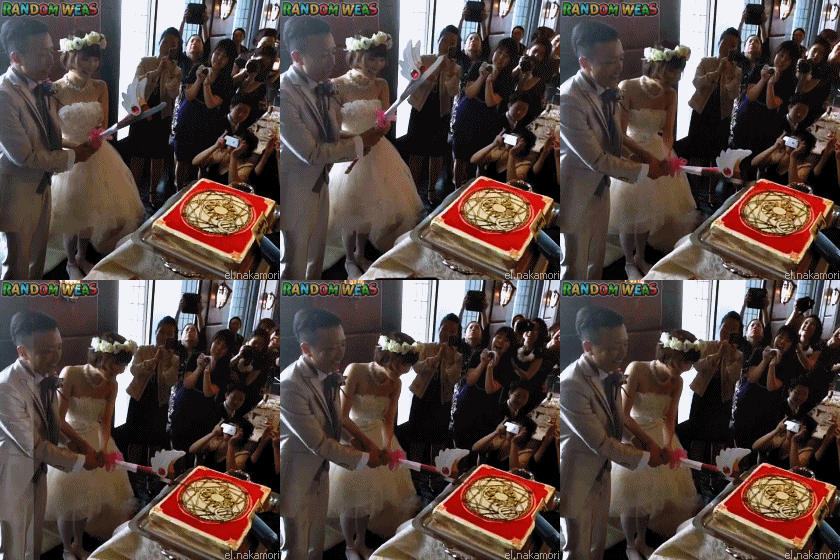
Like find an axe to cut the cake. 

So the boys have graciously allowed me to skip out on my post this week. Don’t have too much fun without me, and I’ll see you next week.

EVAN: Kat’s actually free to skip next week as well; whether or not she takes me up on that offer is another thing entirely. After that point I can only assume that her and John’s marital bliss will have surely faded, and we can continue on with our regularly scheduled programming.

Evan and Gordon Kat Talk: Weddings and Marriage

KAT: Welcome everyone to this week’s Evan and Gordon Talk. This week I will be stepping in for Gordon as he has tirelessly posted a whack  of articles all in a row and could probably use a bit of a rest. Even the reds need their sleep.

Today Evan and I will be talking about weddings [and marriage].

And no, I would like to clarify for you all that Evan chose this topic. Not me. And don’t gender stereotype. It’s bad for your health. Continue reading

Feminism, Homemakers, and Stepford Wives

What’s the first thing that comes to mind when I say the words “wife and homemaker”?

Exactly.

Now as you probably know by now I’m getting married this summer. I’m super stoked about spending the rest of my life with John because he is my best friend and we have awesome adventures, but I’ve been struggling with what it means to become a wife within our cultural context.

Look at us! We’re married! Now we can jump on the bed!

Continue reading

Storm and “Black Hair”

This is somewhat of a continuation off of yesterday’s Fame Day post, concentrating particularly on the Marvel character Storm. Kris Anka’s design for the weather-wielding Ororo Munroe harkens back to her appearance in the 80s [seen on the right].

Keeping consistent with most changes to beloved comic book characters, the mohawk was met with both praise and scorn.

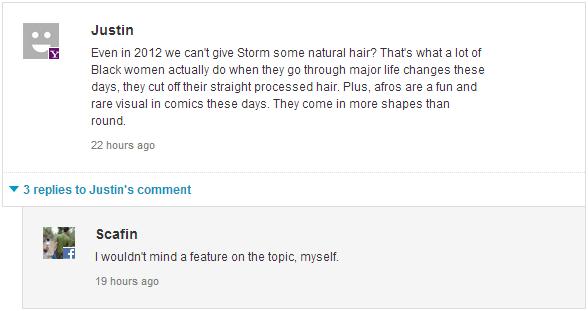
Trawling the comments section of the ComicsAlliance article on the topic, I came across two guys who were very interested in not just the style of her hair, but the state or quality of it as well.


Earlier on Scafin commented about wanting to see Storm’s hair in its natural state. In following up with my reply to his thoughts  [and with a slight miscommunication as to what I meant by “black hair”] he said:

I don’t mean color, though. I really want to see her with white, afro-textured hair. I understand why she was given relaxed hair when she was introduced, as that was the norm back then, but the ubiquity of relaxed hair has declined since then.

The thing is, Storm as a character has always had straight, white hair. The fan-run Marvel Database tells me that she’s descended from “an ancient line of African priestesses, all of whom have white hair, blue eyes, and the potential to wield magic.” That answers Scafin in that the character has never had “black hair.” It’s part of who Storm is now [having been depicted as a young child that way] and to retcon that many years of portrayal would fare poorly with fans.

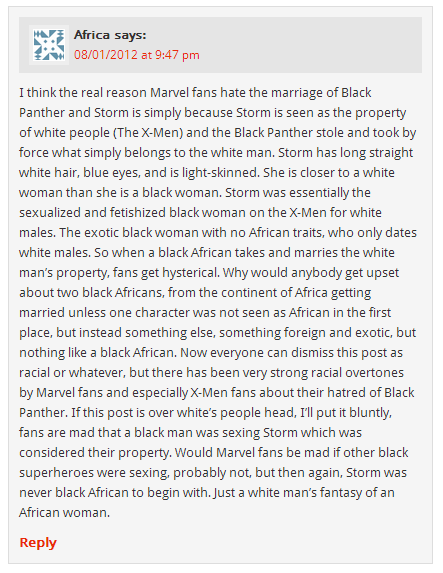
This leads to another question, though, which is why Storm was designed this way at all. This comment on an article about Storm’s marriage to the Black Panther had the following to say about the character’s creation:

I’m going to break this down as quickly and efficiently as possible, so we can concentrate on the more important aspects of the comment.

  • People are upset about the marriage because Marvel didn’t lead up to it well enough. In other words, they weren’t invested, and that’s adding to the fact that marriages in comic books typically do not work [see Peter and Mary-Jane in “One More Day.”]
  • That this is the sexual domination of White over Black when one of the very first relationships Storm gets into in the comics is with Forge, a member of the Cheyenne people. He was not, and still isn’t, white.

David Brothers, a blogger on staff with ComicsAlliance, agreed with part of what Africa had to say, commenting on the same article:

I liked Hudlin’s run on Panther. It was one of the precious few times that Storm actually felt like a black character, instead of a fetish object with blue eyes and perfectly straight hair.

This is in stark contrast to the article he wrote for Marvel a year earlier titled “A Marvel Black History Lesson Pt. 1.” In it he has more than a few good things to say about the heroine, which can be summed with these words:

If Gabe Jones stood for reality, Black Panther for ingenuity, Robbie Robertson for integrity, The Falcon for equality, Luke Cage for self-awareness, and Misty Knight for unadulterated cool, Storm was the combination of all of their traits and more. She was the daughter of a Kenyan princess and a photojournalist from Harlem, and therefore a direct link from African Americans and the continent known as “the Motherland.” She was powerful on a world-class level, refused to allow anyone to be her master, and commanded a massive amount of respect from all who knew her.

Taking into account Brothers’ apparent conflict in viewing the character, I
personally come away from this with the knowledge that Storm is more than just eye candy, she is a strong [in terms of power and character] heroine on par with many of her peers.

While Storm having straight hair may have been a product of the time she was created in, that in no way affects who she is as a character. Marvel has the right to maintain consistency in how she is portrayed, and has other characters who are better examples of having “black hair.” While the event of her marriage had its flaws Storm remains someone who has both strong ties to Africa and one of the most prominent black superheroes of all time. The straightness of her hair should in no way detract from that.

Fairy-Tale Weddings and the Decline of Marriage


So marriage is less popular than it was 50 years ago (this may not be terribly surprising but which I am going to back up with SCIENCE): a study by the Pew Research Center (my new favorite thing) revealed that while in 1960 72% of adults were married, only 51% were in 2010. The median age of first marriages also went up like 6 years – 28.7 for men and 26.5 for women; up from 22.8 and 20.3 (respectively) in 1960.

A lot of comments on these statistics revolve around the idea that marriage is being taken less seriously, which certainly has merit: the rising divorce rate makes divorce a less socially discouraged decision and therefore diminishes the permanent sense of the commitment taken. Also, varied living options and mobile societies make the legal ramifications of marriage more public; no longer a church ceremony involving the boy down the street and a community event, marriage is for many people predominately about tax laws and the legal status, not the community proclamation.

And yeah, those things are probably true. But I suggest that there might be another factor: that, as much as marriage is becoming unimportant socially, we are taking weddings way too seriously psychologically.

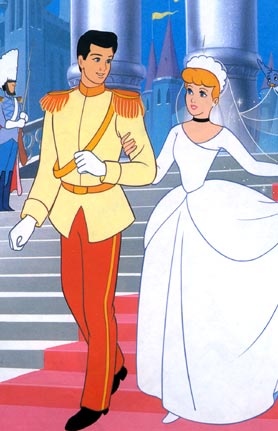
For the Millenials (born between 1980 and 2000), weddings were presented to us as the Happy Ending to stories. Marriage was the denoument – the end-all-be-all – the MacGuffin. Disney movies, early romantic comedies, books, and plays all dramatize the beginning of a relationship – before commitment, when things are exciting (right?) – and a wedding at the end serves as the success. The idea of a princess wedding fascinated females (I wasn’t/am not by any means a very girly girl, for example, and even I can remember slumber party discussions of wedding colors, flower selections, and first-dance-song-choices) of our entire generation.

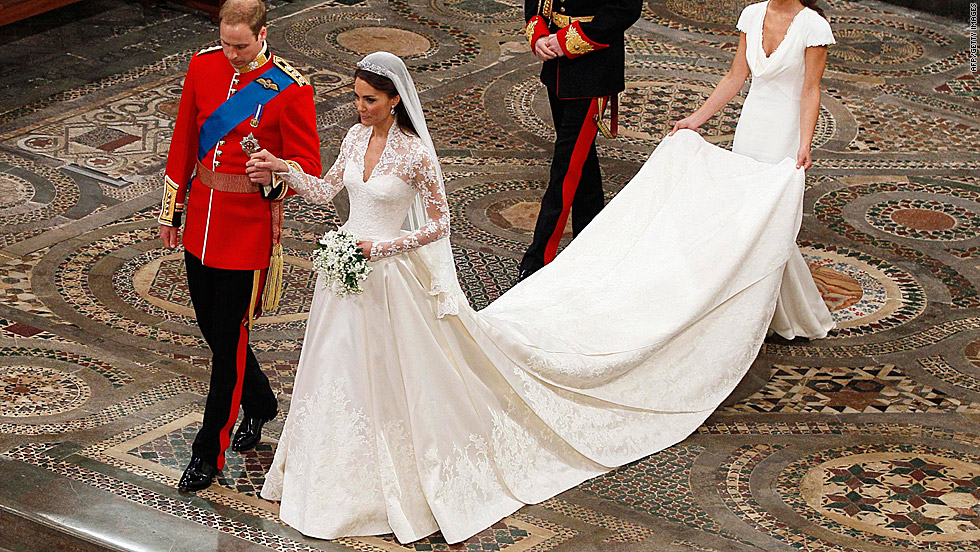
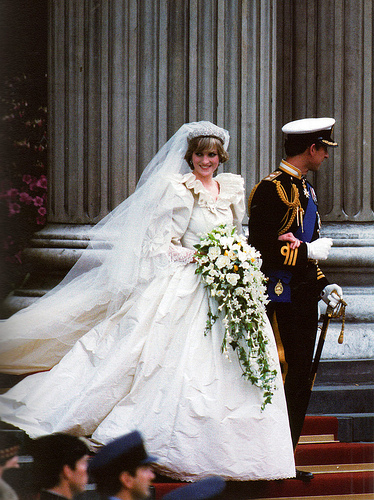
source: madameguillotine.comThis may have had something to with Princess Di’s wedding – or at least, that wedding didn’t hinder the fairy tale story by any rate. Kate and William’s wedding will serve a similar (if possibly less dramatic) purpose for the continuation of the happy-ending weddings portrayed in fiction.

So we, in a weird, way, take marriage way too seriously – idealistically. We fetishize it. It has to be Perfect – and so we have modest weddings costing about $10,000 and shows like Bridezillas, a half-and-half(ish) divorce rate, and the married adult population decreasing by about a third in 50 years. Fairy-tale representations of weddings may be part of the cause of marriage’s approachingly fictional status.

This increase in expectations in our generation might also affect the increase in marriage age – the tendency among young adults now is to become established (don’t get married before you own your own home!) and stable before marriage, instead of going through that scarier economic climb with your spouse. The wedding has to be perfect, and so does the relationship and your economic status – and so we wait.

Is this a bad thing? After all, 44% of Millenials think that marriage is becoming an obsolete institution. Cohabitation is increasingly popular. One possible trouble might lie in the instability of couples leading to more single, economically depressed parents, raising children and working on their own: quite the contrast to the fairy-tale weddings we grew up hearing about.

Christians, Sex, and Marriage, part 2(ish)

A while ago Evan wrote “Christians, Sex and Marriage”, in which he discussed the culture of sex among Christian young adults. Most of them, it was assumed, would be “saving themselves” for marriage, which is (on the surface) a fairly safe assumption, and applicable to a fair amount of Christian students. The culture of silence about sex, however, and the nervous giggles that attend any discussion of it, and the lack of admission that respected, smiling young Christian couples could possibly be doing anything but kissing chastely behind the dormitories makes me want to shout from the rooftops:

Lots of Christian students are having sex. What’s more worrisome is that lots of Christian students are professionals at alternately justifying and denying it.

Even more students are doing everything they possibly can with each other as often as possible without having the kind of sex that potentially impregnates women—and yeah, I think that the long list of not-actually-that-kind-of-sex possibilities is significantly different from the real deal. I also think that it’s sex. I’m pretty sure it would be as defined by our commandment-following-12-year-old selves, at least.

The problem with sex (for nervous promise-ringed young adults) is that it’s a good thing. The other commandments have translated pretty well into a social behavioral code, because one could argue that stealing, lying, murder, etc. are basically destructive things; sex, however, out of all of the commandments, is not.

So sex is super important, is my point, and an essentially good thing. It is one of the most creative things humans can do. It’s taught to us, however, with all the other Evangelical commandments: Don’t be drunk, Don’t do drugs, Don’t have sex. It’s treated, largely, as a thing to be avoided, feared, or even dismissed (“I Love My Future Wife, And I haven’t Even Met Her Yet” shirts, I’m looking at you). Our sex drives, in a vestigial Gnosticism in the contemporary church that saddens me, are seen as shameful things to be suppressed or ignored.

This attitude works fine until we are actually with someone. The main reason to remain celibate was often, basically, “Because the Bible says so,” an argument which weakens palpably the moment you’re alone with an attractive human being who’s attracted to you too. Most of the sex—including the sex leading up to the “real” sex, which, yes, is very different and which, yes, I’m going to continue to assert is still a big deal (commandment-breaking, I would posit, if you’re concerned about such things)—is wrapped up in substantial layers of vague guilt and shame and self-berating.

To assuage our guilt, we also end up deciding upon arbitrary Ultimate Borders of Virginity (which tend towards frequent revision), e.g., “We’re going to keep on all our clothes.” We then realize, e.g., how much one (I guess two) can actually accomplish while remaining clothed. Rinse and repeat with almost any “line” with which we decide to define Purity. I have never seen any line, like “hands above the waist,” work for a couple. Ever. And yet, sadly, it seems to be one of the main strategies of the inhabitants of steamy cars (or, for the carless: stairways, practice rooms, lean-tos, lobbies, cafeteria booths, parking lots, closets, or lawns).

So what we do is immerse ourselves in cycles of guilt and denial and more guilt. This, needless to say, isn’t super healthy. We start to talk about how it’s basically impossible to find a consistent definition of “adultery” as it’s used in the Old Testament. We find out that “fornication” often only applied to women and commandments against it are preceded by things like “don’t marry your dead husband’s brother.” We reassure ourselves that “sexual immorality” in the New Testament, when you come down to it, is pretty vague. The subject of our “Virginity Rocks” t-shirts becomes somewhat more complex than perhaps we once thought, and these newfound nuances conveniently complement our recently emerged interests.

This quick justification, while rather impressive in its ability to persuade even the previously prudest new couples (our argumentative skills and ability to think outside the box can probably be attributed to a strong liberal arts education), is seriously unhealthy. We are taught from an early age to regard sex as plainly Bad, down there with murder and lying and stealing, and so when we realize that it isn’t quite so terrible, it’s pretty easy to renege on our former simplistic convictions. This—not the sex itself, but the quick way in which we flip from “Obviously Not” to “well maybe just a little bit”—is worrisome.

Christian students are deprived of practical conversation about sex. It seems that the contemporary Christian church doesn’t really know what to do with sex besides tell young people to avoid it. Unless the goal is to leave young people confused and ridden with guilt, unless the goal is to communicate an attitude of oversimplified fear and denial when it comes to sex, and unless we prefer a confused silence to more risky and constructive dissenting discourse, the attitude with which sex is approached throughout young Christians’ lives needs to change.