Tag Archives: misogyny

The Internet, The Military, And Feminism – A Brief Interaction Between Two Facebook Pages

First things first, this is going to be another one of my shorter posts. The days ahead are packed so I’ve sat down to rattle something off on Wednesday night just to keep the content coming. Secondly, when it comes to the military and feminism I am very confident in my feelings towards one and very uncomfortable and unsure about the other.

I’m not one to bandy around words like “liberal” and “conservative”, proper nouns or otherwise, but in general the profession of killing others isn’t one that sits easily with me. To say that I think we can solve all of the world’s problems by just sitting down, talking, and hugging it out is a step too far, however. There is clearly a need for such men and women, with World War II being the obvious go-to example of when war is right [literal decades of video games have communicated how evil the Nazis were]. Not everyone can be negotiated with or see reason, no matter how badly we would like that to be true.

nazombies

Nazis are so evil that Nazi zombies are actually better, not worse, because zombies can’t be antisemites.

So no, at bare minimum I do not hate the military or its existence. That of course does not mean I don’t get uneasy about the whole semper-fi-oorah-[yes-I-know-those-are-both-specifically-USMC-related] mentality that appears to be a requirement of serving in the armed forces. It makes sense, of course, to want to foster an unbreakable kinship between people who depend on each other for their survival, but it’s also obvious that this kind of impregnable bond can lead to a lot of terrible things being covered up [see literally any recent news article about police brutality].

It should also go without saying that this club, if we can call it that, is primarily male. According to CNN as of four years ago only “about 203,000 [. . .] or 14.5% of the active duty force of nearly 1.4 million” is made up of women. Even without this statistic it isn’t surprising that the vast majority is men, and that such a male-dominated environment results in particular attitudes and opinions being fostered.

feministgrunts

Feminist-Grunts11bravo, U.S. Infantry Soldiers is a mouthful [and referred to from this point on as Feminist-Grunts], but also the name of a Facebook page I came across with a very unique mission. It claims to be “for Infantry dedicated to respecting women and kicking ass of chauvinistic a**holes,” which doesn’t sound like something I have any problem with whatsoever. It’s also run by a single “feminist female veteran” who describes the page as being a “parody account”. To dig deeper into what she means by that, she says:

“This page is really a parody satire project where I pretend that feminist grunts exist, that they run this page, and that they believe in fairness, equality, and that everyone regardless of sex, gender, race, class, religion, has an undeniable right to pursue whatever careers they want to the best of their ability.”

Continue reading

Bernie Sanders VS. Black Lives Matter: How Is This Helping?

I haven’t been this depressed about writing a post since the attack on Charlie Hebdo. Even as my fingers move across my keyboard I can feel my willpower just oozing right out of me. And it’s not that the issues here aren’t worth talking about- they absolutely are. It’s just that the whole affair has been so…

pointless.

Let me just hit you with the hard facts before we jump into this morass of stupidity and futility.

This Saturday in Seattle Democratic-Socialist and presidential-hopeful Bernie Sanders was holding a political rally for his campaign. Shortly after beginning, a pair of protestors from Black Lives Matter (a nation-wide movement speaking out against police violence towards African Americans) climbed up on stage. The two protestors, for some twenty minutes, recounted grievances of the local black community and scolded Sanders for not having been vocal enough about police violence towards minorities. “…Join us now in holding Bernie Sanders accountable…” stated Marissa Johnson, one of the protestors.

Continue reading

Socially Conscious Comedy Part I: 3 Important Feminist Issues That Amy Schumer Humorously Highlights

I realize Amy Schumer isn’t for everyone. She’s pretty crude, and some of her sketches shift suddenly from funny to uncomfortable.

She also hasn’t done the greatest job approaching intersectionalism through her humour. While she humbly apologized for racially inappropriate jokes that she made in the past, she recently missed the mark again with race jokes in her movie, Trainwreck. That said, I think Schumer offers some fantastic socially conscious comedy. She’s created a niche as a funny feminism, and has drawn attention to some really important women’s issues through her jokes. Below, I’ve outlined a few of the difficult issues that Schumer addresses on her show.

1) Rape

Rape is never funny. However, the way Western society often responds to rape is an absolute joke. Schumer has perfected the socially conscious ‘rape joke’, not by downplaying the seriousness of the violent crime, but by mocking the ridiculous social circumstances that allow rape to go unpunished.

In “A Very Realistic Video Game”, Schumer draws attention to the way female military officers rarely see justice after being assaulted by a fellow officer.

https://youtu.be/BXGJGuH59qw

Similarly, her sketch titled “Football Town Nights” looks at the way athletes’ celebrity status has led entire towns to defend young rapists as though they were victims rather than perpetrators .

2) Internalized Misogyny

There are a lot of ways women police ourselves. We try not to be too cocky, or too naggy, or too loud and obnoxious, or too vain. We are taught to police these behaviours because they will make us less likeable, less dateable, or an embarrassment for our significant others.

Sketches like, “I’m Sorry” or “Compliments” draw attention to the pressure women feel to act coy, even in situations where their male counterpart would be encouraged to be confident.

Meanwhile, “I Have a Boyfriend” and “Hello Mi’Lady” highlight the way women can be manipulated into accepting unwanted advances, since ignoring or rejecting them is considered “bitchy” or “cruel”.

https://youtu.be/e8teRxOSNHs

3) Unrealistic Beauty Standards

Schumer regularly takes on unrealistic beauty standards, especially those that target female celebrities.

Her parodic music video, “You don’t need make-up,” mocks (most) men’s misconception of what ‘natural beauty’ actually looks like.

Meanwhile, “Schumerenka vs. Everett” highlights the way women are expected to sustain a certain type of look, even in the athletic world. This is a problem recently highlighted by a racist/sexist New York Times article that framed Serena Williams as masculine, and even animalistic for her physical strength

https://youtu.be/bPPqE-MA7Mo

With her recent rise to celebrity status, Schumer has also experienced her fair share of body shaming. At her first audition, for example, she was told to “either lose weight or gain a bunch of weight” in order to secure a role as either “the fat friend or the romantic lead.” She has also been targeted by Twitter trolls for being “too fat”. Recently, she dedicated an entire episode to these trolls, by having men on her show debate if she was actually hot enough to be on TV.

Rape, misogyny and beauty standards aren’t just ‘lady problems’, they are societal problems. These issues matter, and I’m glad Amy Schumer is drawing attention to them via her show. I’m also glad Schumer approaches these issues with a sense of humour. Humour has a powerful way of helping us self-examine ourselves, and think more deeply about problems we might have dismissed if they hadn’t made us laugh.

Can Video Games Make Thoughtful Social Critiques?

Just to be clear, I am not a gamer. The only video game I ever successfully completed was Jill of the Jungle, which we owned on floppy disk when I was a kid.

I’m pretty sure I only liked this game because Jane was a super cool tough girl,

In fact, up until this past year I would have argued that video games don’t really have any redeeming qualities. At worst, they are a hotbed of misogyny and xenophobia, as chronicled by female gamers on websites like Not in the Kitchen Anymore and Fat, Ugly or Slutty. At best, they are like a bottomless pit where the lives of children and adults disappear, never to resurface.

Although I suppose the same could be said about pretty well anything.

This year a good friend convinced me to try a Digital Humanities class at my University. For those of you who haven’t heard of the field before (I hadn’t either), Wikipedia defines it as the “intersection of computing and the disciplines of the humanities”.  If you want to see some examples of the kind of research being done in the field, you could check out two of my past posts describing DH scholar Lisa Nakamura’s guest lectures at my university.

While this class has challenged the way I see technology in general, it has particularly challenged my very negative perception of video games. In fact, Ian Bogost, one of the DH scholars we studied in the course, argues that games can form powerful arguments and unique social critiques. In his book, Persuasive GamesBogost describes arguments made by a game as “procedural rhetoric“, or, more simply as “the art of persuasion through rule-based representations and interactions, rather than the spoken word, writing, images, or moving pictures”.

Below, I’ve included four examples of persuasive games my DH professor shared with the class. Each of these games make relevant and thoughtful arguments that wouldn’t have been as effective if they didn’t appear in their procedural form.

The Parable of the Polygons

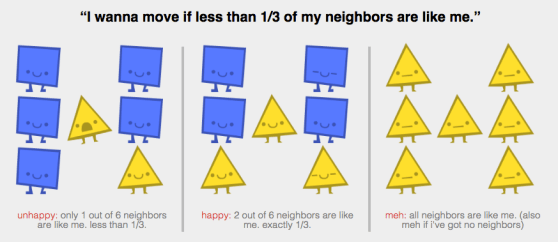
Vi Hart and Nicky Case preface their simple browser game by stating that “This is a story of how harmless choices can make a harmful world.” Hart and Case explain that the triangles and squares are “slightly shapist”. This means that the shapes prefer some level of diversity around them, but will become unhappy if they feel isolated in their community. Players are then asked to drag and drop the shapes until all of the squares and triangles are happy with the community of shapes around them.

Screen Shot 2015-03-25 at 1.28.02 PM

Click on the image to play the game

Once the player begins moving the shapes, it becomes apparent that even a slight bias will lead to large scale segregation. Continue reading

The Trial of Michael Brown

These are the facts:

Michael Brown is dead and Darren Wilson, the man who shot him, has been acquitted by a jury.

The public seems to have latched onto this, interpreting the court’s decision as being not only evident of Wilson’s “innocence” but Brown’s guilt.

But guilt over what?

The past days have seen a reversal of public opinion on Michael Brown, with many online posting gifs of the alleged petty theft he committed shortly before his death. Captions have included statements like “a reminder of who Michael Brown really was” and comments as to his size and stature.

Readers, am I the only one who doesn’t think Michael Brown should be tried over how tall he was? Continue reading

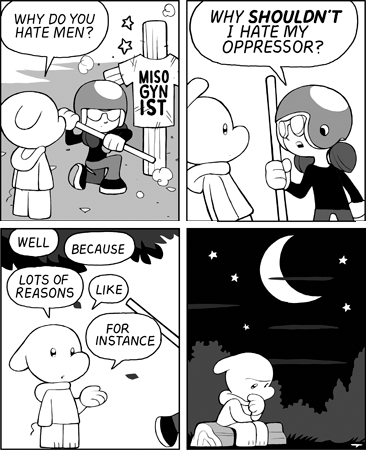
Shame Day: Sinfest and Feminism

Every day, without fail, I read three webcomics.

Cyanide & Happiness, SMBC, and Sinfest.

Here’s what greeted me when I read Sinfest today:

Sinfest: July 15, 2013.

Continue reading