Author Archives: Evan

Go Listen to “Guilty Pleasures: Art and Politics”

Two days ago Gordon and I talked about “hipster racism,” a topic he heard about via an eye-opening lecture by novelist China Miéville. The talk was titled Guilty Pleasures: Art and Politics, and discussed far more than what we were able to given our time.

A number of things: Firstly, I am not going to discuss or summarize his lecture in its entirety; it was forty-some minutes long and that would be ridiculous, just listen to it for yourself. Secondly, I am not a socialist, and much of what he was saying was through that filter. He did, after all, speak at a little something called “Socialism 2012.” I am not someone who has very strong political leanings, but I am someone who truly loves art in its many forms. The following are the three ideas he spoke about that stuck me the most.

The Artist and Their Art

Miéville, about a minute in, states that the socialist position on art and politics is this: “[socialists] do not judge art by the politics of the creator of that art.” He then quickly adds that they do so all the time anyway. I briefly wrote about this in a post about Jewish children’s author Rich Michelson. Michelson hosted a session that was largely about race and background, and how they impact audiences’ opinions of a work. Is a Jewish author allowed to write about the struggle of the civil right’s movement? And if not, then why?

The relationship between creator and his or her art is heavily debated, but its extremes are very easy to criticize. Miéville said that they’d all sat through “egregious folk music” simply because of the grounds of its sentiments expressed. Simply having a good message does not make art good. A Christian movie about the horrors of porn is not in and of itself a bad thing; having it feature ghosts [and be a clear knock-off of Paranormal Activity] is. To put it in the form of a proverb, “the road to hell is paved with good intentions.” Feel free to replace “hell” with “bad art” or “disappointed audiences.”

Guilty Pleasures

The title of his talk and what I’m the most interested in, Miéville listed different axes of socialist guilt. The third of which [17:56] he says is:

The question of quality: “I know it’s not very good but I like it anyway.” A declaration of kind of defensive guilt.

The thing is, he realizes that the statement is inherently flawed. By saying something is not very good we declare that we can make qualitative judgements about art, and this leads to questions like: “What is art? What makes it good, bad, better? What kind of social phenomenon is it?”

When it comes to television shows I have a standard rule, and that is to watch it ’till its dying days. I have watched all of The Office to date, and that is the same as 30 RockHow I Met Your Mother, and a slew of other shows. Sooner or later they begin to break down [see my first example], but I stick to them. The reason I’m bringing this up is The Big Bang Theory.

Gordon hates TBBT. He hates it because, honestly, it’s not a very good show. He often says that “nerdface” is an excellent way to describe their treatment of the characters. That being said, I have, and do [sometimes still] enjoy it. Do I feel guilty? As an English and Writing major, yes. I studied for four years to differentiate between good and bad writing. As a general media consumer and television enthusiast, yes, I still feel guilty. And, as Miéville said, I somehow defend myself by admitting to others that I realize it is not very good.

Does this justify me? I don’t think so. But beyond what it means to be good or bad, what does it mean to like?

What Does It Mean to “Like” Art?

I like the Dungeons and Dragons Monster Manual. I like the novels of Barbara Cummings [sp?]. I like Gramsci’s prison notebooks. [20:15]

None of these statements tells him anything about his relationship with each piece of art, because they’re all so distinct. What further complicates the verb is the discussion of “the art piece one enjoys disliking” [20:32]. We can like to dislike things; Justin Bieber basically encapsulates this idea by himself. While he never ends up truly defining the word, he seeks closure in the writing of another.

What follows is a piece of writing by Lady Mary Wortley Montagu, an 18th century writer, and Miéville’s response to it [34:45]:

“The pretty fellows you speak of I own entertain me sometimes, but is it impossible to be diverted with what one despises? I can laugh at a puppet show and at the same time know there is nothing in it  worthy of my attention or regard.”

This is one of the most liberating things I have ever read in terms of the cultural sphere. It is not obligatory to have footnoted opinions about everything you consume.

I read his meaning in that last paragraph as being that we need not get caught up in guilt. There should be a way of looking at what we like that doesn’t involve us castigating ourselves. I can enjoy the King Fantastic Remix of Drive It Like You Stole It without being a proponent of foul language. Likewise I can read AmazingSuperPowers, be amused, and not have to argue how high- or lowbrow its humour is. While the intent of an artist and the perceived quality of their work should be taken into account, there are times when we can simply like, or more simply enjoy, art, whatever it may be.

Why I’m Okay With The Mandarin

This is part of a multi-blog series about Race and Comic Books put together by RodtRDH. Justin Tiemeyer has written the first of many such posts [about black comic book characters] on his blog, Cavemen Go.
                                                                                                                                                                  

One of my favourite blogs [you can see it in the sidebar] featured an article sometime ago titled “On Marvel, Mandarin, and Marginalization.” The gist of said article asking why an Asian villain like the Mandarin is being portrayed before any Asian American lead heroes. I’m going to start my defence with the quotes racebending.com used:

“There are certain fears and certain strengths the character evokes that are applicable, but of course you have to completely remove any of that short sighted cultural ignorance that leads to any sort of bigotry in the storytelling. That isn’t to say those fears and shortcomings of Iron Man as relating to that character aren’t relevant…He was based in China which was then mysterious because it was Red China. Today China is mysterious in other ways because it’s Global China.”

– Jon Favreau, director of Iron Man and Iron Man 2 to CHUD in 2006

“You have to do The Mandarin. The problem with The Mandarin is, the way it’s depicted in the comic books, you don’t want to see that.”

– Favreau again, to MTV in 2010

“The Mandarin is a racist caricature.”

– Iron Man 3 director Shane Black at Long Beach ComicCon, October 2011

I’m not going to skirt around the fact that the character was indeed rooted in the “yellow peril” that was rampant at the time of his inception, but the following images should paint a picture of his evolution since that time.

From left to right: The Mandarin as he first appeared in the 60s, then the 90s, and the present day.

Continue reading

The Marvel Cinematic Universe Moves On [Without The Black Panther]

We all saw The Avengers; let’s not lie to ourselves here. It’s the third highest grossing film of all time, and we are the reason for that. As of earlier this month Joss Whedon was confirmed as returning to direct the sequel, with the film due to hit theatres on May 1st, 2015.

With a bit of a wait between movies, a buffer of films is currently in the works, including sequels Captain America: The Winter SoldierThor: The Dark World, and, probably the most highly anticipated, Iron Man 3. Also on the docket is the spacefaring super-group Guardians of the Galaxy.

All of this news pleases me. What’s problematic is that when researching this article I found out that the Marvel Studios have a model of “releasing just two films per year.” So let’s see what we have here:

  • Iron Man 3 – May 3rd, 2013
  • Thor: The Dark World – November 8th, 2013
  • Captain America: The Winter Soldier – April 4th, 2014
  • Guardians of the Galaxy – August 1st, 2014

With those four films taking up the next two years a horrifying fact emerges:

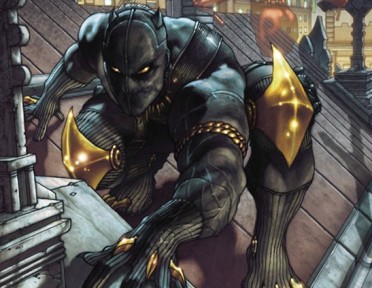
Marvel will not be making or releasing a Black Panther film before the next Avengers movie comes out.

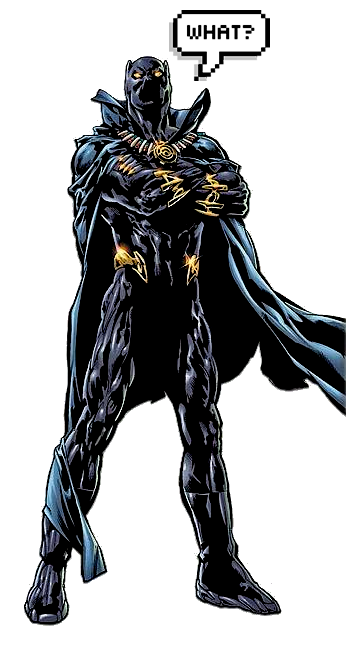
Let me back up a little. Black Panther is, as comic book fans know, T’challa, the king of the fictional African nation of Wakanda. It is an extremely technologically advanced country, and the character himself has a PhD in physics, as well as being a master hunter, martial artist, inventor, and politician. On top of that he wears a suit made of vibranium, the same stuff Captain America’s shield is made of. He’s like if Batman were also the president and he is awesome.

Adding the Black Panther to the Avengers’ roster is not only has precedence in the comics, but it would also add the much-needed diversity that the first film was so sorely lacking. Marvel Studios co-president Louis D’Esposito discussed the possibility of a film starring the Wakandan king by admitting that:

“He has a lot of the same characteristics of a Captain America: great character, good values,”

Which is true. But he doesn’t stop there, going on to say :

“But it’s a little more difficult, maybe, creating [a world like Wakanda]. It’s always easier basing it here. For instance, ‘Iron Man 3’ is rooted right here in Los Angeles and New York. When you bring in other worlds, you’re always faced with those difficulties.”

Cue outrage from fans everywhere. The general argument against the statement above being that a sizeable portion of Thor took place in Asgard. Asgard, the mystical dwelling of the Norse gods. But playing devil’s advocate, as I try to do, perhaps Marvel execs are afraid of portraying Africa badly. Counterpoint: Wakanda is a pretty well-to-do place. Point: maybe they’re afraid of portraying the continent insincerely? Counterpoint: it’s a comic book movie. Point: but, but, but . . . Counterpoint:

Those eyes sneer at D’Esposito’s claims.

Djimon Honsou is a number of things. An immensely talented Beninese American actor is one. The guy everyone wants to play the Black Panther is another. Honsou actually voiced the character for a short-lived TV series on BET which was essentially a motion comic.

Honsou himself has said in a 2010 interview with MovieWeb.com that:

“It is true that I have said certain things about it some time ago and that I would love to play the Black Panther. Also the opportunity came to do the voice over for the animation so I did that, maybe in the hopes that one-day they would finally get around to doing a movie. We have so many super heroes, but none that really defines the African American. I thought it could definitely happen and I have tried to push that envelope before.”

And if that wasn’t enough, Stan Lee himself is on the record as answering the question “What obscure characters would you like to see adapted into a big budget film?” in an AmA [Ask Me Anything] on reddit. His answer was this:

“Black Panther. He’s not too obscure, I hope.”

If the fans, the actor, and Stan “The Man” Lee [who also co-created the character] are all pushing for this there’s really no reason it should not or cannot happen. All that’s standing in the way are a bunch of executives too willing to take the way that’s “always easier.”

Evan and Gordon Talk: The Bechdel Test


EVAN:
So I came across a little something called the “Bechdel Test” through an article on racebending.com. It’s a test that’s supposed to rate how well a film does in terms of portraying women. That’s a rough description, anyway.

GORDON: I’ve heard of it in film criticism. It essentially asserts that for a film to have “real” female characters, it must have a scene in which (1) two women (2) talk to each other (3) about something other than a man. Sounds simple enough, but you’d be blown away by how many movies fail it…

EVAN: And the thing is, some of these movies happen to have perfectly good “strong female characters.” The site bechdeltest.com lists films that do or don’t make the cut, and in the comments section many a person states “but this female character was such and such…”

GORDON: Example?

EVAN: User “lili” disagreed with the rating given Wrath of the Titans, saying:

Although conversation between the two named women was minimal, the character of the main woman was well developed with no sexual stereotyping or weaknesses. I think it passes the Bechdel test in spirit, if not in actual letter.

GORDON: See man, as much as I’d consider myself a feminist, I really don’t like the Bechdel Test and some of the assumptions it seems to make. A lot of it just really doesn’t pan out- I’m looking at the list they’ve got here, and it’s seriously twisted.

Check it out- Sex and the City 2- easily some of the most misogynistic and racist crap out there gets a free pass, and movies like The Rum Diary or Rise of the Planet of the Apes– which have way better portrayals of women- are failed…

EVAN: I mean, it’s easy to see why their criteria was picked- having the women named is extremely important, as it’s a pretty solid way of ensuring that they’re actual character and not just waitresses or other extras. Also having them talk about something other than a man. That’s pretty important stuff, I think, in maintaining that they’re not just female verbal support for the male lead.

Where it really falls apart is the second part of the test: the need for the female character to have to talk to each other-

GORDON: I don’t think you’re being quite hard enough here, dude- this is a bad test. Look at it this way-

The first criteria is that there be two women, which is dumb because it assumes that a woman’s identity is based on how she relates/matches up with/differs/etc. with other women. Totally disregards her qualities (or failings) as an individual, y’know? The second criteria is, like you say, that they have to interact which each other, which again doesn’t make much sense (see previous point). And the third point, while decent, also kinda falls apart- if two men talk to each other about nothing but women, are they not real male characters? Kinda throws relationship movies out of the window.

…Point is, the test sorta shows you when a movie drops the ball on female characters, but a “passing grade” doesn’t really mean much of anything.

EVAN: I agree with you completely. Part of the reason I’m a little less harsh is thinking about how to construct/write a single test which judges a film on something as deceptively simple as the “active presence of female character,” as Feminist Frequency would put it.

GORDON: Well, what makes a female character a female character?

EVAN: Well, I took Human Sexuality my senior year of college, so I can think of a few key specifics-

Continue reading

Nolan, Jefferson, and The Batman

Keep on reading, this’ll make sense.

In the year 1820 Thomas Jefferson shared with a number of his friends a book
he had put together entitled The Life and Morals of Jesus of Nazareth. It was, in essence, the four gospels [Matthew, Mark, Luke, and John] in chronological order. What truly differentiated it from the Bible was the omission of all references to angels, prophecy, references to Jesus divinity and resurrection, and miracles.

In the year 2005 Christopher Nolan’s film Batman Begins made its way into theatres, spawning a trilogy and getting the ball rolling for dozens of “grim and gritty” remakes. In an interview with The Guardian the director said that he “[tried] to do it in a more realistic fashion than anyone had ever tried to [do] a superhero film before.”

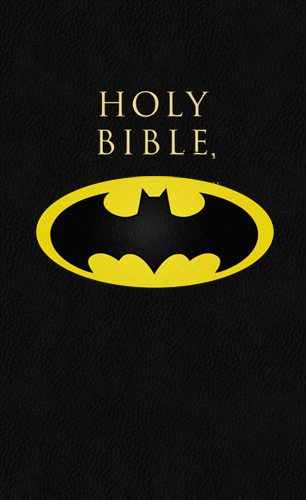
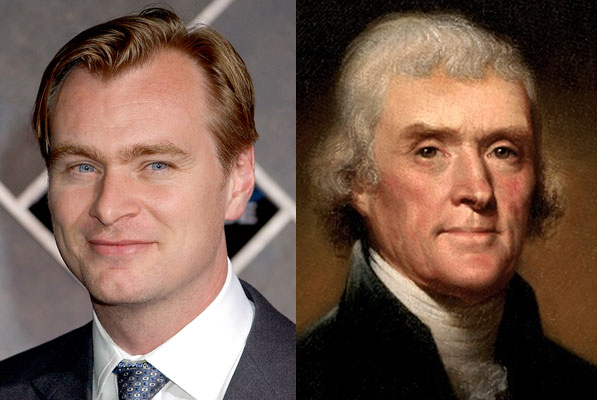
The parallel I’m trying to make should be obvious to any Batman fan, either of the comics or the animated series. Having finally seen The Dark Knight Rises this Tuesday and finishing the trilogy, I can finally say this with confidence that Nolan has done to the Batman canon what Jefferson did to the Bible.

These two men have something against the improbable.

To make things clear, I like Nolan’s Batman movies. He took a concept as seemingly ridiculous as a vigilante crimefighter who dresses up like a bat and somehow grounded it. On top of that he forced us to accept the fact that comic book movies can be more than entertaining, they can be awe-inspiring as well.

An issue that I had with Christopher Nolan and his films was the staunch inability to embrace anything even vaguely fantastical. The problem with that being that the concept is, as I just mentioned, a vigilante crimefighter who dresses up as a bat. With that in mind, maybe the imagination can be stretched just a little more to accommodate a psychopath whose makeup can’t wash off, or a badly scarred man with a deeply split-personality.

Furthermore, by thinning the line between reality [that of the audience] and art [the film being watched] questions are forced to arise. If this is the real world, why didn’t the kidnapping of a Chinese national from his homeland spark an international debacle [The Dark Knight], and <SPOILERS> how is Bruce able to make the jump to escape the prison given the damage in his legs [The Dark Knight Rises]? The films lower our suspension of disbelief, and with our guard down we become quick to ask why.

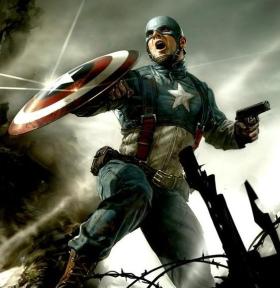
In his film Captain America fought pseudo-Nazis with energy weapons and tanks as large as houses. The audience never questioned this because although the film had some sort of anchor in a real-life event [World War II], we still understood that this was a world with one foot in the fantastic. If we can believe that a scrawny kid from Brooklyn ingesting a “super solider serum” can help the Allies win the war then we can just as easily believe that Hitler’s “deep science division” is led by a man whose face looks like a red skull.

Taking the “magic” out of the Batman mythos was no easy task, and Nolan threw a lot out when he decided what his approach to the canon would be. Scarecrow’s fear gas got the go-ahead, but not the Joker’s laughing gas, or the Venom that Bane uses to grow stronger. Batman could be called by name, but not Catwoman. Batarangs can be seen, and used, but the Batmobile must be free of any visual associations with the character.

Nolan was free to pick and choose what he wanted, and in many ways simply used Batman and his world to tell the stories that he wanted to tell. This is somewhat lost in the third film due to its connections to actual events in the comics [Knightfall and No Man’s Land, though that’s a post for another time], but for the most part he co-wrote the stories and screenplays for all three films. In another interview he states that “I don’t think our Batman, our Gotham, lends itself to that kind of cross-fertilization,” in response to a question about heroes co-existing between films akin to the Marvel Cinematic Universe.

Having stated that, I must admit that I have to view Christopher Nolan’s trilogy of Batman films as- something else. Something not Batman. Batman would never kill purposefully [letting someone die, Batman Begins], accidentally [tackling Harvey Dent, The Dark Knight], or not react to the deaths of others [all throughout The Dark Knight Rises]. I guess I view them as Batman movies about as much as I view the apocrypha part of the Bible. They can be good, and even beneficial, but ultimately miss the mark somehow.

Albert Brennaman, the Patron Saint of White Dancers

I know you’ve probably seen it, but I’m starting with this: 

Arguably one of the most memorable films of 2005 [tenth highest-grossing that year], Hitch wormed its way into our hearts due to a number of reasons. First and foremost was Will Smith, but trailing surprisingly close behind was his co-star, Kevin James, and the bumbling Caucasian everyman he represented.

Now, I’m not one to perpetuate racial stereotypes; I’ve had too many people assume I like rice just by looking at me. But here’s the thing: I Love Rice. As much as many of us would hate to admit it, stereotypes typically have some kind of truth to them. The one I’m writing about today is one many of you have probably heard, and that is that:

White People Can’t Dance.

This is a truth I’ve come to more or less believe due to personal experience. The first piece of evidence being found in college dances I attended [student body 95% Caucasian]. The second was while working at a nightclub a few years ago. A group of four to five white people in their late 20s/early 30s came up to the floor I was busing, and it. . . wasn’t pretty.

Bringing this back to the beginning, what I’ve found is that a lot of the aforementioned not only love that clip from Hitch, they live it. In the most literal sense. Many know the dance by heart, and at parties moves like “the Q-tip” actually make an appearance. The character of Albert Brennaman has been lifted up to this odd place of veneration, his dancing a guide and example for others.

To put it simpler, they are proud of the way they move. There’s no shame there, and they’ve owned the fact that for the most part others don’t think they can dance. Without that social buffer of potential embarrassment, they unknowingly keep the stereotype alive. It’s a vicious cycle, and one illustrated in the equation below:

“White People Can’t Dance” —> white people dance however they want —> white people can’t dance

I’m not judging, it’s just a cultural observation. For an ethnic group to take pride in something they’re not good at is a strange thing, sort of like if Asians decided to own the stereotype that they’re bad drivers. In this case, however, no one is at risk of getting hurt. One group is content to move however they please, and the other is more than happy to sit back and watch it happen.

I leave you with an uncomfortable clip of white people dancing to “Take On Me.”