Category Archives: bizarreness

The Horror, The Horror

Today, I’m going to talk about horror.

Not “frightening stuff,” mind you- horror. There’s a distinction, you see.

Fright is the simple biological jolt you get when something startles or surprises you- a door being slammed, a discordant note blaring out of nowhere, and so on. Tragically, the title of “horror” gets slapped on things (typically movies) that merely have “jump-scares.” Horror on the other hand, is anticipation and dread at the perception of something threatening on a fundamental level.

So why talk about this? Because despite the outcry of some, horror- especially horror movies- holds a special place in our culture. Indeed, horror holds a special place in all cultures, and has since the first Cro-Magnons huddled around some arctic fire and whispered about strange and terrible things lurking just outside the circle of light. What we’re afraid of tells just as much about us as what we admire; a perfect example being Evan’s post on the remake Red Dawn. Evan cites that one of the reasons the new version doesn’t work is because the concept of the US being invaded is today laughable (especially by North Korea, whose entire population could fit into LA county with room to spare), whereas in the 1980s, the fear was far more realistic, or at least, believable.

Now I’m not here to analyze the past decade’s better horror movies and tell you what it is that we seem to be afraid of (not right now, anyways). In this post I’ll just be breaking down the three basic kinds of horror we seem to be responding to.

Fear For Self

First, we have the fear that attacks our egos- not “egos” as in pride, but “egos” as in the psychological term for you. This fits into the greater psychological element of “external anxiety,” meaning the stress we feel as a result of outside factors, such as school, our jobs, hunger, pain, and so on. When we’re afraid for our safety, or empathizing with characters in a movie or TV series who are fearing for their physical safety, we’re looking at this “fear for self” kind of horror. A good example would be any serial killer or monster movie- Psycho or Jaws being the best examples. Now usually we tend to botch this kind of horror, because the protagonists in movies or stories do things we would never do (blonde female college camper running through the woods at night, I’m talking about you). However, when it’s pulled off well, it leaves a noticeable mark on us. It has been said that Jaws created a significant drop in beach-goers after it was released, and you are a dirty liar if you say you’ve never once looked behind the curtain when you go into the bathroom.

Fear Of Self

Just as we have anxieties that stem from external factors, we have stresses and fears that come from within us: “Internal anxiety.” It was theorized by early psychologists, Freud in particular, that our mental issues were a result of us denying or repressing elements within us, most notably the “id”- that part of our mind with all the bloody, vicious, sexual animalistic drives that typically didn’t mesh well with Victorian (or any) society. As with the ego, horror works on this pathway as well- our fear of ourselves. All that madness and evil that we, for the most part, pretend isn’t there. The most obvious examples of this would be werewolf movies and vampire movies (obligatory “**** you, Twilight“) and most any film depicting a change or evolution the protagonist- see Dr. Jekyll and Mr. Hyde, The Wolfman, Dorian Grey, etc.

Fear Of No Self

Lastly we have stress and anxiety attacking (or coming from, depending on how you look at it) the “superego”- that element of our mind consisting of our real or imagined nobility, propriety, decency, etc. Here we encounter “existential horror,” more often called “cosmic horror.” This particular form of horror can be found in movies where the protagonists are fighting a losing battle against some massive, all powerful being- typically otherworldly in nature. Alien invasions and zombie uprisings are both good examples. Here we’re confronted with the fear that we are, in spite of all of our strength, morality, charity; in spite of our humanity, we are actually inconceivably small and insignificant. Ants who have just become aware that there are beings in the universe of incomprehensible magnitude whose simple existence negates everything about them. That unique feeling of powerlessness is separated from “ego fear” in that this form has a distinct hopelessness, rather than helplessness, attached to it.

Of course, every horror story has all three of these elements in it, but what kind of horror story it winds up being depends entirely on what is emphasized. Take AMC’s The Walking Dead– you’ve got your physical fear of the zombies, your id-based fear at what this new world is bringing out in you, and the general horrific despair at the absolute hopelessness of your situation, both in the face of zombies and the truth of human nature. What you wind up being afraid of depends on which element really gets pushed (survival, rationality, hope) and of course, what you individually, and we as a society, find most terrifying.

So what do we fear as a society right now?

Well, with the rampant popularity of zombie stories, and “disaster” films such as Cloverfield, Skyline, and even the whole “Slenderman” craze; it seems to me that we’re torn between physical and existential horror. And perhaps in an economic depression, that’s understandable- after all, we’re confronted with the physical job of keeping afloat in a rough time, and as the crisis drags on and on, the general feeling of hopelessness with regards to our general situation. We respond to characters whose immediate needs are threatened and characters who are struggling to maintain themselves in the face of cosmic nothingness.

At least, that’s my take on it. Feel free to debate me in the comments, and stop by tomorrow for another Shame Day installment.

Where I Try to Explain Red Dawn

I’ve begun seeing trailers on TV, and apparently it hit theatres two days ago, so I figure now’s as good a time to talk about Red Dawn as any.

For those of you who don’t know, Red Dawn is a remake of the 1984 film of the same name. In the original the United States is invaded by both the Soviet Union and its Cuban allies. A group of plucky high schoolers bands together to form a guerrilla fighting force, named the Wolverines after their high school mascot.

In remaking the film the studio, Metro-Goldwyn-Mayer (MGM), realized that they needed to modernize the invaders in light of the current political climate, and chose China. Keep in mind that in the original film that country was apparently America’s only ally, with the following exchange taking place:

“…Well, who is on our side?”
“Six hundred million screaming Chinamen.”
“Last I heard, there were a billion screaming Chinamen.”
There were.”

Production was going smoothly until the summer of 2010 when the Global Times, a Chinese state-run newspaper, got a hold of leaked excerpts of the script. This prompted such headlines as “U.S. reshoots Cold War movie to demonize China” and “American movie plants hostile seeds against China.” In early 2011 the LA Times reported that the film’s villains were changed from Chinese to North Korean to “[maintain] access to the Asian superpower’s lucrative box office.Continue reading

Shame Day: Black Friday

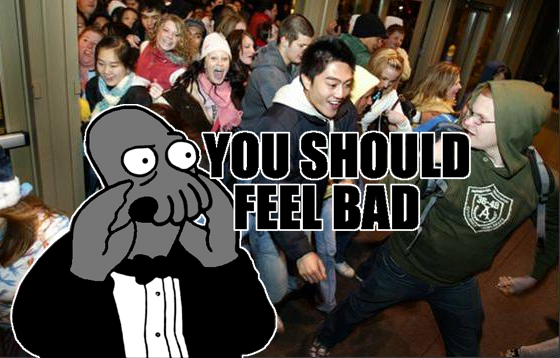
I almost don’t feel like I should have to explain this post. Look at that image on the right, look at that wave of flesh and hunger, which I can only compare to the somewhat recently released World War Z trailer. They move like an organism, a living being that flows into each store, ravenously grabbing at whatever they can.

For the non-Americans among you, Black Friday is the day after American Thanksgiving, which sets off the Christmas shopping season. Last year at this time a few pretty significant events happened, none of which I can say are positive.

The first recorded death from the event happened in 2008, when an employee, once again at Walmart, was literally trampled to death by a wave of shoppers. The stampede could not be halted when other employees tried to help their coworker, and even police who arrived at the scene were shoved and pushed back.

Honestly, I don’t even know what else to say.

Every year the sale begins earlier and earlier, and for a while it was normal for shops to open at 6:00 am. Last year many retailers opened at midnight for the first time. Now, on Black Friday 2012, Walmart [again] and several other superstores have announced that they will be opening their stores at 8:00 pm Thanksgiving Day. This has prompted a very understandable call for a walkout among workers.

If the trend continues this image won’t even make sense anymore.

As a Canadian I’ve celebrated American Thanksgiving only once. It was a time that I spent with a loving family, where copious amounts of food was served and the itis was experienced by many. It was a time of relaxation and enjoying each other’s company, not camping outside superstores in the freezing cold or trampling the meek and lowly [see: Walmart employees] underneath our feet.

All I can say is Happy Thanksgiving, Americans. If you care about at least one retailer [Target] respecting a national holiday, you can sign a petition here. Enjoy your turkey.

Fame Day: Frank Gilbreth

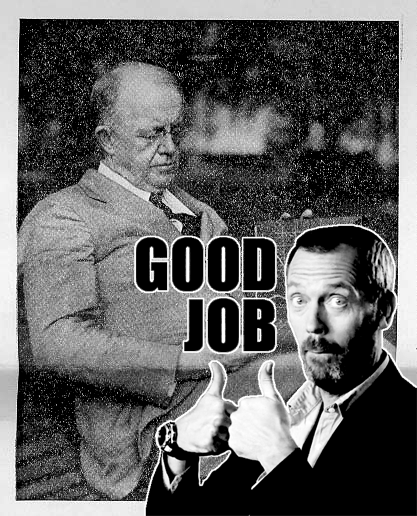
Last week I wrote about George Romero, a film-maker who has had perhaps one of the most profound influences on modern culture. Continuing in that vein, today I’d like to stir up some applause for Frank Bunker Gilbreth, Sr., or as you might better know him, the dad the Cheaper By The Dozen movies.

Now if you’ve seen any of the films, you’ll see the father of the twelve kids hopelessly overwhelmed until the family finally remembers that they need a happy ending to appeal to the widest possible audience causing them to get back together in the last ten or so minutes of movie. Truth is, the actual Frank Gilbreth was an excellent parent who took care of his twelve kids as best as could possibly be expected. How did he manage that? Well, it turns out Gilbreth was an expert in the study and application of efficiency, and applied his unique brand of training to his own family, as well as the workplace. Gilbreth was obsessed with reducing the steps every action took (which he named “therbligs,” reversing his own last name). For example, eliminating the “therblig” of having to search for your razor by having the razor painted bright red, making it easily noticeable. Things such as more efficient guns, pedal-operated trashcans, and arguable the entire study of ergonomics all owe a great debt to this man. But that’s not the big thing.

You ever see a nurse handing a surgeon his tools while in the middle of an operation?

Frank Gilbreth Sr. came up with that.

You ever see a soldier or spy blindfolded, reassembling his gun?

Frank Gilbreth Sr. came up with that too.

Think about that. How many lives have been saved and ended because of this guy? The guy died in 1924- think about all the expansion that’s happened in medicine and warfare since then. Think about all the people who have died or been saved since then. Heck, there’s a decent possibility neither you or I would exist without this guy’s work.

And his legacy is a terrible Steve Martin popcorn movie?

Ladies and gentlemen, if you will, a moment of applause for the real Frank Gilbreth.

Evan and Gordon Talk: Adventure Time‘s Artistic Merit

DISCLAIMER: This week we kind of dropped the ball, so our discussion on the topic is short and then turns to how WE can write this feature a little better. Our apologies.


GORDON:
 Dear faithful and fanatically devoted readers, before we begin, I’d like to give a shout-out to my buddy Pat Noble, socialist candidate for the Board of Education in Red Bank, NJ, who has just been elected. Nice going, comrade!

And now back to the subject of the night: Is there artistic merit in Adventure Time?

EVAN: Whoa. You’re gonna shameless-plug your friend and then let me discuss the topic? Say something about it, haha.

GORDON: Is there artistic merit in beloved Cartoon Network show Adventure Time? Well, let’s break down what we mean by “artistic merit.” Evan?

EVAN: Is it worthy or deserving of being called art? Alternatively, does the show have the admirable qualities or attribute that art has? I guess a question to answer your question is: What is art?

GORDON: Well, let’s not try defining “art”. We’ve been trying to do that ever since we first started scratching pictures of fat ponies onto cave walls, and I doubt we’re gonna solve it in the next half hour or so. Let’s instead focus on the “merit”- what is it that makes ANY show good?

EVAN: Here’s a factor that relates directly to Adventure Time: Accessibility. How accessible does a show have to be to be good? Does it have to be accessible to be good?

GORDON: Are we talking about mass appeal here?

EVAN: Eh, sure, why not.

GORDON: Well, we gotta address that then. I mean, Twilight and the work of Michael Bay are popular, but they aren’t good. At the same time, you can’t just have a show that only you find funny, and then still call it good, right?

EVAN: You’re right. So is there a magic number of people we have to reach when it comes to a show being good? I shudder to remember Tim and Eric Awesome Show, Great Job! and how much our one friend used to love it.

GORDON: What’s worse is that my dad is into that show for some unfathomable reason. But the point is, a good thing ought to be popular to some degree, but popularity can’t be the sole element.

EVAN: Okay, so how about execution? How well the show pulls off whatever it’s supposed to be doing. Adventure Time is a show about a boy and his magical dog that is also his brother adventuring in a colourful post-apocalyptic fantasy world, but it works. They pull it off. I personally think this has a little something to do with its easy-to-digest ten minute segments.

GORDON: And there’s really no way of arguing with that- the story-telling is spot-on, but there’s gotta be more than that. The same can be said  (and this is gonna give Evan an aneurysm), to some degree, of the copy-paste work of Seth McFarlane.

EVAN: Wait. What. What are you saying. What about Seth McFarlane and his horrible, horrible television.

GORDON: What I’m saying is that McFarlane’s shows are both popular and (for what they are) well-executed, and yet we can both agree that his shows aren’t really “good,” at least, not anymore than a bag of chips is “good” food.

Therefore, there’s got to be another element at play, right?

EVAN: Ugh. I can’t even look at the chat window I’m so offended you would say something like that. I wish he would be “well-executed.” Share your other element if you must.

GORDON: Uniqueness. The show has to be unique. It’s not enough to go through the motions (as McFarlane’s shows do), you have to actually be able to make your show something that can’t be seen anywhere else.

EVAN: Something to make your stuff stand out of the crowd, okay, that’s fair. So I guess we can see how Adventure Time stands up to the criteria we’ve come up with.

  • Accessible? Eh, I’d say so, for its demographic and older.
  • Popular? Yeah, again for who I’ve stated.

You want to let these nice people know if it’s unique?

GORDON: Soooo Unique. If you can find anything remotely similar to it made in the past decade, I will slap Evan on the ears and vote for taxing the homeless.

EVAN: I mean, like I said: Boy. Magical Dog. Colourful fantasy world that is also post-apocalyptic.

EVAN: What more could you want?

GORDON: Vampire rocker girls?

EVAN: I would not mind.

GORDON: Oh wait, we’ve got that too.

You want D&D references spliced in with Science Fiction and elements of Gothic Horror?

EVAN: I think we could go for some.

GORDON: WELL WE’VE GOT IT!

EVAN: I think it’s clear that we think Adventure Time is a good show, but one thing that’s been painfully clear with this entry of E&GT is how much trouble it’s been doing this. Might I suggest a little something?

GORDON: Go for it.

EVAN: Let’s just choose our own topics for a little while, just to really get back into the swing of things. Keep things casual, going back and forth, avoid the heavy questions. And then we can ease our way back into all this.

GORDON: I am inclined to agree with you on this one.

EVAN: Yeah? Awesome. Anything in particular you wanted to casually discourse about next time?

GORDON: Well, I don’t think my suggestion about the Disney takeover of the Star Wars franchise was all that bad, even if Adventure Time did win by a landslide…

EVAN: I kinda wanted to talk about Deadliest Warrior.

GORDON: That would be likewise awesome. Let’s do that.

EVAN: Yes. Awesome. I’m going to post this because we are men true to our word and we promise an E&GT every Wednesday. We shall discuss Deadliest Warrior in a week. Or this weekend, maybe, just to get ahead. I mean, whatever.

GORDON: Good night, everyone.

EVAN: Yep, sorry this wasn’t as awesome or decent as usual. But we will be back! With a vengeance. And remember:

Shame Day: Greg Land

As you probably know by now, comics are very important to me. It’s good art and good writing coming together as one, the creation of a medium that’s unique among all others. The ideal combination is a skilled creative writer coupled with a hard-working, attentive artist. This pairing doesn’t always happen, though. Sometimes a writer is forced to work with Greg Land.

If you type “Greg Land” into Google the second search result that comes up is the site known only as “LAAND!“, though the name of the url more than makes up for the possible vagueness. The site is a tumblr dedicated to the man’s “generally bad artwork and the sexist ethical repercussions to hiring him nowadays.”

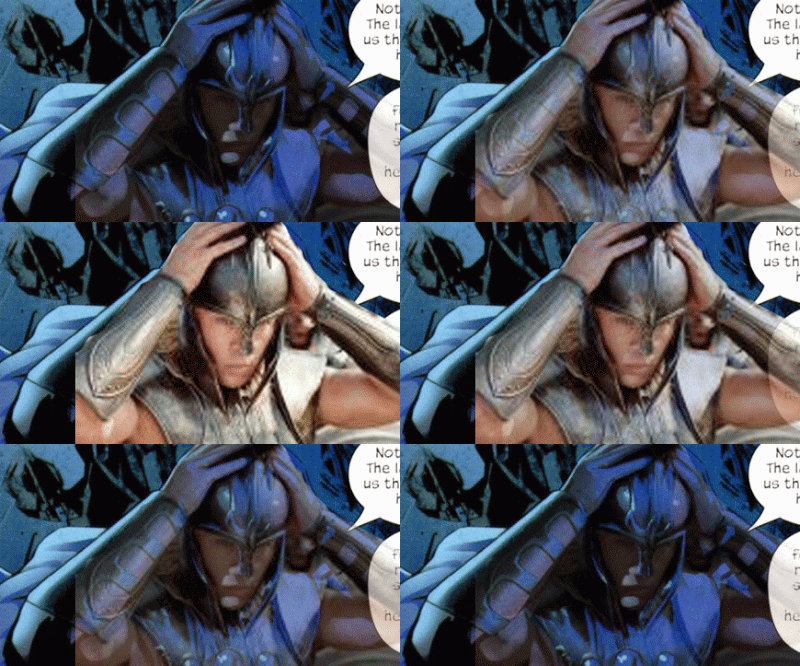
To put it plainly, Greg Land doesn’t draw, he traces. This isn’t all the time, but the fact of the matter is that he does it so blatantly and conspicuously that it is impossible to ignore. The following gif will do more to convince you of this than a thousand pages of my writing.

There is seriously no ignoring that. Clicking the image links to the blog JIMSMASH!!! which catalogues many, many more instances of his copycatting. Another fantastic gif’d example is one where, and this is practically mindblowing, Land rips off of himself. The image on the right transitions back and forth between Jean Grey and Black Canary, both drawn by Land [and for competing companies, too].

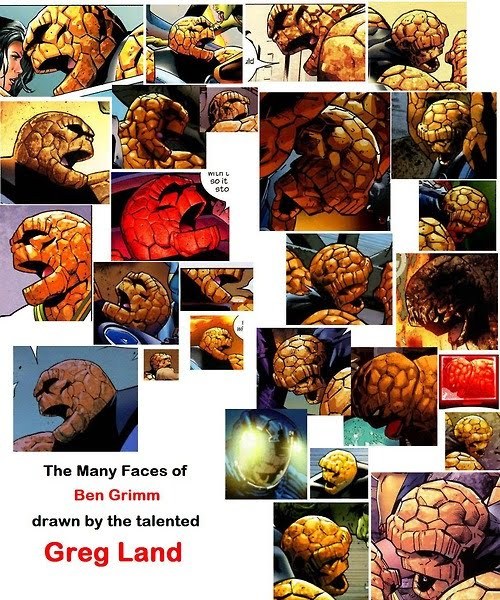
Here’s a pretty great image. It’s “The Many Faces of Ben Grimm drawn by the talented Greg Land.” He is a man who knows how to recycle.

Now all that I’ve mentioned is pretty atrocious, but here’s where it gets unbelievably worse. Observant comic fans have noticed that a lot of his references appear to be directly taken from porn films. There isn’t an argument more convincing than this picture:

What’s most upsetting [and there is a lot to get upset about] is that Greg Land continues to get work.

Marvel NOW! is the company’s decision to take their best titles and switch around talented writers and artists, creating combinations that will take their characters in new and exciting directions. Somehow Greg Land was assigned to Iron Man with writer Kieron Gillen who had this to say about him: “That’s the thing with Greg Land: his photorealistic style really pops and it’s a glamorous book in that way.”

That’s the thing, Kieron. They look photorealistic because he has traced actual photographs.

And right away, with our first look at the book’s interiors, we can already see that Land has ripped off of photos of a cosplayer, and from actually talented artist Adi Granov.

The saddest part is, Greg Land doesn’t even really know how to draw people anymore. His knowledge of anatomy is paltry at best, as helpfully illustrated in the post “Hips Don’t Lie: Pelvis? What Pelvis?” He may have been a legitimate artist once, but he’s traced so much and so often that when he does draw something freehand he can barely recall how to.

I understand that deadlines need to be made, and that in the world of comics this is not always easy to do. That should be taken into account, but this has gone on for so long it hardly stands as a defence. Greg Land should feel bad. His work is absolutely nothing to be proud of.