Tag Archives: university

The Last 3 Books That Made Me Cry (And Why You Should Read Them)

I love getting lost into the world of a book. You know how it is when you can’t handle taking a bathroom break or stopping to eat lunch because it might mean tearing your eyes away from the page? Luckily, as an English major, reading is a big part of my learning experience. Not every book I’ve been assigned to read has been my style, but some of those books have been so good that they sucked me deep into the story until the next things I knew, tears were streaming down my cheeks.

For the sake of this article, I won’t be focusing on all the books I’ve read over the past year. If you want to read a fantastic overview of a wide span of books, I suggest you check out Evan’s 2014 Literary Awards. Instead, I want to share the last three books that made me cry, and, more importantly, I want to discuss the larger issues that make each of these three books valuable reads.

Each of these novels engages with what it means to live in a post-colonial world. In each story, it quickly becomes apparent that the horrors of colonization do not simply end the moment government policy changes.

While I will avoid any key plot points in these books, I will be alluding to general context around the books. If you prefer to go into your reading experience with a blank slate, I should warn you, Spoiler-ish content below.

Wide Sargasso Sea by Jean Rhys

Generally regarded as the post-colonial prequel to Jane Eyre, Wide Sargasso Sea opens in Jamaica, shortly after the abolition of slavery. Rhys’ protagonist, Antoinette, comes from a family of plantation owners who were brought to financial ruin by abolition. As a child, Antoinette struggles to understand what separates her family from the rising class of British capitalists.

By writing from the perspective of a child on the wrong side of history, Rhys prevents any oversimplification of her narrative. She also challenges the idea that colonial injustice somehow ended when slavery did.

Rhys’ strong narrative style creates a story that will immediately pull you in, but her imagery and carefully thought-through word choices create layers of meaning that make this novel much more complicated than it appears at first read. While it initially seems to be a Gothic Romance, Wide Sargasso Sea also explores a variety of important questions around race and gender. Continue reading

Not Strictly Literary: 6 Unexpected Subjects You Learn About in English

I’m currently in the last year of my English undergraduate degree. Well, kinda. I will probably have to do an extra semester to finish off my credits completely, but after next semester I will have finally finished all my English requirements.

Like many students, I kind of fell into my major. In my first year of full time studies I was seriously considering a degree in economics, or anthropology. Until I took a class in those subjects and quickly changed my mind. Once I started figuring out what kind of classes I actually liked, I started talking about doing my degree in Sociology, Political Science, or Environmental Ethics. Then, when I transferred to UVic, I decided I would take their writing program. Well I thought I was decided, until I was invited to join the English Honours program. That invitation totally went to my head and I dropped everything in order to pursue that (very structured) program.

Because of the number of required English classes (and because I blew many of my elective classes during first year), I’ve been taking pretty-well only English classes for the last two years. During that time, I began to ask myself if I had made the best choice. After all, English is really just reading books, isn’t it? Couldn’t I do that in my own time?

Ah, reading for fun/relaxation. Can’t wait until I get to do that again.

Now that I’m getting close to the end of my degree, I’m able to look back and be thankful for (almost) all of the English classes I needed to take. Yes, I still feel like there are a million others I wish I could have taken, but I think I would have felt that way regardless of my major. There are more fantastic courses out there than what you can possibly fit into one undergraduate degree.

Getting close to the end has also allowed me to reflect on the many English courses I have taken and realize just how broad a range of subjects they actually address. I’ve included a few examples below.

Linguistics

Screen Shot 2014-12-08 at 10.32.54 AM

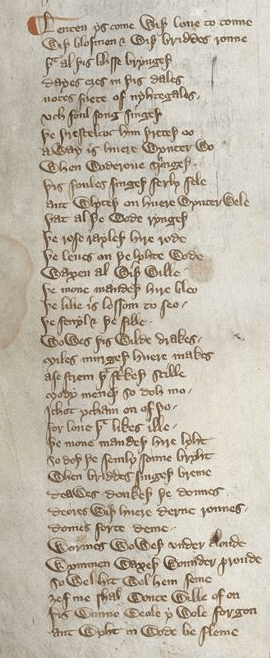
One of the texts we are translating for our final project.

I’m currently finishing off a class on Middle English that I did not want to take. Not at all. I’m required to take a class in early English literature, so I chose this class after a friend recommended the professor. I was then pleasantly surprised to find that it was a fantastic class. It was also not at all what I was expecting.

English has evolved considerably since the 12th century, so it’s hardly surprising that trying to read Middle English texts is like reading an entirely different language.

At the beginning of the class our professor touched on many of the other languages that have influenced the formation of the English language. Then, as the class progressed, a lot of the work we did in class involved translating various works. The translation process required a basic understanding of how to parse language, something I had almost no experience with. Like many English speakers, sentence structure is something I know intuitively, not something I’ve intentionally learned. However, if my experience in Quebec this summer taught me anything, it’s that knowing how to break down language is key to learning a new one. So I’m hopeful that the linguistic skills I’ve been struggling to learn in this class will help me with my future language learning goals. Continue reading

12 Things I Wish Someone Told Me Before I Went to University

I’ve spent several years blundering through the university system. It’s only now, in my fourth year, that I’m beginning to feel like I have a clue how anything works. Alas, it is too late for me to take full advantage of this knowledge, but I thought perhaps I could pass on a few words of wisdom before it’s all over.

You know what they say about sharing…

Below I’ve included a list of things I wish I had known before I started. I wasn’t sure if I was the only one who had no idea what was going on for the first few years of their education, so I also posed the question to Reddit. I’ve included several of their excellent responses below.

1.Know What You Want to Do Before You Start

I know a lot of people who felt pressured to go to university straight out of high school. Then, once they made it to university, they had no idea what program to take. There are seriously A BAZILLION options. I worked for several years after high school, so by the time I started my undergrad I thought I had developed a game-plan. Even then it definitely wasn’t specific enough. I was so
overwhelmed by the number of choices that I ended up taking several courses that had nothing to do with my degree.

Redditor wolf2600 also suggests having a program, or even a career, in mind before choosing a school:

“Don’t choose a school/major on a whim. When deciding on a school/program, go to the school’s website, find their college catalog, and see what courses are offered in the department (along with their descriptions), and also what courses are required for the degree. Majors with the same name can have very different requirements at different schools, and the selection of elective courses can also vary widely.”

Continue reading

Why “Yes Means Yes” Means “Maybe”

It turns out that the one day I postpone writing so I can review Gotham is the same day the whole world decides to go crazy.

In Hong Kong, thousands upon thousands have established “Occupy Central” to challenge Beijing’s infringements of their democratic rights…

…In California, one of the strongest anti-rape laws in recent history has just been passed…

…and Spain and Catalonia get ready to square off with each other in what could very well be the final battle for the small province’s independence.

In short, there’s a ton to talk about and not a lot of time, but since the Catalonians are still gearing up for the fight and the defiant protestors in Hong Kong have yet to be moved, it’s the SB-967 or “Yes Means Yes” Bill that we’ll be talking about today.

Continue reading

The Ethics of Tourism: Considering A Small Place in the Traveller’s Era

Is it immoral to be a tourist?

A few weeks ago we returned from spending a week long vacation in Cuba. You may have even read my last post with suggestions for anyone else who might be interested in traveling there.

So, why, out of the blue, am I asking you about the morality of tourism?

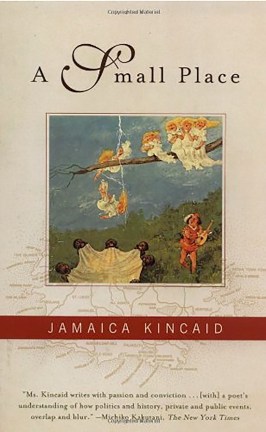
Well, it’s probably because of Jamaica Kincaid and her book, A Small Place.

maxresdefault
Continue reading

BC Girl in a Québécois World Pt. II: What to Expect in Quebec

As you may remember from last week, I’m currently attending a full immersion language school in Quebec. A little over a week ago I gathered in a sweltering auditorium with approximately 250 other students while a professor spoke to us in English, for the last time.

“The people of this village have a name for you anglophones;” he explained, “they call you the ones with the blank stares.”

I’ve been here for about two weeks now, and more often than not that’s how it goes. I limp out something French. The Francophone responds so fast that to my untrained ears a sentence sounds instead like one very long word. It feels a little bit like being two years old again, only with memories of a time when you were actually a competent human being.

Just imagine that first image is someone trying to explain something in French.

Growing up in British Columbia I heard complaints against French language laws, which work to protect French culture. English speakers argued that it was an unfair double standard, and that the French were just being snobby. That has not been my experience here in Quebec.  Continue reading