Tag Archives: USA

Re: Where I Try To Explain Red Dawn

I don’t normally get that angry about things. Disappointed, sure. Upset, often enough. But really, truly angry? That emotion is normally reserved for pure, undistilled racism.

Yesterday I wrote about the production history of Red Dawn, and mostly talked about how the plot was immensely improbable and how the film industry is all about money, et cetera. What I did not at all dwell on was the potential of the film to bring out racism in people, similar [but not at all comparable] to the abuse of Middle Eastern Americans after what happened on 9/11.

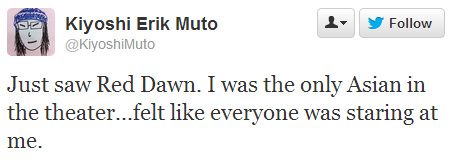
On Facebook Racebending.com directed me to Tumblr user manilaryce, who compiled a number or racist tweets by people who had just watched Red Dawn. I have embedded the image below and on the right.

The following are a few of the tweets that particularly stood out to me:

Kinda wanna kill some Asians right now and defend the homeland, thank you Red Dawn for sparking some patriotism in me

The only reason Im going to see red dawn is cause there’s sexy ass guys running around with guns killing Asians my type of movie;)!

I now hate all Chinese, Japanese, Asian, Korean people. Thanks. #reddawn #amazingmoviedoe

Red dawn was sickkk..just another reason why to hate asians.

This is like when racist Hunger Games fans tweeted about how the casting of a character as Black ruined the movie for them. The difference between that situation and this one is that I feel directly targeted.

One of the tweets, by @elysse223, reads “I usually love Asians, but in Red Dawn I found them terrifying.” After reading that I almost immediately felt worse, like both me and everyone else like me had been transformed into inhuman movie monsters.

The only consolation I can take in all this is that the film is being almost universally panned. Liam Lacey, reviewing the film for The Globe and Mail, says “Red Dawn panders to the worst kind of racist and jingoist impulses, though the movie is so preposterously insincere, it feels like those adjectives should be in air quotes.” Over at Indiewire Gabe Toro describes the film as “stitched together with scotch tape and falling apart at the seams, letting casual racism and misanthropy to spill out the sides.”

I honestly don’t have a lot to say except that I’m angry, hurt, and somewhat unsurprised that this is what audience members all over America are choosing to take away from this movie. I am Asian and I am not evil. I do not want to take over America. I do not want to ever feel like this:

Where I Try to Explain Red Dawn

I’ve begun seeing trailers on TV, and apparently it hit theatres two days ago, so I figure now’s as good a time to talk about Red Dawn as any.

For those of you who don’t know, Red Dawn is a remake of the 1984 film of the same name. In the original the United States is invaded by both the Soviet Union and its Cuban allies. A group of plucky high schoolers bands together to form a guerrilla fighting force, named the Wolverines after their high school mascot.

In remaking the film the studio, Metro-Goldwyn-Mayer (MGM), realized that they needed to modernize the invaders in light of the current political climate, and chose China. Keep in mind that in the original film that country was apparently America’s only ally, with the following exchange taking place:

“…Well, who is on our side?”
“Six hundred million screaming Chinamen.”
“Last I heard, there were a billion screaming Chinamen.”
There were.”

Production was going smoothly until the summer of 2010 when the Global Times, a Chinese state-run newspaper, got a hold of leaked excerpts of the script. This prompted such headlines as “U.S. reshoots Cold War movie to demonize China” and “American movie plants hostile seeds against China.” In early 2011 the LA Times reported that the film’s villains were changed from Chinese to North Korean to “[maintain] access to the Asian superpower’s lucrative box office.Continue reading

Evan and Gordon Talk: The Greatest Flaw of This Generation [Continued]

EVAN: Last week Gordon and I discussed the greatest flaw of this generation, and discussed apathy, laziness, entitlement, and creative bankruptcy. Deciding that we had much more to work with, Gordon left us with this question last week, which heads this continuation of the topic:

““Do we want to be good, or do we just want to look good?”

GORDON: I’m not entirely sure I can come up with any swift dismissal of this possibility, I mean- look at the world we live in. Do we believe in being environmentally and socially conscious? Absolutely. But to what extent? I mean, we’ll chuck our soda cans in the recycling, but are we gonna picket Monsanto?

Are we really just observing these “little” things because they’re expected of us? Do we actually care one way or another?

EVAN: As far as recycling goes, we do that in Canada because it’s the law. Looking good only has so much to do with it.

If we want to go with the example of, say, giving a few dollars towards an environmental organization [or maybe because the fundraiser was cute], that works a little more maybe. It at least contrasts with picketing/protesting. I think we care, but maybe not enough? That’s if we’re quantifying “care” now by the actions that it results in.

GORDON: Is it, perhaps, that we’re cynical? Do we as a generation ultimately despair of the effectiveness of any method of change? Is the reason we’re unable to really go the distance when it comes to our causes because we think it’s all just in vain?

EVAN: Do we think it’s all futile? I mean, we’re certainly led to believe that to some extent. To focus on environmentalism, the extent of the destruction to this earth is growing ever closer to irreversible, and we’re made aware of this.

As far as documentaries and the like go, however, we are told over and over that what we do does indeed matter. Being conscious about how we spend our money and that sort of thing.

GORDON: That’s what we’re told, but then again, the creators of such documentaries are overwhelmingly members of older generations.

Look at the Occupy Movement, for example.

People were there from all demographics, but more than anyone else it was the youth- our generation. Despite massive popularity, that venture ultimately met its death under the boot heels of riot cops and a fog of pepper spray.

It’s been about a year since it all started, and the situation is the same, yet there’s really no push for any resurrection of the movement or even for any major protest at all. Have we given up? We’re all the same people- we have all the same drives and values- have we simply despaired of peaceful protest?

EVAN: It’s funny you should say that, since just yesterday former protesters gathered in a park in Toronto to call attention to the movement that happened a year ago.

That aside, maybe you can explain what exactly happened as the movement petered out. It’s somewhat well-known that the weather was a large contributor to those occupying various streets and cities, but what else led to its collapse. Was it simply fatigue?

GORDON: I’d blame massive crackdowns on the part of the mayors of the occupied cities- let’s not forget that mayor Jean Quan pretty much turned Oakland into a warzone. Injured a protesting war vet so badly most folks thought he was going to become the first casualty of the movement (he pulled through, fortunately).

EVAN: This sort of all falls back to a point I made in relation to apathy our first attempt at this topic. That people care, but simply don’t feel like stepping outside their comfort zones. I realize that this may seem like a ludicrous thing to say in the face of the Occupy Movement, but I feel that the vast majority of youth, our generation, don’t want to do what it takes.

They, we, value comfort too much.

GORDON: I’m gonna have to second that theory.

I remember back when I was in college, going door-to-door trying to get students to boycott various unethical companies [Coca-Cola, Nike] doing business on campus. I was amazed at how many people would nod their heads and smile and agree with each and every word out of my mouth until I called on ’em to stop buying those companies’ products.

Guts. We got none. Difficulty with the concept of actual sacrifice, you know?

EVAN: And the refreshing taste of Coca-Cola is the very basest of comforts. If we can’t part with a caffeinated beverage we’re into, then what can we do?

I’ve joined in your personal boycott of the company, and although it can be a little difficult, it’s certainly nothing compared to being beaten by batons as I march on Parliament.

GORDON: Is that it then? Are our values just skewed ever so slightly in favor of immediate gratification? Do we prefer keeping our skulls in once piece over bread and freedom?

EVAN: History would say: yes. At least until things reach a certain point. Until we realize that being comfortable doesn’t outweigh what we put up with to get that comfort.

GORDON:  So what’s the word for this?

EVAN: To put it simply would be “laziness,” and we both know it’s more than that.

GORDON: “Over-Attachment,” perhaps?

EVAN: “Comfort-Loving”?

GORDON: “Hesitation”? “Looking back towards Sodom”?

EVAN: Looking back towards Sodom assumes that they’re actually doing something.

GORDON: It’s a fear- a very specific kind of fear. The kind where you “choke” just before doing something major.

EVAN: I’m going to say there’s probably something in French or German for that, but since we’re writing this in English we’re pretty limited in our options.

GORDON: Can we make one up?

EVAN: Heh. I don’t see why not.

How about . . . “Statusquophilia.”

GORDON: “Fluxophobia”?

EVAN: Haha, I like how we went different directions with our Greek roots.

GORDON: As do I. Shall we have the readers vote?

EVAN: Sounds good to me, and we should be wrapping things up anyway. Want to summarize how we got here?

GORDON: Ultimately, o readers, it all comes down to this. The great and terrible flaw of our generation- from what we’ve discussed- is not a sin of commission. We are not entitled, we are not lazy, we are not without our values. Our fault is in what we lack the guts to be good, the balls to be bad. In short, the unwillingness to part with what we have for the chance to attain something more. We’re trapped in a dance with the devil we know.

EVAN: Vote for the terminology you like more. “Statusquophilia,” meaning a love for things as they are, or “Fluxophobia,” meaning, in this case, a fear of sacrifice.

GORDON: For next week’s topic, we’ve got: Zombies- Are We Beating a Dead Horse At This Point?

EVAN: Or what is going on with all the wars on television? I’m referring to programs like “Storage Wars” and the like. Real wars are happening, I realize this.

GORDON: And with that, people of the interwebs, we are out of time- make sure to vote for your preferred word as well as the topic for next week, and be sure to check out our new “Fame/Shame Day” feature!

British Television VS American Television

Despite our focus on American issues, we here at Culture War Reportersrecognize that in our world of ever-shrinking borders, there’s plenty more out there than just the cloudless skies of Nevada or the homeless-packed streets of Toronto (Evan, seriously- if the healthcare system’s so good, why does Canada have so many crazy people?).

Today we turn our attention to our pasty cousins across the pond, more specifically, their TV,  excuse me, “Telly” (this is why you lost your empire- well, this and genocide), and how it stacks up next to ours.

CGI and Production Values

Now I have to admit- I haven’t extensively researched British and American television financing, nor have I had a chance to compare the two, taking into consideration differences in the economy and advertising fees over the past couple decades.

What I’m saying is- I’m not an expert.

That said, I don’t need to be an architect to tell you that chances are pretty good that a lot less money was put into making a tent than a condo. British TV shows, put bluntly, just seems to be vastly less funded than their American counterparts. Just take a look at this scene from America’s Battlestar Galactica.

Pretty intense, right? If there’s any poor-quality, it’s probably from the YouTube video, rather than the actual series.

Now look at this clip from Britain’s Doctor Who.

Way worse. And oddly enough, Doctor Who has a bigger fanbase than Galactica, and despite it’s ever-increasing popularity, still has to deal with props dug out of someone’s kitchen drawers. I’m not saying Doctor Who is bad- it’s not. It’s really good- only it’s tough to really feel the full effects of a horrific reveal when the monstrous alien that’s been lurking the shadows until now makes your sock-puppets look scary by comparison. I can’t claim to know the reason for it, and I’m not putting the Brits down for it- I’m simply saying that funding- especially in CGI- appears to be a significant difference between the worlds of British and American TV.

Pretty Faces

You’ve probably heard jokes cracked about this. Not the “British are ugly” or the “British have bad teeth” jokes- the fact that the people on British television have the audacity to look like the people you’d see on the street.

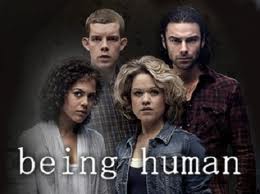
That’s not to say the Brits don’t share the American weakness for fantasizing and glamorizing each and every facet of life, but it’s pretty clear that it’s nowhere near on the scale we have here in the US. Here- take a look at the leading characters of the American version of Being Human.

The guy on the left is decently attractive, as is the girl, and the guy on the right looks more or less like a life-sized Ken doll. Idealized people- no question about it. Now look at the same characters in the British original:

There’s not a huge difference between the girl (the blonde girl is another character- ignore her), and the dark haired guy certainly isn’t his American counterpart and stop looking at that guy’s ears! Yes, they’re huge- they’re gargantuan– and no, this isn’t just an unflattering photo- they actually are trying to escape his head in the first three seasons.

The point is, when it comes to their actors, the British are- well, appear to be- considerably less shallow. They don’t need a couple of supermodels to tell a compelling story of murder, secrecy, and perversion- and speaking of which…

Raunch Codes

Watch this clip- but before you do, get all children and Weslyans out of the room.

Pretty nasty stuff, right? Don’t say we didn’t warn you!

People complain that American media is nothing but sex and violence, but believe me- those Axe commercials are prudish compared to the Brits (and indeed- most of Europe). We may give the Brits a run for their money when it comes to blood and gore but never will we compete with them when it comes to explicitness of this degree. It’s almost to the point where it’s not even repulsive- you’re just impressed at how logic-deafeningly far they take it.

But only almost.

The Dying and the Dead

It’s been said that the difference between British comedies and American comedies is that American comedies begin with everything going wrong and end with everything being fixed, while British comedies begin with everything going right and end with everything falling apart. I wouldn’t call a story where everyone dies of scurvy at the end a comedy, but then again, I don’t whittle my life away on a miserable island full of alcoholics and skinheads.

I can say that because the only people who hate the British more than the Irish, the Kenyans, the Indians, the Chinese, the Australians, the New Zealanders, Iranians, and the Egyptians are the British themselves.

The simple fact of the matter is that there is this viciously self-deprecating mentality that pervades every element of British culture (barring fox hunts, which are just weird) that couldn’t be further removed from the general sense of optimism that you tend to find in America. Just take a look at British crime series.

Now I’ve seen quite a few, and while this certainly isn’t universally true, what I’ve typically found is that British murder mysteries focus on the whole “Whodunnit?” element, whereas American murder mysteries either have a “How’d he do it?” or a drive to keep the murderer from murdering again. Gross over-generalizations, I know, but it does seem to be true that American crime series episodes end with the detectives patting each other on the back for having done justice, while British crime series episodes end with the detective giving some despairing monologue about the tragic depravity of all mankind.

Because that’s a very depressing (and therefore, British) way to end the post- allow me offer this:

To say I’ve been ragging a bit on the British would be an understatement, and no- despite our attempts to be unbiased, we here at Culture War Reporters don’t care much for contemporary English culture. That established, there may very well be something to be said for the Brit’s here. Is it pretty? Not remotely, but for all the weirdness (from our perspective) that British TV has to offer, it can’t be denied that it’s simply more “real” than American TV. The sets aren’t shiny, the people aren’t (exclusively) gorgeous, and a stories of sin and murder actually recognize human suffering. There’s certainly a lot from British TV that merits imitation here in America.

Except for sexually explicit sausage commercials. **** that.

Evan and Gordon Talk: Facebook and Privacy

EVAN: So in spite of the fact that I voted for my topic of preference on last week’s poll, Facebook and privacy and whatnot won. Having bitterly admitted that, Gordon?

GORDON: While the topic of Facebook (or all social networking) and privacy certainly isn’t a new debate, it’s not one that’s lost its relevance either.

As we rely on the internet more and more as our primary means of communication and entertainment, how do we address the issue of having every little element of our lives dissected and sold to the highest bidder?-

EVAN: I mean, really, everyone has been the target more or less of having their information used by Facebook. Log on and check out those sidebar ads; every one has been tailored using the cookies of sites you’ve visited. Which is why mine are always StarCraft related, etc.

GORDON: First thing we gotta ask is- “Is this really a problem? Aint it better to have ads that are actually relevant to you, rather than yet another ****ing insurance commercial courtesy of Geico?”

EVAN: Ugh, Geico. How many ad campaigns can a single company have?

EVAN: Moving disgustedly along, that’s a very relevant point. I’m interested in video games, so to have sidebar ads about such things is not something I can really complain about.

GORDON: I’ve got a pretty aggressive adblock, so I’m fortunate enough not to have to deal with that; but the underlying assumption with that kind of thought is that ads are inevitable. That you can’t get away from ’em, so you might as well try to get ones you like…

EVAN: Which is why, as you well know, I only thumbs up a select number of ad types on Hulu. Food, alcohol, video games, and certain movies.

GORDON: But with Hulu- you are the person in control. I mean, think of it this way: would you tolerate a guy going through your garbage so he can send you junk mail tailored to you?

EVAN: I’ve gotta think about that for a second . . . I mean, not getting junk mail about window/door services would be nice.

The whole “going through your garbage” thing definitely carries some different associations then simply tracking cookies. Maybe it’d be more like- a TV guy who follows you around when you shop, noting what you are and aren’t interested in.

GORDON: But that’s also flawed- in that scenario, you’re actually looking for stuff to buy….

EVAN: Well, you window shop, I mean- browsing, etc. Looking at what you look at, that sort of thing.

GORDON: So I’ve got this obnoxious guy following me wherever I go, listening in on my every word, and trying to sell me his wares without rest. Isn’t that one of the ironic punishments in Dante’s Inferno?

EVAN: Bringing this back to Facebook and whatnot, do we in general have a problem with the ads? I mean, they’re not the most obtrusive to begin with.

GORDON: Well, ads are only one example. What about your location?

EVAN: People want that stuff, though. It’s part of this new generation, tweeting where you are, statuses that read “I just had lunch with ______ at ______.”

GORDON: I’m not talking about when you state your location, I’m talking about when your location is pinpointed and used regardless of your awareness. Sexy Singles in Houghton being a prime example.

EVAN: Heh.

For context, Houghton is where we both attended college. It is so small it is not considered a town. It is a hamlet.

GORDON: The majority of the population- vast majority- is made up of the student body.

EVAN: Vast majority.

GORDON: Meaning that the town decreases by about 80% each summer.

EVAN: But those ads are all the same- they’re just slapping a different town [or hamlet] name onto whatever’s being advertised.

GORDON: But are you really okay with that? That not only your interests are out there, but your location as well? Regardless of your consent?

EVAN: As far as I can tell, it’s more eerie than anything else. And it goes from creepy to laughable when something like “Sexy Singles in Houghton” comes up.

GORDON: Now, as you are in Canada, this might not sound as relevant to your situation- but what about the gummint’ commin’ t’get’ ya?

I mean, there have been issues here in the States,  huge issues, with companies turning over personal information- including conversations- to law enforcement and security agencies without much (if any) process.

EVAN: Heh. “Gummint.” But yeah, that stuff has definitely happened. And seriously, what Facebook does with our personal information is very important.

GORDON: I guess it’s more or less the same for me- though I was a bit older, and having grown up in Syria (where they eventually blocked Facebook)- I never put anything on there I didn’t assume everyone could and would read.

Still do. Or don’t, rather.

EVAN: It’s interesting in that privacy settings are so much more advanced now though, in a way. If you don’t want people looking at even your profile pictures you can do that. Meaning that potential employers can’t use it as a legitimate check on future employees anymore.

GORDON: Now that  is messed up. We can all agree on that.

EVAN: Hm?

GORDON: Employers attempting to maintain control over their workers by monitoring their FB profiles, citing “character” as a reason or justification.

EVAN: Ah, that’s what you were getting at. So to some extent we’re in control of an aspect of our privacy on Facebook.

GORDON: No question. But speaking in a more general sense, what does that do to us as a people? As a society?

EVAN: Well, I for one am incensed when I want to look at a pretty girl’s profile pictures, and even though she clearly has them, I’m told that “there are no pictures in this album.” Bold-faced lies.

GORDON: You’re a pervert.

EVAN: My point stands.

GORDON: So we’re more dishonest with each other? We’re still ironing out the wrinkles in our old-world/cyber-world blend?

EVAN: Are we more dishonest with each other? I mean, if we’re really deconstructing this, the internet has made us more dishonest than we’ve ever been ever.

GORDON: Explain.

EVAN: Nothing we put online is necessarily true. Dating website profiles back me up on this.

GORDON: This is true. Are we then actually more skeptical and guarded despite the critics’ claims?

EVAN: Which are-

GORDON: The general spiel- the internet (social networking especially) is playing on our trust and making us more and more exposed for those who would make money off of us.

EVAN: Ah. Vulnerable, etc. I gotcha.

I’d say people in general are still naive enough to fall for obviously stupid ads [if they didn’t work they wouldn’t still be around]. But we are more skeptical as a generation, so really both are true.

GORDON: Fair enough.

EVAN: And we are exactly out of time.

GORDON: Remember to stop by next week for our discussion on the upcoming season of Community.

EVAN: Yes. It’s gonna be good. And I already know you’re going to end this with that Troy/Abed gif.

GORDON: I am indeed.