Tag Archives: writing

Evan and Gordon Talk: The Walking Dead

GORDON: Ladies and gentlemen  devoted readers and people who found our blog by googling “dokata fanning playboy.” We’re were to have a frank and open discussion about “The Walking Dead,” both the critically acclaimed television series and Robert Kirkman comic books of the same name.

EVAN: I’d like to issue a fair warning to those who haven’t read the comic series or caught up on the show that there will be SPOILERS. You have been duly warned.

GORDON: Indeed. I’d like to kick things off by talking a bit about how the books and the television series differ, and whether or not that’s a good thing.

EVAN: I think there’s a firm answer there. The show differs a lot from the books, and that’s definitely a good thing.

GORDON: How so?

EVAN: Sticking to the book means that there aren’t any surprises for loyal fans of the series, and keeps them guessing. Furthermore, it allows AMC and others involved to play a little bit more loosely with the way the show is going, without feeling too tied down.

GORDON: I thought about that.

EVAN: And?

GORDON: At the same time, I feel there’s definitely a lot lacking from the series as a result of their pretty strong (and ever increasing) departure from the source material. Take some of the deaths, like Dale’s and Shane’s, for example. It’s like knowing you’re gonna go get Chinese food versus being surprised that you get some potato chips with your nasty sandwich.

EVAN: I agree. Both deaths were undeniably very well-written and powerful moments. I just think there’s something to be said for not being slavishly dedicated to one vision of the show.

And as far as Dale’s death is concerned, I can easily see his key line being spoken by some other character some ways down the road.

GORDON: I guess my point is that while the show does keep you on your toes, the changes it makes are typically just less impressive than the story itself. I think loyal fans of the series would be just as cool seeing a faithful show as one that goes its own way.

I mean, look at it this way: The books are dark. Really dark. I’m talking Laurie’s comic-book ending dark. It pushed the envelope in ways I just have yet to see the show do. That was a lot of the charm of the books- how unflinching it was. I’m just not getting that same power with the show’s spin.

EVAN: It’s obvious that fans are going to want a show that is as close to what they originally experienced in the comics as possible. I also agree that the comics are undeniably better than the show.

My point is that I think the deviation is good and realistic. Having the Governor both physically and sexually assault Michonne is probably not something we’re going to see. Neither did I think we were going to be witness to a woman and her baby being brutally gunned down.

The writing is weaker, but I don’t think that faults the direction to not stick to the book, it faults the current writers.

GORDON: Interesting, but it seems that the logical solution to that is to try to get closer to the hard-hitting story the books gave us. Here’s what I’m hearing from you:

“The books are objectively better, but the fault is with the show’s poor writing.”

Seems like you either just start trying to write a better zombie story while trying to stay within sight of the original material and characters (which kind of kills the point), or just stick to the material to begin with.

EVAN: I don’t think they’re not trying to write better stories. I’m saying they’re not succeeding. I don’t think they set out to do a bad job.

GORDON: Fair enough. So what needs to be done then?

EVAN: As with most forms of media taking into account constant feedback from fans and acknowledging their mistakes. Season 2 at the farm really dragged on, and was low on the zombie killing. At the very least, this season has given us plenty of “walker”-eviscerating action.

GORDON: No argument there . . . no complaint either. But I don’t think it’s a solution; just something to help ease the need for something more.

EVAN: You do get that not everything in the comics can make it on TV, though, right?

GORDON: Of course. And I wasn’t going to say that. I mean, ever since the season began, I’ve been like: “How the **** are they going to show a baby being shot on national television?”

The rest I could imagine, but not that.

EVAN: Okay, how about we move on to something most fans of the AMC show can relate to: How horrible Andrea is all the time always.

GORDON: That bugs me. I like Andrea. Andrea gets it.

EVAN: Andrea is horrible. Andrea almost shot Daryl in the face. Because she couldn’t listen to people telling her to hold the **** up.

GORDON: That was messed up. But otherwise, I think the criticism of her is all just BS.

I mean, everyone’s like, “Gah- I hate Andrea! Why can’t she see that the Governor is evil?”

And I’m like: “Please. If you had survived as long as she had, which you wouldn’t, you would be groveling at the man’s feet for a bowl of warm soup, let alone a flippin’ suburban paradise free from living corpses.”

Relatively, anyways.

EVAN: She only survived because of Michonne, who I don’t like all that much at the moment. And for the most part, I agree with you about the Governor not being a bad dude.

GORDON: Let’s not turn this into my twisted/completely reasonable sense of morality. What I think the show is really lacking is the eeriness. You got that in the first season, when Rick was on his own, that feeling of isolation. Upping the action doesn’t solve that problem, especially as more an more characters come in.

EVAN: What I really want to see is the whole idea, which has been communicated but could be better, that it’s not the zombies you’re afraid of, it’s the people. Two kids die, and everyone things it’s the huge black dude who did it. Turns out it’s the mild-mannered white guy who decapitated these two little girls.

GORDON: Very unexpected. Dang, there was so much good stuff there that we’ll never get to see. . .

EVAN: The theme of the books, if I could sum it up in three words, is “People Are Monsters.” I think that’s really what needs to come out of AMC’s Sunday evenings.

GORDON: I agree completely.

EVAN: We’ve got a little bit of time, do you want to share with the nice people why, barring slaughtering a few US Army men, the Governor’s not such a mustachio-twirling villain?

GORDON: In their defense, that version was pretty over-the-top; like a living Snidely Whiplash.

EVAN: In the books, you mean?

GORDON: Yeah.

EVAN: What I meant, though, is that as you said people are yelling at their screens, crying “Andrea you dumb blonde, can’t you see you’re making out with the devil?”

GORDON: They are, and without cause (barring knowledge from the book). I mean, people suspect because they’re the audience and can see the big picture. But if we’re talking realistically, they would be more eager than Andrea. I’m just saying the criticism of Andrea as being blind is utter nonsense.

EVAN: And furthermore, what has he done to have anyone assume he’s a bad dude? Taken away their weapons in a peaceful town. Shown them tons of hospitality. If anything, we’d all be telling Michonne to chill the eff out and stop glaring at everyone/thing.

GORDON: Exactly. People need to chill out.

EVAN: And, even though I’m sure we could’ve gone on for another hour, that just about concludes our time. Any topics you have in mind for next week? Probably not something television-related, to avoid the hat trick.

GORDON: True. Let’s talk about food. Let’s hypothesize the greatest food show of all time.

EVAN: Yes. Agreed. EVAN AND GORDON OUT.
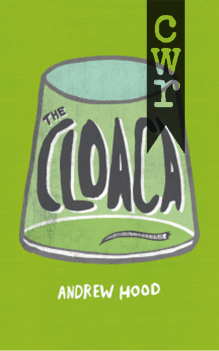
The Cloaca: A Book Review

The sophomore collection of short stories from Halifax-based author Andrew Hood, The Cloaca is 138 pages of people who don’t know what they’re doing.

Described on the back cover as “your high school gym coach, drunk and dishing dirt on all the other teachers on the crosstown bus,” the stories in this book capture your attention like a man on a bicycle wiping out in the rain, or a bunch of Italians yelling at each other on the sidewalk [both of which I saw two days ago]. Continue reading

Underemployed, Pilot Episode: A TV Review

Right after finishing the very first episode and right before reading what the A.V. Club’s TV Club thought about it seemed like the perfect time to write my review of MTV’s Underemployed.

As a recent college graduate, the premise instantly caught my attention. Five young Chicagoans begin their first episode slightly buzzed on the eve of their graduation, dreaming about where they’re going to be in a year. Throwing lofty goals back and forth they’ve already begun planning their 1-year reunion where they’ll celebrate their “world domination.”

From left to right: Miles, Daphne, Sophia, Raviva, and Lou.

The characters are Lou and  Raviva, the couple who broke up so that both parties could go on to pursue their dreams [grad school and music, respectively], Miles, the would-be model, Daphne, the aspiring advertiser, and author-to-be Sophia, who I lovingly dubbed “VA” for “virginal Asian girl” [I thought the full acronym somewhat inappropriate].

Flashforward to the present and, to make things easier myself, the friends find themselves making up the following list:

  • Lou is street-canvassing [fundraising] for an environmental organization.
  • Raviva is working at a bar in which music is played.
  • Miles is a part-time male stripper.
  • Daphne is an unpaid intern at an advertising agency.
  • Sophia is working at a “Donut Girl” and is still a virgin.

Now, before I get any further, I’ll have you know that I am a sucker for ensemble shows. Friends is television gold as far as I’m concerned, and as a result I’m fairly into Community, and, even more recently [and into], Happy Endings. That being said, Wikipedia’s extremely scant article on the show categorizes it as a comedy-drama, or “dramedy.”  The problem is, the show is heavy on the drama, and very light on the humour.

Raviva shows up at Lou and Miles’ apartment pregnant. This, of course, creates the situation of Lou realizing he needs to take care of her. How this is dealt with is almost painful, and awkward in a way that just isn’t funny. His clumsy attempts at trying to find out whether or not he’s the father aren’t even cringe-worthy in a way that’s entertaining [see: The Office].

Elsewhere Daphne lets her super-hunky boss know that she has been an unpaid intern for one year, a premise that made me so livid I thought I was going to spit. He, in turn, asks he out to lunch, where they kiss, and then proceed to have sex in his car [after promising her that he’ll work things out].

On the smaller side of things, a cougary woman gives Miles her card while he works catering at an art gallery, which piques his interests since it reads “GQ.” They later have sex. Sophia meets an old classmate who is, of course, on the pathway to success, and his boss, who is a lawyer.

None of these things in and of themselves are terrible, the problem is pacing. Almost everything that’s introduced is almost instantly resolved, meaning that as viewers we don’t have much to look forward in the next episode, or the season to come in general.

For starters, Raviva wastes absolutely no time in giving birth to a beautiful baby girl. Miles finds a job with his dad [albeit after many, many interviews], and Daphne confronts her boss and demands to be paid [and coming out with a great deal of $750 a week and a parking space]. On the comedic side even the joke of Miles thinking he’s gotten a modelling gig is explained away in seconds. The man he thinks is Calvin Klein straight-up tells him that “You’re here to serve mojitos, and mini tacos, and eye candy.”

As far as events that completely blindside the viewer out of nowhere, Sophia is invited out on the phone. We’re led to believe it’s her former classmate, but it’s his boss, which is surprising. What’s even more surprising is that his boss makes a move on her. And then they are having lesbian sex and I no longer had any idea what was going on.

You can tell that somehow the people at MTV realized how the plot leaves us without much to look forward to [save for Daphne’s continuing tryst with hunky boss] by how the episode ends. With a voiceover and caption saying “this season, on Underemployed” followed by almost two full minutes of what’s to come.

In the end, I found myself interested in watching future episodes, but only because of what the teaser provided. While Sophia hints at her search for sexual identity by telling Daphne that “I might be [different]” it takes the teaser to slap us in the face with her saying “I don’t know what my sexuality is.” In other news, new parents Miles and Raviva will struggle, and cheat on each other [just tongue action, as far as I can tell]! All of these things serve to pull the viewer in, but none of these hooks can be found in the pilot.

I’ll probably be tuning in next week to watch at least the second episode, but it’s not very likely. While Underemployed scratches the surface of what it means to find purpose in life after dreams crash and burn, its pacing and distinct lack of laughs also means that it offers a look at life after college that moves both quickly and joylessly.

Stray Observations [something the TV Club does and that I’ve always wanted to do]:

  • None of these characters have average, run-of-the-mill names. To be fair, neither did most of the cast of Friends.
  • For kids who’ve just gone through four years of college, those are some pretty unrealistic goals. Touring as a musician? Writing [let along publishing] a novel?
  • It is oddly refreshing, however, to see an Asian character who majored in English and is big into writing.
  • While I have complained about a dearth of humour, there was a line, said by Raviva’s mother, that I thought was funny: “She is like a set of Russian dolls right now, and every one of them is a total b-tch.”
  • Finding out that Miles became a male stripper was also pretty funny.
  • The episode ends with the five friends having dinner in the biggest apartment I have ever seen. I’m talking bigger than the apartment in New Girl, and a little bigger even than Dave and Max’s in Happy Endings.

There is absolutely no way they could afford this apartment. No. Way.

  • Finally, the show made the decision of actually saying the title of the show in the following line by Sophia: “If life is just about working and earning money we’re all screwed. But if life is about living, none of my friends are underemployed.” I hope they’re proud of themselves for that.

Underemployed
Tuesdays, 10 p.m. EST
MTV

Go Listen to “Guilty Pleasures: Art and Politics”

Two days ago Gordon and I talked about “hipster racism,” a topic he heard about via an eye-opening lecture by novelist China Miéville. The talk was titled Guilty Pleasures: Art and Politics, and discussed far more than what we were able to given our time.

A number of things: Firstly, I am not going to discuss or summarize his lecture in its entirety; it was forty-some minutes long and that would be ridiculous, just listen to it for yourself. Secondly, I am not a socialist, and much of what he was saying was through that filter. He did, after all, speak at a little something called “Socialism 2012.” I am not someone who has very strong political leanings, but I am someone who truly loves art in its many forms. The following are the three ideas he spoke about that stuck me the most.

The Artist and Their Art

Miéville, about a minute in, states that the socialist position on art and politics is this: “[socialists] do not judge art by the politics of the creator of that art.” He then quickly adds that they do so all the time anyway. I briefly wrote about this in a post about Jewish children’s author Rich Michelson. Michelson hosted a session that was largely about race and background, and how they impact audiences’ opinions of a work. Is a Jewish author allowed to write about the struggle of the civil right’s movement? And if not, then why?

The relationship between creator and his or her art is heavily debated, but its extremes are very easy to criticize. Miéville said that they’d all sat through “egregious folk music” simply because of the grounds of its sentiments expressed. Simply having a good message does not make art good. A Christian movie about the horrors of porn is not in and of itself a bad thing; having it feature ghosts [and be a clear knock-off of Paranormal Activity] is. To put it in the form of a proverb, “the road to hell is paved with good intentions.” Feel free to replace “hell” with “bad art” or “disappointed audiences.”

Guilty Pleasures

The title of his talk and what I’m the most interested in, Miéville listed different axes of socialist guilt. The third of which [17:56] he says is:

The question of quality: “I know it’s not very good but I like it anyway.” A declaration of kind of defensive guilt.

The thing is, he realizes that the statement is inherently flawed. By saying something is not very good we declare that we can make qualitative judgements about art, and this leads to questions like: “What is art? What makes it good, bad, better? What kind of social phenomenon is it?”

When it comes to television shows I have a standard rule, and that is to watch it ’till its dying days. I have watched all of The Office to date, and that is the same as 30 RockHow I Met Your Mother, and a slew of other shows. Sooner or later they begin to break down [see my first example], but I stick to them. The reason I’m bringing this up is The Big Bang Theory.

Gordon hates TBBT. He hates it because, honestly, it’s not a very good show. He often says that “nerdface” is an excellent way to describe their treatment of the characters. That being said, I have, and do [sometimes still] enjoy it. Do I feel guilty? As an English and Writing major, yes. I studied for four years to differentiate between good and bad writing. As a general media consumer and television enthusiast, yes, I still feel guilty. And, as Miéville said, I somehow defend myself by admitting to others that I realize it is not very good.

Does this justify me? I don’t think so. But beyond what it means to be good or bad, what does it mean to like?

What Does It Mean to “Like” Art?

I like the Dungeons and Dragons Monster Manual. I like the novels of Barbara Cummings [sp?]. I like Gramsci’s prison notebooks. [20:15]

None of these statements tells him anything about his relationship with each piece of art, because they’re all so distinct. What further complicates the verb is the discussion of “the art piece one enjoys disliking” [20:32]. We can like to dislike things; Justin Bieber basically encapsulates this idea by himself. While he never ends up truly defining the word, he seeks closure in the writing of another.

What follows is a piece of writing by Lady Mary Wortley Montagu, an 18th century writer, and Miéville’s response to it [34:45]:

“The pretty fellows you speak of I own entertain me sometimes, but is it impossible to be diverted with what one despises? I can laugh at a puppet show and at the same time know there is nothing in it  worthy of my attention or regard.”

This is one of the most liberating things I have ever read in terms of the cultural sphere. It is not obligatory to have footnoted opinions about everything you consume.

I read his meaning in that last paragraph as being that we need not get caught up in guilt. There should be a way of looking at what we like that doesn’t involve us castigating ourselves. I can enjoy the King Fantastic Remix of Drive It Like You Stole It without being a proponent of foul language. Likewise I can read AmazingSuperPowers, be amused, and not have to argue how high- or lowbrow its humour is. While the intent of an artist and the perceived quality of their work should be taken into account, there are times when we can simply like, or more simply enjoy, art, whatever it may be.

Is Rich Michelson As Good As Anybody?

This past weekend I was privileged to attend the Festival of Faith & Writing at Calvin College. I went to a lot of the sessions and was practically drowned in ideas and information; there’s a lot to process, and I’m only just beginning to look over the notes I took. With that in mind, I’d like to discuss a talk I attended entitled “Extolling or Exploiting?”

10864659-large

Richard (Rich) Michelson is Northampton’s poet laureate. He’s also the author of over a dozen children’s books, many of which have won awards including Amazon.com’s 12 Best Children’s Books of the Decade. His presence was humble, friendly, and unassuming, broken only when he began talking about a topic very sensitive to him, the question and stipulations of who is allowed to write what.

To provide some background, Michelson is White and Jewish. Many of his books explore the lives of Jewish children. Quite a few of his books also feature African-American characters.

In 2008 his book As Good As Anybody: Martin Luther King and Abraham Joshua Heschel’s Amazing March Towards Freedom was published. It tracks the paths of both men, respected spiritual leaders, and the journey that drew them to march together in the 1965 civil rights march from Selma to Montgomery. The book features an introduction by  Martin Luther King’s wife, Coretta Scott King, and was the book to receive the aforementioned award from Amazon.com.

The Coretta Scott King Award is awarded for books about “the African American experience, that are written for a youth audience (high school or below).” In spite of appearing to fit the description of the award perfectly, Michelson’s book was not even considered. There were two reasons for this. The first was that Michelson was not African American. The illustrator, being Latino, was also ineligible.

As he recounted this series of events a slight tension arose in his voice. As Good As Anybody was and is, well, as good as any of these other books. It documents the life of a prominent African American individual and the great deeds he undertook in his life. The issue here lies in the ethnicity of the author.

So he asked us, does intent matter? The Education of Little Tree is a novel that recounts the fictional memoirs of a Cherokee boy. The author, Forrest Carter, was revealed to be Asa Carter, a former member of the Ku Klux Klan. Prior to that being revealed, however, many praised the work, Oprah Winfrey going so far as to promote it on her show in 1994.

Rich Michelson is a White Jewish man, and he wants to tell stories about African American history. By doing so, is he robbing African American authors of that niche market? Are editors maybe more comfortable dealing with him than they  might be with Black authors?

I don’t have the answers, and from what I can tell Michelson doesn’t claim to either. He believes that we can all write what we want, but it’s up to society to determine whether or not they deem your writing “appropriate.”

[Very] Brief Thoughts On Entertainment

A bitter, angry old man once said:

There’s been a growing dissatisfaction and distrust with the conventional publishing industry, in that you tend to have a lot of formerly reputable imprints now owned by big conglomerates. As a result, there’s a growing number of professional writers now going to small presses, self-publishing, or trying other kinds of [distribution] strategies. The same is true of music and cinema. It seems that every movie is a remake of something that was better when it was first released in a foreign language, as a 1960s TV show, or even as a comic book. Now you’ve got theme park rides as the source material of movies. The only things left are breakfast cereal mascots. In our lifetime, we will see Johnny Depp playing Captain Crunch.

That same man wrote The League of Extraordinary GentlemenV for Vendetta, and one of Time Magazine’s All-Time 100 Novels, Watchmen. Alan Moore certainly has the writing credentials, but is he accurate in his assessment of the future of entertainment?

The truth is, as you’re probably well-aware, that the publishing industry is an ever-changing thing. ComicsAlliance writer Chris Sims has called for the “big two” [Marvel and DC Comics] to get serious about webcomics. In other words, for the two publishers to release content for free to compete in an age where people just aren’t buying print anymore. It would work as a way to increase and maintain interest in their product, and would even help sales; people who like reading something online will typically buy it if they like it enough.

As for creativity, I wrote in a post earlier this month [Mashin’ It Up] about people who are seemingly just reaching into a bucket of tropes and smashing them together at high speeds. Cowboys and Aliens was a movie that came out last year, and it wasn’t even original; it was an adaptation of a [honestly, not very good] webcomic. Not only that, but by next year Gore Verbinski will have directed Lone Ranger, with Johnny Depp as Tonto. That could be considered one step closer to Captain Crunch, I suppose.

At the same time adaptations are being made of novels. They may not be original screenplays, but the original work is nothing like a TV show from the 80s, it’s not built on nostalgia. Audrey Niffenegger’s The Time Traveler’s Wife was adapted for the big screen, and although it didn’t do great with the critics it still stands as evidence that books will do well; and they’ll do well enough to warrant films. This could lead into the conversation about how some books receive film opportunities before they’re even published, but that’s for another time.

The “conventional publishing industry” will continue to change; it has and it will continue to. Alan Moore is a cynical miser of a man [subjective], but he has a point that shouldn’t be ignored. We’re not doing great in regards to creativity, and it’s an area we should expect more from. Cynicism may appear to be the logical place to turn to, but looking for media worthy of attention is the more worthy activity.