Category Archives: Economy

Fame Day: Socialism Conference

I’m writing these words in the last hours of what has been a quiet May Day.

For me, at least.

Elsewhere in the world, red and black flags are being proudly waved as people march through the streets, chanting and singing. In Greece, a nation-wide strike is being carried out in defiance of massive lay-offs enacted by the government. In Bangladesh, thousands are protesting after the collapse of a sweatshop resulted in the death and injury of hundreds of workers. Similar protests have broken out in the Philippines as nearly 10,000 workers march in Manila. Youth in Spain are raging against the nearly 30% unemployment rate. Korea, Cambodia, Turkey, Indonesia- just to name a handful- are witnessing similar turnouts.

Continue reading

Evan and Gordon Talk: Work

EVAN: Ladies, gentlemen, those who fall into neither category [I’ve been taking a course on gender], tonight Gordon and I will be talking about what most everyone in the world has to do to get by, and that is work.

As a topic it spun out organically from our conversation on naps and time, and it’s hard to discuss the hours in the day when such a large chunk of it is spent at one’s job.

GORDON: More specifically, it was through a general observation that too often, our work simply isn’t fulfilling.

This is certainly something we can all relate to; Evan and I in particular, having scrubbed down dorm toilets for minimum wage.

EVAN: Oh yes, the very high New York state minimum wage of $7.25.

GORDON: And yes, we were paid by the hour, meaning the better we were at our job, the less we made.

Continue reading

Evan and Gordon Talk: College Grad Reactions to “Easy Money” Shows

EVAN: Dear readers, we have gathered here today to read as Gordon and I discuss the concept of what I’m calling “easy money” shows, and how we, as recent college graduates, view them.

GORDON: You mentioned a few specific examples earlier on- could you list ’em off again for the readers?

EVAN: Well, at the top of my list is a personal favourite of mine, “Storage Wars.”

Not only does it tickle me to no end that Jarrod ignores Brandi’s warnings not to bid [at around 00:26], but I am enraptured by the promise of finding treasure among, well, garbage. Continue reading

Some Thoughts On Advertising

There are certain things in life that can be avoided.

For all our howling about vapid, synthetic pop-songs we do, at the end of the day, have the ability to simply turn the radio off. For all our wailing about trashy, stupid television, we have the ability to just point our remote and switch off the TV. Even people who annoy us we can at least avoid.

But that’s not so much true when it comes to advertising. Unless you’re living in an underground bunker somewhere in Colorado, it’s not something you can get away from.

Why you’d even be reading this blog, I don’t know.

Between telemarketers, logos, TV and radio, billboards (including mobile ones, which we have in Vegas), and the internet, there’s really no escaping. Even if you’re sitting alone in your house, it’s all around you. You’ve got company emblems stitched onto your shirts. Manufacturer’s names written on your underwear. Go to your kitchen, and you’ll find advertisements on the back of pasta and cereal boxes.

I’m only here to offer some food for thought; I won’t be taking up myself the war cry that advertisements and commercials always play to the lowest common denominator. Sexuality in the crassest, most objectified form, greed, gluttony, envy, passivity, sloth (not the kind shown above)- it’s all there, and thrown at us every waking minute of every day of our lives. What does that do to us?

Most people who work with this line of thought point to the movie Idiocracy as a dark prophecy of the world to come.

In this movie, a man is (accidentally) cryogenically frozen and awakens in a dystopian future where advertising and trashy TV has resulted in the average human IQ dropping well into the double digits. While it’s not a masterpiece in and of itself, and it’s suggestion that dumb people have inherently dumb kids is just plain wrong, the fact that more and more our society seems to be moving towards Idiocracy is downright eerie.

I will, nonetheless, offer an alternative for you to ponder.

What if advertising is actually raising our BS awareness? Information on the internet is usually either (at best) misrepresented or (at worst) outright falsehood. We don’t seem dumber as a species for it- on the contrary, we seem more skeptical and discerning. Perhaps we are, in fact, becoming tougher to fool. Naturally I can’t point to any cause-and-effect relationship, but it’s certainly something to think about.

Of course, there’s the dark alternative to that as well.

What happens to our psyches and society when we’re constantly on-guard against everything? Is that paranoid cynicism really healthy for us? What does it do to us to hold everything in contempt as just another scheme to take away your money? Even if we tone that down a bit, what does it do to us to walk through life constantly being sold things? Cradle to grave, confronted by sales pitch after sales pitch- how can that be anything but damaging?

Again, this isn’t to simply rail against advertising. There’s plenty that advertising, well, I don’t want to say “does right,” but certainly does “well.” Managing to communicate messages or ideas in the shortest amount of time using the smallest amount of words and images is, well, impressive. The ability to remotely encode associations, emotions, and reactions in the human mind through slogans, catch phrases, campaigns and the like is undeniably clever, even if more than a little Orwellian.

Imagine if all that money, research, and manpower was put towards something actually constructive. Imagine even just a quarter of all advertising dedicated to communicating positive messages. How much more of an intelligent, healthy, compassionate society would we be? If nothing else, it would mean some telemarketers could do something more fulfilling with their lives than shilling out cruises in the Caribbean.

It’s just something to think about.

Shame Day II: ISPs and the Six Strike System

Normally, Thursdays here at Culture War Reporters is dedicated to “Fame Day,” in which Evan and I call attention to people, events, or trends we think aren’t getting the attention they deserve.

But not today.

Partly due to my illness, partly due to some unforeseen time constraints, and mostly because of the severity of the issue in question, today there will be no Fame Day.

Instead, we’ll be performing an emergency Shame Day on the subject of yesterday’s terrible news that five major internet service providers (ISPs) will be implementing a “six-strike” system on people suspected of copyright infringement.

Let me break it down for you.

Normally, when you sign up with an internet provider, exactly what you do or don’t do with your connection is entirely and exclusively your business. Whether it’s something as impressive as you doing an electric guitar cover of the hallelujah chorus or as lousy as writing a thousand comments calling that same YouTube video gay is all up to you. What you read, what you write, what you post, what you view- the ISP is simply there (as the name states) to provide internet.

But no longer.

Yesterday, five major ISPs (Verizon, Time Warner, Cablevision, Comcast, and AT&T) announced that they would be participating in this anti-piracy initiative spearheaded by the “Center for Copyright Information” or “CCI”- a lobbyist group for a number of media groups. Quite simply, individual users suspected of “copyright infringement” will be given five warnings, the sixth “strike” resulting in their internet speed being slashed to dial-up quality for an unspecified amount of time.

Now you’re probably thinking “Hey- just don’t pirate stuff and you’ll be fine!” and you know what?

You’re right. You don’t have to pirate.

I’m taking over from this point on for a number of reasons. For the most part because although Gordon had good things to say, he didn‘t necessarily say them well, and in some cases didn’t make very much sense; we’re going to chalk that up to his recent illness. I will be relating to you what points of his that I can, while adding my own.

-Evan.

Gordon’s next point is that for the most part, many people pirate because of time and money. Focusing on time, the truth is that we can’t always guarantee that we’ll be at home on a Thursday night to catch The Office. Maybe we’re working another job [many of us need to], or maybe we just forgot. What options does this leave us?

For those of us in America, Hulu is always an option. The on-demand streaming site once provided a very broad range of TV programming, and Gordon points out that it’s a fantastic resource, or at least used to be. Nowadays, however, it’s a lot more difficult to use than it used to be. Hulu Plus, which requires a subscription, is needed to watch a lot of older shows, sometimes even episodes that aired a month ago, if New Girl is any indication. With one of the most convenient resources made less so, is it any wonder that so many people simply turn to torrents?

Gordon’s next point, and a very valid one, is this issue of the Six Strike System and how it relates to piracy. There’s an issue of what exactly is at stake here. Gordon insists that the answer to that is everything, and while I’m not fully with him on that, there’s some sense to what he’s saying.

The thing is that almost anything can be considered copyright infringement. YouTube covers, memes [which often use screenshots of shows like Futurama {see: our Shame Day image}], Gordon’s beloved gifs, even many of the pictures of this blog, in spite of being Photoshopped, don’t technically belong to us.  Would we have our internet cut because we run this blog? [Answer: I wouldn’t, because I am Canadian.]

To finish off what Gordon wrote earlier today, the issue is that the people in question aren’t being penalized by an international agency, or even the state or federal government. The fact of the matter is that these ISPs are “using their lobbies to persecute and prosecute suspected users without due process” [quoting Gordon]. What truly incensed him more than anything, though, was the way they’re going about it. That they’re holding themselves up as Knights of Good when in reality they’re just proud that they’re “selectively picking off anyone their bosses deem a threat to their unending stream of profit.”

Untitled-2

Piracy is not a subject I agree with Gordon on, and in fact I had a very hard time letting his last piece on the subject be put up on the blog. If people really, truly love art, whether it take the form of television or movies or video games they need to vote with their wallets and know that what they love is worth spending money on.

That being said, I do believe that what these ISPs are doing is wrong, particularly in that they have no one to be accountable but themselves. No business or corporation should have that right. Shame on these ISPs, and shame on the Center for Copyright Information.

Shame Day: Hollywood and the VFX Industry

Let me begin this by saying that I did not watch the Oscars on Sunday night. I made a little joke on Facebook about how I didn’t have to because everyone else was doing it for me, and 14 people liked it, so I’m pretty funny. Anyway, let’s move this along.

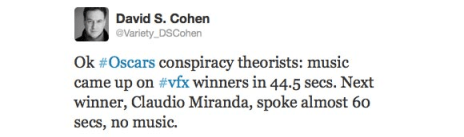
Ang Lee’s adaptation of the Yann Martel novel Life of Pi won the award for best VFX [visual effects], which I can only imagine was deserved because, well, I have not seen it. Bill Westenhofer, the VFX supervisor for Rhythm and Hues Studios, was giving his acceptance speech when he was cut off by music, as pointed out by Variety’s David S. Cohen:

Word on the street is that this is because of what he was about to talk about. See, it would be wonderful for Rhythm and Hues that they received so much promotion due to winning an Academy Award if they weren’t bankrupt. Westenhofer had planned on addressing the crisis within the industry during his speech, and was thankfully able to voice his thoughts afterwards to writer Bill Desowitz for his blog, where he said:

At a time when visual effects movies are dominating the box office, that visual effects companies are struggling.  And I wanted to point out that we aren’t technicians.  Visual effects is not just a commodity that’s being done by people pushing buttons.  We’re artists, and if we don’t find a way to fix the business model, we start to loses the artistry.  If anything, Life of Pi shows that we’re artists and not just technicians.

During his acceptance speech for best director Ang Lee forgot to thank his VFX collaborators at Rhythm and Hues, which prompted a letter from Phillip Broste, the lead compositor at Zoic Studios. It’s quite long, but I feel like quoting two of the last few paragraphs, because they really say quite a lot:

Mr. Lee, I do believe that you are a thoughtful and brilliant man. And a gifted filmmaker.  But I also believe that you and everyone in your tier of our business is fabulously ignorant to the pain and turmoil you are putting artists through.  Our employers scramble to chase illegal film subsidies across the globe at the behest of the film studios.  Those same subsidies raise overhead, distort the market, and cause wage stagnation in what are already trying economic times.  Your VFX are already cheaper than they should be.  It is disheartening to see how blissfully unaware of this fact you truly are.

By all accounts, R+H is a fantastic place to work; a truly great group of people who treat their employees with fairness and respect.  Much like Zoic Studios, the fabulous company that I am proud to work for.  But I am beginning to wonder if these examples of decency will be able to survive in such a hostile environment.  Or if the horror stories of unpaid overtime and illegal employment practices will become the norm, all because you and your fellow filmmakers “would like it to be cheaper.”

It’s no mystery that most summer blockbusters these days are built on the backs of animators, artists who spend hours upon hours trying to perfect the texture of wood grain or the way light reflects off of the ocean. Rhythm and Hues won two awards for Life of Pi, both the Academy Award and the BAFTA Award for Best Special Effects; they won both awards in 2007-2008 for The Golden Compass. This studio going bankrupt is like . . . . well . . . . an award-winning studio running out of money because they weren’t getting paid enough.

Untitled-1

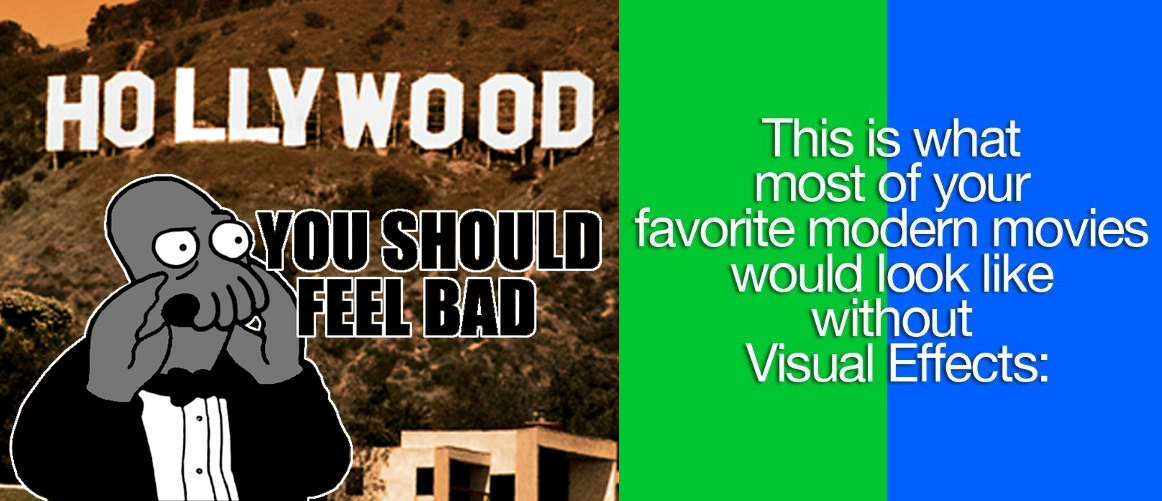
People who work in VFX are just as much artists as painters, musicians, and photographers, and all have the right to be fairly compensated for their work. Good art takes time and effort, and if Hollywood refuses to give those in VFX the respect and money that they deserve then we need to let them know how wrong they are. Tell people about what’s happening, tweet with the hashtag #VFXprotest, check out VFX Solidarity International, and don’t be okay with Samuel L. Jackson talking over Robert Downey Jr. just because you like the guy as an actor: