Category Archives: internet

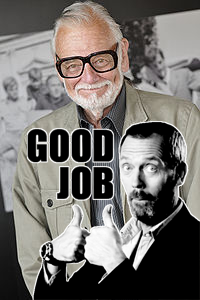
Fame Day: George Romero

Who invented Rock-and-Roll? Who should be credited as the inventor of the video game? Who’s responsible for the Zoidberg meme? Who is responsible for the way we celebrate Halloween?

Simple truth of the matter is, we can trace plenty of elements of culture to the general time period or people group where they originated, but never just who first came up with the idea of shoelaces, or “push it somewhere else Patrick.”

There’s plenty of our culture that we just accept without being able to credit the inventor, however, this Fame Day we’ll be shining the spotlight on someone we can.

The one and only George Romero, whose influence on our culture arguable is on par with Rock-and-Roll.

Romero, for those few of you who might not recognize the name, is the creator of such films as Night of the Living Dead, Dawn of the Dead, and Day of the Dead, and according to many the father of all zombies.

Now while that affectionate title has been attached to him, the fact of the matter is, Romero did not invent the concept of the living dead. What he did do, however, was bring the concept out of obscurity, and do it so well that his work has become the basis for all subsequent zombie-horror. Zombieland, The Walking Dead, Shaun of the Dead, Resident Evil, Left for Dead, World War Z, Plants Vs. Zombies, Stephen King’s Cell, “Thriller,” I am Legend, you name it. There’s hardly an aspect of our culture that hasn’t had some zombie influence or spin-off (even before our recent craze), and there’s hardly an aspect of the zombie mythos that hasn’t been cemented and popularized by Romero. The man has simply hit it out of the park.

Now I’m not saying you have to like zombies- you don’t. I’m not saying that you have to like the films of George Romero- I don’t. But you have got to respect a man who has had such a profound influence on not only American, but world culture over the past half century (that’s right, half-century).

So, George Romero, in this last minute before midnight on Halloween 2012, we here at Culture War Reporters are tipping our hats to you.

Fame Day: Racebending.com

This Thursday I want to call attention to a website that’s been in this blog’s links-sidebar basically since its inception. I came across Racebending.com around the time it began, and their stance on equality casting and representation in the media is one of the many reasons I decided it was time to start writing more about what I thought mattered.

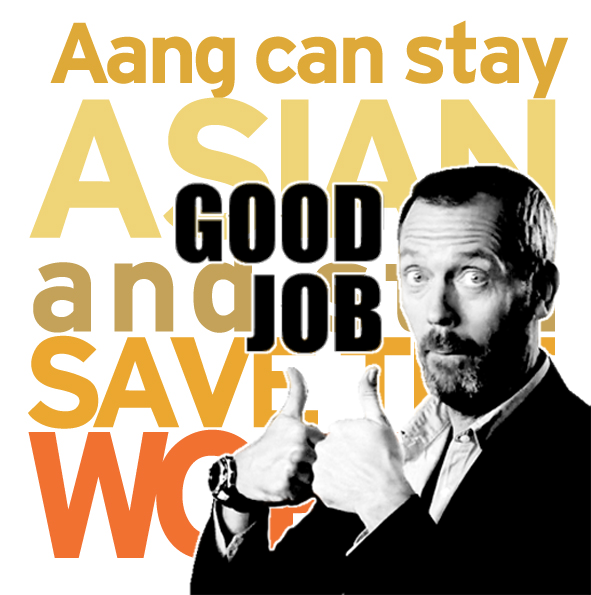
As their name might suggest, the site came about as a response to M. Night Shyamalan’s film adaptation of the Nickelodeon show Avatar: The Last Airbender. The entirety of the series was set in a distinctly Asian-inspired universe, and the casting decision was made to have the majority of the protagonists be played by Caucasian actors. The change is starkly apparent in the image below:

And for those of you who don’t think Zuko is a villain, click on the link for a thorough explanation.

The organization did a great amount in revealing the decisions that went into the making of the film. Most importantly was their breakdown of the casting calls that read “Caucasian or any other ethnicity,” and how the language affects those who apply for the roles as well as hinting at what they are looking for. They also exposed the blatant racism used by casting director Deedee Rickets, who was quoted as answering the question “Are you at a disadvantage if you didn’t wear a costume?” with the following:

Absolutely not! It doesn’t mean you’re at a disadvantage if you didn’t come in a big African thing. But guys, even if you came with a scarf today, put it over your head so you’ll look like a Ukrainian villager or whatever.

Although the movement was not enough to sway the studio, producers, or director of the film, the site stays up, continuing to work towards educating the internet on when and where whitewashing is taking place, and what people can do to stop it. They also take care to call attention to those who are advancing the role of minorities in the media, giving credit where it’s due.

Most recently the blog has been concentrating on the upcoming film Cloud Atlas, which stands out due to its use of “yellowface” by various actors. While the directing Wachowski siblings and others have cited the theme of reincarnation and  the fact that actors of colour will also be playing White roles, media liaison Mike Le lays out the stark difference between the two. In an interview with  the radio station Vocalo 89.5 he explains the tradition of yellowface in cinema as a means of controlling the perceptions of a race, and the damage it has done and can still do.

All in all, Racebending.com is run by people who are doing good things, and who care about representation whether it be based on race, gender, or orientation. They strive to see the media reflect the immense amount of diversity in our world, and that alone should be worth checking them out.

Culture, Not Criteria

Earlier today Evan sent me a link to a documentary on YouTube dealing with the subject of “hacktivists,” or more specifically, the rise of internet mischief and mayhem group “Anonymous.” For the most part, the movie was decent enough, though of course it wasn’t without its own agenda and a there are a few misconceptions resulting from that. But this post isn’t going to be a review. Rather, it’s going to launch off from an interesting phenomena I saw throughout the documentary- and that was the way people talked about Anonymous.

See, whenever people talk about the group, they usually have to veer off into a parenthetical speech where they try to explain just exactly who these guys are, and how at the same time they can be anybody, because anybody can be “Anonymous.” The end result is that they wind up sounding like a paranoid schizophrenic or conspiracy theorist, and the explanation itself doesn’t sound all that believable. After all, how can any individual or group take on the mantle and conduct whatever hacking or pranking or ranting they do against their enemies without some leadership? How do they do anything if they have no demands or agenda?

The problem here (and elsewhere, but we’ll get to that in a minute) is that a completely wrong lens is being used to look at the group. People are looking for structure or goals- the two things that usually define any collection of people, and that’s where it falls apart. Anonymous isn’t a group, it’s an idea. It’s a culture.

Now that sounds strange, but bear with me here.

What’s a conservative?

You probably have an image in your head right now. You can probably tell me what a conservative would think about a certain issue, or how he or she would act in a certain scenario, or the general value system one might have, but if I really pushed you for criteria, my guess is that you wouldn’t be able to give me one. After all- there are varying ideas of “conservatism,” and no real defined boundaries. You’ll find conservatives who state that the “religious extremists” have a skewed view of conservative values, and those same extremists offer the exact same criticism of those wimpy fiscal conservatives. Regardless of the specifics, once you stand back, both groups do fit neatly into the category of “conservative.”

Now apply the same general lens to Anonymous.

What’s “Anonymous”? It’s not a group with an ideology- it’s an ideology with a group, or rather, a whole bunch of groups. Consensus isn’t made through secretive discussion boards or by a clandestine collective of angry computer-geeks. Consensus isn’t made at all- actions simply stem from a general set of perspectives and ideas (the most major of which is freedom of speech and opposition to censorship) held by the adherents. Anonymous doesn’t exist as a coherent, structured group anymore than any culture or subculture exists as a coherent, structured group. Sure you’ve got your major players, and you’ve got various projects or movements within, but at the end of the day, there’s no list of demands, just a set of values.

The reason I bring this up is that this kind of organic organization is becoming more and more prevalent in our culture, the most notable example perhaps being the “Occupy Movement.” Critics of the movement, in its early days, continually parroted the protest of “But what do they want?“- the issue with that being that there was no, and never could be, any list of demands. Occupy wasn’t a structured or unified group- it was, like Anonymous is, a culture. A massive number of people sharing (and developing) certain common perspectives and values and then taking actions based on those views (those actions further developing those views, and so on ad infinitum). Trying to get demands out of Occupy protestors would’ve been about as fruitful as trying to get demands out of conservatives. You’re going to get conflicting specifics, even if there is a general set of guiding principles.

And of course, there are others out there. Though there’s no real term or name for it yet, there’s a rising “Manly” culture, comprised of elements of survivalists, masculinists, and guys who debate each other on-line about how to build porches and properly maintain classic muscle cars. Now I can’t claim to know the origin of this- perhaps it’s partly a reaction against our increasing dependence on technology, perhaps it stems from our powerlessness in a time of political and economic hardship- but either way, it is a growing culture based in principals of independence, self-sufficiency, self-control.

On the other side of the spectrum, there’s the general philosophies and ideas of the trans-humanists, futurists, utopians, geeks, nerds, and people who worship the ground Bill Nye and Neil DeGrasse Tyson walk on. Those who view technology as being the solution to most, if not all, human ills, and eagerly await the day when you can get a free jet-pack when you go in for your cancer vaccine.

Now why bring any of this up?

Because it’s important.

We’re currently breaking away from the liberal/conservative paradigm, and we’re going to need to understand what else is out there. This isn’t to say that we’ve only had conservative and liberal cultures- that simply isn’t true. But we can’t deny that there has been, over the past decade, developments of new value-systems which are really neither here nor there. New and alternative views for what the world ought to be, and how you ought to be in it. Over the course of the next few weeks, I’ll be focusing on dissecting these various concepts, so be sure to stop by next Monday for my examination of “Manly” culture.

Looking Back at a History of Booze and Bacon

It’s been pretty evident for a while now that a lot of you have gotten here due to a post I wrote almost exactly a year ago, “Epic Meal Time: Leaving Grease Stains on Pop Culture.” In it I extol the internet show and its evolution into something that ultimately rewards long-time viewers, as well as its impact on pop culture.

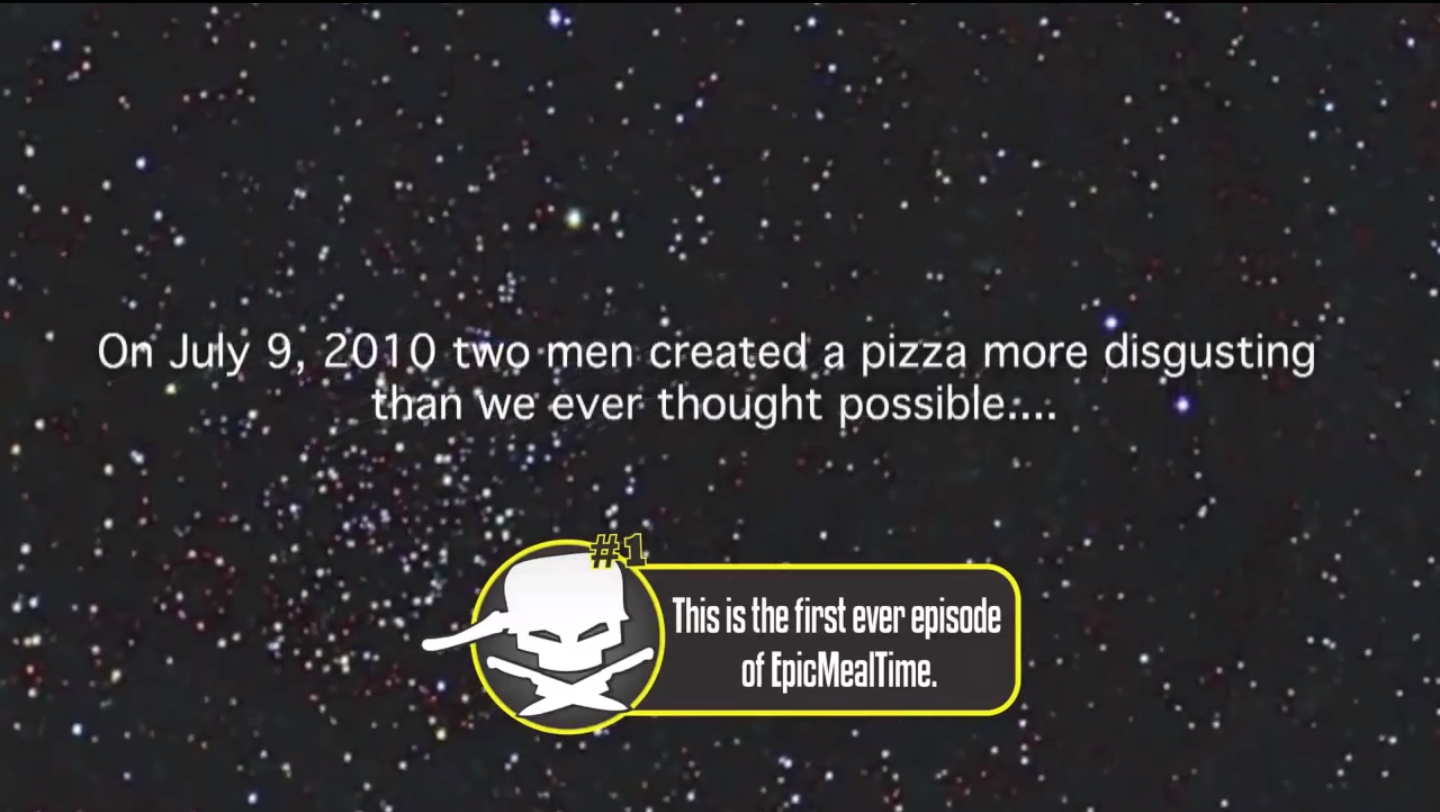
Coinciding with the anniversary of my original EMT post is the show’s second birthday, and a loving tribute to their first episode ever, the Fast Food Pizza. Video below:

While two whole years of epic meals is impressive enough, what got me even more excited is what the crew uploaded yesterday.

The new feature, going by the name “Flashback Friday” is a director’s commentary of sorts, presumably all done by creator and star of EMT, Harley Morenstein. Essentially the entirety of their Fast Food Pizza episode, the main difference takes the form of pop-ups that are very reminiscent of Xbox Live Achievements, or [probably more accurately] VH1’s Pop-Up Video

Additional changes include a bacon strip censor bar for Muscles Glasses’ eyes, as well as vocal distortion. From this point on they moved forward with turning him into a silent, powerful destroyer of fast food and liquor.

What I probably appreciate more than the fact that they made this video is that they haven’t removed the first. There’s a trend on the internet to simply remove or take down earlier work, or whatever you’re not proud of. Both Harley and Epic Meal Time are sticking to their roots in remembering the first video that got them where they are today. And that means not removing this video with Alex Perrault [as you’d call him sans aviators, I suppose], or another where they, believe it or not, actually use vegetables.

EMT announced on its twitter account that if fans liked the video then they’d continue to do more. While not all of the feedback was positive, I for one hope that the likes, and views, continue to multiply. Watching the behind the scenes of almost anything is interesting, even more so learning about the history behind two years of booze and bacon.

EDIT: After their fourth episode on YouTube the EMT guys have decided to move the show over to their own site. You can watch every one of the episodes here, where they continue to be put up every Thursday.

This S.H.I.E.L.D. Needs a Little Colour

In the wake of The Avengers‘ 1.5 billion dollar success it was inevitable that Disney/Marvel would be creating a sequel. They also decided to broaden both the universe and the franchise by green-lighting a TV series based on the organization in the comics, titularly named S.H.I.E.L.D.

It marks Joss Whedon’s return to television, as he will be both directing and producing the pilot. Acting as directors and producers, however, are his brother Jed Whedon and his sister-in-law Maurissa Tancharoen. The three formerly worked together on the online cult classic Dr. Horrible’s Sing-Along Blog, which actually leads me to the point of this post.

The DVD and Blu-Ray versions of Dr. Horrible a commentary track titled Commentary! The Musical, which consists of entirely new songs performed by the cast and crew. Track 10 was written and performed by Tancharoen, and I’ve embedded it here:

While obviously very tongue-in-cheek, as an Asian-American in the entertainment industry she’s more than a little aware of the imbalance in roles for racial minorities. Having her and Jed Whedon take off as showrunners if the pilot is a hit, this is a huge opportunity for a show other than Hawaii Five-0 to feature a good number of Asians in their main cast.

The perfect opportunity for this takes the form of S.H.I.E.L.D. agent James “Jimmy” Woo. Originally starting out with the FBI, he created and led the first ever super-hero team to exist with a government mandate. Although he later left to join the Agents of Atlas, Woo was a high-ranking member of S.H.I.E.L.D. and definitely a possible addition to the upcoming series.

In general, it’s exciting to have the comics come to the small screen as a live-action show. Cartoons like The Avengers: Earth’s Mightiest Heroes and the classic Batman: The Animated Series have proven very popular, but were directed at a younger audience. In recent years  The Walking Dead is the only program based on comics that has received any amount of positive attention.

Disney/Marvel have a chance, as they often do, to bring diversity through a form of media, this time television. With Jed Whedon and Maurissa Tancharoen at the helm, here’s hoping that we might even see our first ABC series headlining an Asian actor that is also a spinoff of a major motion picture based on a comic book.

Evan and Gordon Talk: Facebook and Privacy

EVAN: So in spite of the fact that I voted for my topic of preference on last week’s poll, Facebook and privacy and whatnot won. Having bitterly admitted that, Gordon?

GORDON: While the topic of Facebook (or all social networking) and privacy certainly isn’t a new debate, it’s not one that’s lost its relevance either.

As we rely on the internet more and more as our primary means of communication and entertainment, how do we address the issue of having every little element of our lives dissected and sold to the highest bidder?-

EVAN: I mean, really, everyone has been the target more or less of having their information used by Facebook. Log on and check out those sidebar ads; every one has been tailored using the cookies of sites you’ve visited. Which is why mine are always StarCraft related, etc.

GORDON: First thing we gotta ask is- “Is this really a problem? Aint it better to have ads that are actually relevant to you, rather than yet another ****ing insurance commercial courtesy of Geico?”

EVAN: Ugh, Geico. How many ad campaigns can a single company have?

EVAN: Moving disgustedly along, that’s a very relevant point. I’m interested in video games, so to have sidebar ads about such things is not something I can really complain about.

GORDON: I’ve got a pretty aggressive adblock, so I’m fortunate enough not to have to deal with that; but the underlying assumption with that kind of thought is that ads are inevitable. That you can’t get away from ’em, so you might as well try to get ones you like…

EVAN: Which is why, as you well know, I only thumbs up a select number of ad types on Hulu. Food, alcohol, video games, and certain movies.

GORDON: But with Hulu- you are the person in control. I mean, think of it this way: would you tolerate a guy going through your garbage so he can send you junk mail tailored to you?

EVAN: I’ve gotta think about that for a second . . . I mean, not getting junk mail about window/door services would be nice.

The whole “going through your garbage” thing definitely carries some different associations then simply tracking cookies. Maybe it’d be more like- a TV guy who follows you around when you shop, noting what you are and aren’t interested in.

GORDON: But that’s also flawed- in that scenario, you’re actually looking for stuff to buy….

EVAN: Well, you window shop, I mean- browsing, etc. Looking at what you look at, that sort of thing.

GORDON: So I’ve got this obnoxious guy following me wherever I go, listening in on my every word, and trying to sell me his wares without rest. Isn’t that one of the ironic punishments in Dante’s Inferno?

EVAN: Bringing this back to Facebook and whatnot, do we in general have a problem with the ads? I mean, they’re not the most obtrusive to begin with.

GORDON: Well, ads are only one example. What about your location?

EVAN: People want that stuff, though. It’s part of this new generation, tweeting where you are, statuses that read “I just had lunch with ______ at ______.”

GORDON: I’m not talking about when you state your location, I’m talking about when your location is pinpointed and used regardless of your awareness. Sexy Singles in Houghton being a prime example.

EVAN: Heh.

For context, Houghton is where we both attended college. It is so small it is not considered a town. It is a hamlet.

GORDON: The majority of the population- vast majority- is made up of the student body.

EVAN: Vast majority.

GORDON: Meaning that the town decreases by about 80% each summer.

EVAN: But those ads are all the same- they’re just slapping a different town [or hamlet] name onto whatever’s being advertised.

GORDON: But are you really okay with that? That not only your interests are out there, but your location as well? Regardless of your consent?

EVAN: As far as I can tell, it’s more eerie than anything else. And it goes from creepy to laughable when something like “Sexy Singles in Houghton” comes up.

GORDON: Now, as you are in Canada, this might not sound as relevant to your situation- but what about the gummint’ commin’ t’get’ ya?

I mean, there have been issues here in the States,  huge issues, with companies turning over personal information- including conversations- to law enforcement and security agencies without much (if any) process.

EVAN: Heh. “Gummint.” But yeah, that stuff has definitely happened. And seriously, what Facebook does with our personal information is very important.

GORDON: I guess it’s more or less the same for me- though I was a bit older, and having grown up in Syria (where they eventually blocked Facebook)- I never put anything on there I didn’t assume everyone could and would read.

Still do. Or don’t, rather.

EVAN: It’s interesting in that privacy settings are so much more advanced now though, in a way. If you don’t want people looking at even your profile pictures you can do that. Meaning that potential employers can’t use it as a legitimate check on future employees anymore.

GORDON: Now that  is messed up. We can all agree on that.

EVAN: Hm?

GORDON: Employers attempting to maintain control over their workers by monitoring their FB profiles, citing “character” as a reason or justification.

EVAN: Ah, that’s what you were getting at. So to some extent we’re in control of an aspect of our privacy on Facebook.

GORDON: No question. But speaking in a more general sense, what does that do to us as a people? As a society?

EVAN: Well, I for one am incensed when I want to look at a pretty girl’s profile pictures, and even though she clearly has them, I’m told that “there are no pictures in this album.” Bold-faced lies.

GORDON: You’re a pervert.

EVAN: My point stands.

GORDON: So we’re more dishonest with each other? We’re still ironing out the wrinkles in our old-world/cyber-world blend?

EVAN: Are we more dishonest with each other? I mean, if we’re really deconstructing this, the internet has made us more dishonest than we’ve ever been ever.

GORDON: Explain.

EVAN: Nothing we put online is necessarily true. Dating website profiles back me up on this.

GORDON: This is true. Are we then actually more skeptical and guarded despite the critics’ claims?

EVAN: Which are-

GORDON: The general spiel- the internet (social networking especially) is playing on our trust and making us more and more exposed for those who would make money off of us.

EVAN: Ah. Vulnerable, etc. I gotcha.

I’d say people in general are still naive enough to fall for obviously stupid ads [if they didn’t work they wouldn’t still be around]. But we are more skeptical as a generation, so really both are true.

GORDON: Fair enough.

EVAN: And we are exactly out of time.

GORDON: Remember to stop by next week for our discussion on the upcoming season of Community.

EVAN: Yes. It’s gonna be good. And I already know you’re going to end this with that Troy/Abed gif.

GORDON: I am indeed.