You can’t ignore Taylor Swift. Whether it’s having her mic snatched by Kanye, hosting Saturday Night Live three years ago, or having her hit “We Are Never Ever Getting Back Together” play as you flip through radio stations [yes, some people still listen to the radio] she’s become a public pop culture icon and she’s not going anywhere anytime soon.
Yes, she’s loved by millions, but also derided by a sizable number. While many of the judgements stem from her seeming inability to hold down a relationship, this more often than not seems like the public concentrating on an aspect of superstardom that they tend to turn a blind eye to when it comes to their respective favourites. What Taylor Swift really receives a lot of flak for [and for better reason] is the content of her music.
I first came across this idea on a blog post by Shelby Fero that has since been taken down. Recently I managed to dig it up again since it had been replied to on another tumblr, and you can check it out here. [EDIT: That has since been taken down as well] There’s a four-minute video you can watch, but if not, Let me recap it:
It’s a follow-up to another post on tumblr where she says, in one line without profanity, “‘Mean’ by Taylor Swift pisses me off so much.” Which is fine. The video goes on to elaborate her point, and is largely about the music video. In essence Fero says that it’s fine to have a song about those bullied because of their sexuality or poverty [both seen in the music video], but you can’t marry or compare that to your own problems about being told you’re not a good singer; you can’t put yourself into this song and still have it be about these other bigger problems.
Over the past couple years, the issue of regulating the internet has repeatedly arisen, and while there have been many issues contributing to this, there is perhaps none more well known than the contention over copyright infringement and piracy.
Now for a brief disclaimer.
I am a Marxist. I do not believe in “property” as the word would be recognized today. Every written work, every film, every piece of art belongs to every human being living. The Godfather series is just as much a part of our legacy and inheritance as the Mona Lisa, and as such, access to it should be enjoyed by all.
This is all to say that I don’t view “copyright infringement” as constituting any true offense. On the contrary, it’s simply the people taking back what was rightfully meant for them to begin with- but I’m not here to talk about that.
No, I’m here to talk about how the music and film industries’ witchhunt for media pirates is doing them (and everyone else) far more harm than good. Let me break it down for you.
I. Some People Will Never Buy
It’s a strange statement, but a true one. There may be a slim minority of people who pirates actually are keeping from the major industries through their cheaper/free service, however it ought to be fairly safe to say that there are plenty of people out there who would not otherwise listen to certain artists or watch certain shows. We’re living in tough times, and with your average movie ticket running at about twenty bucks (to say nothing of the gas getting to the theater and back), for many of us piracy is the only way we’ll see new movies and shows. Assuming there’s a segment of the population who will never, ever pay to see The Godfather, stamping out free avenues- namely piracy- doesn’t save the industry any cash. On the contrary, it just means that those people who don’t get to see the movie because they won’t pay for it aren’t talking about it, and generating buzz that might well attract people who will pay to see the movie. And speaking of them…
II. Some People Will Always Buy
Just as some people simply can not or will not pay (such outrageous prices) for entertainment, you will find people who will spare no expense when it comes to it. There are plenty of people who want to see movies on the big screen. There are plenty of people who want to see their band live in concert.The Mona Lisa is a perfect example of this.
You can see pictures of Mona Lisa anywhere; it’s one the most widely recognized images in human history. Because it’s available for free most anywhere, no one will actually go see it, right? After all, it’s been “pirated” to death. Yet that room in the Louvre is packed wall to wall with people who want to see the thing for themselves. Why? Because it’s the original. Doesn’t matter that it’s roped off, or behind glass, or barely visible, or that the guards usher you along after thirty seconds- it’s still wildly popular. The same is true of all media. Some people- plenty of people- will part with their cash to see Avatar in 3D, rather than watching some grainy, laggy version taken on a hand-held video camera in Thailand.
III. Anti-Piracy Hurts the Audience
You may not have experienced this in the states, but there was once a time when DVDs were listed by region codes, and could only be played on players that recognized that region. In other words, a DVD from America couldn’t be played on a DVD player from Europe and vice versa. You were granted a limited number of “switches,” but seeing as how you typically only got seven, it just put off the problem, rather than solving it. The goal (one of ’em, at least) was to prevent international piracy of DVDs through cracking down on how far away they came from, but all that just came down to it being a huge hassle for everyone, regardless whether or not their purchase was legitimate. Imagine all the time, money, and manpower that was invested in that venture that wound up solving nothing and quite possibly leading the industries involved to lose more money over that debacle than they would’ve lost to actual piracy. The same could be said for those hyperbolic ad campaigns comparing piracy to car theft
IV. Anti-Piracy Hurts the Industry
And while we’re talking about the industry shooting itself in the foot, let’s not forget the fact that preventing access to one film will very often lead to prevention of access to another. Quite simply, a person who doesn’t see The Godfather is not likely to go see the sequel, whereas someone who has seen The Godfather has a far better probability of winding up trying to see the sequel, either legitimately or through piracy. Is it a guarantee? No, but it’s still a better chance for the industry to make some cash than by preventing the person from seeing the first film at all.
V. Anti-Piracy Hurts the Environment
Lastly, I have to point out that we have free access to most films, music, and TV shows anyways- down at the local library. Only problem with that is when I drive to the library, I’m spending gas money, creating traffic, and spitting out exhaust fumes. Now I can get most anything down there for absolutely free, and no one complains. But imagine instead that I save on gas money, I keep the streets clear, and I reduce my carbon footprint by staying inside and watching the same movie I would’ve gotten free at the library. Suddenly, I’m a soulless criminal. Does that make sense to you?
What’s to be gained from all of this? Despite the doom-and-gloom prophecies of the industries, piracy continues on its merry path and yet we haven’t seen a decrease in the quality or production values of our movies.
We have more music artists now than we did a decade ago (at least, more access to them), in spite of piracy, and two of the most popular genres of our generation, techno and dub-step (I will never stop being ashamed of that) is heavily based on remixing and sampling other people’s work, i.e., piracy.
Look- I’m not asking the media giants to be happy about piracy, but at the same time, I have to question whether it’s really even worth it. All that cash being poured into anti-piracy gambits isn’t working– if it doesn’t already outweigh the revenue lost, wouldn’t all that time and effort be better spent elsewhere? Wouldn’t it be more profitable elsewhere?
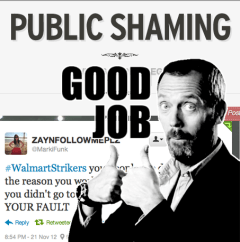
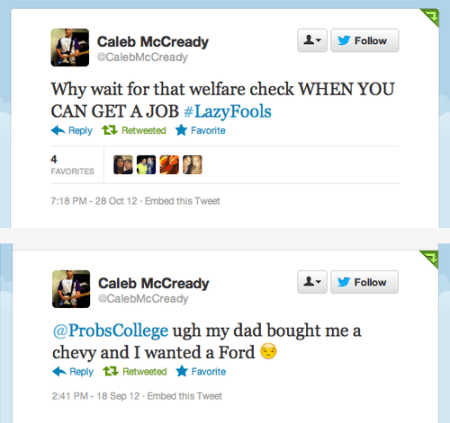
I started retweeting people complaining about welfare, food stamps, etc. and then following it up with a previous tweet of theirs that makes them look hypocritical/dumb/etc. I discovered that as I would retweet these, my followers would start @replying these people and let them know they were idiots. They would then delete their offending tweet. Well, I couldn’t let that happen. So, I screenshot away.
What Binder is very aware of is that Twitter is, by and large, a public forum. Anything that you tweet, unless your privacy settings are changed, can be read by anyone and everyone; my local Metro, and other newspapers around the world, have a section dedicated to them. This is something that people like Donald Trump often forget. As he mentions, once the tweets draw enough attention they are normally taken down. While this is unfortunate, screencaps serve to archive these tweets, and I’ve embedded a few for your viewing pleasure. The first two are a few of the more relevant ones, and the last is a wonderful showcase of hypocrisy:
In response to Korean pop artist PSY closing the American Music Awards.
Regarding a few Mexican high school marching bands and dancers marching in the Macy’s Thanksgiving Day Parade.
Just one of the many, many tweet comparisons that highlight the plight of the privileged.
A lot of the “tweets of privilege” happen to be teens and twenty-somethings writing about employment and the economy. There’s a definite trend of people saying that the jobless are lazy, when only months before they were complaining about being unemployed. What Matt Binder is doing with his blog is exposing hypocrisy where it so often festers [the internet], while also helpfully reminding everyone out there to watch what they say. If you stick your foot in your mouth out loud, there’s a chance someone will hear it, but less that someone will actually record it. On the other hand, making a tweet in poor taste about someone’s dead brother online is really all it takes to get on the news. So let’s give a round of applause for this Tumblr and its creator, and for what it is on the internet: a shining light that unveils the words of the wealthy and unwise. You can follow Matt Binder on Twitter at, easily enough, @MattBinder.
The last of my installments (for now) in looking at these rising alternative cultures is “Free Information Culture,” which shares the same problem with “science” culture in that there’s really no good name for it yet. I’ve referred to it before as “internet culture,” only the problem with that is that, like “science culture,” it isn’t so much the culture of the thing itself as the culture of the fanbase. In simpler terms, it’s the difference between Hollywood culture and movie-lover culture- it’s the end product that’s valued.
So what’s the internet’s “end product”?
Besides porn and stuff like this…
Free Information.
Whether it’s the news, or Wikipedia, or TED Talks, or Imgur, or anything else imaginable, it’s on the internet for free and public use. It’s something of a great equalizer. No matter where you’re from, what language you speak, what class you hail from- you can create or say anything and then get called gay in the comment section.
And while that last bit is sort of a joke, it does play a role in developing the “free information culture.” Granted, general anonymity can make us vicious and vile people, but it also (to some extent) strips us of our egos. When you make something online, you really don’t get much, if any, credit, but that’s alright since it isn’t the point. It’s just about creating, nothing more or less. Who drew the first rage face? Who started up Bad Luck Brian? Who edited and sourced that one Wikipedia page you used to stitch your last minute term-paper together? Who puts together those monthly fail compilation videos? I don’t know and will probably never know, but I do know that they’ll keep coming because of the simple joy of creating them. I and every other person with a half-decent internet connection.
And all of this simply isn’t understood by some people.
Recall the massive outcry against the SOPA and PIPA bills? What prompted the creation of these acts was that some people- certain corporations in particular- couldn’t quite wrap their heads around the idea of free and unlimited access. Now maybe you agree with them, and maintain that posting copyrighted material of any kind is piracy and immoral, however, what needs to be understood is that this was viewed as an act on the very nature of the internet and everything it had come to represent.
Again excluding porn and stuff like this…
Now more and more companies are catching on to the idea that it’s wiser to try to work with the faceless and vengeful cat-worshippers of the internet than against them- just look at video game companies that are starting to work in tandem with modders. The game Minecraft in particular is a good example of this, as many of the new aspects of each update to the game coming from the fan-forums themselves. Nevertheless, there are still plenty of people out there (I’m looking at you, Music Industry) who continue to struggle (vainly) against the dissemination of what they view to be the “information wants to be free” crowd.
Again, it all boils down the core of the culture that the internet has produced, gravitating around the concepts of freedom and egalitarianism. Look at Wikileaks founder, Julian Assange.
If he did his work back in the early 90s, we can be pretty sure he’d be viewed overwhelmingly as a candidate for a James Bond villain. But today we (for the most part) view him as being a heroic (or at least positive) figure in a world that’s become increasingly secretive and unequal. Why this dramatic shift in perception? Again, it’s the internet and it’s affect on us. In a time of economic crisis we might not be able to go to the movies, or eat out, or drive for miles to see a friend, but we can watch something online, or browse recipes, or video-chat with the same buddies that you’d otherwise not be able to see. Any threat to your full and unrestricted access to the internet is, by proxy, a threat to some of the last pleasures you have left.
Hence the formation of a culture obsessed with the values of free speech, free access to information, and freedom from censorship. And with every development of the internet or our access to it serving as another leap in the evolution of the culture, it’s safe to say that the howl of anger that the governments of the world met when trying to create such bills as ACTA is only going to intensify.
A long, long time ago, back before it was announced that Bane would be the “big bad” in this summer’s The Dark Knight Rises, Bat-Fans everywhere were talking villains. Who would square off against the Caped Crusader next, and who would play him or her?
The most popular pick was The Riddler, as he was deemed the one most suited to Nolan’s gritty, realistic world. It didn’t take long after that for people to settle on the actor most qualified to take on the role: Neil Patrick Harris.
This was popular enough to warrant at least twoseparate Facebook petitions, fan-made posters [see above], and even a fake movie trailer. A month before the actual film hit theatres everywhere the people at ScreenCrush decided to announce that they too thought that NPH looks like the Riddler. He was even the picked for the role in a post on this blog that I did not write; just a reminder that my fellow writers and I will (and do) not always agree.
Even more recently, I read a post on reddit titled “My personal pick for the flash.” The accompanying image was a photo of Neil Patrick Harris. I disagreed, and, before you fly into some/any sort of rage, let me defend myself.
I love How I Met Your Mother. That being said, I really, really enjoy the character of Barney and the nonstop energy and enthusiasm the actor brings to the role. It’s how most people know the guy, and I can see why most people are struck with how, well, awesome he is. But after I saw the aforementioned post on reddit and composed a reasonably put response, I knew what I had to do:
To start with, let me list the last few movies in NPH’s filmography, in descending order:
American Reunion [2012]
The Muppets [2011]
A Very Harold & Kumar 3D Christmas [2011]
The Smurfs [2011]
Beastly [2011]
Comedies and children’s films. To be fair, Beastly appeals to more of a younger, Twilight-loving crowd, and it’s also where Harris plays his most serious role: a blind, wacky, wisecracking tutor.
That’s not to say that he can’t pull off emotional depth. HIMYM‘s Barney doesn’t go through every relationship like it’s nothing, and more than a few times has to face the fact that maybe he does want love, or at least stability. Dr. Horrible’s Sing-Along Blog, which you should all watch if you haven’t, is a really enjoyable musical about a supervillain, but also has some deeply heart-wrenching moments.
In spite of all that, I just don’t think Neil Patrick Harris has what it takes to take on the role of a member of Batman’s rogues gallery, or don the cowl of the Fastest Man Alive. Just because he voiced Nightwing in the very well-done animated film Batman: Under the Red Hood doesn’t make him qualified to do anything similar live-action. The headlining role in an independently done musical is not the same as a film in a huge franchise.
If his HIMYM co-star Cobie Smulders’ performance as Maria Hill in The Avengers is any indication, he won’t do a terrible job, he just won’t do great. Neil Patrick Harris is an immensely talented actor, singer, and dancer, but I don’t believe he’s not the next big thing in comic book movies. Feel free to disagree.
Now that’s a lousy title, so let me kick things off by immediately clarifying what I’m talking about. This isn’t academia, or the world of contending theories and thirty-page papers on the finer points of psychopharmacolgy in relation to the mating habits of the Atlantic bluefin tuna. While this kind of world certainly does exist, it’s not what we’re talking about here. This is the culture not so much of scientists, as it is of science fans: those who are becoming increasingly invested in the idea that advancements in our knowledge is not only inherently awesome, but the solution to many, if not most or all, of the world’s problems.
“But Gordon, you striking portrait of wisdom and nobility,” you may be asking, “don’t we all fit that category?”
And to some extent, yes, we do. Even the most hardcore Luddite or primitivist will applaud the polio vaccine or HIV medication, but even so, there is a growing number of people who take things to the next level entirely. Check out this trailer:
Kind of a crazy premise- guy transfers his consciousness into a machine body. But still not too far off from the way many people believe we’ll eventually be living. “Transhumanism”, they call it, which, to grossly simplify it, is the general idea that the best (or even inevitable) course of human existence is to “evolve” beyond the confines of our biology. That with the progression of science and technology we’ll stop the effects of aging and be capable of improving upon our own minds and bodies. If you wanted to find a decent illustration of this kind of issue, try watching Battlestar Galactica (the new ones), or better still, Caprica. Now this is an extreme element of this culture, but a contributing element nonetheless. Major advances in prosthetics over the years, as well as films such as Surrogates, Gamer, Avatar, The Matrix, I, Robot (heck, any film or media dealing with the whole “what makes a person a person?” question) have all been instrumental in introducing transhumanist ideas. But of course, it’s more than just that.
It also has a lot to do with these guys:
These guys right here are arguably responsible for popularizing this entire culture, breaking down even dry subjects and making them compelling and (relatively) easy to grasp, even if only on the most basic level. You probably won’t go off to revolutionize the world of astrophysics after a few episodes of Cosmos, but chances are you’ll come away amazed. Would the recent Mars landing have had the same widespread popularity as it did without these guys? Would the cutting of manned space-missions have been met with the same outrage? Almost certainly not.
To some extent, the decline of religious adherence in the West may also be a factor in this culture. A growing number of individuals in the US are simply reporting themselves as being “without religion,” and the “science culture’s” emphasis on altruistic humanism (more on that in a minute) and skepticism offer a sympathetic atmosphere. The fact that many leaders (or at least, poster boys) for the culture are atheist (Mythbusters’ Savage and Hyneman, for example) or agnostic (Neil Degrasse Tyson) is also certainly a factor.
And perhaps the most fundamental element of all in this culture is the concept of “post-scarcity.” Quite simply, it’s the idea that we have progressed to a point where we no longer have scarcity of resources. E-books are typically used as an example, with adherents of the idea pointing out that with almost everything ever written in human history accessible in digital form, we could potentially give access to everything ever written to every man, woman, and child who will ever live without ever cutting down a single tree. The same logic is applied to film and music as well.
All of this combined creates and fuels a culture based ultimately on values of human welfare. In many respects, it’s the polar opposite of the “manly” culture discussed last week, emphasizing interdependence rather than independence, cooperation rather than competition, and progressive and postmodern social norms rather than traditional ones.
So what are the pros and cons of the culture?
Positives:
The fundamentally altruistic and humanistic elements of the culture are certainly something to be admired.
Money goes into scientific research, and cures and advancements come out; you can explain that.
Quite simply, the idea that we, as individuals and societies “aren’t done yet” creates a great atmosphere for experimentation, advancement, and general optimism about our conditions.
Negatives:
We could talk about playing God and paternalistic big-government and all that, but ultimately, the issue of the “science culture” is a fundamental misunderstanding of the way things actually are in the world. While it’s certainly true that there’s enough to go around, we simply aren’t a “post-scarcity” world. The vast majority of the planet is desperately poor, and their needs have to be met. The culture’s basic tenets also have the issue of seeming to assume that science is the answer to everything- that we can maintain our (general) levels of consumption and simply have our decadence off-set by the latest, greatest advance in clean energy. Now even if you assert that our problems can be solved by a use of technology to give us a surplus of everything we could ever possibly need, the same fact of the matter is that those technologies do not yet exist. The entire outlook is, quite simply, utopian, and while optimism should be applauded, it desperately needs to be tempered with realism.
And that’s it for today- be sure to check out Tuesday’s “Shame Day” post, and check in next time for our look at “internet/free information culture.”

 You can’t ignore Taylor Swift. Whether it’s having her mic snatched by Kanye, hosting Saturday Night Live three years ago, or having her hit “We Are Never Ever Getting Back Together” play as you flip through radio stations [yes, some people still listen to the radio] she’s become a public pop culture icon and she’s not going anywhere anytime soon.











 That’s not to say that he can’t pull off emotional depth. HIMYM‘s Barney doesn’t go through every relationship like it’s nothing, and more than a few times has to face the fact that maybe he does want love, or at least stability. Dr. Horrible’s Sing-Along Blog, which you should all watch if you haven’t, is a really enjoyable musical about a supervillain, but also has some deeply heart-wrenching moments.


