Category Archives: writing

A Comic Lover’s Opinion on “The Bakersfield Expedition” [Last Night’s Episode of The Big Bang Theory]

I love comics. In no way should this be a surprise to anyone who’s given this blog more than a passing glance. I also love television a lot, and when the two happen to overlap you can be assured that you have my undivided attention.

Yesterday I wrote a little bit about Bleeding Cool’s response to The Big Bang Theory episode “The Bakersfield Expedition”, half of which revolved around the premise that the show’s female cast would be entering a place traditionally closed off to their gender. I was able to catch the show last night and have many thoughts, but my ultimate conclusion is this: It really wasn’t that bad.

The guys, Sheldon, Leonard, Raj, and Howard are all off to the Bakersfield Comic-Con, so the girls enjoy their weekend alone by having brunch [an idea celebrated by the character we all know is an alcoholic, Penny].  While sitting around and enjoying their croissants and mimosas, Amy states that she doesn’t get why the guys go to these conventions. To which Penny responds:

“The four of them work at a major university, they’re all super smart, how can they still be into something made for 12-year-olds?”

Which did not please me. Having given it a second viewing, however, I realize that it’s a believable response and the perspective many people still have on the medium today. Bernadette suggests that they try to become a part of their significant others’ lives by seeing what the big deal with comics is, and soon they’re all off to their LCS [local comic store].

As the promo advertised, the following does indeed happen:


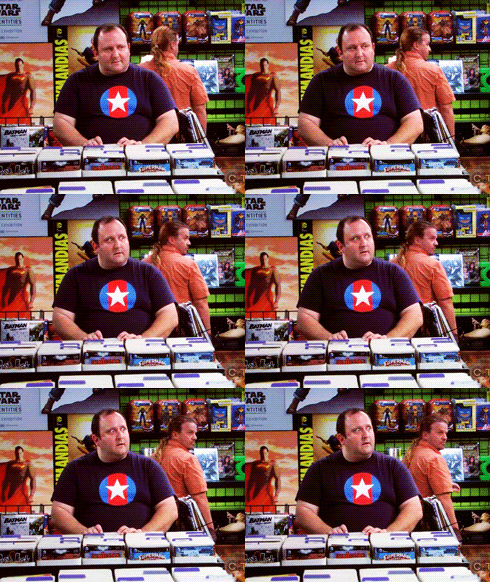
But it’s a quick gag that thankfully doesn’t overstay its welcome. Owner of the store and new series-regular Stuart is quick to chastise his socially awkward clientele and is soon talking to the girls about comic book recommendations.

Amy’s direct approach of asking “Alright, well who’s the best super hero?” and Stuart’s haste to nip that line of questioning in the bud was fantastic. There isn’t really any media that’s cut and dry as far as what “the best” is, and his whispered “What do you want to do, start a riot?” communicated well that this is a pretty contentious topic in certain circles.

Stuart also does a great job in saying that there are many different kinds of comics, and a little later on that there are different types of super heroes as well. The character really shines when he recommends to the ladies the incredible Fables #1, about which he says:

“The artwork is sophisticated, it’s intelligently written and it doesn’t objectify or stereotype women.”

Unfortunately Penny ultimately chooses for the group when she looks over and sees an issue of Thor and notes that:

Back at the apartment Amy and Bernadette sit quietly as they wait for Penny to finish the twenty-or-so-page issue. The following exchange occurs:

Amy: “There was a lot of action, the story moved along at a brisk pace, it was overall, what’s the word I’m looking for?”

Penny: “Stupid”

Amy: “So stupid.”

This upset me when I first watched it, but upon finding out the title was Thor, God of Thunder #2, written by Jason Aaron and illustrated by Esad Ribic I was dumbfounded. The Big Bang Theory has always been really good about keeping their comics contemporary, and the stock in Stuart’s shop actively changes to keep up with what’s new on the stands, but this was something else entirely. Aaron’s new Marvel NOW! title follows the character as he grows from a young, brash god to the hero we all know today and then further on to his role as the future king of Asgard. It’s masterfully written, and features artwork like this jaw-dropping splash page [which also happens to be my current desktop wallpaper.

I’m willing to assume, probably correctly so, that the show was in no way actually referring to anything in the actual book [though it would not surprise me to have an entire page featuring the single word “Krakka-DOOM” in a Thor title].

Then, as the three gripe about the waste of time that is their boyfriends’ [and husband’s] pastime, Bernadette notes that “It’s crazy, they spend hours arguing about things that don’t even exist!” And then things get interesting. Penny mocks the idea of a “hammer so heavy that no one else can pick it up” and then before you know it the girls are deeply debating the fundamentals of who or what can wield Mjolnir.

A lot of good points are bandied back and forth, but the best is easily Penny’s observation that:

“If we were in outer space, anyone could pick up the hammer  because it would be floating around in a weightless environment that’s right the slow reader used science suck on that.”

Wonderful. I say that without a trace of sarcasm.

After a fairly unenjoyable pan back to whatever it is the guys are doing we return to see that the girls are in Sheldon and Leonard’s apartment, eating takeout with comics strewn all around them. They are still talking about Thor’s hammer. Then the following exchange happens [and this is my last quote, I promise]:

Bernadette: Red Hulk must be worthy.

Penny: How can Red Hulk be worthy?

Bernadette: You don’t know his life!

If there was any laugh-out-loud moment of this entire episode that was it.

Coming away from watching “The Bakersfield Expedition” for the second time [which I did to write this post] I have to say that I quite enjoyed exactly half of it. Absolutely no part of me was invested in the guys trekking [ah ha] around the desert as a Federation landing party. What I was interested in was watching three characters, formerly wholly unfamiliar with comic books, arguing intensely about a matter which, and I’ll be honest, is not important in most senses of the word.

While The Big Bang Theory has often taken the nerdier passions and portrayed them in a fairly mockable light, it was certainly not so in this episode. Yes, comic books were referred to as something for twelve-year-olds, but Stuart does a great job in telling both the girls and the audience that it’s a broad, diverse medium that has beautiful illustrations and excellent writing, as well as a little eye candy for the ladies.

Rich Johnston at Bleeding Cool thinks they did a passable job at addressing comics, but continues to assert that it’s still The Television Show That Hates [Comic Book Fans]. The episode review over at The A.V. Club’s TV Club actually referenced the Bleeding Cool movement [which you again read about in yesterday’s Fame Day post] and similar to what I did focused mainly on the girls’ plot for this episode. The comments section of that review go over the age old conversation of how the show treats its subject material and its potential audience, but that is another post for another day.

All I have to say is that I was pleasantly surprised by the episode, and enjoyed it much more than I thought I would. I also finally received the second volume of Mark Waid’s Daredevil, so this is not a day on which I can feel unhappy. Here’s another picture of Thor from Issue #4 of Aaron and Ribic’s title for all you lovely people.

Taylor Swift and Artistic Intent

You can’t ignore Taylor Swift. Whether it’s having her mic snatched by Kanye, hosting Saturday Night Live three years ago, or having her hit “We Are Never Ever Getting Back Together” play as you flip through radio stations [yes, some people still listen to the radio] she’s become a public pop culture icon and she’s not going anywhere anytime soon.

Yes, she’s loved by millions, but also derided by a sizable number. While many of the judgements stem from her seeming inability to hold down a relationship, this more often than not seems like the public concentrating on an aspect of superstardom that they tend to turn a blind eye to when it comes to their  respective favourites. What Taylor Swift really receives a lot of flak for [and for better reason]  is the content of her music.

I first came across this idea on a blog post by Shelby Fero that has since been taken down. Recently I managed to dig it up again since it had been replied to on another tumblr, and you can check it out here[EDIT: That has since been taken down as well] There’s a four-minute video you can watch, but if not, Let me recap it:

It’s a follow-up to another post on tumblr where she says, in one line without profanity, “‘Mean’ by Taylor Swift pisses me off so much.” Which is fine. The video goes on to elaborate her point, and is largely about the music video. In essence Fero says that it’s fine to have a song about those bullied because of their sexuality or poverty [both seen in the music video], but you can’t marry or compare that to your own problems about being told you’re not a good singer; you can’t put yourself into this song and still have it be about these other bigger problems.

Continue reading

Evan and Gordon Talk: New Lit. Genre

GORDON: Ladies, gentlemen, voices I hear in my head during the dark, long hours of the night, we’re going to deviate from our past record of discussing television to talk about creating a new literary genre.

EVAN: Which is a daunting task, to say the least. I mean, genres have gotten ridiculously specific as of late. There’s a “gay horror” genre now. It’s not something to spook homophobes, it’s literally horror fiction for homosexuals.

GORDON: There are so many terrible, ignorant jokes I wanna make right now, but I’m not going to. But I agree- we can’t just slap two genres together. Poe is credited with inventing the deective novel- is there a particular profession that hasn’t really been explored much?

EVAN: Hm . . . Everything dramatic and even slightly connected to death is out. That includes forensic scientists, doctors or any sort, lawyers, etc. And the thing is, a genre that revolves around a profession requires an exciting one.

GORDON: Would it count if we revived the explorer/exploration novel?

EVAN: Not if the title of this post is “Evan and Gordon Talk: New Lit. Genre.”

GORDON: Touché. Here’s an idea: a “Nietzschean” novel.

EVAN: Go on-

GORDON: Well, to brutally simplify the philosophy, the only “bad guys” are the people who aren’t doing anything. Otherwise it’s more like an epic tale of colliding forces all of whom technically could be the protagonists and antagonists.

EVAN: That’s an interesting direction, but I suppose my issue is how alternatingly broad and specific it is- So in these novels you’re proposing, the only villains are the idle?

GORDON: the idle, the apathetic, those trapped by their antiquated sense of morality, and those enslaved to their brute instincts and empty rationality.

EVAN: I suppose it works, but have difficulty seeing it as the header to a shelf in a bookstore. Which is sort of what I was envisioning we would do in creating our new genre.

GORDON: Huh. What’s your idea?

EVAN: Well, this isn’t my idea, but I recently came across this brilliant new novel put together by Ryan North, creator of the webcomic Quantz.

GORDON: Go on.

EVAN: He Kickstarted it and it made like, twenty times what they asked for, but basically it’s Hamlet, but a Choose Your Own Adventure story. And it’s for various characters, too- like, you can read as Hamlet’s father, who eventually must die to become a ghost, et cetera.

GORDON: Huh. If we’re going down that track, how about a novel written in such a way where you can rip out certain sections, rearrange ’em, and wind up with a completely different story?

EVAN: It would work, but sounds exceedingly difficult to pull off. I’m trying to think of how exactly one would go about writing one . . .

I think, keeping in discussing literature, we could devise a new medium of sorts- it would be a marriage of the graphic novel and the traditional novel. Heavy on both text and imagery, a seamless integration that showcases both the artist and the author.

GORDON: That’s sounds like your average Alan Moore book.

EVAN: The Watchmen comes close to it, but it’s ultimately still a graphic novel which prioritizes that sort of storytelling over the bits of prose sandwiched in between the panels.

How about we look at steampunk, and see if we can branch out from it? That seems to be the newest sort of genre out there nowadays.

GORDON: Fair enough. I’m just struggling to figure out an era of technology to “punk.” After all, steam power was really the first major leap in technology.

EVAN: And “cyberpunk” is already a thing as well.

Thanks, tumblr, for once again providing the perfect gif.

GORDON: This is true. But what else is there? Modern tech? “Modpunk”?

EVAN: Well, we don’t necessarily need to “punk” something. We just need to look at what makes/made steampunk so popular and work off of that-

GORDON: It’s the art, the world, the fancy suits. But yeah, it’s the rich world that’s created; it appeals to us.

EVAN: It’s also a union of history junkies and the sci-fi/fantasy crowd, I think that’s a pretty large aspect of it.

Are there two sort of interest groups that we can intertwine? I mean, it’s already been done with horror and romance, long before Stephenie Meyers ever came along.

GORDON: Huh. I’ll admit, I’m having trouble trying to think of one that hasn’t already been covered. As of yet, I think my Nietzschean idea was the strongest lead we yet have.

What if went down that route? Trying to twist philosophies into narratives- the allegory of the cave would make a good story.

EVAN: I think the main issue is how broad it could get- though I suppose it could just be “Philosophical Fiction.” That I could see in a bookstore.

GORDON: That’d be cool. I mean, it all appeals to the questions and struggles we already have. Yet barring Rand (may raccoons urinate on her grave) and LeGuin, I can’t think of any explicitly “philosophical” novels.

EVAN: That may speak for their effectiveness/popularity.

I was thinking about taking a genre that’s immensely popular to this day, and smashing it together with another one. Self-help books.

GORDON: Heh.

EVAN: People eat ’em up.

GORDON: I’m just imagining a really sarcastic self-help book.

EVAN: Comedy and self-help has probably been done . . . hm . . . I would love to see a whole line of books that masqueraded as self-help books that you could gift to the naive.

GORDON: Heh, that’d be cool.

EVAN: They’d be excessively over the top, but just believable enough for people to [literally] buy them.

GORDON: That’d be funny, but it’s really not a genre.

EVAN: I think if self-help books are a genre then fake self-help books would be as well.

GORDON: It’s really more of a gag.

EVAN: Yeah, I suppose you really couldn’t have that many of them.

How about an exaggeration of the choose your own adventure book?

GORDON: Like forcing you to branch out into multiple novels?

EVAN: Ooh, that’s an idea! So your choices would determine what novels you get next; that’s brilliant.

GORDON: Ain’t it? You’re welcome, America.

EVAN: And Canada. And the world. Let’s open up our borders here.

GORDON: Except Luxembourg. **** you guys.

EVAN: You don’t even know anyone from Luxembourg.

GORDON: Exactly- what makes ’em think they’re so good they don’t talk to me?

EVAN: We are going to lose the viewership of an entire country because of you.

GORDON: Boo hoo.

EVAN: All . . . possibly one of them.

GORDON: Hey, Luxembourg! Andorra called, they want their quaint charm and history back!

EVAN: And with the slamming of an entire nation done, and with a few very decent ideas about exciting places literature could go, we should look forward to what we talk about next-

GORDON: New film style?

EVAN: Seems like we’d be following very closely the same sort of conversation. Not to mention really most of what can be done has been done.

GORDON: This is true.

EVAN: Hm . . . How about . . . nerd culture, just in general- The Big Bang Theory, the current conversation about “nerd girls,” the whole shebang.

GORDON: Sure thing.

EVAN: Okay, that fully wraps up our time. Say good-bye to the nice people, Gordon.

GORDON: AAAAAAAAAAAAAAAAAAAAAAAAAAAAAAAAAH!

I’m lousy at saying good-bye.

EVAN: I don’t know what I expected.

You can vote below as usual, if you’d like.

The Horror, The Horror

Today, I’m going to talk about horror.

Not “frightening stuff,” mind you- horror. There’s a distinction, you see.

Fright is the simple biological jolt you get when something startles or surprises you- a door being slammed, a discordant note blaring out of nowhere, and so on. Tragically, the title of “horror” gets slapped on things (typically movies) that merely have “jump-scares.” Horror on the other hand, is anticipation and dread at the perception of something threatening on a fundamental level.

So why talk about this? Because despite the outcry of some, horror- especially horror movies- holds a special place in our culture. Indeed, horror holds a special place in all cultures, and has since the first Cro-Magnons huddled around some arctic fire and whispered about strange and terrible things lurking just outside the circle of light. What we’re afraid of tells just as much about us as what we admire; a perfect example being Evan’s post on the remake Red Dawn. Evan cites that one of the reasons the new version doesn’t work is because the concept of the US being invaded is today laughable (especially by North Korea, whose entire population could fit into LA county with room to spare), whereas in the 1980s, the fear was far more realistic, or at least, believable.

Now I’m not here to analyze the past decade’s better horror movies and tell you what it is that we seem to be afraid of (not right now, anyways). In this post I’ll just be breaking down the three basic kinds of horror we seem to be responding to.

Fear For Self

First, we have the fear that attacks our egos- not “egos” as in pride, but “egos” as in the psychological term for you. This fits into the greater psychological element of “external anxiety,” meaning the stress we feel as a result of outside factors, such as school, our jobs, hunger, pain, and so on. When we’re afraid for our safety, or empathizing with characters in a movie or TV series who are fearing for their physical safety, we’re looking at this “fear for self” kind of horror. A good example would be any serial killer or monster movie- Psycho or Jaws being the best examples. Now usually we tend to botch this kind of horror, because the protagonists in movies or stories do things we would never do (blonde female college camper running through the woods at night, I’m talking about you). However, when it’s pulled off well, it leaves a noticeable mark on us. It has been said that Jaws created a significant drop in beach-goers after it was released, and you are a dirty liar if you say you’ve never once looked behind the curtain when you go into the bathroom.

Fear Of Self

Just as we have anxieties that stem from external factors, we have stresses and fears that come from within us: “Internal anxiety.” It was theorized by early psychologists, Freud in particular, that our mental issues were a result of us denying or repressing elements within us, most notably the “id”- that part of our mind with all the bloody, vicious, sexual animalistic drives that typically didn’t mesh well with Victorian (or any) society. As with the ego, horror works on this pathway as well- our fear of ourselves. All that madness and evil that we, for the most part, pretend isn’t there. The most obvious examples of this would be werewolf movies and vampire movies (obligatory “**** you, Twilight“) and most any film depicting a change or evolution the protagonist- see Dr. Jekyll and Mr. Hyde, The Wolfman, Dorian Grey, etc.

Fear Of No Self

Lastly we have stress and anxiety attacking (or coming from, depending on how you look at it) the “superego”- that element of our mind consisting of our real or imagined nobility, propriety, decency, etc. Here we encounter “existential horror,” more often called “cosmic horror.” This particular form of horror can be found in movies where the protagonists are fighting a losing battle against some massive, all powerful being- typically otherworldly in nature. Alien invasions and zombie uprisings are both good examples. Here we’re confronted with the fear that we are, in spite of all of our strength, morality, charity; in spite of our humanity, we are actually inconceivably small and insignificant. Ants who have just become aware that there are beings in the universe of incomprehensible magnitude whose simple existence negates everything about them. That unique feeling of powerlessness is separated from “ego fear” in that this form has a distinct hopelessness, rather than helplessness, attached to it.

Of course, every horror story has all three of these elements in it, but what kind of horror story it winds up being depends entirely on what is emphasized. Take AMC’s The Walking Dead– you’ve got your physical fear of the zombies, your id-based fear at what this new world is bringing out in you, and the general horrific despair at the absolute hopelessness of your situation, both in the face of zombies and the truth of human nature. What you wind up being afraid of depends on which element really gets pushed (survival, rationality, hope) and of course, what you individually, and we as a society, find most terrifying.

So what do we fear as a society right now?

Well, with the rampant popularity of zombie stories, and “disaster” films such as Cloverfield, Skyline, and even the whole “Slenderman” craze; it seems to me that we’re torn between physical and existential horror. And perhaps in an economic depression, that’s understandable- after all, we’re confronted with the physical job of keeping afloat in a rough time, and as the crisis drags on and on, the general feeling of hopelessness with regards to our general situation. We respond to characters whose immediate needs are threatened and characters who are struggling to maintain themselves in the face of cosmic nothingness.

At least, that’s my take on it. Feel free to debate me in the comments, and stop by tomorrow for another Shame Day installment.

Evan and Gordon Talk: The Walking Dead

GORDON: Ladies and gentlemen  devoted readers and people who found our blog by googling “dokata fanning playboy.” We’re were to have a frank and open discussion about “The Walking Dead,” both the critically acclaimed television series and Robert Kirkman comic books of the same name.

EVAN: I’d like to issue a fair warning to those who haven’t read the comic series or caught up on the show that there will be SPOILERS. You have been duly warned.

GORDON: Indeed. I’d like to kick things off by talking a bit about how the books and the television series differ, and whether or not that’s a good thing.

EVAN: I think there’s a firm answer there. The show differs a lot from the books, and that’s definitely a good thing.

GORDON: How so?

EVAN: Sticking to the book means that there aren’t any surprises for loyal fans of the series, and keeps them guessing. Furthermore, it allows AMC and others involved to play a little bit more loosely with the way the show is going, without feeling too tied down.

GORDON: I thought about that.

EVAN: And?

GORDON: At the same time, I feel there’s definitely a lot lacking from the series as a result of their pretty strong (and ever increasing) departure from the source material. Take some of the deaths, like Dale’s and Shane’s, for example. It’s like knowing you’re gonna go get Chinese food versus being surprised that you get some potato chips with your nasty sandwich.

EVAN: I agree. Both deaths were undeniably very well-written and powerful moments. I just think there’s something to be said for not being slavishly dedicated to one vision of the show.

And as far as Dale’s death is concerned, I can easily see his key line being spoken by some other character some ways down the road.

GORDON: I guess my point is that while the show does keep you on your toes, the changes it makes are typically just less impressive than the story itself. I think loyal fans of the series would be just as cool seeing a faithful show as one that goes its own way.

I mean, look at it this way: The books are dark. Really dark. I’m talking Laurie’s comic-book ending dark. It pushed the envelope in ways I just have yet to see the show do. That was a lot of the charm of the books- how unflinching it was. I’m just not getting that same power with the show’s spin.

EVAN: It’s obvious that fans are going to want a show that is as close to what they originally experienced in the comics as possible. I also agree that the comics are undeniably better than the show.

My point is that I think the deviation is good and realistic. Having the Governor both physically and sexually assault Michonne is probably not something we’re going to see. Neither did I think we were going to be witness to a woman and her baby being brutally gunned down.

The writing is weaker, but I don’t think that faults the direction to not stick to the book, it faults the current writers.

GORDON: Interesting, but it seems that the logical solution to that is to try to get closer to the hard-hitting story the books gave us. Here’s what I’m hearing from you:

“The books are objectively better, but the fault is with the show’s poor writing.”

Seems like you either just start trying to write a better zombie story while trying to stay within sight of the original material and characters (which kind of kills the point), or just stick to the material to begin with.

EVAN: I don’t think they’re not trying to write better stories. I’m saying they’re not succeeding. I don’t think they set out to do a bad job.

GORDON: Fair enough. So what needs to be done then?

EVAN: As with most forms of media taking into account constant feedback from fans and acknowledging their mistakes. Season 2 at the farm really dragged on, and was low on the zombie killing. At the very least, this season has given us plenty of “walker”-eviscerating action.

GORDON: No argument there . . . no complaint either. But I don’t think it’s a solution; just something to help ease the need for something more.

EVAN: You do get that not everything in the comics can make it on TV, though, right?

GORDON: Of course. And I wasn’t going to say that. I mean, ever since the season began, I’ve been like: “How the **** are they going to show a baby being shot on national television?”

The rest I could imagine, but not that.

EVAN: Okay, how about we move on to something most fans of the AMC show can relate to: How horrible Andrea is all the time always.

GORDON: That bugs me. I like Andrea. Andrea gets it.

EVAN: Andrea is horrible. Andrea almost shot Daryl in the face. Because she couldn’t listen to people telling her to hold the **** up.

GORDON: That was messed up. But otherwise, I think the criticism of her is all just BS.

I mean, everyone’s like, “Gah- I hate Andrea! Why can’t she see that the Governor is evil?”

And I’m like: “Please. If you had survived as long as she had, which you wouldn’t, you would be groveling at the man’s feet for a bowl of warm soup, let alone a flippin’ suburban paradise free from living corpses.”

Relatively, anyways.

EVAN: She only survived because of Michonne, who I don’t like all that much at the moment. And for the most part, I agree with you about the Governor not being a bad dude.

GORDON: Let’s not turn this into my twisted/completely reasonable sense of morality. What I think the show is really lacking is the eeriness. You got that in the first season, when Rick was on his own, that feeling of isolation. Upping the action doesn’t solve that problem, especially as more an more characters come in.

EVAN: What I really want to see is the whole idea, which has been communicated but could be better, that it’s not the zombies you’re afraid of, it’s the people. Two kids die, and everyone things it’s the huge black dude who did it. Turns out it’s the mild-mannered white guy who decapitated these two little girls.

GORDON: Very unexpected. Dang, there was so much good stuff there that we’ll never get to see. . .

EVAN: The theme of the books, if I could sum it up in three words, is “People Are Monsters.” I think that’s really what needs to come out of AMC’s Sunday evenings.

GORDON: I agree completely.

EVAN: We’ve got a little bit of time, do you want to share with the nice people why, barring slaughtering a few US Army men, the Governor’s not such a mustachio-twirling villain?

GORDON: In their defense, that version was pretty over-the-top; like a living Snidely Whiplash.

EVAN: In the books, you mean?

GORDON: Yeah.

EVAN: What I meant, though, is that as you said people are yelling at their screens, crying “Andrea you dumb blonde, can’t you see you’re making out with the devil?”

GORDON: They are, and without cause (barring knowledge from the book). I mean, people suspect because they’re the audience and can see the big picture. But if we’re talking realistically, they would be more eager than Andrea. I’m just saying the criticism of Andrea as being blind is utter nonsense.

EVAN: And furthermore, what has he done to have anyone assume he’s a bad dude? Taken away their weapons in a peaceful town. Shown them tons of hospitality. If anything, we’d all be telling Michonne to chill the eff out and stop glaring at everyone/thing.

GORDON: Exactly. People need to chill out.

EVAN: And, even though I’m sure we could’ve gone on for another hour, that just about concludes our time. Any topics you have in mind for next week? Probably not something television-related, to avoid the hat trick.

GORDON: True. Let’s talk about food. Let’s hypothesize the greatest food show of all time.

EVAN: Yes. Agreed. EVAN AND GORDON OUT.

Fame Day: Dwayne McDuffie

This post is one that I write with both deep respect for its subject, as well as a great sense of loss. His impact on the world of comics is greater than many realize, and it was a truly tragic event when he passed away on February 21st of last year due to complications from emergency heart surgery.

While I didn’t know it at the time, McDuffie had a huge influence on my becoming a fan of comic books. Growing up in the Philippines, my dad got his hands on a bunch of trade paperbacks, one of which was Static [now Static Shock]. The series was one of many that was published my Milestone Media, a comic company co-founded by McDuffie and three others. Their aim was to “express a multicultural sensibility” that he felt was missing from the industry, and they succeeded.

The titular Static was the electric alter-ego of African American teen Virgil Ovid Hawkins, and continues to be one of my favourite comic characters ever. One of the many created by McDuffie for Milestone, he embodied the awkwardness of adolescence and the effects of vigilantism on one’s personal life. His world was realistic and gritty without succumbing to the darkness that other such worlds do. Static was well-written, action-packed, and, most importantly, relatable.

After Milestone had stopped publishing new companies, McDuffie went on to enter the world of television. He was hired as a staff writer for the Justice League animated series, and was promoted to both story editor and producer as the show became Justice League Unlimited. Of the show’s 91 total episodes McDuffie wrote, produced, or story-edited 69. McDuffie also did extensive work on continuing the Ben 10 series, wrote for the Teen Titans show, and scripted a number of DC’s direct-to-DVD animated films.

Dwayne McDuffie also had an extensive career working for both DC and Marvel, and earned three Eisner Awards. In addition he was awarded many others, including Comic Con International’s Inkpot Award. Above all, he was able to affect the entire industry for the better. It’s just a tragedy that he left us as soon as he did.