
The Martian is Guilty of Whitewashing
Last Thursday the Media Action Network For Asian-Americans [MANAA] issued a statement criticizing director Ridley Scott for the whitewashing of Asian roles in his film The Martian. Their judgements are twofold, namely citing that:
- NASA’s director of Mars operations Dr. Venkat Kapoor as an Asian-Indian character who identifies religiously as being “a Hindu.” The group pointed out that in Scott’s film, his name is changed to Vincent Kapoor, and he’s played by British black actor Chiwetel Ejiofor, who says his father was “a Hindu” but that his mother was “Baptist.”
- Mindy Park, described by Weir as Korean-American, is played in the movie by Mackenzie Davis, a white, blonde actress.
Now I wish I could proceed on to the rest of this blog post, but people have asked the question as to whether or not this is, technically, whitewashing. It’s going to take a few paragraphs, but let’s get that out of the way-
Okay, The Martian is Guilty of Racebending/Whitewashing
Let’s start from the very, very, very top. The Wikipedia entry for this can actually be found under “racebending”, with “whitewashing” cited as being [citation needed] a more archaic term. Their definition of this practice is:
“when the race or ethnicity of a character, in a story, is altered to an ostensibly more ‘palatable’ or ‘profitable’ ethnicity.”
The reason people have been asking the question as to whether or not this did in fact take place is that The Martian is a film adaptation of a novel by author Andy Weir. As such the source material is devoid of any visual aids in regards to the explicit ethnicities of its characters. Weir himself had a number of things to say about this with MTV News at the Toronto International Film Festival where the film debuted [the interview occurred before MANAA’s statement]:
In regards to writing and describing his characters’ ethnicities-
“So unless a physical description is somehow relevant to the plot, OK, you know he’s missing a leg — something like that, but unless it’s like really important to the plot then I don’t physically describe my characters at all.”
“You can imagine them however you like. Like, for instance, the ethnicity of Mark, I never told you.”
In response to criticisms of Chiwetel Ejiofor being cast as Vincent Kapoor-
“He’s an American. Americans come from lots of different sources! You can be Venkat Kapoor and black.”
In response to criticism of Mackenzie Davis being cast as Mindy Park-
“Whatever ethnicity she has, she’s an American and her family has been in America forever, which is why her first name is just Mindy, but her last name is Park. But Park is also a British surname so the casting people [could have] thought Mackenzie Davis looks like someone descended from Brits. And she did a great job! I’m certainly not complaining about anything related to casting.”
 While not a direct quote, MTV News also shares how Weir envisioned Park while writing the novel:
“He did admit that he’d always pictured Mindy Park as of Korean lineage, but emphasized again that he had never actually explicitly written her as Korean.”
This is all well and good, but problematic in that it doesn’t jive with an interview that took place in May of this year with the blog domesoph. When asked by blogger Sophie Milam about how he approached writing his extensive cast, Weir responded [emphasis added]:
“I didn’t set out to deliberately balance the crew. For the most part, I just wanted them each to be unique enough for the reader to tell them apart without prompting. It’s a real problem in written fiction. You don’t have the face on-screen or voice being heard to remind the audience who’s who. They need to know it immediately from the name.
So there are no two people on Hermes who are the same demographic. There’s one white American guy (Beck), one Hispanic guy (Martinez), and one German guy (Vogel). There are two women of undefined ethnicity (presumably white) but one of them is the Commander, so you won’t get them confused either. Especially since they all call her ‘Commander’.
So it wasn’t any deliberate attempt at diversity. It was really just a shortcut to making sure the reader knew who was who. You’ll find I pulled the same trick with the NASA characters: Teddy (white guy who is in charge), Mitch (white guy who isn’t in charge), Venkat (Indian), Annie (white woman), Mindy Park (Korean woman), Rich Purnell (African American).”
Now I want to be fair and admit that not every author is [or can be] Alan Moore, who has very publicly denounced all film adaptations of his own work. Weir is currently working on his sophomore novel, with The Martian making up the entirety of his current bibliography. As an author with his first-ever book being adapted by Hollwood, and with the film rumoured to be nabbing an Oscar, there are more reasons against than for when it comes to rocking the boat. So let’s discard what Weir has to say, separate from his novel, completely.
All art is open to interpretation regardless of the creator’s intent, so without Weir’s opinions here’s what we know about the characters:
- “Venkat [not Vincent, as he’s known in the film] Kapoor” is an East Indian name.
- It’s stated within the text that Vincent Kapoor is a Hindu.
- While “Mindy” is ethnically ambiguous, “Park” is the third most common Korean surname. “Park” is also an English and Scottish surname.
That being said I’m willing to make the concession that free of Weir’s intentions Mindy Park certainly could have been either White or East Asian. When it comes to Venkat Kapoor, on the other hand, most signs point towards him being South Asian, more specifically East Indian. Let’s pull up the definition for “racebending” again:
“when the race or ethnicity of a character, in a story, is altered to an ostensibly more ‘palatable’ or ‘profitable’ ethnicity.”
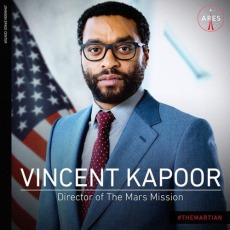
Chiwetel Ejiofor is an Academy Award winning actor. He’s also a Nigerian English man, part of a demographic that has not struggled in Hollywood compared to many others. Comparatively speaking I would run out of American films headlining East Indian talent before I ran out of fingers. Are Black men more profitable than Indian men? Everything I know about North America answers a resounding yes. So this is what we’re left with:
Venkat Kapoor was racebent for The Martian.
Mindy Park [given the author’s intent] was whitewashed for The Martian.
To be fair [and I think I have been thus far], East Indian actor Irrfan Khan had been in talks to play Kapoor but had to decline due to another commitment. It’s worth noting that the role had been intended for Khan, and it’s also commendable that- Continue reading




 Culture War Reporters