Gangs of schoolchildren sporting red scarves chant slogans as they march through the streets. A shop owner tears down an old sign for containing counter-revolutionary terminology. A man is publicly shamed for wearing pants too tight for manual labor- a young woman with scissors cut from the hem to above the knee. The son of a landlord is dragged through the streets as insults are hurled at him.
These are scenes from the so-called “Cultural Revolution”. Begun by Mao and his followers in 1966, these rallies and mass actions were meant to purge China of the last vestiges of antiquated, foreign, and Capitalist thought, replacing it with a proletarian culture that would forever cement the victory of the Maoists in 1950.
The Cultural Revolution quickly degenerated into something that could only be likened to the Reign of Terror following the French Revolution, with anyone accused of counter-revolutionary sentiment facing political and physical attacks. The “revolution” became a hotbed for corruption and suppression of dissent of any kind, and one might even argue that this major attempt to push socialism upon its inhabitants is actually what eventually led to the unraveling of Chinese Communism and its replacement with the sweatshops and slave-labor we more commonly associate with that nation today.
Mao, you see, had it backwards- trying to seize power and then change the hearts and minds of the public. That’s not a revolution, comrades, that’s just a coup. Rosa Luxemburg, an early but seminal Marxist thinker, once asserted that even if each and every civil servant and elected official were to suddenly become Communists, the world would not be one iota closer to being a Socialist one. Luxemburg understood the true nature of revolution- not some bleak military conquest but a fundamental change in the thinking and values of the majority of society. My ability to make you memorize Lenin, work on communal farms, and wave red-and-black flags will not make you Communists, no matter how long you do it (and even if it did, you’d be some pretty lousy Communists at that). The entire disastrous venture of the cultural revolution may have been avoided had Mao heeded the words of American Socialist and presidential candidate Eugene Debs when he proclaimed:
In the simplest possible terms, leaders come and go, the great will of the masses does not. For our struggle is not against flesh and blood, but against the rulers, against the authorities, against the powers of this dark world and against the spiritual forces of evil in the heavenly realms. The fight to change the basic values and principals of the people must come first– but how is this done?Continue reading →
GORDON:The Culture “War” has more often than not been used as a metaphor, but every once in a while (and with increasing occurrence) battles of the heart and mind start to include blood and iron as well.
Today we’re going to be discussing the ongoing Crisis in the Ukraine, both in regards to its roots and its implications in our society as a whole.
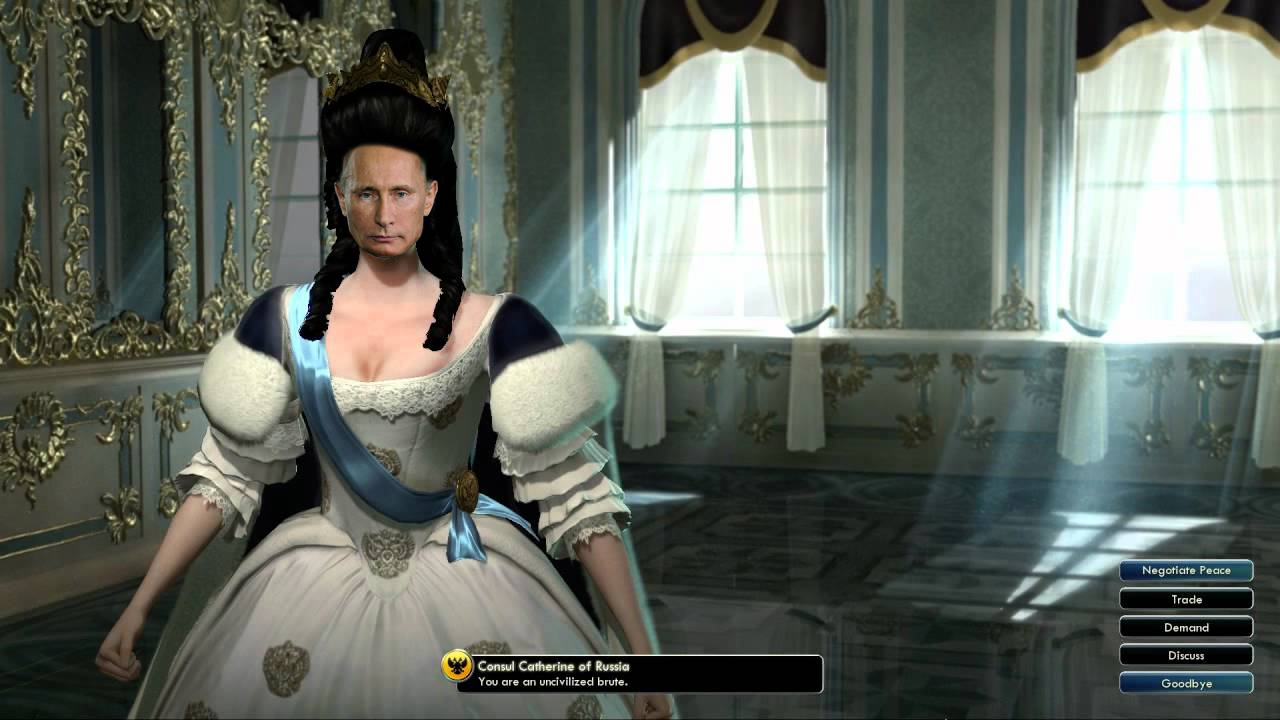
EVAN: I’m going to be one hundred percent honest with you, Gordon, and with all of our readers, I’m primarily going to be viewing a lot of Russia’s actions, and the responses of the other world powers, almost purely as if this were all a game of Sid Meier’s Civilization V.
I’ve just started watching Kroll Show (named for its star and creator, comedian Nick Kroll) recently but it’s already risen to the top of my list in terms of TV- so much so that I’ll be taking this Fame Day to recommend it to you.
Now in concept alone, Kroll Show isn’t anything new. Each episode is comprised of skits (interspersed lightly with commentary from Kroll and his comic co-stars) riffing on television, with reality TV taking the brunt of the riffs. You’ve probably seen this done before in less successful enterprises or recognize it as roughly 50-85% of all Seth McFarlane jokes.
We make no pretension of being unbiased here at the CWR. We have our particular axes to grind and banners to wave. Evan, you’ll notice, often covers the place of Asians in culture- in no small part because Evan is a combo of a few Asian peoples himself, and more directly affected by that issue. I, alternatively, grew up in the Middle East, and after having spent pretty much the entirety of my life with Arabs and Muslims (not the same thing, shouldn’t have to explain that), I’m more sensitive to Middle Eastern issues- Islamophobia in particular.
I could spend all day railing on the treatment of the Middle East/Arabs/Occupied Palestine/Muslims/etc. The way Arabs/Muslims are singled out for scrutiny and criticism. Casting Indian actors to play Arabs, since Arabs don’t match their own stereotype. The lack of appreciation for the key role the Middle East played in preserving and advancing science and philosophy.
You get the idea.
So rather than trying to tackle a single issue that could be (should be, and has been) covered by an entire academic book, I’m going to hit up super-specific issue.
EVAN: Alright, people of the internet, it’s time to stop correcting each other’s grammar in YouTube comments sections and start tuning in to the wisdom we’re about to drop out of our mouth-holes/fingertips.
On this installment of E> we will be discussing the ever-popular C2H5OH, more commonly known as alcohol, and how it’s treated in Western culture.
GORDON: Now right here we’re running up against a problem: “Western” culture isn’t exactly united on the subject of drinking. I mean, for the most part we’re fans, but there ARE some pretty distinct differences. For example, a severe alcoholic in Canada or America would in Europe be simply known as an Englishman.
EVAN: You make a very astute point, so I’m going to propose we boil this down to how North America [barring Mexico, sorry (though to be fair they should be used to this by now)] treats alcohol.
GORDON: Poor Mexico.
But let’s get right down to it and try to get a handle on the general stance we have on drinking in the west. We certainly like drinking, but drunkenness is largely viewed as something either juvenile or to be relegated to the weekends. Is that fair?
EVAN: Somewhat debatable.
GORDON: Then let’s debate.
EVAN: I suppose the question you have to ask yourself is who thinks it’s juvenile? I know a fair amount of people who consider it fairly normal to drink until they can’t see on the weekends, as regular and sacred a routine as my going to church on Sundays.
GORDON: I’ll admit freely that this does happen, but I wouldn’t say it’s what the average person does. In fact, the only people who really have the time and/or physical ability to do so are usually young people and students, bringing me back to the original point.
WHAT’S THE DEAL WITH YOUNG PEOPLE IN AMERICA [AND CANADA] AND BOOZE?
EVAN: I agree. So let’s talk about that. What’s the deal with young people in America [and Canada] and booze? Imagine I said that in a Jerry Seinfeld sort of voice.
GORDON: Well, Canada I can’t speak to as much, but I’d argue that the fact that booze is forbidden until the age of 21 has a lot to do with it. It turns alcohol, and to a similar degree, inebriation, into a taboo pleasure and a sign of rebellion and… well, I don’t want to say “maturity,” but I guess “adulthood” is gonna have to suffice.
EVAN: You’re preaching to the choir. A drinking age of 21 is levels of ridiculous, I mean, the only thing you can’t do at that age is rent a car [that’s at 25]. In Ontario the drinking age is 19, which is more or less what I imagined it would be when I was a kid.
GORDON: I’m guessing drinking doesn’t have quite the same mystique that it does in the US, huh?
EVAN: Well, to paint a picture of underage drinking, I visited Toronto for a summer while I was still living in Thailand. I must’ve been . . . sixteen, I guess. When I hung out with some former schoolmates a lot of what was talked about was fake IDs, and something called “drunk dial,” or something, which was apparently a number you could call where people of age would bring you booze for cash.
GORDON: Booze for cash? As opposed to what? Beads and trinkets? You have forever altered my image of Canadian society.
Youth drinking is such a small/easily dismissed part of drinking, though. What else is there to say?
GORDON: So says the hyped-up Hollywood media. High school is nothing but a drug-frenzied orgy to listen to ’em.
EVAN: Dude, when people become of age a lot of them get smashed, this is a true fact.
GORDON: Hence the need to get rid of the drinking age.
EVAN: Okay, so we do away with the drinking age altogether. Now what?
GORDON: Now drinking isn’t something you get to do, it’s something that has to be earned. 21 isn’t some magical number at which you can do no wrong and drink as much as you’re able. Abuse will still be there, but ideally we’ll see a drop in a lot of the stupid binging for binging’s sake.
EVAN: Wait, so how would we earn the right to drink?
GORDON: Well, naturally there’s not going to be any universal standard. I’m hoping decent parenting and societal pressure will enforce general standards for drinking. An eighteen year old who doesn’t drive recklessly and maintains a general balanced perspective on life shouldn’t be barred from having a glass of wine with dinner, especially when his twenty-four year old brother who still acts like a four year old has no limitations in this regard.
EVAN: I just realized that in many Canadian provinces drinking with parental supervision is permitted. I cannot find anything to the same effect for the US. Wait. Hold the phone.
“…17 states do not ban underage consumption, and the remaining 18 states have family member and/or location exceptions to their underage consumption laws.”
GORDON: I’m pretty sure there’s one state somewhere in the Midwest with an old prohibition-era law stating that a minor can buy alcohol if accompanied by an adult, though only in very select situations; it’s pretty archaic.
Though let’s hash this out a bit- I’m guessing that most families aren’t going to be hosting chugging contests, or having little Timmy do tequila shots off the baby-seat.
EVAN:I don’t think that’s what people are worried about, though. I think the concern is more about fourteen-year-olds heading down to their local liquor store and buying a bottle of something that would kill an elephant.
Not to that extreme, of course, but at my old high school there was at least one kid who turned to drinking as a way to deal with stress.As to how, let it be known that you can buy beer at 7-11s in Thailand.
GORDON: You can buy anything in Thailand.
EVAN: You are not wrong.
GORDON: While I do absolutely agree with you, I think we’re asking the wrong question. It’s not “How can we stop kids from drinking” it’s “Why are kids drinking (stuff that would kill an elephant)?”
EVAN:It’s because, as we’ve said, it’s a taboo thing. I think what needs to happen is for us to somehow, in America and Canada, bring alcohol back to the level it currently is in Europe, where you can have wine on a table alongside your water and not have the kids think anything of it.
My question to you is how we change that Western way of viewing hooch.
GORDON: Well, I think the first step is to, like I said, abolish the drinking age.
From there I think it’s a matter of getting people to see drinking more realistically. Again- demystify
EVAN: I get what you said about nixing the drinking age, and we both admitted there may be a few issues there. How exactly are supposed to demystify, though? That was my question to begin with.
GORDON: Well, I don’t want to say we institute a campaign trying to portray the downsides of alcohol, but I imagine that’d backfire more than anything else. As surreal as it might sound, I’d say that more open drinking and easier access to drinking would be the answer. You get to see drinking in it’s entirety- the good stuff and the bad- without an agenda being shoved down your throat.
EVAN: My counterpoint to your suggestion that we should let loose on the public drinking is that we work on the institution that has so demonized the bottle.
Southern Baptists have been down on booze for quite the while, in spite of the fact that our Lord and Saviour partook of the fruit of the vine more than a few times in the Good Book.
GORDON: And the Wesleyans share their part in this. Though in regards to that, I’m not exactly sure how to argue with those people- what argument can I make that hasn’t already been made in the past couple hundred years?
EVAN: Yeah, I don’t know.
“You guys, Jesus drank. He drank with friends and enjoyed it, but he never got drunk. It’s cool, you guys.”
Anyway, we should start wrapping up. Do you want to give us a recap of what we’ve discussed?
GORDON: We’ll as great minds think alike, we’ve pretty much bagged on the existence of drinking ages, agreed that drinking among underage kids is a problem resulting from alcohol’s taboo nature, and batted around a few ideas for solving that problem- generally concluding that we need more drinking and exposure to it. That sound about right?
EVAN: I don’t necessarily think more people need to drink to increase awareness that it’s not a bad thing, but that’s more or less correct.
I wish I had a beer right now.
GORDON: Mmm. New Belgium is coming out with a new stout. It looks fantastic.
EVAN: Yeah, I don’t know a lot about beer past the fact that I wouldn’t mind a cold one right now.
GORDON: It would be refreshing. And speaking of which, we need a new topic for next week. I’ll keep with our discussion of vices and offer up the topic of Smoking and Society.
EVAN: That’s a pretty good one. I’ll propose that we discuss . . . dangit . . .
I’d say we should discuss this new season of Community, but that’d require you to watch all of the new season before next Tuesday night.
GORDON: I have way more free time than you think. It shall be done.











 Culture War Reporters
Let’s Talk About The Hijab
I could spend all day railing on the treatment of the Middle East/Arabs/Occupied Palestine/Muslims/etc. The way Arabs/Muslims are singled out for scrutiny and criticism. Casting Indian actors to play Arabs, since Arabs don’t match their own stereotype. The lack of appreciation for the key role the Middle East played in preserving and advancing science and philosophy.
You get the idea.
So rather than trying to tackle a single issue that could be (should be, and has been) covered by an entire academic book, I’m going to hit up super-specific issue.
The hijab. Continue reading →
Rate this:
3 Comments
Posted in America, Europe, feminism, Islam, media, race, religion
Tagged Aceh, afghanistan, Africa, America, Arab, Asia, bigotry, Christopher Titus, comments, congressman todd akin, Culture, Egypt, Europe, expression, feminism, Feminist, freedom of speech, Hijab, human-rights, indian actors, Indonesia, Iran, Islam, Islamophobia, Jordan, Kevin Hart, Lebanon, Malala Yousafzai, mennonite, Middle Eastern, middle-east, misogyny, missouri congressman, modesty, no shirt no shoes no service, north america, patriarchal, patriarchy., politics, racism, racist, rape, religion, saudi arabia, secular, social standards, stubbenville, Syria, Todd Akin, trial, western, westerner, women's issues, women's rights