I’ve never seen an episode of My Little Pony: Friendship Is Magic. I hear good things, though, and understand if people do like it [and they do] because Lauren Faust is the mind behind the show, and she was largely responsible for The Powerpuff Girls which I still think is one of the best things Cartoon Network has ever done. But again, I’ve never seen any MLP.
Anyway, bronies, right? My favourite go-to source for words you won’t find in Webster’s, Urban Dictionary defines the term as:
“A name typically given to the male viewers/fans (whether they are straight, gay, bisexual, etc.) of the My Little Pony show or franchise. They typically do not give in to the hype that males aren’t allowed to enjoy things that may be intended for females.”
Which, given that very broad description, sounds fine. A person viewing something that is ostensibly for male viewers only, something like . . . I don’t know . . . Lego Ninjago, is not something I think anyone would have a problem with. Anyway. just keep this reasonably sizable fanbase in mind as we move forward-
My Little Pony: Misandry is Magic
That’s the title of a post on tumblr a friend of mine linked me to two days ago. Two short bits of context, misandry is the flipside of misogyny, being the hatred of men instead, and this was originally posted by someone who went by nomisandryplease. I say “went by” because heading over to his site reveals what is seen below and absolutely nothing more:
To get to what exactly this guy was bullied for, and I actually don’t doubt that he was, to some extent, the main point to his post was that MLP is a show that, while enjoyable, ultimately treats males very poorly. Continue reading →
A few years ago I took a fantastic Political Science course at my local community college.
Unfortunately, Señor Chang did not go to my college.
Our professor wanted everyone to love Political Science as much as he did, so he gave us a lot of freedom on what we would write our major class papers on. That’s how I ended up writing a paper called “Advertising, the Gateway Porn: How Hypersexualization Undermines Cross-Gender Relationships.”
Last week I tried to use some of my research from that paper to cover a topic Gordon introduced in a previous post, how advertising can be just as damaging as pornography, but I quickly realized there was far too much information for just one post. That’s why today I’m going to continue with the topic of sexualization in advertising. Continue reading →
Let me clarify. There is nothing actually wrong with the colour pink. I’m not personally a fan, but I don’t have anything against the colour itself. I have an issue with how it is being used. It’s being used to tell children that certain toys are for girls and certain toys are for boys.
Often it’s as simple as taking the same toy and making one pink and one blue. But more often than not toys are also separated into certain play “scripts.” These scripts teach children that different behavior is appropriate depending on if you are a boy or girl. While little girls are sold kitchen sets, little boys are sold mini tools kits.
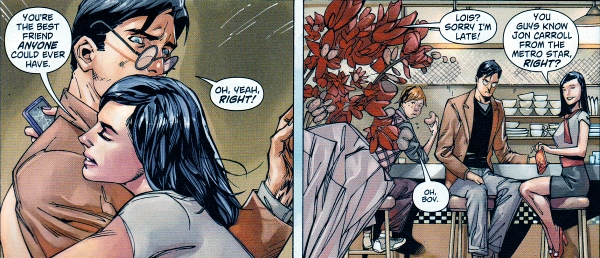
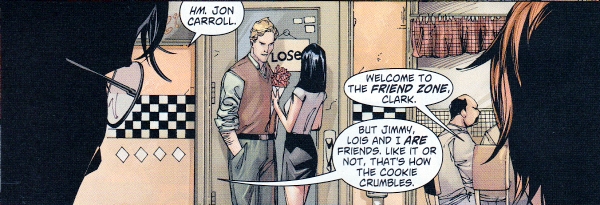
Last Wednesday, in Action Comics #21, a little something happened between Lois and Clark. And to cut you off before you make any natural assumptions, Superman is actually dating Wonder Woman in the present continuity. Anyway, I’ll let the panels speak for themselves:
A few weeks ago I stumbled onto a website called The Microaggressions Project and then promptly forgot about it. Returning to it tonight I looked over the “About” page, which had the following paragraph at the top:
This project is a response to “it’s not a big deal” – “it” is a big deal. ”It” is in the everyday. ”It” is shoved in your face when you are least expecting it. ”It” happens when you expect it the most. ”It” is a reminder of your difference. ”It” enforces difference. ”It” can be painful. ”It” can be laughed off. ”It” can slide unnoticed by either the speaker, listener or both. ”It” can silence people. ”It” reminds us of the ways in which we and people like us continue to be excluded and oppressed. ”It” matters because these relate to a bigger “it”: a society where social difference has systematic consequences for the “others.”
A little later on they define what “microaggressions” are, a term that was originally coined to speak about racial experiences. From the essay “Racial microaggressions in everyday life: implications for clinical practice,” which appeared in American Psychologist, Vol. 62, No.4:
“Racial microaggressions are brief and commonplace daily verbal, behavioral, or environmental indignities, whether intentional or unintentional, that communicate hostile, derogatory, or negative racial slights and insults toward people of color.”
One example of this could be a White couple walking down the street and having a Black man pass by them on the sidewalk. The woman clutches her purse tighter against her body, the subconscious idea being, of course, that Black men are prone to crime and should not be trusted.
As an Asian-Canadian I’ve experienced microaggressions plenty of times. I’ve had someone ask me if I was half-White [I am clearly not] with their rationale being that my “English was very good.” It can be an everyday occurrence for non-White people [I deign to use the word minorities, since I do believe that balance is turning the other way], and begs the question: “Why is this such a big deal?”
Writer of the aforementioned article and author of Microaggressions in Everyday Life: Race, Gender, and Sexual Orientation, Derald Wing Sue, PhD, has observed that microaggressions have actually been found to: “(a) assail the mental health of recipients, (b) create a hostile and invalidating work or campus climate, (c) perpetuate stereotype threat, (d) create physical health problems, (e) saturate the broader society with cues that signal devaluation of social group identities, (f) lower work productivity and problem solving abilities, and (g) be partially responsible for creating inequities in education, employment and health care.”
In other words, a Black or Latino man being stopped for a “random vehicle check” by police could be upset, and may even be accused of overreacting. Maybe they should simply be used to this and not let it bother them. The truth is that it makes them feel, even if only subconsciously, like second-class citizens. It’s true in a case as blatant as this one, and in an as subtle an action as hanging a Confederate flag or having a Native American stereotype as a high school mascot.
Microaggressions work in every direction. It’s like going to a Vietnamese restaurant and being given a fork and spoon instead of chopsticks because you’re White and not Asian. Microaggressions are built on assumptions and can make people painfully aware of who they are. They are rarely meant to offend, but often do.
It truly is a shame that so much of the time we send out microaggressions without so much as a second thought, and then defend ourselves by deeming the offended to be “too sensitive.” While we won’t always be aware of how our words or actions can harm others, we can at the very least listen to the people being hurt, and in doing so try to lessen the presence of microaggressions in our society.
GORDON: Moved by your incessant letters, as well as tearful pleas from more than one head of state, yours truly has returned for this and only this installment of Evan and Gordon Talk
You’re welcome, America.
EVAN: Truly, you are too gracious. [Also, we cater to an international readership].
This week the two of us will be discussing men and manliness [or masculinity]. Which makes perfect sense since we are, after all, men.
GORDON: MANLY men. We once made an axe using nothing but things we found in the woods. On the very same day, we built a grave for a drowned beaver.
EVAN: He is not lying. But, moving forward, one of the reasons I brought up this topic is because it’s loaded with possibilities. There’s the idea of the, for lack of a better term, the “Barney Stinson,” the fratbro who watches Spike TV day in and day and out, and this recent ad that appeared in The Times of India due to the gang-rape and murder of a 23-year-old woman [click on the image to visit an article on it].
GORDON: Well, let’s narrow down some the of core qualities that make a man a man. Or at least, commonalities in all cultures and subcultures of what “manliness” is.
EVAN: How about- the ability to provide for one’s family.
GORDON: We’ll take it. Ability to defend oneself, with either words or deeds?
EVAN: I think we could expand that to simply being physically able. Physicality means both being able to defend oneself and loved ones as well as attack others for whatever reason you might have.
GORDON: Assertiveness- that’s it. Not taking guff from any of these swine.
EVAN: Who exactly “these swine” are aside, I’d also like to suggest that, in essentially every culture out there, manliness is directly associated with heterosexuality.
GORDON: The Spartans, actually, were unbelievably gay. Heck, the entire basis of western civilization is pretty gay. I want to strike that one from the record; highly sexual would probably be a better statement.
EVAN: I’m gonna have to stick by it. The majority of cultures out there use the term homosexual derogatorily, I think it’s hard to look past it.
GORDON: I guess I’ll allow it. Tough. A man is tough. Stoic. Potentially emotionless.
EVAN: That sounds pretty good to me. Want to total them up? Really just list ’em all out for us.
GORDON: [AND THEN GORDON LISTEN THEM ALL]
A man is tough.
A man provides for his family [loved ones].
A man doesn’t take **** from anyone.
A man gets it on.
Scratch that last one and you have the stereotype of a black woman.
EVAN: Okay, now rate yourself by that list of qualities.
GORDON: I realize that there are billions of people out there who have hellish existences, but taking in what I’ve dealt with in my own life, I’d say I’m pretty tough.
EVAN: You’re definitely pretty emotionless.
GORDON: I don’t have a family, but I certain provide for myself, proud proletarian that I am.
I’ve yet to be in a situation I’ve been unable to diffuse diplomatically, but I certainly have my limits and lines that I will not allow to be crossed.
And I view my sexuality as my own business. I ain’t exactly good with the ladies (see the emotionless bit), but I also think anyone who judges a man’s worth by his sexual activity isn’t worth the time of day anyhow (see the “no taking crap from anyone” bit).
Yeah, I’m a man. Or a woman. It kinda falls apart.
EVAN: A man is tough: I’m a pretty emotional dude. I distinctly remember crying after I saw A Walk To Remember. I was also 13, but I guess that’s neither here nor there.
A man provides for his family: Like you, I don’t have a family. I live with my granddad, though to be fair I do take care of him, so I’m good in that area.
A man don’t take none: I am not a confrontational person. I also can’t say I’ve been in a fight-or-flight situation, though, This remains to be seen, I guess.
A man get it on: Since I live by a certain religious standard, I have not yet gotten it on. See my post on virginity. I am a virgin.
A man don’t take none: I am not a confrontational person. I also can’t say I’ve been in a fight-or-flight situation, though, This remains to be seen, I guess.
So how do we stack up as men by most cultural standards?
GORDON: I think we stack up well, all things considered.
EVAN: Okay, I just remembered why I wanted to discuss this topic in the first place, and it pertains to the last manly attribute on our list [the one that we both happened to fail]:
Click on the image to read it in a new tab.
GORDON: . . .
How exactly does one respond to that?
EVAN: I’d say an ellipsis sums it up pretty well.
GORDON: Yeah, I’m going to call BS on that. I couldn’t begin to list the number of men who were celibate and achieved more in their lives than this guy ever will.
EVAN: Which I agree with completely. It is pretty messed up, though, how many people [guys] live by this rule of thumb.
GORDON: I think the point remains that this isn’t any reasonable way to spend one’s existence. Nikola Tesla accomplished more than a week than I imagine this guy fishing on Omegle will in his lifetime.
EVAN: To take a line from your book, touché.
GORDON: Going back to the original list, the issue is that most of this could just as easily be said of a woman. I work with people who are in pretty rough situations. Many of the women I work with a single mothers, living below the poverty line, struggling to provide for their families. Pride is really the only thing they have left. They don’t take crap from anyone, and they can’t allow themselves to be dragged down by their circumstances. Are they “manly” woman?
EVAN: I’d say that they fit three of the four categories, but it depends largely on how you want to view the word “tough.” I felt like we sort of defined it as having to do with emotions, which, and I don’t think I’m spouting insanity right now, are something that women seem to be pretty in touch with. Which would then put them at 2/4, or half the qualities.
GORDON: Certainly we can agree that these women quietly endure crap that would have most white-collar executives curled up in the shower weeping.
Barring the issue of promiscuity, everything we’ve covered would be- by our standards today and most standards the world over- “womanly” characteristics.
EVAN: Including the predilection towards physicality and violence towards others?
GORDON: You ever fought a woman?
EVAN: You know neither of us have ever fought anyone.
GORDON: Speak for yourself. I studied Judo for five years, and I had my share of matches against female opponents.
EVAN: We’re talking actual fights, though. Not martial arts matches with set rules and moves without the added chaos of scratching and biting [which I would probably carry out with gusto].
GORDON: Believe me, I got my butt handed to me plenty of times. There’s nothing but prejudice keeping women from being just as effective at fighting as men.
EVAN: Right, but that’s not a cultural expectation, is it?
GORDON: Not in this culture, no, but in other cultures this does exist. I’d point to the high numbers of women in the militaries of countries affected by leftist ideology- Nepal, for example
EVAN: We are talking the majority of cultures, though. Just as I don’t think I’d
equate homosexuality with “manliness” because the Spartans [who were very manly] engaged in it, I’m likewise not willing to accept that most societies placed women in that physically aggressive role.
GORDON: Point taken.
EVAN: But I get what you’re saying.
A number of the key qualities we defined as being “manly” are, in general, key qualities of being successful human beings.
GORDON: Exactly.
My entire issue with contemporary feminism is that it tries spin traditionally “feminine” (i.e. submissive, weak, emotional) traits as being equally as healthy- if not more so- than traditionally “masculine” traits rather than trying to divorce itself from the old “feminine” trait set entirely.
I like my women like I like my men: self-assured, tough, and independent. That probably didn’t come out quite the way I intended.
EVAN: Don’t worry, I took it at face value.
And, since we’ve successfully transitioned away from a discussion on masculinity towards more of one discussing feminism, I’m forced to admit that we are well past our time limit.
GORDON: That we can agree on.
Until we get internet, it’s radio silence on my end.
EVAN: So I suppose you’ll have to say good-bye to these nice people until then, while I scramble to maybe find a replacement writer for the next little while.
GORDON: For whenever I get back, I’d recommend that we talk about our generation’s greatest strength or victory, as we spoke a while ago about our generation’s greatest failing.
EVAN: And I am going to recommend . . . okay, this is ridiculous, but our ideal girl. Just because I know your answer is something everyone wants to read.
That is all for today, folks. I’d like to thank Gordon [who left before this conversation could end] for heading over to his grandparents’ and getting online for this, he’s a real champ. Thanks for reading!

 Anyway, bronies, right? My favourite go-to source for words you won’t find in Webster’s, Urban Dictionary defines the term as: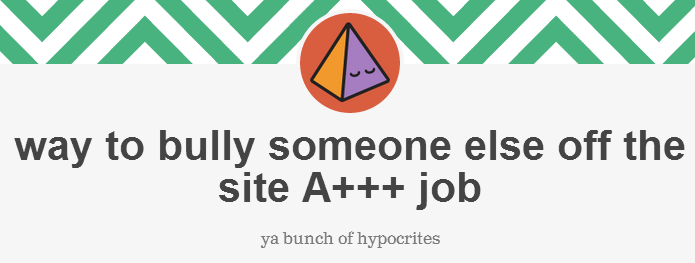


 EVAN: I think we could expand that to simply being physically able. Physicality means both being able to defend oneself and loved ones as well as attack others for whatever reason you might have.


 Culture War Reporters