In recent years there’s been talks of the possibility of fans seeing a black James Bond at some point. Do you have any personal favorites that you would consider for the role?
I didn’t realize that there was this talk and then I did a film with Idris [Elba] and he said that he met Barbara Broccoli [James Bond producer] and that it does seem like there is a possibility in the future that there could very well be a black James Bond. And I would have to vote for Idris because I just finished working with him and he’s a great guy. [Laughs]
Obviously this change would rile people [and racists] quite a bit, but it actually fits in with a very popular fan theory. The idea is that “James Bond” is a codename that’s passed on from one agent to the next, justifying the change of roles as the decades have rolled on, and the extreme personality changes in the character. Lee Tamahori, the director of Die Another Day actually espouses this theory, and thought it would be great if former Bond Sean Connery could make an appearance in his movie alongside Pierce Brosnan.
Idris Elba is an immensely-talented actor, and a shoe-in for the role. The London native has clearly thought long and hard on the issue, and although he appears to have had some uneasiness about it, the following quotes show that he now appears to be very on board with the idea.
I would do it, but I don’t want to be called the first black James Bond. Do you understand what I ‘m saying? Sean Connery wasn’t the Scottish James Bond and Daniel Craig wasn’t the blue-eyed James Bond. So if I played him, I don’t want to be called the black James Bond.”
I engaged in a recent debate with someone over the casting of Ben Kingsley as the Mandarin in the upcoming Iron Man 3, and the same argument I’ve heard time and time again popped up. “The person who’s best for the job gets cast.” Somehow, though, I doubt that those who believe this will be using the same logic in support of Idris Elba portraying James Bond.
In all honesty, the world probably isn’t ready for a Black James Bond. People are, in general, averse to change, especially when it comes to their beloved characters. While a film with Elba as Bond will receive a large amount of criticism [much of it racist], it may just be the beginning to a world that truly doesn’t see colour.
This is somewhat of a continuation off of yesterday’s Fame Day post, concentrating particularly on the Marvel character Storm. Kris Anka’s design for the weather-wielding Ororo Munroe harkens back to her appearance in the 80s [seen on the right].
Keeping consistent with most changes to beloved comic book characters, the mohawk was met with both praise and scorn.
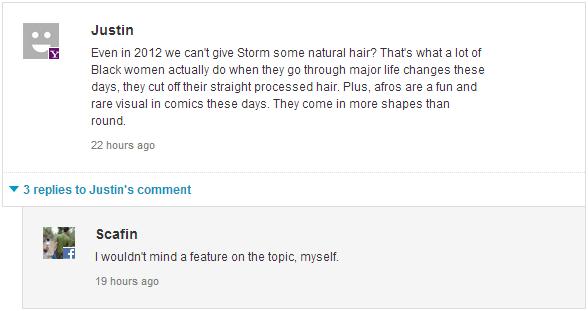
Earlier on Scafin commented about wanting to see Storm’s hair in its natural state. In following up with my reply to his thoughts [and with a slight miscommunication as to what I meant by “black hair”] he said:
I don’t mean color, though. I really want to see her with white, afro-textured hair. I understand why she was given relaxed hair when she was introduced, as that was the norm back then, but the ubiquity of relaxed hair has declined since then.
The thing is, Storm as a character has always had straight, white hair. The fan-run Marvel Database tells me that she’s descended from “an ancient line of African priestesses, all of whom have white hair, blue eyes, and the potential to wield magic.” That answers Scafin in that the character has never had “black hair.” It’s part of who Storm is now [having been depicted as a young child that way] and to retcon that many years of portrayal would fare poorly with fans.
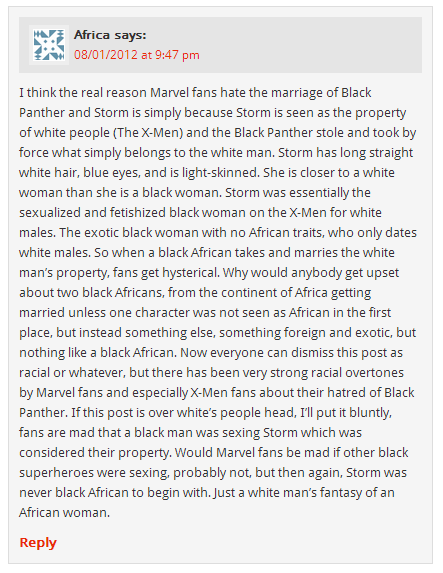
This leads to another question, though, which is why Storm was designed this way at all. This comment on an article about Storm’s marriage to the Black Panther had the following to say about the character’s creation:
I’m going to break this down as quickly and efficiently as possible, so we can concentrate on the more important aspects of the comment.
People are upset about the marriage because Marvel didn’t lead up to it well enough. In other words, they weren’t invested, and that’s adding to the fact that marriages in comic books typically do not work [see Peter and Mary-Jane in “One More Day.”]
That this is the sexual domination of White over Black when one of the very first relationships Storm gets into in the comics is with Forge, a member of the Cheyenne people. He was not, and still isn’t, white.
David Brothers, a blogger on staff with ComicsAlliance, agreed with part of what Africa had to say, commenting on the same article:
I liked Hudlin’s run on Panther. It was one of the precious few times that Storm actually felt like a black character, instead of a fetish object with blue eyes and perfectly straight hair.
This is in stark contrast to the article he wrote for Marvel a year earlier titled “A Marvel Black History Lesson Pt. 1.” In it he has more than a few good things to say about the heroine, which can be summed with these words:
If Gabe Jones stood for reality, Black Panther for ingenuity, Robbie Robertson for integrity, The Falcon for equality, Luke Cage for self-awareness, and Misty Knight for unadulterated cool, Storm was the combination of all of their traits and more. She was the daughter of a Kenyan princess and a photojournalist from Harlem, and therefore a direct link from African Americans and the continent known as “the Motherland.” She was powerful on a world-class level, refused to allow anyone to be her master, and commanded a massive amount of respect from all who knew her.
Taking into account Brothers’ apparent conflict in viewing the character, I
personally come away from this with the knowledge that Storm is more than just eye candy, she is a strong [in terms of power and character] heroine on par with many of her peers.
While Storm having straight hair may have been a product of the time she was created in, that in no way affects who she is as a character. Marvel has the right to maintain consistency in how she is portrayed, and has other characters who are better examples of having “black hair.” While the event of her marriage had its flaws Storm remains someone who has both strong ties to Africa and one of the most prominent black superheroes of all time. The straightness of her hair should in no way detract from that.
In the wake of TheAvengers‘ 1.5 billion dollar success it was inevitable that Disney/Marvel would be creating a sequel. They also decided to broaden both the universe and the franchise by green-lighting a TV series based on the organization in the comics, titularly named S.H.I.E.L.D.
It marks Joss Whedon’s return to television, as he will be both directing and producing the pilot. Acting as directors and producers, however, are his brother Jed Whedon and his sister-in-law Maurissa Tancharoen. The three formerly worked together on the online cult classic Dr. Horrible’s Sing-Along Blog, which actually leads me to the point of this post.
The DVD and Blu-Ray versions of Dr. Horrible a commentary track titled Commentary! The Musical, which consists of entirely new songs performed by the cast and crew. Track 10 was written and performed by Tancharoen, and I’ve embedded it here:
While obviously very tongue-in-cheek, as an Asian-American in the entertainment industry she’s more than a little aware of the imbalance in roles for racial minorities. Having her and Jed Whedon take off as showrunners if the pilot is a hit, this is a huge opportunity for a show other than Hawaii Five-0 to feature a good number of Asians in their main cast.
The perfect opportunity for this takes the form of S.H.I.E.L.D. agent James “Jimmy” Woo. Originally starting out with the FBI, he created and led the first ever super-hero team to exist with a government mandate. Although he later left to join the Agents of Atlas, Woo was a high-ranking member of S.H.I.E.L.D. and definitely a possible addition to the upcoming series.
In general, it’s exciting to have the comics come to the small screen as a live-action show. Cartoons like The Avengers: Earth’s Mightiest Heroes and the classic Batman: The Animated Series have proven very popular, but were directed at a younger audience. In recent years The Walking Dead is the only program based on comics that has received any amount of positive attention.
Disney/Marvel have a chance, as they often do, to bring diversity through a form of media, this time television. With Jed Whedon and Maurissa Tancharoen at the helm, here’s hoping that we might even see our first ABC series headlining an Asian actor that is also a spinoff of a major motion picture based on a comic book.
EVAN: So last week I asked people on Facebook what they wanted us to talk about, and the answer that got the most votes was affirmative action. This is a pretty broad topic, but thinking about it in the past couple of days I have at least a few possible directions to go with it. But before we do that, a definition-
“policies that take factors including ‘race, color, religion, gender, sexual orientation, or national origin’ into consideration in order to benefit an underrepresented group ‘in areas of employment, education, and business’, usually justified as countering the effects of a history of discrimination.”
Though of course, we’re probably more familiar with it in regards to racial or gender quotas for certain businesses.
EVAN: Right, like hiring a minority to make some sort of company quota-
GORDON: Ironically, despite the outcry against this particular aspect of affirmative action, it isn’t actually legal in the US to set quotas for any race.
EVAN: Which I did not know. But it happens, of course.
GORDON: That it does. That quota being typically “100% white.”
EVAN: And Gabe’s childish delight at pulling in someone who wasn’t black [Kelly], like all of the other entries were.
GORDON: It’s been a while since I’ve seen it.
EVAN: It’s all good.
GORDON: Let’s get right down to it here- affirmative action is still a contentious practice, but let’s face it, now more than ever it’s demonstrative of inherent bias in the system.
EVAN: As someone who doesn’t keep up with the news as often as he should, the most recent event I can recall that featured this was the rioting that was happening in Paris.
GORDON: Go on…
EVAN: Oh man, I was really hoping you’d remember. But it was a minority group rioting, and the way they solved it all was that employers had to hire people from this group, and pay them regardless of how well/hard they worked.
GORDON: Ergh- it’s France. These are the same people who nearly elected a neo-Nazi to be prime minister, and and have massive racial bigotry issues- just look at their expulsion of the Roma.
I’d hesitate before using them as an example- let’s bring the issue a little closer to home. Take America, for example.
EVAN: Well, your home.
GORDON: We have a workforce completely and utter disproportionate to the population. Even as the white population diminishes, the vast majority of administrative jobs are held by white males.
EVAN: Misrepresentation of an entire population, yeah?
GORDON: Absolutely.
EVAN: So that’s America, but where does affirmative action come into it, are you saying it’s needed?
GORDON: I’m saying that it isn’t working. If affirmative action was meant to end hiring and promotional discrimination on the basis of race and gender, it’s utterly failed, and the proof of that is everywhere around us.
EVAN: Well, you know more about the States than I do, especially with you saying that it’s illegal. Are there any affirmative action movements than you can bring up at all?
GORDON: The only major issue I can recall in the past couple years was a lawsuit brought against Walmart.
EVAN: Go on.
GORDON: Back in 2007, a gender discrimination lawsuit (Walmart v. Dukes) was filed, with a massive number of women citing that despite nearly two-thirds of Walmart employees being women, only a third of management was female- and that’s to say nothing of other charges against Walmart’s routine exploitation of its female employees.
A court (tragically) ruled that the various individuals suing didn’t have quite enough in common to constitute being a “class”, so the case was more or less thrown out.
EVAN: Their sharing a gender not withstanding?
GORDON: Welcome to America.
EVAN: Moving on to something I may know a little more about, affirmative action is a term that comes up quite a lot in regards to Native Americans, or what we in Canada refer to as “First Nations.”
GORDON: Shoot-
EVAN: There’re reservations, of course, land that belongs [is given] to said people. I’ve heard many times friends saying that they were 1/16 such and such, and would be able to “claim land.” Also the fact that gambling is legal on such properties, which I still don’t fully understand.
GORDON: The issue of native rights is an entirely different topic- something we oughta cover, but not quite in this post.
EVAN: I’m just saying that I think it ties directly into what we’re discussing. This is all stuff that’s “usually justified as countering the effects of a history of discrimination.”
GORDON: Granted. One could make an argument for lumping together reparations and affirmative action, but affirmative action is really strictly defined as pertaining to admissions- into either a university or the workplace.
How IS that in Canada, anyways? You got management proportionate to your population makeup?
EVAN: I am not sure. Let me check.
Well, I can confidently say that our minority population is 16%, though this excludes First Nations. Taking them into account, they add 4%, making a solid 20% of our population being nonwhite.
GORDON: Okay. So in your experience, is one in five Canadian manages/execs/bosses/administrators/etc. from a minority group?
EVAN: I’d say that in Toronto, at least, you’re as likely to see a white person as a non-white person. Depending on the neighborhood, you may find it difficult to see more than a handful of Caucasians.
GORDON: But in management…
EVAN: Right. I’m not exactly in a lot of offices… So I don’t know if I can comment on that.
GORDON: Gun to your head…
EVAN: I want to say 1/5 are probably minorities. Which matches up with the statistics I mentioned.
GORDON: Ah, good.
EVAN: I’m a little perturbed that you put a gun to my head in this post.
GORDON: Heh…
Before any of the readers jump down my throat, I know am I’m looking at the problem from a white-liberal viewpoint. Simple fact of the matter is, college is expensive (don’t I know it… **** you Evan, and your ridiculously great government benefits), and the small, wealthy majority in US is (overwhelmingly) white. Someone might make an argument for qualifications being required over race, but that’s exactly where affirmative action is SUPPOSED to come in.
It’s meant to help even the playing field, but it just doesn’t- again, look around.
EVAN: Qualifications required over race and affirmative action. Could you explain that further?
GORDON: Imagine you’re an employer. And imagine this we’re not living some depression-era-hellscape where you’re asking that an entry level employee have five to ten years of experience.
EVAN: . . . I’m listening. This is a dreamworld you’re painting.
GORDON: You have to fill a position, and there are two candidates- a white guy with a college degree, and a black guy without one (again, college is ****ing expensive). Who do you give the job to?
EVAN: The qualified one. The white guy.
GORDON: And imagine you need this position filled again the next year. And the next and the next, and you keep getting the same basic candidates. Who do you pick?
EVAN: Obviously whoever can do the job better. But where is affirmative action, like you said, supposed to come in?
GORDON: The people with jobs get money, the people with money send their kids to college, and so on. Affirmative action is meant to make sure that people aren’t discriminated against on the basis of their race, so that two equally qualified people stand an equal chance of getting in.
It’s like trying to back-paddle in the middle of a maelstrom.
EVAN: Ah, I see what you’re getting at. But what about minority scholarships?
GORDON: Even there, there’s an issue. Poor schools don’t get good funding, they tend to produce students who aren’t as prepared as their wealthier peers, and even bright ones who would otherwise school their peers wind up doing worse on tests. Unless you’re exceptionally gifted…
Again, it’s trying to apply a band-aid to an open wound.
EVAN: One more simile, for the road. Our time’s just about wrapped up.
GORDON: It all boils down to this- there is a need for equity and equality in the workplace- a desperate need. But affirmative action is like using a toothpick to fight dragons [emphasis added]- its the wrong tool of the job, and even if it was appropriate for the situation, it’s still not very effective…
EVAN: Join us next week, where hopefully I know more about what we’re talking about, when we discuss-
So this news came out while I was still at camp, so I’m definitely a little behind the times. Ubisoft revealed at E3 in early June that another game in the Assassin’s Creed series would be joining Assassin’s Creed III when it launched this October 30th. The following is a trailer for that game:
The AC franchise has always been ahead of its time in terms of racial representation. Altaïr ibn La’Ahad, a Syrian assassin, Ezio Auditore da Firenze, an Italian, and Ratohnhaké:ton [Conor Kenway], English/Mohawk are the stars of the first, second, and third games respectively. Each game has given slavish devotion to historical accuracy, but each has also starred a male protagonist. Until now.
Aveline de Grandpré is an African/French assassin, the only black female video game character I can think of besides Rochelle of Left 4 Dead 2, and from what I can tell a complete and total badass. This is a huge step on Ubisoft’s part, and I’m both impressed and proud that they’ve made this choice. Especially when the reception was so expected.
Clicking on the image to the left will bring up comments on the video I posted. Choice comments are:
Yup, [I know] AC isnt so realistic, but a women?
okay a female is reasonable but seriously y does she have to be black! wtf
looks like i’m not alone on this lol. so many people think i’m racist or something lol
It may seem like this is only to be expected from the video game community, often [and accurately] thought to be both extremely racist and sexist. It was only earlier this year that fans of the book series The Hunger Games took to the internet to express their disgust that Rue, a character in the novel, was portrayed by a black actress in the film.
The image on the right is one of many incredibly offensive tweets about the casting. Jezebel reported on the phenomenon early this year, but it seems that it’s not the only Hunger Games related news that the site has to write about this year.
While the role of Panem-ian heartthrob Finick Odair has already been given to Sam Claflin, months earlier a campaign was started to give it to biracial actor Jesse Williams. This was, again, met with some pretty intense criticism. From racists. Unfortunately a lot of the negative/ignorant comments on this messageboard have been deleted, though Jezebel’s write-up on the situation can be read here. The campaign tumblr is still out there, though it now also discusses racial casting, which I definitely don’t have a problem with.
Suffice to say, the world still has a ways to go before we, in North America, anyway, can simply start accepting that not everyone out there is white, and therefore not everyone who appears in art, either electronic or literary, is either. These comments I posted may just be an example of the “loud minority,” but if female or nonwhite protagonists are really a big deal, maybe we should be loud as well.
I think Aveline de Grandpré is an amazing addition to an already stellar video game series. I think it is fantastic that she’s black and that she is a woman, and I think that you should too.
This is part of a multi-blog series about Race and Comic Books put together by RodtRDH. Justin Tiemeyer has written the first of many such posts [about black comic book characters] on his blog, Cavemen Go.
One of my favourite blogs [you can see it in the sidebar] featured an article sometime ago titled “On Marvel, Mandarin, and Marginalization.” The gist of said article asking why an Asian villain like the Mandarin is being portrayed before any Asian American lead heroes. I’m going to start my defence with the quotes racebending.com used:
“There are certain fears and certain strengths the character evokes that are applicable, but of course you have to completely remove any of that short sighted cultural ignorance that leads to any sort of bigotry in the storytelling. That isn’t to say those fears and shortcomings of Iron Man as relating to that character aren’t relevant…He was based in China which was then mysterious because it was Red China. Today China is mysterious in other ways because it’s Global China.”
– Jon Favreau, director of Iron Man and Iron Man 2 to CHUD in 2006
“You have to do The Mandarin. The problem with The Mandarin is, the way it’s depicted in the comic books, you don’t want to see that.”
I’m not going to skirt around the fact that the character was indeed rooted in the “yellow peril” that was rampant at the time of his inception, but the following images should paint a picture of his evolution since that time.
From left to right: The Mandarin as he first appeared in the 60s, then the 90s, and the present day.





This S.H.I.E.L.D. Needs a Little Colour
It marks Joss Whedon’s return to television, as he will be both directing and producing the pilot. Acting as directors and producers, however, are his brother Jed Whedon and his sister-in-law Maurissa Tancharoen. The three formerly worked together on the online cult classic Dr. Horrible’s Sing-Along Blog, which actually leads me to the point of this post.
The DVD and Blu-Ray versions of Dr. Horrible a commentary track titled Commentary! The Musical, which consists of entirely new songs performed by the cast and crew. Track 10 was written and performed by Tancharoen, and I’ve embedded it here:
While obviously very tongue-in-cheek, as an Asian-American in the entertainment industry she’s more than a little aware of the imbalance in roles for racial minorities. Having her and Jed Whedon take off as showrunners if the pilot is a hit, this is a huge opportunity for a show other than Hawaii Five-0 to feature a good number of Asians in their main cast.
The perfect opportunity for this takes the form of S.H.I.E.L.D. agent James “Jimmy” Woo. Originally starting out with the FBI, he created and led the first ever super-hero team to exist with a government mandate. Although he later left to join the Agents of Atlas, Woo was a high-ranking member of S.H.I.E.L.D. and definitely a possible addition to the upcoming series.
In general, it’s exciting to have the comics come to the small screen as a live-action show. Cartoons like The Avengers: Earth’s Mightiest Heroes and the classic Batman: The Animated Series have proven very popular, but were directed at a younger audience. In recent years The Walking Dead is the only program based on comics that has received any amount of positive attention.
Disney/Marvel have a chance, as they often do, to bring diversity through a form of media, this time television. With Jed Whedon and Maurissa Tancharoen at the helm, here’s hoping that we might even see our first ABC series headlining an Asian actor that is also a spinoff of a major motion picture based on a comic book.
Rate this:
5 Comments
Posted in comics, internet, media, race, television
Tagged Agents of Atlas, Asians, Batman: The Animated Series, casting, Commentary! The Musical, Disney, Dr. Horrible's Sing-Along Blog, Hawaii Five-0, Jed Whedon, Jimmy Woo, Joss Whedon, live-action, Marvel, Maurissa Tancharoen, No One's Asian In The Movies, race, roles, S.H.I.E.L.D., television, The Avengers, The Avengers: Earth's Mightiest Heroes, The Walking Dead, Whedon