Tag Archives: shame day

“White Washed Tombs” or “Shame and Social Pressure”

Yours truly is not one to shy away from railing on things I doesn’t like. Or people, I dislike, for that matter. Over the past few months I’ve offered the middle finger to TLC and NBC for their exploitative and repellent shows, ISPs, nationalism, the British monarchy, and one especially vile lobbyist group dubbing itself “Concerned Women for America.” In fact, that last group was so downright nasty I straight up likened them to cancer in the form of a social movement.

And you know what?

I stand by that.

Continue reading

Shame Day: Microaggressions

A few weeks ago I stumbled onto a website called The Microaggressions Project and then promptly forgot about it. Returning to it tonight I looked over the “About” page, which had the following paragraph at the top:

This project is a response to “it’s not a big deal” – “it” is a big deal. ”It” is in the everyday. ”It” is shoved in your face when you are least expecting it. ”It” happens when you expect it the most. ”It” is a reminder of your difference. ”It” enforces difference. ”It” can be painful. ”It” can be laughed off. ”It” can slide unnoticed by either the speaker, listener or both. ”It” can silence people. ”It” reminds us of the ways in which we and people like us continue to be excluded and oppressed. ”It” matters because these relate to a bigger “it”: a society where social difference has systematic consequences for the “others.”

A little later on they define what “microaggressions” are, a term that was originally coined to speak about racial experiences. From the essay “Racial microaggressions in everyday life: implications for clinical practice,” which appeared in American Psychologist, Vol. 62, No.4:

“Racial microaggressions are brief and commonplace daily verbal, behavioral, or environmental indignities, whether intentional or unintentional, that communicate hostile, derogatory, or negative racial slights and insults toward people of color.”

One example of this could be a White couple walking down the street and having a Black man pass by them on the sidewalk. The woman clutches her purse tighter against her body, the subconscious idea being, of course, that Black men are prone to crime and should not be trusted.

As an Asian-Canadian I’ve experienced microaggressions plenty of times. I’ve had someone ask me if I was half-White [I am clearly not] with their rationale being that my “English was very good.” It can be an everyday occurrence for non-White people [I deign to use the word minorities, since I do believe that balance is turning the other way], and begs the question: “Why is this such a big deal?”

Writer of the aforementioned article and author of Microaggressions in Everyday Life: Race, Gender, and Sexual Orientation, Derald Wing Sue, PhD, has observed that microaggressions have actually been found to: “(a) assail the mental health of recipients, (b) create a hostile and invalidating work or campus climate, (c) perpetuate stereotype threat, (d) create physical health problems, (e) saturate the broader society with cues that signal devaluation of social group identities, (f) lower work productivity and problem solving abilities, and (g) be partially responsible for creating inequities in education, employment and health care.”

In other words, a Black or Latino man being stopped for a “random vehicle check” by police could be upset, and may even be accused of overreacting. Maybe they should simply be used to this and not let it bother them. The truth is that it makes them feel, even if only subconsciously, like second-class citizens. It’s true in a case as blatant as this one, and in an as subtle an action as hanging a Confederate flag or  having a Native American stereotype as a high school mascot.

To broaden this to the scope that The Microaggressions Project seeks to attain, microaggressions can include people saying to a person with Asperger’s, with no ill-intent whatsoever, “That you seem so normal!” It can be a 17-year-old girl being told by her gynecologist that just because she has access to birth control pills doesn’t mean she can just sleep around.

Microaggressions work in every direction. It’s like going to a Vietnamese restaurant and being given a fork and spoon instead of chopsticks because you’re White and not Asian. Microaggressions are built on assumptions and can make people painfully aware of who they are. They are rarely meant to offend, but often do. 

It truly is a shame that so much of the time we send out microaggressions without so much as a second thought, and then defend ourselves by deeming the offended to be “too sensitive.” While we won’t always be aware of how our words or actions can harm others, we can at the very least listen to the people being hurt, and in doing so try to lessen the presence of microaggressions in our society.

Shame Day II: ISPs and the Six Strike System

Normally, Thursdays here at Culture War Reporters is dedicated to “Fame Day,” in which Evan and I call attention to people, events, or trends we think aren’t getting the attention they deserve.

But not today.

Partly due to my illness, partly due to some unforeseen time constraints, and mostly because of the severity of the issue in question, today there will be no Fame Day.

Instead, we’ll be performing an emergency Shame Day on the subject of yesterday’s terrible news that five major internet service providers (ISPs) will be implementing a “six-strike” system on people suspected of copyright infringement.

Let me break it down for you.

Normally, when you sign up with an internet provider, exactly what you do or don’t do with your connection is entirely and exclusively your business. Whether it’s something as impressive as you doing an electric guitar cover of the hallelujah chorus or as lousy as writing a thousand comments calling that same YouTube video gay is all up to you. What you read, what you write, what you post, what you view- the ISP is simply there (as the name states) to provide internet.

But no longer.

Yesterday, five major ISPs (Verizon, Time Warner, Cablevision, Comcast, and AT&T) announced that they would be participating in this anti-piracy initiative spearheaded by the “Center for Copyright Information” or “CCI”- a lobbyist group for a number of media groups. Quite simply, individual users suspected of “copyright infringement” will be given five warnings, the sixth “strike” resulting in their internet speed being slashed to dial-up quality for an unspecified amount of time.

Now you’re probably thinking “Hey- just don’t pirate stuff and you’ll be fine!” and you know what?

You’re right. You don’t have to pirate.

I’m taking over from this point on for a number of reasons. For the most part because although Gordon had good things to say, he didn‘t necessarily say them well, and in some cases didn’t make very much sense; we’re going to chalk that up to his recent illness. I will be relating to you what points of his that I can, while adding my own.

-Evan.

Gordon’s next point is that for the most part, many people pirate because of time and money. Focusing on time, the truth is that we can’t always guarantee that we’ll be at home on a Thursday night to catch The Office. Maybe we’re working another job [many of us need to], or maybe we just forgot. What options does this leave us?

For those of us in America, Hulu is always an option. The on-demand streaming site once provided a very broad range of TV programming, and Gordon points out that it’s a fantastic resource, or at least used to be. Nowadays, however, it’s a lot more difficult to use than it used to be. Hulu Plus, which requires a subscription, is needed to watch a lot of older shows, sometimes even episodes that aired a month ago, if New Girl is any indication. With one of the most convenient resources made less so, is it any wonder that so many people simply turn to torrents?

Gordon’s next point, and a very valid one, is this issue of the Six Strike System and how it relates to piracy. There’s an issue of what exactly is at stake here. Gordon insists that the answer to that is everything, and while I’m not fully with him on that, there’s some sense to what he’s saying.

The thing is that almost anything can be considered copyright infringement. YouTube covers, memes [which often use screenshots of shows like Futurama {see: our Shame Day image}], Gordon’s beloved gifs, even many of the pictures of this blog, in spite of being Photoshopped, don’t technically belong to us.  Would we have our internet cut because we run this blog? [Answer: I wouldn’t, because I am Canadian.]

To finish off what Gordon wrote earlier today, the issue is that the people in question aren’t being penalized by an international agency, or even the state or federal government. The fact of the matter is that these ISPs are “using their lobbies to persecute and prosecute suspected users without due process” [quoting Gordon]. What truly incensed him more than anything, though, was the way they’re going about it. That they’re holding themselves up as Knights of Good when in reality they’re just proud that they’re “selectively picking off anyone their bosses deem a threat to their unending stream of profit.”

Untitled-2

Piracy is not a subject I agree with Gordon on, and in fact I had a very hard time letting his last piece on the subject be put up on the blog. If people really, truly love art, whether it take the form of television or movies or video games they need to vote with their wallets and know that what they love is worth spending money on.

That being said, I do believe that what these ISPs are doing is wrong, particularly in that they have no one to be accountable but themselves. No business or corporation should have that right. Shame on these ISPs, and shame on the Center for Copyright Information.


Shame Day: Hollywood and the VFX Industry

Let me begin this by saying that I did not watch the Oscars on Sunday night. I made a little joke on Facebook about how I didn’t have to because everyone else was doing it for me, and 14 people liked it, so I’m pretty funny. Anyway, let’s move this along.

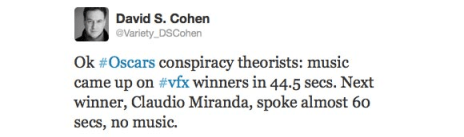
Ang Lee’s adaptation of the Yann Martel novel Life of Pi won the award for best VFX [visual effects], which I can only imagine was deserved because, well, I have not seen it. Bill Westenhofer, the VFX supervisor for Rhythm and Hues Studios, was giving his acceptance speech when he was cut off by music, as pointed out by Variety’s David S. Cohen:

Word on the street is that this is because of what he was about to talk about. See, it would be wonderful for Rhythm and Hues that they received so much promotion due to winning an Academy Award if they weren’t bankrupt. Westenhofer had planned on addressing the crisis within the industry during his speech, and was thankfully able to voice his thoughts afterwards to writer Bill Desowitz for his blog, where he said:

At a time when visual effects movies are dominating the box office, that visual effects companies are struggling.  And I wanted to point out that we aren’t technicians.  Visual effects is not just a commodity that’s being done by people pushing buttons.  We’re artists, and if we don’t find a way to fix the business model, we start to loses the artistry.  If anything, Life of Pi shows that we’re artists and not just technicians.

During his acceptance speech for best director Ang Lee forgot to thank his VFX collaborators at Rhythm and Hues, which prompted a letter from Phillip Broste, the lead compositor at Zoic Studios. It’s quite long, but I feel like quoting two of the last few paragraphs, because they really say quite a lot:

Mr. Lee, I do believe that you are a thoughtful and brilliant man. And a gifted filmmaker.  But I also believe that you and everyone in your tier of our business is fabulously ignorant to the pain and turmoil you are putting artists through.  Our employers scramble to chase illegal film subsidies across the globe at the behest of the film studios.  Those same subsidies raise overhead, distort the market, and cause wage stagnation in what are already trying economic times.  Your VFX are already cheaper than they should be.  It is disheartening to see how blissfully unaware of this fact you truly are.

By all accounts, R+H is a fantastic place to work; a truly great group of people who treat their employees with fairness and respect.  Much like Zoic Studios, the fabulous company that I am proud to work for.  But I am beginning to wonder if these examples of decency will be able to survive in such a hostile environment.  Or if the horror stories of unpaid overtime and illegal employment practices will become the norm, all because you and your fellow filmmakers “would like it to be cheaper.”

It’s no mystery that most summer blockbusters these days are built on the backs of animators, artists who spend hours upon hours trying to perfect the texture of wood grain or the way light reflects off of the ocean. Rhythm and Hues won two awards for Life of Pi, both the Academy Award and the BAFTA Award for Best Special Effects; they won both awards in 2007-2008 for The Golden Compass. This studio going bankrupt is like . . . . well . . . . an award-winning studio running out of money because they weren’t getting paid enough.

Untitled-1

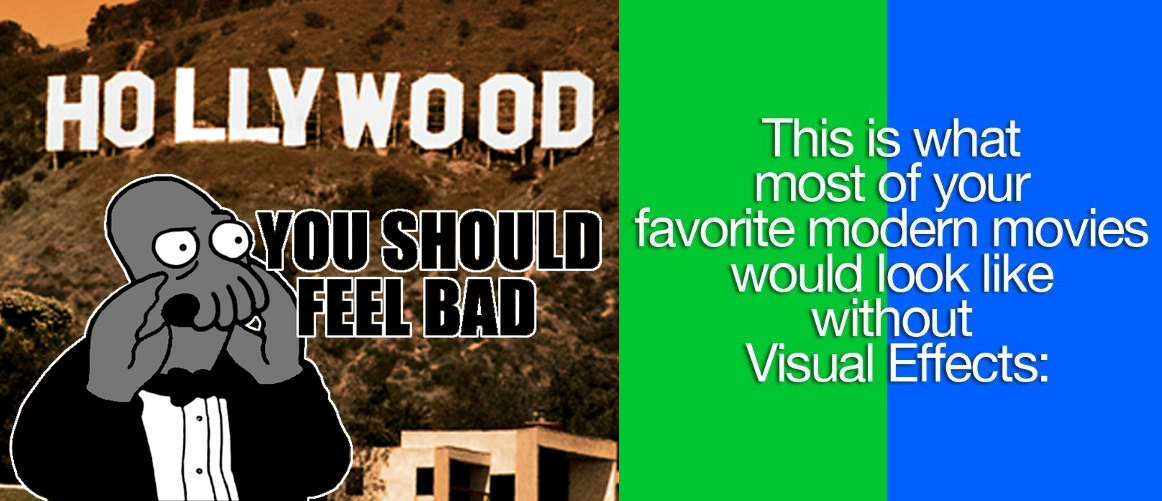
People who work in VFX are just as much artists as painters, musicians, and photographers, and all have the right to be fairly compensated for their work. Good art takes time and effort, and if Hollywood refuses to give those in VFX the respect and money that they deserve then we need to let them know how wrong they are. Tell people about what’s happening, tweet with the hashtag #VFXprotest, check out VFX Solidarity International, and don’t be okay with Samuel L. Jackson talking over Robert Downey Jr. just because you like the guy as an actor:

Shame Day: Porn and Racism

Let’s be honest, porn is not the highest art form to begin with. That being said, it’s 2013, people. It is the 21st century and I expect better from all of us, even those in San Fernando Valley [lovingly dubbed “Porn Valley” by those in the industry].

glenntwdNow, I’m going to assume that most of you are familiar with AMC’s The Walking Dead [I’d be surprised if you weren’t, really]. If not, what you need to know is that it features among its core cast Glenn, who is played by Korean-American Steven Yeun]. A cast member of the original comic book series, Glenn makes his entrance by saving Rick, the protagonist of the series, and goes on to be an all-around successful human being [which, in a zombie apocalypse, equates to being a badass]. So that’s what you have to know about that.

What you also have to know, if you weren’t aware, is that porn studios churn out parodies like nobody’s business. They’ve parodied everything from beloved childhood cartoons [The Flintstones: A XXX Parody] to a 1976 DC/Marvel comic books crossover event [Superman vs Spider-Man XXX: An Axel Braun Parody]; nothing is sacred. It should come as no surprise, then, when they decided to take a stab at adapting AMC’s The Walking Dead [if you watch it, you’d know why I have to write it out like that].

Porn star Danny Wylde was cast to play Glenn in the as-of-yet untitled film. In it, he will be appearing as follows:

Continue reading