Tag Archives: video games

Shame Day: Video Game Companies

eaeaI am a dude who loves video games. I’ve played so much Team Fortress 2 in the past few weeks that it’s essentially become a ritual for me, something to do while and after I eat dinner. What I don’t always love are the business practices these  companies  engage in.

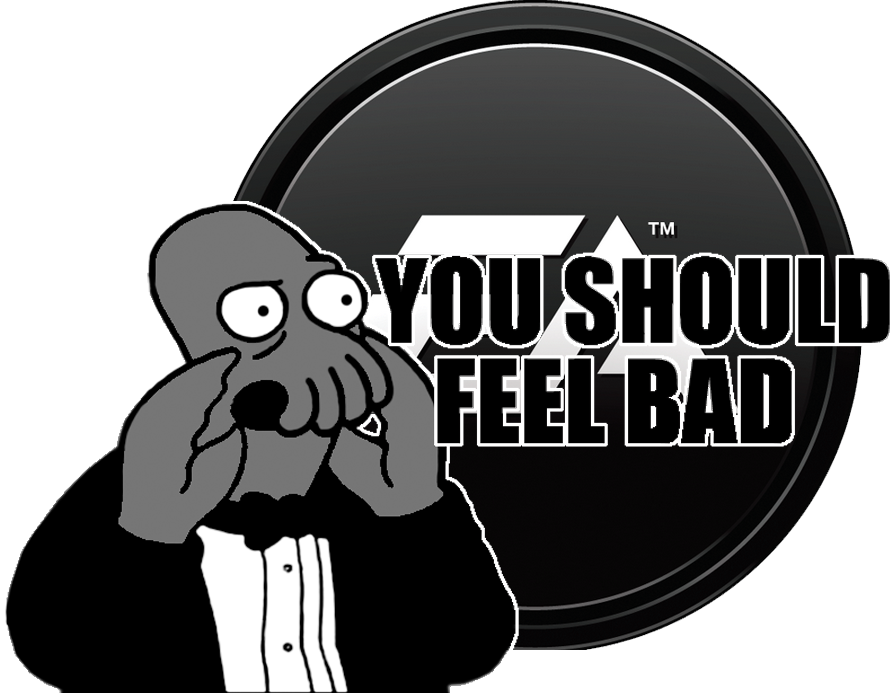
The image I Photoshop’d together depicts the EA [Electronic Arts] logo because they’re a company that I’m positive some of the blame lies with when it comes to generally being horrible to its employees.

I was turned onto this flagrant abuse of humanity through a webcomic Scott Kurtz [of PvP] and Mike Krahulik and Jerry Holkins [of Penny Arcade] put together. The comic, titled The Trenches, follows the life of a QA [quality assurance] guy whose name escapes me at the moment. The important part is that below the comic is a feature called Tales From The Trenches, which catalogues nightmare stories from those who toil within in the industry.

Below is one of my favourites, entitled “Weekend Funtimes.” My favourite not in that I enjoy reading it, but in that it encapsulates some of the horror of working  for large corporations:

We were about two months into “crunch” when they decided to up our hours AGAIN, taking us to over 80/week. The only available day to squeeze these extra hours in? Sunday!

I arrive at the building Sunday morning, only to find it locked—no other businesses had Sunday hours. I call my supervisor, who proceeds to fuss at me about interrupting his “family” time. My team had all arrived for work by that point, which just seemed to make him angrier. He tells me he is on his way and hangs up.

Flash forward ten minutes. We’re all still freezing (it was winter and -10 windchill) when we see his car come around the corner at the end of the block. He drives up the road, rolls his window down, and THROWS the office key at me—all without ever slowing down.

He calls me twenty minutes later to make sure we had gotten in, then informed me we would have to make up the time we had “wasted” waiting on him. He ended the call telling me to never interrupt his family time again.

That’s fairly despicable, and definitely up there among the worst of them. It was posted last month, and while it’s unknown when the event actually happened there is a date we can pinpoint: November 10th, 2004. The date that “EA: The Human Story” was posted to LiveJournal by user “EA Spouse.”

The post is a thorough examination of EA’s policies, especially regarding the infamous “crunch time” that its employees have to go through as the game nears its impending launch. She writes with a genuine, heartfelt voice that stems from being the wife of an EA employee. This is definitely present in the penultimate paragraph of her piece:

If I could get EA CEO Larry Probst on the phone, there are a few things I would ask him. “What’s your salary?” would be merely a point of curiosity. The main thing I want to know is, Larry: you do realize what you’re doing to your people, right? And you do realize that they ARE people, with physical limits, emotional lives, and families, right? Voices and talents and senses of humor and all that? That when you keep our husbands and wives and children in the office for ninety hours a week, sending them home exhausted and numb and frustrated with their lives, it’s not just them you’re hurting, but everyone around them, everyone who loves them? When you make your profit calculations and your cost analyses, you know that a great measure of that cost is being paid in raw human dignity, right?

Better known by her blogging handle, little did Erin Hoffman know what sort of action her post would lead to. In part it resulted in the filing of three class action lawsuits against EA and the beginning of many changes within the industry. Her post inspired another entitled “Why Crunch Modes Doesn’t Work: Six Lessons” which garnered a fair amount of attention within the online community.

That being said, Tales From The Trenches continues on into 2013, and it’s undeniable that many are slaving away in gaming companies because they love the final product. Their devotion to video games means that they’re stuck in jobs where they’re treated poorly by anyone and everyone a rung above them on the corporate ladder. Yes, this can be said of many work environments, but few have the same number of young, eager individuals so passionate to take part in what they’ve enjoyed their entire lives.

So shame on EA, and shame on any and all video game companies that treat their employees like dirt. No one said starting a career was easy, but no one should have to toil away thanklessly for an abusive system, either.

Internet Disgusted By Video Game Promotion [Also: Zombie Breasts]

Way back in the February of 2011 the following trailer was released for the video game Dead Island:


It was so impressive that last I heard, Lionsgate was going to make a Dead Island film based on the trailer. Not the game, the trailer for the game. A feature-length film based on the trailer for a video game. Think on that for a bit.

What it does is speak volumes for the game’s publisher, Deep Silver, and those it hired to advertise the game. There was an emphasis placed on the feelings of terror and loss and the need to protect one’s family; it sought to set itself apart from other zombie games [of which there are so many]. Unfortunately the game turned out to be your fairly standard run-of-the-mill zombie hack and slash, but that’s not the point here.

The point is that this trend was actually continued in the promotion of the game’s sequel, Dead Island: Riptide, the trailer of which can be viewed here. The tone is once again consistent with that of the first, highlighting the terrors of a vacation gone horribly, horribly wrong. Which is great. And which is why the following seems so shockingly out of place.

The image you see above is a promo image for the European “Zombie Bait Edition” of the game, the crowning glory of which is the statuette at the centre. This was, earlier this week, described as being “Dead Island’s grotesque take on an iconic Roman marble torso sculpture.” This was met with understandable outrage and disgust from the internet, which prompted those at Deep Silver to scramble wildly and release the following apology:

“We deeply apologize for any offense caused by the Dead Island Riptide “Zombie Bait Edition”, the collector’s edition announced for Europe and Australia. Like many gaming companies, Deep Silver has many offices in different countries, which is why sometimes different versions of Collector’s Editions come into being for North America, Europe, Australia, and Asia.

For the limited run of the Zombie Bait Edition for Europe and Australia, a decision was made to include a gruesome statue of a zombie torso, which was cut up like many of our fans had done to the undead enemies in the original Dead Island.

We sincerely regret this choice. We are collecting feedback continuously from the Dead Island community, as well as the international gaming community at large, for ongoing internal meetings with Deep Silver’s entire international team today. For now, we want to reiterate to the community, fans and industry how deeply sorry we are, and that we are committed to making sure this will never happen again.”

 So no harm now foul, right? Dead Silver took back their horrible statuette and we can chalk another victory up for the internet! But why exactly were people upset? An article on Rock, Paper, Shotgun which I linked to but will link to again said this about it:

This is beyond disgusting. It’s as if someone were attempting to demonstrate the most misogynist idea that could possibly be conceived, in an attempt to satirise the ghastly trend. A text book example of the most extreme ends of misogynist fantasy, a woman reduced to nothing but her tits, her wounds hideously depicted in gore, jutting bones, and of course barely a mark covering her globular breasts.

It’s very prevalent in a lot of zombie imagery you can find nowadays, and it’s certainly present in this picture of a zombified Snow White on the left. Her body is mutilated [appropriately so, for a zombie] but her breasts remain completely untouched. There’s this sense of the grotesque from the image as a whole, but her chest remains an object of potential titillation.

I don’t think I have to say too much about how grossly sexist this is, and how prevalent it is in the society we live in. What I am going to say is thank God that on some level we can make enough of a public outcry to stop stuff like this before it happens. The bottom line is this: if we as a community [on the internet or otherwise] care enough about something, we really can do something about it.  Even if it’s just stopping the production and sales of a tasteless statue.

———

A rebuttal to essentially everything I’ve written can be read in an article by Daav Valentaten on Venture Beat entitled “The Dead Island: Riptide reaction was an equality fail.” I present it as a counterpoint to my own post.

Where I Try to Explain Red Dawn

I’ve begun seeing trailers on TV, and apparently it hit theatres two days ago, so I figure now’s as good a time to talk about Red Dawn as any.

For those of you who don’t know, Red Dawn is a remake of the 1984 film of the same name. In the original the United States is invaded by both the Soviet Union and its Cuban allies. A group of plucky high schoolers bands together to form a guerrilla fighting force, named the Wolverines after their high school mascot.

In remaking the film the studio, Metro-Goldwyn-Mayer (MGM), realized that they needed to modernize the invaders in light of the current political climate, and chose China. Keep in mind that in the original film that country was apparently America’s only ally, with the following exchange taking place:

“…Well, who is on our side?”
“Six hundred million screaming Chinamen.”
“Last I heard, there were a billion screaming Chinamen.”
There were.”

Production was going smoothly until the summer of 2010 when the Global Times, a Chinese state-run newspaper, got a hold of leaked excerpts of the script. This prompted such headlines as “U.S. reshoots Cold War movie to demonize China” and “American movie plants hostile seeds against China.” In early 2011 the LA Times reported that the film’s villains were changed from Chinese to North Korean to “[maintain] access to the Asian superpower’s lucrative box office.Continue reading

Free Information Culture

The last of my installments (for now) in looking at these rising alternative cultures is “Free Information Culture,”  which shares the same problem with “science” culture in that there’s really no good name for it yet. I’ve referred to it before as “internet culture,” only the problem with that is that, like “science culture,” it isn’t so much the culture of the thing itself as the culture of the fanbase. In simpler terms, it’s the difference between Hollywood culture and movie-lover culture- it’s the end product that’s valued.
So what’s the internet’s “end product”?

Besides porn and stuff like this…

Free Information.

Whether it’s the news, or Wikipedia, or TED Talks, or Imgur, or anything else imaginable, it’s on the internet for free and public use. It’s something of a great equalizer. No matter where you’re from, what language you speak, what class you hail from- you can create or say anything and then get called gay in the comment section.

And while that last bit is sort of a joke, it does play a role in developing the “free information culture.” Granted, general anonymity can make us vicious and vile people, but it also (to some extent) strips us of our egos. When you make something online, you really don’t get much, if any, credit, but that’s alright since it isn’t the point. It’s just about creating, nothing more or less. Who drew the first rage face? Who started up Bad Luck Brian? Who edited and sourced that one Wikipedia page you used to stitch your last minute term-paper together? Who puts together those monthly fail compilation videos? I don’t know and will probably never know, but I do know that they’ll keep coming because of the simple joy of creating them. I and every other person with a half-decent internet connection.

And all of this simply isn’t understood by some people.

Recall the massive outcry against the SOPA and PIPA bills? What prompted the creation of  these acts was that some people- certain corporations in particular- couldn’t quite wrap their heads around the idea of free and unlimited access. Now maybe you agree with them, and maintain that posting copyrighted material of any kind is piracy and immoral, however, what needs to be understood is that this was viewed as an act on the very nature of the internet and everything it had come to represent.

Again excluding porn and stuff like this…

Now more and more companies are catching on to the idea that it’s wiser to try to work with the faceless and vengeful cat-worshippers of the internet than against them- just look at video game companies that are starting to work in tandem with modders. The game Minecraft in particular is a good example of this, as many of the new aspects of each update to the game coming from the fan-forums themselves. Nevertheless, there are still plenty of people out there (I’m looking at you, Music Industry) who continue to struggle (vainly) against the dissemination of what they view to be the “information wants to be free” crowd.

Again, it all boils down the core of the culture that the internet has produced, gravitating around the concepts of freedom and egalitarianism. Look at Wikileaks founder, Julian Assange.

If he did his work back in the early 90s, we can be pretty sure he’d be viewed overwhelmingly as a candidate for a James Bond villain. But today we (for the most part) view him as being a heroic (or at least positive) figure in a world that’s become increasingly secretive and unequal. Why this dramatic shift in perception? Again, it’s the internet and it’s affect on us. In a time of economic crisis we might not be able to go to the movies, or eat out, or drive for miles to see a friend, but we can watch something online, or browse recipes, or video-chat with the same buddies that you’d otherwise not be able to see. Any threat to your full and unrestricted access to the internet is, by proxy, a threat to some of the last pleasures you have left.

Hence the formation of a culture obsessed with the values of free speech, free access to information, and freedom from censorship. And with every development of the internet or our access to it serving as another leap in the evolution of the culture, it’s safe to say that the howl of anger that the governments of the world met when trying to create such bills as ACTA is only going to intensify.

Fame Day: Extra Credits

Video games and video game culture gets a lot of bad press- not all of it
undeserved. However, in the midst of all the pandering, casual sexism, and juvenile sensibilities, there is a radiant beacon of hope.

Penny Arcade’s (and for a while, The Escapist’s) very own Extra Credits web show!

Even if gaming isn’t your thing, you have got to respect these guys and their weekly 11-minute clips for their neutrality and maturity alone. With the sensationalist media trying to cast even the smallest flaw of video games as the worst threat to humanity since polio, and the gaming community defending even the most idiotic element of their pastime as if it were the Dead Sea scrolls, that Extra Credits manages to remain the calm voice of reason that it is ought to be applauded.

But of course, there’s more on that. These guys are the good angel on the shoulder of the gaming industry, calling for video games to be not only a source of entertainment, but also of education and even a new form of art. Whether or not you agree with that is up to you, but you’ve got to admit- it’s a bold and noble stance in a subculture that too often obsessed with doing this:

Extra Credits, here’s to you- keep doing the great work you’re doing!

P.S.: Evan, being the meany-face that he is, is forcing me to make this post longer. Set below is one of Extra Credit’s finer videos, and an easy introduction into their more jargon-heavy clips on narrative, mechanics, and other elements of video games.

People Are Upset About Aveline de Grandpré [What Else Is New?]

So this news came out while I was still at camp, so I’m definitely a little behind the times. Ubisoft revealed at E3 in early June that another game in the Assassin’s Creed series would be joining Assassin’s Creed III when it launched this October 30th. The following is a trailer for that game:


The AC franchise has always been ahead of its time in terms of racial representation. Altaïr ibn La’Ahad, a Syrian assassin, Ezio Auditore da Firenze, an Italian, and Ratohnhaké:ton [Conor Kenway], English/Mohawk are the stars of the first, second, and third games respectively. Each game has given slavish devotion to historical accuracy, but each has also starred a male protagonist. Until now.

Aveline de Grandpré is an African/French assassin, the only black female video game character I can think of besides Rochelle of Left 4 Dead 2, and from what I can tell a complete and total badass. This is a huge step on Ubisoft’s part, and I’m both impressed and proud that they’ve made this choice. Especially when the reception was so expected.

Clicking on the image to the left will bring up comments on the video I posted. Choice comments are:

Yup, [I know] AC isnt so realistic, but a women? :/

okay a female is reasonable but seriously y does she have to be black! wtf

looks like i’m not alone on this lol. so many people think i’m racist or something lol

It may seem like this is only to be expected from the video game community, often [and accurately] thought to be both extremely racist and sexist.  It was only earlier this year that fans of the book series The Hunger Games took to the internet to express their disgust that Rue, a character in the novel, was portrayed by a black actress in the film.

The image on the right is one of many incredibly offensive tweets about the casting. Jezebel reported on the phenomenon early this year, but it seems that it’s not the only Hunger Games related news that the site has to write about this year.

While the role of Panem-ian heartthrob Finick Odair has already been  given to Sam Claflin, months earlier a campaign was started to give it to biracial actor Jesse Williams. This was, again, met with some pretty intense criticism. From racists. Unfortunately a lot of the negative/ignorant comments on this messageboard have been deleted, though Jezebel’s write-up on the situation can be read hereThe campaign tumblr is still out there, though it now also discusses racial casting, which I definitely don’t have a problem with.

Suffice to say, the world still has a ways to go before we, in North America, anyway, can simply start accepting that not everyone out there is white, and therefore not everyone who appears in art, either electronic or literary, is either. These comments I posted may just be an example of the “loud minority,” but if female or nonwhite protagonists are really a big deal, maybe we should be loud as well.

I think Aveline de Grandpré is an amazing addition to an already stellar video game series. I think it is fantastic that she’s black and that she is a woman, and I think that you should too.