Author Archives: CWR Guest Writer

Coming Out, Moving Forward

When I was last dating a man, I talked long and loud about my queerness. I objectified female celebrities with the gusto of a barely post-pubescent male; I loudly debated the finer plot points of such luminous queer media as MTV’s Faking It; I was here and I was queer and I was proud, and god forbid anyone think I was straight, just because I was dating a man. I was all too familiar with that sort of misconception, but in reverse: when I had dated a woman for the first time, in my last year of high school, we had done that most high school of things and changed our relationship status on Facebook. This led a group of people – people who had known me over the course of multiple years and witnessed many ridiculously dramatic and public instances of romantic interest in men – asking me over and over again if I was a “lesbian, now”.

Being tacitly bisexual is a constant parade of those sorts of questions (as is being openly bisexual, unfortunately, but to a lesser extent). My unwillingness to announce my sexuality to everyone I met meant that when I was dating a woman, people assumed I was a lesbian, and when I was dating a man, people assumed I was straight.

And I was tired of it. I was tired of desperately trying to flip my self-presentation every time I was in a relationship, tired of worrying if I was queer enough, not to mention whether I seemed queer enough. Those worries became even more present when I became the co-editor in chief of my college’s only LGBTQ+ campus publication. How could I position myself as a leader in the queer community when I was in an ostensibly heterosexual relationship? Would anyone take me seriously as a queer advocate and writer if I happened to be dating a man come publishing time? Continue reading

Justin Trudeau Makes Me Cry: The Trouble with Strategic Voting

I love democracy. No bullshit. The idea of “one citizen, one vote” fills me with hope and pride. As a woman, a Canadian, and a self-declared citizen of the world I am acutely aware that voting is a hard-won privilege. People my age (particularly women) have given life and limb to make voting my right. So usually, when I vote, I swell with pride. This year I hated voting. Voting made me so sad. Because this year I voted strategically. In Vancouver South Liberal party candidate Harjit Sajjan is most likely to beat Conservative candidate Wai Young. So I voted Liberal.

Before I get too far I need to note I’m not a right-wing-hater. In fact, I pride myself on being relatively non-partisan (but left). I don’t think that people who vote Conservative have bad hearts. In fact I am sure there is enormous goodness in the heart of your average Conservative MP. Good hearts aren’t hard to come by. I do think that the government, as it is, has gone too far. I believe that Stephen Harper’s once good heart has been corrupted by unchecked power. And that’s why I lied on my ballot.

Nor am I a Liberal-hater. Like many of his Conservative competitors and coworkers Justin Trudeau has a good heart. Since I was a child I loved Justin Trudeau. He was my political celebrity crush. He was my rock star. He was like the sensitive one from a political boy band.

trudeaujpg

Photo by Jean-Marc Carisse – CC BY 2.0, 

I had so much hope for his solo career. And that childhood crush sort of lingered through until adulthood. I was SO excited when I heard that he (he!) would be speaking at my university (mine!!!). I was going to get to be in the same room as Justin Trudeau! I couldn’t wait to hear what political wisdoms he would impart and what solutions he would offer to the Conservative infestation we seemed to be having in the cabinet. I arrived two hours early and helped set up chairs. Then he started to speak. At first I was confused. Then I got sad. Then his stupid face started to piss me off. Continue reading

3 Life Lessons I Learned in Church (Or, the Hilariously-Sad Realization that I Grew Up in a Cult)

“Here’s an easy way to figure out if you’re in a cult: If you’re wondering whether you’re in a cult, the answer is yes.” ― Stephen Colbert, I Am America

They say hindsight is 20/20. Never has this cultural idiom been so true to me as the moment that  I realized I grew up in a cult. After conducting some personal and academic research about the characteristics of a cult, the scales fell from my eyes and, hallelujah, I could see.

It wasn’t as earth-shattering as I would have expected, in some ways, it was like I always knew. I just had to step out of the cult closet and see for myself.

A few characteristics of a cult include financial mismanagement, abusive behaviour, and attempts to control members through manipulation. During my time in my childhood church I experienced and/or witnessed each of these concerning behaviours. Don’t get me wrong, we weren’t the kind of horror movie cult that was sacrificing babies, or drinking poisoned Kool-Aid. Generally, it wasn’t even all that bad. But on the spectrum of church to cult, we had more in common with a cult than the typical church.

I learned a lot from my recent revelation, and I wanted to share what I learned with you. Below, I’ve included three life lessons I learned in church, or, as I like to say, the hilariously-sad realization I grew up in a cult.

Life Lesson #1: Your Time is Valuable

“If God is up at five in the morning for prayer… (dramatic pause)… Then you should be, too!”

Time is arguably our most valuable commodity, and it’s your time that a cult will take the most of. For most cults, controlling your time is almost as good as controlling your money. Since I was quite young I didn’t donate a lot of money, but let me give you a breakdown of how I spent my time:

There are 168 hours in a week. We sleep about 56 hours, and work about 40 hours each of the five workdays. That leaves about 72 hours left to do what we like. In our cult, we were told that our time was spiritual money in our spiritual bank account. If we had free time we weren’t doing enough for the Lord.

In a given week we would spend 19 hours in prayer (both communal and private), 6 hours in service, 4 hours doing street ministry (aka knocking on people’s doors and handing out pamphlets), 10.5 hours of driving ministry (picking up families for church programs), 3 hours youth ministry, 4 hours outreach ministry, and 5 hours in worker meetings or music practice. That left 19.5 hours of free time for 7 days, or approximately 2.7 hours of free time per day. To put it another way: if our free time had been money we would have barely made enough to support a child in a third world country.

When I finally committed to not go to church (cult) anymore, I suddenly had time to do what I wanted. It was as if I had discovered my belly button for the first time as an adult, which would be mind-blowing, to say the least.

Life Lesson #2: Question Everything

“When you come in here, turn off your brain.”

Ignorance is bliss, but cult ignorance? That shit is magical.

The first thing a cult takes away is your ability to question. You are not allowed to question leadership, the lack of faith healings, or the way money is being managed. You are discouraged from receiving a secular education and told to “turn off your brain” so the spirit could lead. Asking certain questions could get you ex-communicated. This meant that the Leaders would restrict any communication/contact between the ex-communicated person and the rest of the church congregation. This delicate practice was meant to somehow force the individual into repentance and to return once again to their (dysfunctional) church family.

In order to demonstrate your “true faith” you were required to leave your logic at the door and take everything on faith, no matter how absurd some of the services would get (running around the building and shouting at the top of your lungs was a frequently occurring event). While this kind ignorance was truly blissful, it quickly got out of hand.

Growing up in a cult was a lot like growing up in a tiny magical bubbleMy tiny bubble consisted of a small intimate group of people that saw each other every day. Like most charismatic churches we believed in faith healing, prosperity, and gifts of the spirit (speaking in tongues).

However, we also believed we could:

  • change the weather
  • drive cars without gas
  • teleport
  • pray back a woman’s hymen so she could re-lose her virginity on her wedding night (honest truth)
  • pray away the gay
  • chase demons out of the church (this actually involved physically running around)
  • pray over adult video stores to close them down (it actually did close down two weeks later, BTW)
  • repel bullets through prayer (when the persecution came)
  • pray people out of the grave.

It was a strange, wonderful, magical bubble, to say the least. But it was also a bubble that needed to burst.

For me, the pin that burst the bubble came the day we were asked to pray for a specific group of people to die.

We prayed, and they died, further justifying our beliefs in our magical powers.

It was scary, scary to be in a group of people you love and have grown to know over decades, then, one day, to see them all pray in mindless fervour for someone to die.

This is when the magic ended, I no longer viewed the world through the foggy haze of my magic bubble. I suddenly realized this was all crazy and I had no choice but to leave.

Life Lesson #3: Know When to Walk Away, And Know When to Run

“I don’t trust people with an education, they think too much with their head.”

As cliche as it sounds, things aren’t always meant to last forever. Leaving the safety and security of the community was hard. It was like a divorce; a divorce where you had to separate yourself from every single member of your family one by one. Although I came out relatively unscathed, there were people who I cared about who lost everything: family, money, and community.

The loss of community was the most heartbreaking. It left many bewildered and asking themselves a multitude of questions: What had been the point of all that hard work and time? Why did we pray so much? Why did I give away so much money? And why did I needlessly hate myself for natural body functions? Masturbation jokes aside, after leaving, or rather running, from the cult that I grew up in I learned that I don’t need their edification in my life to have purpose. I could live and make my own choices, without fear that God or church will disapprove. In my cult-free life I have found joy and purpose. Plus, there’s no one trying to steal my money anymore.

The writer of this post has chosen to remain ANONYMOUS.

We Need More Women in STEM, But I’m Not One Of Them

Hello everyone, my name is Emily and I am bad at math. Sometimes this makes me feel like a failure as a feminist.

See, I’m a nerd at heart (surprise!), and a lot of my favourite websites and blogs accrete STEM (Science, Technology, Engineering, and Mathematics) news alongside covert footage of the new Millenium Falcon. I certainly don’t mind after all, I follow NASA on Facebook. I really am truly interested in most of the science news that comes across my dash, but it’s like being a child with a crush on one of her parent’s friends: I think it’s so incredibly cool and it thinks I’m kind of silly. Left-brainers range from befuddled to downright arrogant when dealing with us right-brainers.  

At any rate I see a lot of news about how important it is to get more girls into STEM fields, and it leaves me feeling a little guilty.  I would consider myself both a nerd and a feminist, and yet my brain seems to be built like a sieve with number-shaped holes.  Seriously, when my husband was doing his engineering degree he would sometimes vent about the concepts he was learning and even when I was trying very hard to focus and follow what he was saying, my brain would go fuzzy and I’d entirely lose track of his words.  Numbers just make my brain congeal a little.

This, but with math.

I’m not exaggerating.  I can do the same problem four times and get four different answers.  The numbers swim and change places, and working through problems feels like pushing something heavy through something thick, only to find out you were moving the wrong heavy object once the job is done.  STEM types laud math for being so reliable and utterly logical, but it’s always felt rather arcane to me. Continue reading

Pro-Israel vs Pro-Palestine: Can There Be a Third Option?

About a year ago I wrote a paper on media bias in coverage of the Israel-Palestine conflict. In her feedback, my professor accused me of being a Palestinian sympathizer and in the same breath called me pro-Israel. This conversation, in my mind, highlights the fact that no matter how careful I am, neutrality on this issue has become nearly impossible.

bethlehemwestbank

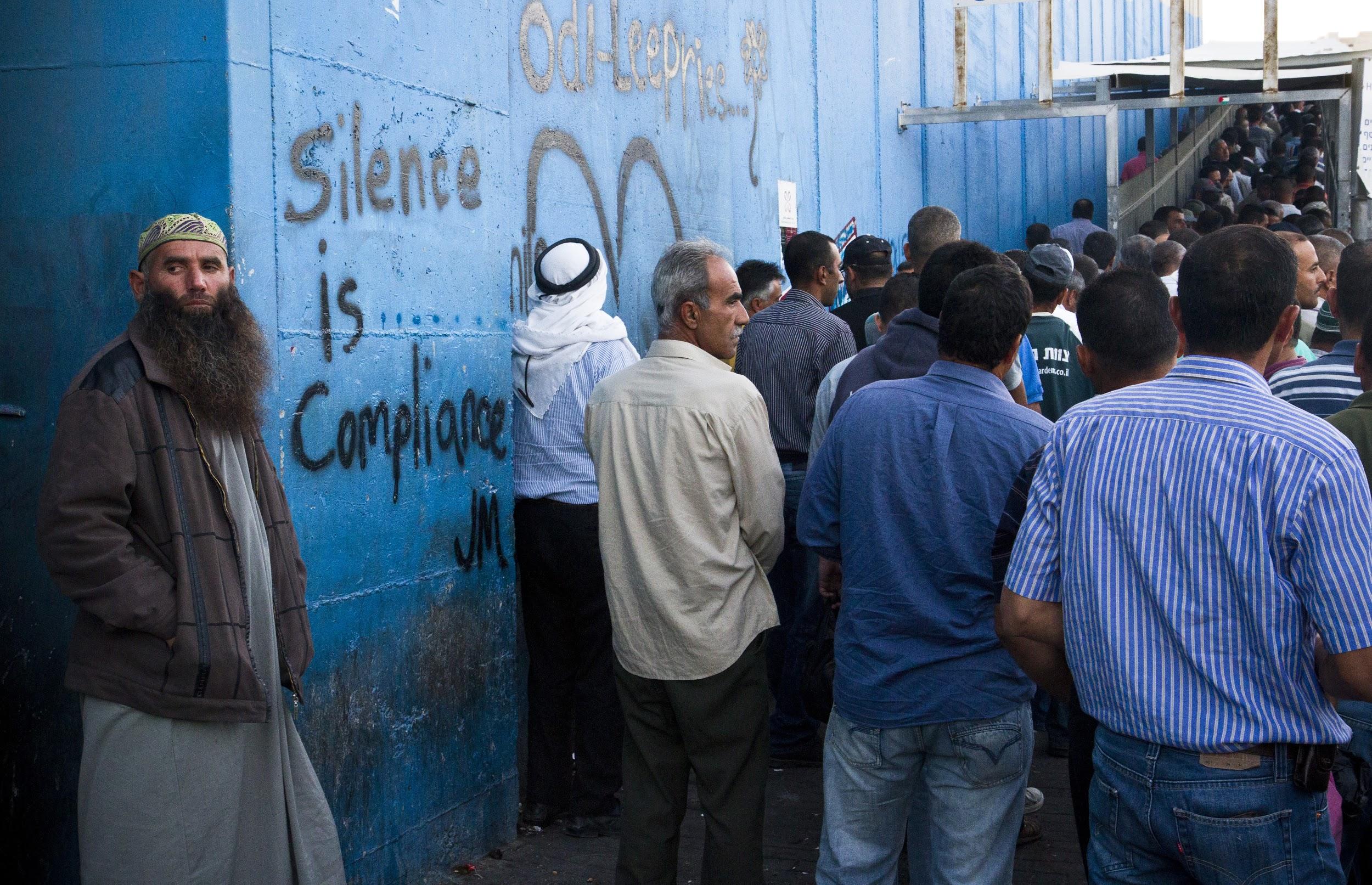
Bethlehem, The West Bank: Every morning hundreds of Palestinians line up at the barrier to make it through the checkpoint in time for work in Jerusalem. It often takes 3+ hours to make it through.

Let’s face it, no one wants to talk about the Israel-Palestine conflict. No matter what stance you take, you’re going to offend someone. Since violence and tensions have somewhat lessened since last year, or at least have become overrun by other more flashy news stories, there hasn’t been a whole lot of coverage on the conflict. Though governments may be in a constant process of peace talks and negotiation the situation for most Israeli and Palestinian citizens remains unchanged.

westernwall

The Western Wall, Jerusalem

About three years ago I spent some time living in both Israel and the West Bank. As a writer and photographer I naturally blogged about my experience, and the response I got was both shocking and highly predictable. This conflict touches on so many aspects of history and culture that it has become absolutely polarizing on the fronts of ethnicity and religion. Like the situation with my professor I managed to piss off people on both sides as I desperately clung to what I liked to think was middle ground, searching for a “pro-peace” option.

propeace Continue reading