Author Archives: Evan

Is Stormgate Postapocalyptic or Post-Postapocalyptic?

Stormgate is, to use the developers’ own words, a “next-generation” RTS game that is currently in the Early Access stage of its release. For those who aren’t in the know, real-time strategy emphasizes building bases and commanding an army of various units, and Frost Giant Studios counts among its number some of those responsible for such hallmarks of the genre as StarCraft II and Warcraft III. While the “sci-fi and fantasy” setting clearly cribs ample inspiration from its predecessors, recent developments beg the question of when the Human Vanguard faction is supposed to exist in relation to the initial invasion by the demonic Infernal Host. To ask it plainly, is Stormgate set in a postapocalyptic world?

The most obvious place to find our answer would be the official site’s homepage, which I’ve already cited above (all following emphasis has been added): 

These resilient soldiers have harnessed futuristic technology to rebuild their civilization after surviving an Infernal Host invasion – a devastating near-extinction event.

The Vanguard’s own faction page:

The Vanguard was formed to serve as humanity’s last bastion of defense with Earth on the brink of extinction. Representing the greatest scientific minds, toughest soldiers, and most brilliant strategists from around the world, the Vanguard stands resolute against the invading Infernal Host.

And, finally, the Media Kit page, which explicitly presents the setting:

The story takes place hundreds of years in Earth’s future, in an all-new post-apocalyptic game setting where science fiction and fantasy collide.

So why the confusion? While much hay has been made about the game’s art style, many detractors have pointed specifically toward the Vanguard’s general aesthetic as being too shiny and polished in light of their position as “humanity’s last bastion of defense” after a “near-extinction event.” It would seem that the present visuals don’t actually match up with this postapocalyptic setting, but digging further into Frost Giant’s other posts it appears that fans are being told two distinct things.


A Vanguard army readies themselves for battle.

Continue reading

Colonial Williamsburg: A Culture War Report

“What do you think of when you hear the word colonial?”

That was the question posed to me and others by a Black interpreter, a title that the Colonial Williamsburg Foundation has chosen to use over the more popular “historical reenactor.” It’s also one I had asked myself in the months leading up to the one-week vacation my spouse and I would be taking in Williamsburg, Virginia. To be perfectly honest, my answer before visiting didn’t amount to very much at all. Leftist internet circles and the odd Key & Peele sketch had helped me arrive at the conclusion that the Founding Fathers were a problematic bunch, but having eschewed American History in high school my familiarity with them was limited to binge-listening to Hamilton.

In spite of, or maybe due to, the level of my ignorance, I was excited to take a trip back to the 18th century in what I would later learn was the first permanent English colony in the Americas. While the City of Williamsburg owns the public streets that the restored Colonial-era buildings can be found on, buying tickets allowed the two of us to enter several of them and join walking tours. (Lifehack: teachers receive a 25% discount, so either marry one or finish a years-long education degree to save a little money!)

The interior of the Governor's Palace, with portraits of Queen Charlotte and King George III bordering the doorway.

The interior of the Governor’s Palace, with portraits of Queen Charlotte and King George III bordering the doorway.

Continue reading

My Wedding Reception/A Superspreader Event: A Culture War Report

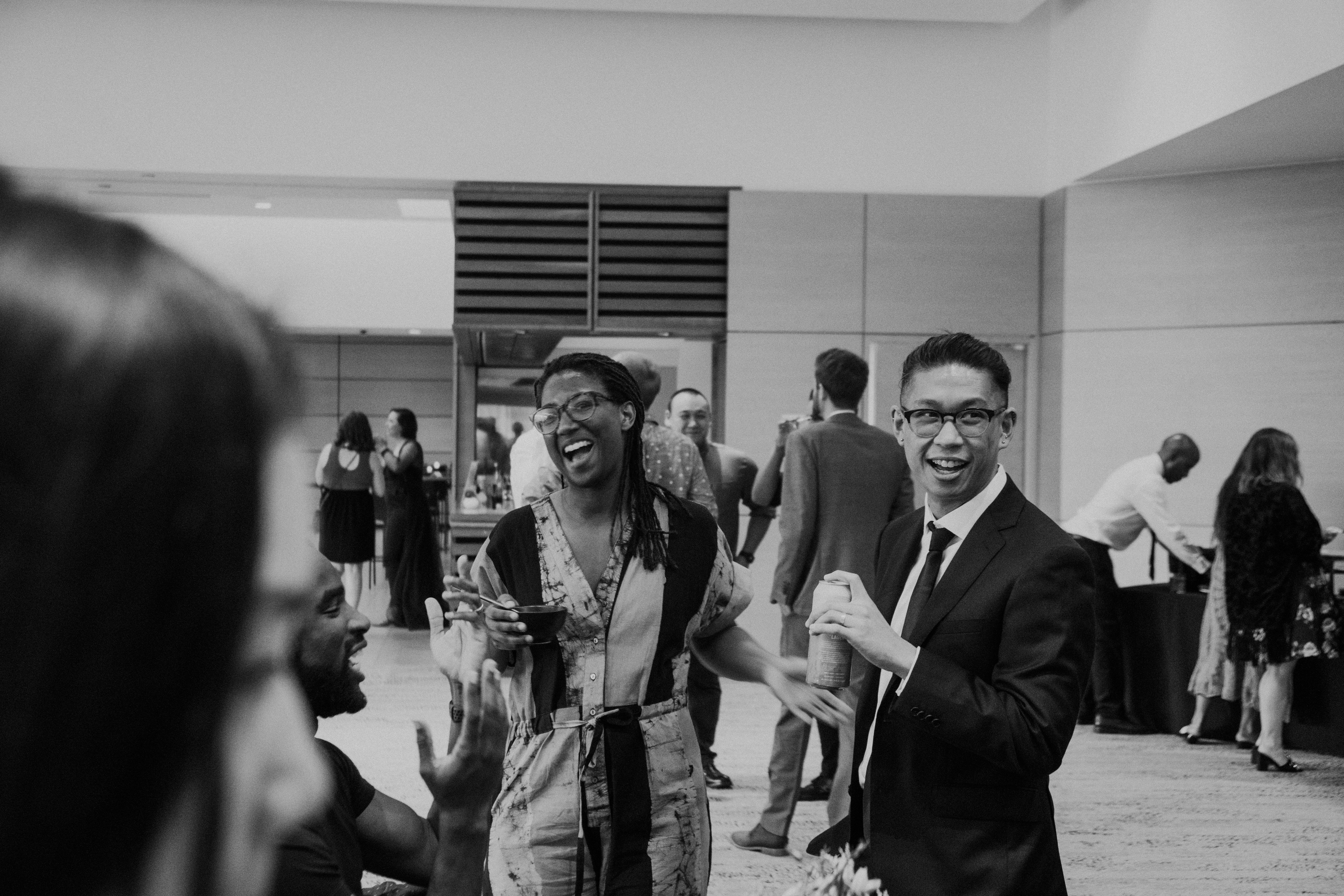
A black-and-white photograph of smiling guests at a formal event, including the writer of this blog post.

Of those visible and pictured here, roughly 1/3 have since tested positive for SARS-CoV-2. (That’s me on the right holding the beer.) Photo credit: Josiah Bilagot (@jbilagot)

Long-time readers of the site will be familiar with this feature as the rare recounting of a hands-on lived experience. Over the years my co-writers and I have shared our personal encounters attending such events as a LARP-ing session, major esports finals, and even an “Extreme Midget Wrestling” match. While each was a brief glimpse into an occasion the general public may never stumble across, what I’m sharing today is much more personal and, unfortunately, much more likely.

This past Saturday, July 23rd, my spouse and I hosted a reception at the very lovely Bluma & Appel Salon at the Toronto Reference Library to celebrate one year of marriage with our friends and family. It was a far cry from our actual wedding in July of 2021, when the backyard ceremony was comprised of the two of us, our pastor, my parents, my grandfather, and our photographer. Had we all seven gone inside afterward to share a meal in an enclosed room we would have flagrantly broken the provincial COVID guidelines at the time. In contrast the reception included roughly one hundred guests from dozens of households, interacting unmasked, dancing, and even enjoying a Indian vegetarian-vegan buffet-style dinner. It was one of the first pure, unbridled moments of joy I’ve felt in quite a long time. Continue reading

The Christian Decision to Rejoice or Weep Over the Past Weekend

The apostle Paul’s letter to the Romans of his day has been described as an “all-encompassing…[summary] of the Christian faith,” at least by the Devotional Study Bible I’ve held on to since I was a child. As a result it contains a number of passages that will be all too familiar to the present and former church-goers among you. Romans 10:9, for example, is a pithy primer on salvation for the would-be evangelist, whereas 8:28 is a verse that’s often brought to bear in tough or uncertain times. A particular section that’s been weighing on me is more broad in its usage: Romans 12:15.

Rejoice with those who rejoice; mourn with those who mourn.

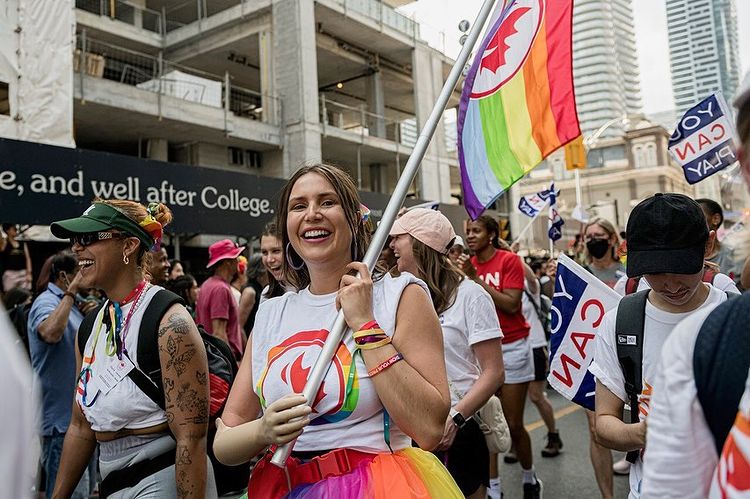
Photograph kindly shared by Erin Latimer. Photo credit: Christopher Katsarovluna (@catsarov)

Photograph kindly shared by Erin Latimer. Photo credit: Christopher Katsarovluna (@catsarov)

It brought to mind an event from several years ago, in the hazy span of time between my tween years and my early twenties. My family was all together for a summer in Toronto, and it was the weekend of the city’s Pride Parade. I remember it raining that Sunday, and hearing my mother muse aloud that it was a good thing the weather had taken a turn for the worse as it would undoubtedly put a damper on the festivities. She intimated that for her this was a time of great sadness.

I couldn’t help wondering if she felt the same way at the beginning of this week.

Continue reading

The Importance of the Asian Himbo

I haven’t explicitly blogged about the Asian-American experience in three years, last touching on the topic back in 2019 when I interviewed Bachelor contestant Revian Chang about her experience on the reality dating show. With May being Asian Heritage Month up here in Canada and Asian American and Pacific Islander Heritage Month south of the border, I thought it would be appropriate to return to a subject I’ve explored so often since this blog’s inception. What I didn’t expect was the immense weight that would accompany my decision.

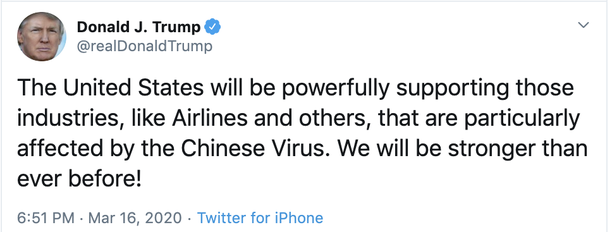
Thinking over the interim in which this site lay dormant I’m reminded of the 2021 Atlanta spa shootings, a horrific incident that struck me so deeply that it wasn’t until an old coworker asked me how I was feeling that I realized I was angry. I think back on a time where it felt like with every passing day was a new story about yet another hate crime being enacted against Asian people, violence born out of xenophobia that studies have shown flourished with the former POTUS’s tweets about the global pandemic.

POTUSmorelikePOS

Even now, during the month when we as Asian people living in North America should be keeping our heads high, acknowledging our past hardships and present triumphs, we’re reminded only four days in that distrust of Asian Americans has been steadily growing over the past year. 33% of Americans believe that Asian Americans are “more loyal to their country of origin than to the United States.” Countries that many have never even stepped foot in.

The increased difficulty surrounding my existence is directly tied into the dehumanization of my race. The man who shot and killed eight people (six of them being Asian women) was able to do so because he viewed them as temptations before he was able to consider them people. Opposite that mindset, the model minority stereotype that surrounds Asian Americans might seem positive, but it still reduces individuals down to qualities they might not even embody. It’s why a range of representation is so crucial, and the reason the Asian himbo is so important. Continue reading

Why Does the Billionaire Romance Hero (Still) Exist?

No one needs a billion dollars, no one person needs that much money, starts the viral TikTok song by Chaz Cardigan. It’s a fairly straightforward thesis, and even though the original video has since been taken down, the sound persists and has been used by countless other users, with videos like the one I linked to collectively garnering millions of views. Backing up that initial point, the lyrics continue:

A billion is a thousand million,
That’s twenty-one thousand years of work
At minimum wage to make that money
To hoard like you deserve it.
No one makes a billion dollars
Without exploiting workers.

Although this earworm acts as evidence that a platform predominantly skewed toward Gen Z is cool with vilifying the ultrawealthy, the sobering truth remains that as a culture we worship billionaires. It’s not just people who go far out of their way to simp for Elon Musk, either-

-it’s the constant media attention paid to those who make more in a single day than most of us are able to in an entire year. To be absurdly rich, at least in North America, is to achieve celebrity status, and the news cycle reacts accordingly. While the lavish praise heaped at the feet of such icons as Warren Buffett can often feel like it borders on infatuation, things truly cross that line when we consider the literary genre of billionaire romance. The name really says it all: the category exists to portray fictional billionaires as the desirable objects of our affections. Continue reading