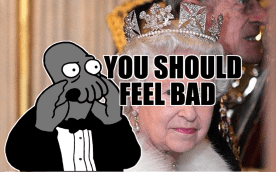
That’s right: the British Monarchy. I’m taking them down.
Again.
Being a radical lefty, there’s no one easier out there for me to bash than a woman making a speech about austerity measures while wearing a golden crown encrusted with diamonds pillaged from war-torn Africa and impoverished India.I have, in fact, done so before on another blog, and got chewed out by a Brit for daring to disrespect “my queen.” I responded to the (presumably) pasty twit that I’m not actually British and therefore am not a subject of an inbred German family.
I have never felt more American
So if I’ve touched on the subject before, why do it again?
Because this is something that really is a shame.
Let’s talk about money.
You can’t really argue with the fact that the money- tax money- used to prop up this family could be put to better use, “better use” being pretty much anything else- from reducing education costs to building new roads. Heck, even studying the mating habits of the sea otter would have more pay-off.
Because they are freaking adorable…
Now I can hear all you romantics and loyalists shriek out:
“BUT GORDON! IT’S NOT THAT MUCH! VERY LITTLE CASH ACTUALLY GOES INTO SUPPORTING THE MONARCHY!”
“Very little cash”? The queen- the queen alone- gets an allowance of a little more than a million dollars a year. Is that a lot of money?
Yeah, it is.
It’s a million dollars per year for having been born into one family and not another. It’s a million dollars that could be spent relieving poverty. And of course, it’s not just a million dollars. Not when you take into account everything else done for her. The security, the transportation, the servants- heck, the freaking A/C for any one of her royal residences probably costs more than I’d make in three years.
“BUT GORDON! WHAT OF THE TOURISM?”
Ah yes, the tourism.
Who could live without this stuff?
Because if the queen went away, the castles, the diamonds, the viking graves, the monuments- those would all just vanish as well. Tourists do not go to Britain expecting to have a face-to-face conversation with the queen. Tourism is not going to die with the Mountbatten-Windsors. Besides, if your entire economy is built on the frail shoulders of an octogenarian, you really don’t deserve to have a civilization to start with.
“IT’S DIFFERENT! THEY’VE GOT A CELEBRITY FOLLOWING!”
So does Honey Boo Boo. So does Justin Bieber.
“THIS OBSESSION CREATES JOBS!”
You think these people’s undeserved fame and fortune winds up creating jobs? Heck, war creates jobs, that doesn’t make it something worth pursuing. Greed, gluttony, envy and cowardice have given us thousands of jobs- some causes aren’t worth the effects.
“DIPLO-“
Don’t you dare say diplomacy. Don’t you dare.
An elderly woman with a funny hat isn’t going to do anything a bunch of children holding hands can’t- heck, Severn Suzuki did more in her five minute speech at the UN at the age of 13 than the Queen has done in her entire reign.
Let’s grow up, people.
Princesses are not from Disney. Princes do not sprout from frogs [I don’t think Gordon understands how fairy tales work. -Evan]. Royalty are inbred leeches draining funds from society that could be used help people who are actually productive. 1 million dollars isn’t much? Tell that to a bum begging for change. Tell that to a ghetto kid trying to get into college. Tell that to a war widow. This drooling over the royal family isn’t simply childish, it’s barbaric. There’s nothing quaint and charming about a handful of human beings enjoying fame and fortune simply for having been born.
If you’ve read even a couple of my posts, you’ll probably be able to guess that yours truly is more than a little bit political.
The problem with having political views pretty divergent from the rest of the country is that I often get stuck between two (supposedly) diametrically opposed worldviews who flood my inbox with conflicting petitions. The group whose legalize gay marriage petition I signed fully expects that I’ll jump at a chance to demand a ban on assault rifles, and vice versa.
Today being both inauguration day and Martin Luther King day, the liberal and progressive groups I’ve signed with have naturally been rejoicing like kids on Christmas morning.
Me?
Not so much.
What ticks me off isn’t that Obama is going to be president for another four years (okay, that does tick me off, but no more than any other proposed candidate), it’s all these people attempting to draw lines between what happened earlier today on the steps of the capitol and what happened half a century ago only a short distance away.
Now this certainly isn’t the first time Obama and MLK have been thrown together, and as simple examples of key figures in African American history, there’s really nothing wrong with that. What gets me- what really gets me- is how the two men are imagined as being part of the same great lineage, and nothing could be further from the truth.
What is so often forgotten is that MLK wasn’t simply an advocate of non-violence for the purpose of advancing the cause of civil rights- he was an advocate of non-violence for the purpose of stopping violence. MLK despised conflict, and was one of the staunchest voices of opposition to the Vietnam war. But hey, don’t take my word for it, hear it from the man himself:
Strong words, eh?
Those sentiments of King don’t exactly overlap with those of Obama on the subject of drone strikes and decade-long military occupations. Heck, at 3:40, King straight up declares his views to be biblical- something that the neo-cons and religious right in this country would definitely take issue with. Can you imagine MLK living today?
Well you don’t have to- Aaron McGruder, creator of The Boondocks, already has.
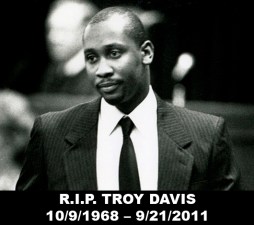
Again- regardless of feelings about either MLK or Obama, you can’t deny that the two of them were/are integral figures in American history, but it’s there that the similarities need to stop. Guantanamo Bay was not King’s dream for the country. Same goes for drone strikes, indefinite detention, record deportation rates, and the White House’s inaction on the wrongful execution of Troy Davis.
I’m just speculating, but I imagine King’s reaction would look a bit more like this.
EVAN: This week on E> we take a break from scrutinizing film to look back about seven or so months to a different time of our lives: college. Now that we’ve both graduated we find ourselves in a different stage of life, and it begs the question of what those four years did for us, and whether or not that’s what we wanted or expected.
GORDON: Throughout my college career, especially towards the end, I heard a recurring argument:
“College is a scam,” they said, “It’s a trap or, at very best, a waste of money. You don’t learn anything you can actually translate into a job, so either drop out while you can or don’t sweat the grades and party your buns off.”
EVAN: Wait, who is the “they” that was saying this?
GORDON: I’ve read it in various Cracked articles, I’ve seen it covered in webcomics and in comments, I’ve heard it on the radio. Not always the same tone, but it always boiled down to that essential idea. “College doesn’t teach you what you really need to know, it just puts you in debt and wastes your time.”
EVAN: Well, I guess that really begs the question of “What is it that we’re really supposed to know?” If college is the great institution to prepare us for our lives, what should it have taught us?
GORDON: Some would argue that technical and vocational skills are what we really need. Stuff that’s meant to train us for jobs. Wrenches, not Whitman.
EVAN: Which is the sort of thing you see advertised on television late at night or in the middle of the day; schools for electricians and dental assistants and plumbers and what have you.
GORDON: Which always come across as propaganda films from a dystopic alternate timeline. They can claim to be breaking the mold all they want- I’ll still always just see Orwellian Factory-Schools designed train the subservient masses for laboring in name of supreme leader and glorious fatherland.
EVAN: Heh heh.
The contrast to this idea you brought up when first introducing this topic, that the two sides could be seen as college prepping us for our careers or making us more well-rounded individuals.
There’s obviously more to it than that, but how would you boil the latter option down to its essence?
GORDON: I’d probably cite our own alma mater’s (for me more just “mater”) slogan of “global mindedness.” The idea is to create people who are, first and foremost, thinkers. Logical and critically minded thinkers with strong creative abilities and appreciation for art and wonder. A noble enough sentiment to be sure.
EVAN: To really engage with this topic I feel like we should have equal footing, and I’ll have to give our readers a little bit of context-
I’m currently unemployed, and chose to live the latter part of 2012 living with and taking care of my grandfather, whose wife [my grandmother] passed away in September. My job hunt has only very recently started up again.
I say that because as it stands one of us is currently working and knows how his education has aided him and the other is not.
GORDON: I, unlike my Canadian counter-part, am currently employed, having worked two jobs simultaneously for a while there. Having vainly searched for a job the entire summer and most of the fall, I am now working a job helping unemployed people find work, the irony of which is not lost on me.
EVAN: And did you, my Employed-American friend, find that a degree helped you in your search for work?
GORDON: In all honesty, I’m not sure.
On one hand, I can say that certain classes I brought definitely assisted me in securing a job, but those classes really more on the whole “applied” spectrum of education. I definitely didn’t need to go to a top 3% college. People, it turns out, don’t give a crap about where you went.
EVAN: Again, I can’t comment from experience, but I’d like to say that it depends on the job.
GORDON: This is probably true. However, if you were looking for a job, which is gonna look better on a resume? Four years of college, or four years of experience in that field? From everything that I’ve seen, I’d take experience every time.
EVAN: And I agree with that entirely. I can’t count the number of want ads I’ve seen [and this is for stuff like janitorial work, and dishwasher] that require “minimum 2 years work experience.”
It’s like, heck, what was I doing in school when I could’ve been out working this whole time?
GORDON: But of course, that brings up the first question: what’s the point of college? Are we expected to choose a career path and be trained like the mindless, dehumanized proles that we are?
EVAN: Well, for me personally my career goals were more tailored to an academic setting. My personal interest in writing and editing is definitely something that can and is fostered in that environment.
That being said, if I had skipped my four years of college to simply freelance as hard as I could out there in the real world, would I be a better writer today? I honestly couldn’t tell you.
GORDON: The problem is that both sides have really, really big flaws.
On the one hand, turning college into a simple vocational training course does truly rip the soul right out of academia. It makes it just the place you go to get a desk job instead of a manual one.
On the other hand, college as it is now, while fostering intellect and creativity, is as unhelpful as it is expensive. Why put yourself over a hundred thousand dollars in debt to not get employment?
EVAN: I guess in the bigger picture, what is it that we want to do with our lives?
There are plenty of jobs out there that don’t require a college education, and that certainly benefit from hard work at an early stage.
On the flip-side, there are jobs that you simply can’t get without a degree.
GORDON: We also can’t imagine that we can simply get any job we want to begin with. It’s all a gamble. I can get a degree in biology, but that doesn’t at all mean I’m gonna get a job in biology- heck, I’d probably be lucky if I got something even close!
EVAN: Like a janitor in a pharmaceutical company. Or the guy who delivers mail to a biology professor’s house.
GORDON: Exactly. So is that it, then? It’s the whole dang system?
EVAN: I mean, yeah. I feel like more often than not that’s all it really boils down to.
GORDON: So let’s talk about an ideal universe. Or at least one that ain’t quite so screwed up. What’s college look like? Give me your take.
This does not count as an ideal college…
EVAN: It’s tricky, man- Because I would like everyone to be well-read individuals who think about the media that they access and have a fuller understanding of what makes us who and what we are as a culture, I mean, that’s the dream-
But at the same time I acknowledge that there are people who don’t care a whit about any or all of that.
And with so many people who enjoy poetry and the arts, while those are debatably important parts of society, what happens when they need to find work? How many playwrights can any single country sustain?
GORDON: My response would be “how many playwrights are there actually out there?”
EVAN: I think there’s a difference between the actual number, and how many individuals would actually like to be a part of that number.
GORDON: Touché, but we can blame certain jobs being glorified and others suffering from unwarranted contempt.
But let’s move on. College. Your college- what’s it look like?
EVAN: A thorough exploration of the ideas that created Western civilization, the one most of us live in today, because it’s extremely important to observe our origins before we can look at our present and then ahead, after that.
A strong emphasis on writing with the reason that without the ability to properly communicate our thoughts how can we even really fully think them to begin with.
GORDON: Sounds to me that you’re still leaning more towards the side of academia.
EVAN: Well, like we’ve discussed, I have a slight bias. And I suppose we haven’t really defined the question as far as the purpose of college.
GORDON: My take would a combination of both sides, with the end goal being application. We’re talking about the study of English for the purposes of applying the principles in same, either in writing or screenplays or entertainment or communication of some kind.
I feel this would allow for all the creative and academic elements while keeping the whole process grounded. No ivory towers.
EVAN: I don’t think my take discounts the possibility of lining up with what you said, but that’s a really good description of how college could and maybe should be.
That being said, we are actually overtime.
GORDON: You wanna talk about drugs and culture next time?
EVAN: I think at some point we could hand this back to the viewers, actually. We’ve really gotten a handle on this whole E>. I’m just not sure when or how to do so.
GORDON: The readers are slack-jawed cattle who would eat their own shoes if we told them to.
EVAN: I should probably edit that out of the final post.
GORDON: Nah, we can let ’em vote. My subject would be Drugs and Culture.
EVAN: Mine would be . . . um . . . huh. About SNL. How to fix SNL.
GORDON: Nice. Let it be so.
EVAN: Tell the nice people to have a good Wednesday, Gordon.
GORDON: Have a good Wednesday, Gordon.
EVAN: And don’t forget to vote, readers! Thanks for putting up with my co-writer!
If it isn’t, then you probably aren’t familiar with the series (and should count yourself truly fortunate), so for you blissfully innocent, here’s the basic run-down.
The Left Behind series is based on the book of Revelation in the Bible, as well as certain (delectably) apocalyptic verses in Old Testament books. I say “based on”, but that’s more to demonstrate the authors’ intentions. Left Behind is “based on” the book of Revelation in the same way that Teenage Mutant Ninja Turtles is based on Vasari’s biographies of Italian Renaissance artists.
In the sixteen-novel series, all true (cough, Protestant, cough) Christians have been “raptured” (removed from the world and taken directly to the after life), leaving behind the unsaved protagonists of the story who find themselves contending with the oncoming “tribulations” (the host of hardships and catastrophes marking the end times) and the rise of the antichrist, who walks the earth in the form of a Romanian politician who takes control of the UN (because, you know, there’s no one more powerful than the UN).
Things more powerful than the UN: The Student Government of MLK Jr. Middle School, A Junior Sales Rep from Prescott Pharmaceuticals, Paris Hilton’s Chihuahua
Needless to say, I don’t think very highly of the series. But hey, if we’re looking for badly written fan-fiction, why not haul Twilight to the guillotine?
It’s because of the fan part. That’s what really gets me. We’re not talking about someone fawning over the idea of stalker-veggie-sparkle-vampires, we’re talking about someone fawning over the idea of millions- billions– of human beings undergoing agonizing deaths. Think I’m reading into things? Take a look at this passage from the series:
The riders not thrown leaped from their horses and tried to control them with the reins, but even as they struggled, their own flesh dissolved, their eyes melted, and their tongues disintegrated. As Rayford watched, the soldiers stood briefly as skeletons in now-baggy uniforms, then dropped in heaps of bones as the blinded horses continued to fume and rant and rave.
Seconds later the same plague afflicted the horses, their flesh and eyes and tongues melting away, leaving grotesque skeletons standing, before they too rattled to the pavement.
You might say “Sure, that’s violent, but that isn’t exactly glorifying it, is it?”. Let me continue on.
…Jesus nudged His magnificent white charger and descended to the top of the Mount of Olives.
As He dismounted, Carpathia shrieked out his final command, “Attack!” The hundred thousand troops followed orders, horsemen at full gallop firing, foot soldiers running and firing, rolling stock rolling and firing.
And Jesus said, in that voice like a trumpet and the sound of rushing waters, “I AM WHO I AM.”
At that instant the Mount of Olives split in two from east to west, the place Jesus stood moving to the north and the place where the Unity Army stood moving to the south, leaving a large valley.
All the firing and the running and the galloping and the rolling stopped. The soldiers screamed and fell, their bodies bursting open from head to toe…
So much for turning the other cheek, eh?
And here’s what gets me about the series. It’s not the generally bad writing or the twisted theology- it’s just how freakishly popular the series is. Popular enough not to spawn just one movie attempt, but two. It’s hard enough for good stories to get a second chance at something like that, let alone this junk. And it’s the implication of that popularity which gnaws at me. There are people out there- a lot of people- who genuinely look forward to this supposed apocalyptic scenario, or an apocalyptic scenario, anyhow. People who fully expect the end of the world to be a plague and hellfire ridden Armageddon, complete with WWIII and genocide of unheard of proportions. People who look forward to this- and not in a “in the sweet by and by” way, I’m talking about a “I love the smell of napalm in the morning” kind of way.
You can’t deny that this blood-thirsty anticipation does exist. If you’re even only vaguely familiar with the Christian (American-Christian, more on that in a second) subculture, you’ll almost have certainly run into this. There’s plenty of other lousy Armageddon fantasies out there.
And what makes it all the worse is just how utterly undeserved all this hidden vitriol is. This vengeful glee isn’t coming from people who have been mercilessly persecuted for their faith. This isn’t coming from the families of martyrs or the congregations of assassinated priests and pastors in the third world. The churches of Africa, Asia, and South America have enough problems combating war, poverty, and disease to be drooling over prophesied war, poverty, and disease. No, this is the bitter vindictiveness that only comfort and safety can breed. All this body-bursting leering isn’t a result of imprisonment (not that it would be justified there either), it’s a result of being snubbed by Bill Maher or portrayed as yokels on some sitcom.
That’s just messed up.
Now this isn’t Shame Day, but that doesn’t mean we can’t all gather ’round and ruthlessly mock something that so richly deserves it, and if this drivel doesn’t deserve it, I don’t know what does.
I was recently listening to a stand-up routine by British comedian Robert Newman, who in the course of an Iraq War joke stated something I thought was pretty dang profound.
“Just because you’re fighting the bad guys doesn’t mean that you’re the good guys.”
I really can’t think of anyone this statement applies better to than the adherents of the rising “Body Positive Movement.”
You hear that, starving kids in Sudan?
Who are these people? Well, the the “body positive” movement is the result of a reaction against the air-brushed, Photoshopped, and ultimately anorexic presentation of beauty offered by mainstream culture. It’s given us Dove’s “True Beauty Campaign” in which “real” women were used as models (hoping you’ll forget that the same people who run Dove run Axe).
It’s given us memes like this:
And it’s given us a host of philosophical epitaphs on how the size of your brain or heart are vastly more important than the size of your waistline.
“Buuuut we’re gonna use a skinny model anyways…”
And it all has a certain logic to it. Forget society’s standards! Be comfortable with who you are! Your insides are all that should count! Reject anorexic beauty standards! Enough making yourself sick trying to pursue unrealistic and unattainable goals! Only you can make you feel inferior!
And so on.
Now I know that it must sound pretty weird that these people would wind up being the subject of a Shame Day. After all, what’s wrong with rejecting the media’s unattainable and anorexic standard of beauty and embracing your body for what it is?
Well, suppose your body looked something like this:
Sure, I could say this guy is “husky” or “bigger” or “shaped differently” or use any other paper-thin euphemism for fat. Doesn’t change a thing. I could name the asteroid about the hit the earth Friendly Ed and there’d still be as much devastation when Edward hits New York. We can call it anything we want- we’re still not changing the fact that being fat isn’t any more healthy than being stick-thin.
“But Gordon, you incandescent beacon of enlightenment, surely these people aren’t advocating anything like that!“
And no, not all of them are- but enough of the big players are endorsing pretty much this philosophy. Let me offer this post from The Body Positive’s website as an example. In her article “‘Tis the Season to be Squishy”, Connie Sobczak asserts that there’s really nothing wrong with gaining weight during winter months, as this is simply the body’s natural reaction the cold as a result of evolutionary adaption. And that is true- only Sobczak goes on to use that factual statement to prop up some far more dubious claims.
“So, the next time you ‘feel like a steak’ or ‘need a cookie’ it could be your brain and not your stomach talking.” Out of the mouths of doctors!”
**** That.
What Sobczak is doing here is attempting to twist evolutionary biology into an excuse for lack of self-control. There’s nothing wrong with wanting to eat a bag of chips. There’s nothing wrong with wanting to eat a bag of chips in winter when you need more calories. There’s nothing wrong with stating that as your reason for eating more chips. But taking all of that and coming away with the conclusion that eating chips (or anything else) is retroactively sanctioned by biology and stating that this conclusion is supported by medical professionals is as dishonest as it is deluded.
Case and point.
Look, it’s true that who you are on the inside is vastly more important than who you are on the outside, no one is going to argue that. But let’s talk about excess, people. Let’s talk about gluttony. Aren’t these realities? Let’s compare the number of people who have had become ill or died as a result of being overweight and contrast it to the number who have become ill or died as a result of being underweight in this country. Which side is gonna have claimed more?
Now that ain’t an endorsement of anorexia or our twisted standards by any means, it’s simply a counter-point.
But hey- maybe it’s not a health thing. Maybe it’s just about being comfortable with who you are regardless of your size. That’s the line taken up by comedian Gabriel Iglesias in his stand-up routine.
Towards the end of one of his acts he states that he wouldn’t want to live to be a hundred if it means he couldn’t eat cake. He asserts that working out doesn’t ensure you’ll live long- why not enjoy life while you have it?
Why not indeed?
So if that’s the case, why are we jumping on the bulimic and anorexic members of society in the fist place? Hey- if health isn’t an issue and happiness is, why is a a girl weighing less than seventy five pounds any worse than a girl weighing three hundred? Why is it “Body Positive” for a woman to expand her waistline and self-loathing when she expands her bust line? It just doesn’t pan out.
Look, I’m not here to offer any solutions. I’m six feet tall (when I’m not slouching, which is always) and skinny. I smoke a little bit, drink a little more, and could stand to cut down on the meat and up my intake of fruits and vegetables considerably. I don’t work out, but then again, if wolves were to be introduced to my city, I’d probably be ok. Despite my extreme examples, the vast majority of us are neither morbidly obese or carried off by strong winds. All that’s to say that I’m in no place to pass judgment on anyone, nor is it my intention to do so. I’m simply here to point out the hypocritical and seemingly self-serving logic being employed by the group in question.
Let me begin by explaining that this is not a review of the simultaneously acclaimed and decried 2012 Tarantino blood-fest. You want to hear one of those, I’d recommend clicking over to Spill or The Escapist’s “Escape to the Movies.” No, what I want to talk about are some specific elements and segments of the film which have become points of contention, controversy, and debate in the past weeks.
Let’s start with the most obvious:
I. Saying “Nigger” Every Other Word
I won’t claim to know your stance on the word “Nigger”- heck, I’m not even sure of my own stance. Perhaps you view the term as so degrading and reprehensible as to merit burning it from spoken language. Perhaps you believe that appropriating and using the word strips it of its power to even be used as an insult. Maybe you see it as being purely contextual- a term of address with audience and a terrible insult with another.
It’s all Elmo ever thinks about
There are probably strong points to be made on all sides, but perhaps the stance you cannot take is that the use of the word “nigger” was inappropriate for the movie.
Now before you take up the battle-cry of “Tarantino is just trying to shock us!” or “Tarantino uses the word excessively in his other movies!” I have to say this.
You’re right.
It’s Tarantino; that’s not an excuse, that’s a fact. You wanna take up his use of the word in other films, then that’s part of the whole debate mentioned above. Simple truth of the matter is that this use of the word “nigger” would still be controversial if the film had been made by anyone else. So let’s talk about it.
Let’s assume that this movie, with selfish or noble intent, is trying to demonstrate a glimpse of the world in question; the use of that word is almost bound to come up. I might throw out the example of Mark Twain’s classic novel Huckleberry Finn, and while by sheer volume Django probably has Huck beat for use of the word, by percentage I’d posit the two are pretty evenly matched. The escaped slave Jim is repeatedly and almost exclusively referred to as “Nigger Jim,” as are the other black characters in the book. Now Twain was anti-slavery and used that word to demonstrate the dehumanization of African Americans (which is why taking the word out of versions of the book is so dumb), as well as reflect the general use of the word. Now I’m admittedly no historian, but if the writings of Twain and other authors are any indication of the times, I wouldn’t say the film is quite so far off as some critics might suggest.
And speaking of historical accuracy…
II. The KKK, or Lack Thereof
There is a scene in the film during which a group of men wearing white sacks over their heads attempt to stage an attack on Django and Schultz. New Yorker contributor Jelani Cobb writes “Tarantino depicts the K.K.K. a decade prior to its actual formation in order to thoroughly ridicule its members’ (literally) veiled racism.” While that scene was (in my own opinion) side-splittingly hilarious, Jelani, and many others, are dead wrong in assuming that this scene depicted historical inaccuracy.
Take this section from Huckleberry Finn:
Why don’t your juries hang murderers? Because they’re afraid the man’s friends will shoot them in the back, in the dark — and it’s just what they WOULD do.
“So they always acquit; and then a MAN goes in the night, with a hundred masked cowards at his back and lynches the rascal. Your mistake is, that you didn’t bring a man with you; that’s one mistake, and the other is that you didn’t come in the dark and fetch your masks.
Again, this is a Tarantino movie set in a Tarantino universe. That’s not a defense, simply, as I’ve already stated, a fact. If you’re looking for a historical account of the pre-war South, a spaghetti-western revenge flick probably ain’t the best place to look for it. There are going to be certain inaccuracies, and there are going to be things the filmmaker has to get right- but all of that is beside the point (which we’ll get to in a minute). All of that’s to say if you’re gonna try to criticize (or praise) the movie’s deviation from historical truth, make sure you’re (1) doing it for the right reason and (2) that you’re critique is actually right.
III. Samuel L. Jackson as Uncle Tom
In Django, Samuel L. Jackson plays the role of the villain’s head-slave Stephen, who isn’t so much a character as a caricature of the most groveling, snivelling Uncle Tom you will ever see or even imagine. This guy makes Uncle Ruckus look like Eldridge Cleaver.
You are guaranteed one genuine Gordon hug if you know who Eldridge Cleaver is.
I’ve heard people call this portrayal offensive, bordering on “black-face” in its depiction of stereotypical “black” mannerisms. It’s exactly for that reason that I didn’t have a problem with the character.
I really have no reason for putting this gif in here…
See, the entire point is to make fun of the guy- and not just him, but the quisling slaves that did indeed exist. I don’t think that this portrayal robbed the film of the gravity of slavery anymore than Bugs Bunny foiling a cartoonized Hitler robbed WWII of it’s gravity.
If Django Unchained exaggerated the horrors of the slavery, if the film depicted one one-hundredth of the horrors of slavery, I will never write again. Despite the allegations of this critic, the truth of the matter is that we could depict the institution of slavery for a century and be no closer to depicting an ounce the inhumanity of it all than when we first started. Does the film exaggerate slavery? Absolutely not. Does it make light of it? Certainly this was a concern of mine going into the movie, but having seen it, I really don’t think it can be faulted there either. The film does, I believe, make a distinct effort to show slavery as brutish and ugly as possible. Or, at the very least, the slavery scenes; this is, after all, a revenge movie first and foremost.
V. The Point
That’s the thing I feel most people are missing here. This ins’t a movie about slavery, this is a movie with slavery in it. It’s a revenge film in which one sorely persecuted character dispenses well-deserved justice upon his persecutors and we all nod our heads in approval and feel a sense of pride and joy well up as we look into this fantasy where the bad guy does get what’s coming to him. Slavery is the backdrop, not the subject, of the movie, but it’s just such a major issue that most of us are getting hung up on it. The equivalent might be bashing a western on the basis that the actual “wild west” was pretty peaceful- factually true, but still missing the goal of the story.
No, this is not a historically accurate film. No, it doesn’t capture the horror of slavery. No, it doesn’t even try to wrestle with it. No, it’s not a discussion of our checkered heritage. No, it’s not the film to drag that dark, bloody history out into the light of day.

 That’s right: the British Monarchy. I’m taking them down.





 EVAN: This week on E> we take a break from scrutinizing film to look back about seven or so months to a different time of our lives: college. Now that we’ve both graduated we find ourselves in a different stage of life, and it begs the question of what those four years did for us, and whether or not that’s what we wanted or expected.








 Culture War Reporters