Category Archives: America

Evan and Gordon Talk: Kung Fu Movies

EVAN: Last week you all voted for us to talk about the popularity of kung fu movies, so that is what we’re doing. The question that’s been on my mind being, why aren’t they popular anymore?

GORDON: See, I’m gonna have to butt heads with you right out of the gate. I just don’t think that kung fu movies are unpopular- at least, not anymore than at the supposed height of their glory…

EVAN: But there’s definite evidence of a time when they were all the rage. There were the dubbed martial arts films in the 70s and 80s, as well as the immense popularity of actors like Bruce Lee, Jackie Chan, and now Jet Li.

GORDON: No argument there.

EVAN: Recently, all that really comes to mind is Li’s role in The Expendables 2. Which is by no means a large one, considering the immensity of its cast.

GORDON: Well, that’s part of the problem- movies have developed since the 70s and 80s- none perhaps more dramatically than the action flick. Take The Matrix, for example.

EVAN: Definitely a revolutionary flick.

GORDON: Amazing stunts, choreography, and so on- and all hugely influenced by kung fu movies. In fact, Wikipedia goes right ahead and lists it as a “King Fu” movie.

Now look at an action film from the 60s or 70s. At the very best, you get Dirty Harry pistol-whipping some thug, and more often than not, you get Captain Kirk doing some weird slap-fight with a man in green spandex.

EVAN: Hey, that man in green spandex had it coming.

GORDON: This is true. What I’m driving at here, I guess, is that kung fu movies haven’t gone away- they’ve been incorporated into every major action flick made since the 80s.

Just look at fight scenes in a modern action movie- that’s Judo, or Jui Jitsu, or Karate, or Muay Thai, and so on and so forth.

EVAN: Okay, let me come at this from a different angle. Would you say that at this point in time, Jet Li is the go-to guy as an Asian actor who specializes in martial arts?

GORDON: More or less, sure.

EVAN: How many [Western] movies has the guy been in compared to Jason Statham?

GORDON: Couldn’t say. I’m guessing Statham’s got him beat, though.

EVAN: Why is it that more often than not, whenever martial arts are depicted in a movie they’re performed by a white guy?

GORDON: Oof- where to begin? Tacit racism, hiring ease, translation, and so on.

EVAN: I’m just saying that there was a time, mid to late 90s and early 00s where Asian actors could still headline these films. You’ve got the Rush Hour films and Shanghai Noon and its sequel, to name some Jackie Chan vehicles. And you had stuff like Romeo Must Die with Jet Li.

As far as Wikipedia can tell me, all the martial arts films starring Asians in the last few years were made in Asia.

GORDON: And are nevertheless seen by Western audiences. Take The Raid, an Indonesian film, or The Man With the Iron Fists, which people are pretty psyched for, or Tony Jaa’s work.

EVAN: Yes. Tony Jaa.

GORDON: As there did before. I mean, barring certain movies, like Crouching Tiger, Hidden Dragon or Rush Hour, how much appeal did kung fu movies have anyways? I’m not knocking them or anything, but it seems that with certain exceptions for major pieces, kung fu movies (in the West) have always been mostly popular as a sugenre with fans of said subgenre. Much like the monster movie, or the sci-fi horror.

EVAN: At some point they epitomized the action genre, so I’d say they had a lot of appeal. I mean, it rode the trend of dojos and whatnot opening up all over North America.

GORDON: Wasn’t that with the 80s stupid action flick, though? I mean, c’mon. It was the 80s. Get some Aryan guy to face-kick a bunch of minorities, slap on an over-the-top title and you’ve got a hit.

EVAN: I was mostly referring to the fact that Asian martial arts films became so popular that they started creating them in Hollywood, using Asian actors.

GORDON: So the issue here isn’t kung fu- it’s Asians in media…

EVAN: We can concentrate on the genre and its popularity before we follow that train of thought. Why do you think it’s lessened so much? And if it has, what has replaced it?

GORDON: I think that the rise in awareness of martial arts in the West is responsible for that. Suddenly, you can get all the amazing choreographed fights without them being (necessarily) rooted in Asian culture.

The equivalent would probably be the Western/Cop flick and it’s influence on Hong Kong action movies.

EVAN: So what you’re saying is that Western culture has realized that this isn’t a genre that solely the East can lay claim to.

GORDON: Not entirely, anyways. Depends on how you define a “Kung Fu Movie.” I was just going with a movie that’s heavily rooted in martial arts.

EVAN: I mean, I’d say that it’s because the Asian actors that we [Westerners] can relate to are getting old. Jackie Chan is 58. Jet Li is 49. No one has really stepped up [or has been able to] and taken their places.

GORDON: Well- no argument there. Barring perhaps Tony Jaa. Who will **** you up if you so much as look at his elephant the wrong way.

EVAN: ช้าง อยู่ ไหน [chang yuu nai]?! If you saw the movie, you’d get it.

GORDON: Go see the movie. Now.

EVAN: Watch it please. Tom Yum Goong as it was released in Thailand, but retitled The Protector for an American release.

GORDON: Also, eat tom yum goong. It is the best thing ever.

EVAN: Anyway. I just think it’s interesting, the fact that there’s clearly still an interest in Asian martial arts.

Using two panda-related examples, Dreamworks’ Kung Fu Panda movies, and Blizzard’s upcoming expansion for World of WarCraft, Mists of Pandaria.

GORDON: This is true.

EVAN: Pandarens had existed in WarCraft for years before those movies, by the way. Just for everyone who’s saying that Blizzard ripped the concept of anthropomorphic martial arts fighting pandas from a Jack Black movie.

GORDON: And with that, we’re out of time.

EVAN: Don’t we have ten more minutes? We started at ten past.

GORDON: Oh. I thought we started on the hour.

EVAN: Nay. And we’re keeping all of this dialogue.

GORDON: To assure our readers that we too are flawed mortals?

EVAN: Well, that one of us is.

GORDON: Touché.

Back on the subject- let’s not forget that thanks to Netflix and piracy, it’s easier and easier to get movies from out of the country anyways. Just look at Red Cliff.

EVAN: Red Cliff?

GORDON: Epic action movie. Based on ancient Chinese history, and a text called “The Romance of the Three Kingdoms,” if I recall correctly. Some sort of an Eastern equivalent to “swords and sandals” flicks. Which are awesome, by the way.

EVAN: Yes. We do love our “swords and sandals” movies.

GORDON: Go watch Ironclad. Watch it now.

EVAN: If only to watch Paul Giamatti’s veins pop out on his neck as an angry King John.

GORDON: Words cannot describe how irritated he is in that movie. It defies logic.  Also, a man gets beaten to death with his own arm.

EVAN: Actually, I am fairly sure the severed arm belonged to a different guy.

Back on topic one last, time, before we run out of it- It seems that Asian cinema continues to chug on, producing martial arts movies even if Western Cinema has since moved past that. In a way, what was popular for a period of time in Hollywood never stopped in Asia. Though those movies still changed the action genre in a huge way.

GORDON: Absolutely. From The Bourne Identity to Batman Begins, the blood of Kung Fu movies still pumps strong. And with that, we’re out of time. Be sure to swing in next week for our discussion on the upcoming season of Community.

EVAN: Nooooooooo. That’s next-next week. The day before the new season starts.

GORDON: Why must you make a fool of me?

EVAN: Why must you make a fool of yourself.

GORDON: Anyways. Be sure to vote for our discussion topic next week.

EVAN: And thanks for reading!

Celebrity Mortality and Actual Loss

Eight days ago Michael Clarke Duncan, who you probably know better from the Green Mile but who I remember as the Kingpin in Affleck’s Daredevil, passed away having never fully recovered from a heart attack. Whenever a celebrity dies people take to the internet to mourn, and I saw the following comment on one of MGK’s very simple memorial posts:

What struck me was what exactly made this summer more heartbreaking than any other. Was it the suicide of Top Gun filmmaker Tony Scott? The passing of puppeteer Jerry Nelson? Moreover, was this summer any more “heartbreaking” than 2009, when Michael Jackson, Farrah Fawcett, Ed McMahon, and Billy Mays died? Continue reading

The Good, the Bad, and the Racist

Over the past weeks, there’s been some talk here in Vegas about changing the name of our airport from McCarran to something- anything– else. Named after Nevada senator Pat McCarran (1876-1954), the group pushing for the change were of the opinion that it wasn’t quite right having one of the busiest airports in the world named after a viciously racist Fascist-sympathizing McCarthyite. Last night, I caught a bit of a local talk-show as I was channel surfing, and heard the subject get brought up. Steve Sebelius, a major journalist in Vegas, was commenting on the name-change movement’s loss of momentum, pointing out that despite McCarran’s psychotic antisemitism and racial bigotry, he was the principal defender of gambling in Nevada, and that without him “None of us would be sitting here”. The show wrapped up after that closing comment, and whether or not the they addressed the whole issue of what comprises one’s legacy I can’t tell you. Frankly, I would like to see the airport’s name changed- and not just the airport, but every street, boulevard, and building named after a bigot. But as the journalist rightly pointed out, the world doesn’t quite work in white and black.

Pictured: Pat McCarran, who objects to me using the words “white” and “black” so close to each other…

As much as we’d like to imagine (at our history book’s insistence) that America was created by heroic men who only drank distilled freedom and wiped the sweat from their brows with patriotic American flags autographed by Jesus, this nation was built on the backs of slaves and the bones of Native Americans. The same man who authored the Declaration of Independence owned his sister-in-law, and despite his assertion that it was self-evident that all men are created equal, hated and feared German immigrants with a passion that the Minutemen Project would feel is “a bit much”. Jackson- the hero of Federalism, the slaughter of Native Americans. FDR, the creator of the New Deal, the guy who forced over a hundred thousand Japanese Americans out of their homes and into prison camps. Between genocide, exploitation, segregation, and a host of other forgotten sins, there’s not much in US history or culture that doesn’t carry with it a stain of injustice or inequity.

Our food included…

But how, then, do we deal with this? If we rename racist streets or airports, why stop there? Why not get rid of the sexists’ names? Or those who were just plain greedy or arrogant or inept? It seems if we go down that road, we’ll wind up leaving everything blank as we dig through history in search of the perfect human being. On the other hand, we can’t exactly drive down Hitler avenue and assert that his anti-smoking campaign is just as much a part of his legacy as the concentration camps and Kristalnacht. So how do we measure a figure’s good acts against his bad ones? I’d personally like to see Jefferson Street renamed Malcolm X Street, yet I have to simultaneously deal with the fact that X held many racist views himself until his conversion and change of heart later in life. Again, how do we discern between the good guys and the bad guys? No one’s perfect, but not everyone uses child soldiers either. Simply, people are complicated.

Case and point…

And because I don’t want to leave you hanging with another “Make of it what you will” post (as I did in my report on Extreme Midget Wrestling– check it out), I’m going to fly in the face of caution and offer this criteria for naming your airports and roads:

I. Is he or she a good guy?

That’s it. If you can’t answer “yes” immediately to that question, and if “mostly” doesn’t work either- move on to someone else. Simple as that. There is always going to be controversy- and we’re going to have to deal wit that. Values change, secrets are uncovered, and some heroes become villains and villains heroes- but for now. For right now- let’s go ahead and make the change. Yeah, it’s a pain in the neck, but if we do it right the second time around, hopefully we won’t need to change up the names for a another seventy years or so. And before someone writes in about it being part of our past or our heritage- let me shoot you down right now. Yes, bigotry, as ugly as it is, is a part of our history. But changing names doesn’t mean that we’re running away from it- it means we’re passing judgment on it. In the end, that’s what I want to cite as my heritage- not racism, but the condemnation thereof.

Evan and Gordon Talk: Affirmative Action

EVAN: So last week I asked people on Facebook what they wanted us to talk about, and the answer that got the most votes was affirmative action. This is a pretty broad topic, but thinking about it in the past couple of days I have at least a few possible directions to go with it. But before we do that, a definition-

GORDON: Well, that eternal fount of knowledge that is Wikipedia sets affirmative action down as:

“policies that take factors including ‘race, color, religion, gender, sexual orientation, or national origin’ into consideration in order to benefit an underrepresented group ‘in areas of employment, education, and business’, usually justified as countering the effects of a history of discrimination.”

Though of course, we’re probably more familiar with it in regards to racial or gender quotas for certain businesses.

EVAN: Right, like hiring a minority to make some sort of company quota-

GORDON: Ironically, despite the outcry against this particular aspect of affirmative action, it isn’t actually legal in the US to set quotas for any race.

EVAN: Which I did not know. But it happens, of course.

GORDON: That it does. That quota being typically “100% white.”

EVAN: I meant more along the lines of the executive minority training program featured in Season 6 of The Office.

GORDON: That too. “Token” minority hiring.

EVAN: And Gabe’s childish delight at pulling in someone who wasn’t black [Kelly], like all of the other entries were.

GORDON: It’s been a while since I’ve seen it.

EVAN: It’s all good.

GORDON: Let’s get right down to it here- affirmative action is still a contentious practice, but let’s face it, now more than ever it’s demonstrative of inherent bias in the system.

EVAN: As someone who doesn’t keep up with the news as often as he should, the most recent event I can recall that featured this was the rioting that was happening in Paris.

GORDON: Go on…

EVAN: Oh man, I was really hoping you’d remember. But it was a minority group rioting, and the way they solved it all was that employers had to hire people from this group, and pay them regardless of how well/hard they worked.

GORDON: Ergh- it’s France. These are the same people who nearly elected a neo-Nazi to be prime minister, and and have massive racial bigotry issues- just look at their expulsion of the Roma.

I’d hesitate before using them as an example- let’s bring the issue a little closer to home. Take America, for example.

EVAN: Well, your home.

GORDON: We have a workforce completely and utter disproportionate to the population. Even as the white population diminishes, the vast majority of administrative jobs are held by white males.

It’s like what I brought up in my article on TLC.

EVAN: Misrepresentation of an entire population, yeah?

GORDON: Absolutely.

EVAN: So that’s America, but where does affirmative action come into it, are you saying it’s needed?

GORDON: I’m saying that it isn’t working. If affirmative action was meant to end hiring and promotional discrimination on the basis of race and gender, it’s utterly failed, and the proof of that is everywhere around us.

EVAN: Well, you know more about the States than I do, especially with you saying that it’s illegal. Are there any affirmative action movements than you can bring up at all?

GORDON: The only major issue I can recall in the past couple years was a lawsuit brought against Walmart.

EVAN: Go on.

GORDON: Back in 2007, a gender discrimination lawsuit (Walmart v. Dukes) was filed, with a massive number of women citing that despite nearly two-thirds of Walmart employees being women, only a third of management was female- and that’s to say nothing of other charges against Walmart’s routine exploitation of its female employees.

A court (tragically) ruled that the various individuals suing didn’t have quite enough in common to constitute being a “class”, so the case was more or less thrown out.

EVAN: Their sharing a gender not withstanding?

GORDON: Welcome to America.

vv

EVAN: Moving on to something I may know a little more about, affirmative action is a term that comes up quite a lot in regards to Native Americans, or what we in Canada refer to as “First Nations.”

GORDON: Shoot-

EVAN: There’re reservations, of course, land that belongs [is given] to said people. I’ve heard many times friends saying that they were 1/16 such and such, and would be able to “claim land.” Also the fact that gambling is legal on such properties, which I still don’t fully understand.

GORDON: The issue of native rights is an entirely different topic- something we oughta cover, but not quite in this post.

EVAN: I’m just saying that I think it ties directly into what we’re discussing. This is all stuff that’s “usually justified as countering the effects of a history of discrimination.”

GORDON: Granted. One could make an argument for lumping together reparations and affirmative action, but affirmative action is really strictly defined as pertaining to admissions- into either a university or the workplace.

How IS that in Canada, anyways? You got management proportionate to your population makeup?

EVAN: I am not sure. Let me check.

Well, I can confidently say that our minority population is 16%, though this excludes First Nations. Taking them into account, they add 4%, making a solid 20% of our population being nonwhite.

GORDON: Okay. So in your experience, is one in five Canadian manages/execs/bosses/administrators/etc. from a minority group?

EVAN: I’d say that in Toronto, at least, you’re as likely to see a white person as a non-white person. Depending on the neighborhood, you may find it difficult to see more than a handful of Caucasians.

GORDON: But in management…

EVAN: Right. I’m not exactly in a lot of offices… So I don’t know if I can comment on that.

GORDON: Gun to your head…

EVAN: I want to say 1/5 are probably minorities. Which matches up with the statistics I mentioned.

GORDON: Ah, good.

I love how useful this GIF is...

EVAN: I’m a little perturbed that you put a gun to my head in this post.

GORDON: Heh…

Before any of the readers jump down my throat, I know am I’m looking at the problem from a white-liberal viewpoint. Simple fact of the matter is, college is expensive (don’t I know it… **** you Evan, and your ridiculously great government benefits), and the small, wealthy majority in US is (overwhelmingly) white. Someone might make an argument for qualifications being required over race, but that’s exactly where affirmative action is SUPPOSED to come in.

It’s meant to help even the playing field, but it just doesn’t- again, look around.

EVAN: Qualifications required over race and affirmative action. Could you explain that further?

GORDON: Imagine you’re an employer. And imagine this we’re not living some depression-era-hellscape where you’re asking that an entry level employee have five to ten years of experience.

EVAN: . . . I’m listening. This is a dreamworld you’re painting.

GORDON: You have to fill a position, and there are two candidates- a white guy with a college degree, and a black guy without one (again, college is ****ing expensive). Who do you give the job to?

EVAN: The qualified one. The white guy.

GORDON: And imagine you need this position filled again the next year. And the next and the next, and you keep getting the same basic candidates. Who do you pick?

EVAN: Obviously whoever can do the job better. But where is affirmative action, like you said, supposed to come in?

GORDON: The people with jobs get money, the people with money send their kids to college, and so on. Affirmative action is meant to make sure that people aren’t discriminated against on the basis of their race, so that two equally qualified people stand an equal chance of getting in.

It’s like trying to back-paddle in the middle of a maelstrom.

EVAN: Ah, I see what you’re getting at. But what about minority scholarships?

GORDON: Even there, there’s an issue. Poor schools don’t get good funding, they tend to produce students who aren’t as prepared as their wealthier peers, and even bright ones who would otherwise school their peers wind up doing worse on tests. Unless you’re exceptionally gifted…

Again, it’s trying to apply a band-aid to an open wound.

EVAN: One more simile, for the road. Our time’s just about wrapped up.

GORDON: It all boils down to this- there is a need for equity and equality in the workplace- a desperate need. But affirmative action is like using a toothpick to fight dragons [emphasis added]- its the wrong tool of the job, and even if it was appropriate for the situation, it’s still not very effective…

EVAN: Join us next week, where hopefully I know more about what we’re talking about, when we discuss-

A Culture War Report: Extreme Midget Wrestling

It’s just shy of 8:00 in the Riviera hotel and casino, one of the last of the original Las Vegas casinos. I’m in the lobby, waiting for the show to start and killing time with some people-watching. An Elvis impersonator passes through, followed shortly by the Beatles. There’s your businessmen, your tourists, your townies out for the evening. A woman in her early fifties, covered in tattoos and carrying a four-foot glass vase of alcohol. Some hipsters in tight jeans taking their picture with the Extreme Midget Wrestling advertisement, some bros in tight Hollister t-shirts boasting about how much vodka they downed. There’s a guy in line to buy tickets with a “Hooked On Jesus” shirt, and a couple female body-builders. All strutting, sauntering, and stumbling past while U2’s “Pride (In the Name of Love)”- a tribute to the life and work of MLK Jr.-  plays in the background.

There’s probably a message in there somewhere.

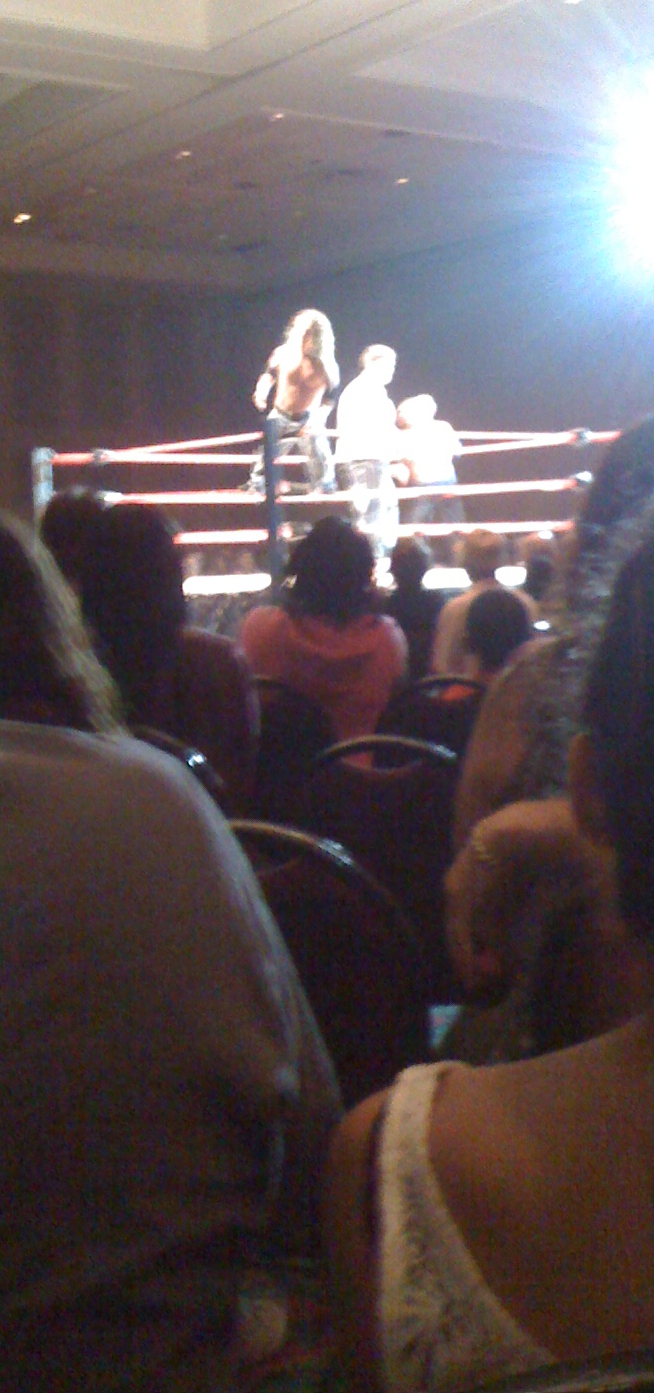
It’s about 8:20 when I get into the room- they’ve got a miniature fight ring in the center and thirty or so rows of seats fanning outwards from all sides, with little mobile booths on the outer orbit selling bad popcorn and overpriced drinks. Before you get the wrong idea- no, I’m not the kind of guy who’s a regular attendee of midget wrestling. I’m here in my capacity as a self-styled journalist on assignment on the front line of the culture wars.

The barker is hyping the crowd, working up a call-and-respond chant.

“Half the size!”

Twice the violence!”

“Half the size!”

Twice the violence!”

And as the cheering dies down, the referee appears on stage waving the American flag, and then everyone rises as the national anthem begins to play and the barker declares “This is for the troops!” The last notes play and the first of the wrestlers bounds up into the ring. Roughly 4’10”, and snarling at the DJ to turn his music down as he breaks into a quip about what a worthless town this is.

Boos and hisses from the audience.

I don’t know what y’all are booing at- half of you don’t even live here!”

A few seats down from me, a guy in a baseball cap starts howling at the ring.

Fake midget! You’re a fake midget! FAKE MIDGEEEET!!!

The wrestler ignores him- tries to get on with his smack talk as the guy keeps yelling.

You’re not a midget! Freaking Hobbit! Hey Hobbit-boy! Where’s Frodo, bitch?!”

Amidst more hisses and laughter at the guy’s insults, the wrestler finishes his spiel. The barker announces the challenger- a guy by the name of “Little Fabio”. He’s 4’8″, and has long flowing hair as golden and curly as the finest ramen noodles.

The fight begins. Choreographed, of course. Staged punches, slaps, metal trays to the cranium- it’s all there. It’s not staged well enough to be realistic, or over the top enough to be comedic, but then again, no one’s exactly expecting a production of Shakespeare. The crowd does what it can to get involved, and when Little Fabio mimics an elbow slam as he bounces off the top rope, they break out into cheering. And so it goes- long silence as the two wrestlers clumsily bat at each other and raucous whooping when the occasional stunt is performed. It doesn’t help much that the two stumble out of the ring and fight each other on the ground, where no-one who isn’t in the first couple rows can see anything. At long last, it ends, the barker making a joke about Little Fabio “taking out the trash”- which doesn’t really work, since Little Fabio dumps the smack-talker into a laundry cart, not a dumpster. The crowd applauds with general approval, but already they’re getting bored. “Lil’ Rampage,” representing Las Vegas is up next, sashaying down the ramp in a fur coat. His opponent hops into the ring, and the same scene is played out again. Back and forth with the pulled-punches and choke-holds, the audience trying to get worked up as the barker shouts out stuff like “Oooh! Drop-kick to the huevos!” Intermission finally arrives, and more than a few people filter out through the door. A security guard tries to get people to stop their kids (yeah, there are plenty of kids here- even couple who brought their baby) from climbing on the ring- no one listens, of course.

Note to the Riviera: Nothing says “I don’t have any real authority” more than a guy wearing cargo shorts. Invest the cash- get your security guys some pants.

People shuffle backs to their seats, and as the final strains of AC/DC’s “Thunderstruck” fade, we seize the opportunity to move up into one of the vacated rows. Better view, but you still can’t see a thing when they’re going at it outside the ring beyond the brief flash of trashcan being lifted over someone’s head before it disappears below the front rows and only a hollow crashing noise tells if you it hit someone. At 4’6″ it’s “The Machine” versus “The Athlete” of New York City. “The Athlete” is actually pretty neat to watch- clearing the ropes with a back flip and bounding up the corner posts with a kind of mad dexterity usually reserved for cats. Simple truth of the matter is that once they get at it, you do forget that they’re midgets- or at least, the fact that they are midgets (brought up only in the barkers patronizing and terrible puns) just doesn’t seem at all relevant. For some reason, there’s a cop stalking up and down the aisles, though exactly who or what she’s looking for, I really don’t want to know. The bouts are getting better, in both the acting and the stunts, but that doesn’t stop a small but steady trickle of people out of the room. Some wrestler with a vague dog-persona is vanquished, and most everyone assumes the show is over (yours truly including). A mass exodus occurs before it dawns on the barker what’s happening and he shouts that we’re just about to get to the main event- by the time it starts, half the audience is gone.

Which is a shame, because this is the point where everything picked up fast.

“The Little Show” pops out from behind the curtains, wearing jet-black sunglasses and a shrunken version of the holocaust cloak from The Princess Bride. 4’4″, they say as he sheds his cape and rips off his black wife-beater to reveal- that’s right- a smaller black wife-beater underneath. Obviously we were all hoping he’d rip that one off to reveal yet another, smaller wife-beater under that, but nothing came of it. The kids in the front row are going nuts as the tempo is ratcheted up as Disturbed’s “Get Down With The Sickness” blasts over the speakers, and “The Little Show” waltz around the ring, making sure everyone kicks a good look at the flames at the bottom of his black pleather pants. Dang those were cool pants. Then his challenger appears.

His name?

“Baby Jesus.”

That’s right- “Baby Jesus.”

3’6″. Gold cross emblazoned on his left pant-leg. Break-dancing in the ring. Break-dancing.

The crowd goes crazy and the barker is spewing out every pun he can come up with. These were my favorites:

Who has more midget muscle!?

<Baby Jesus gets slammed into the ground> “Oooh! He almost sent him back to heaven!”

C’mon, Baby Jeezus! C’mon!

Little Show charges, but Baby Jesus stretches the ring’s ropes open and steps aside, sending Little Show flying through. The front rows are standing up now, and one section has started up the chant of “Ho-ly Shit! Ho-ly Shit! Ho-ly Shit!”. Back in the ring, Baby Jesus takes a chair to the face but comes back with a beautiful crowd hype as he does the worm for no apparent reason. Just as it appears all is lost for BJ, he flips over (yes, flips over) Little Show and wrestles him to the ground, pinning him down as the cheesiest referee imaginable slaps the ground three times. Everyone’s standing and cheering, and Baby Jesus is declared the winner, lugging away a belt easily twice his size.

A battle royale is declared as all eight wrestlers clamber back into the ring. They have at it, but most of the entertainment at this point is coming from the barker’s increasingly ridiculous slogans.

IT’S MIDGET MAYHEM!!!”

MIDGETGEDDON!!!!!!”

CLASH OF THE MIDGETS, EVERYBODY! CLASH OF THE MIDGETS!!!”

One by one, they wrestlers are bumped off, until it’s only Baby Jesus left in the ring. Next thing you know, it’s being declared that Polaroids will be sold for 10 bucks a pop, and that you should pick up a t-shirt or get your poster autographed. I wait in the hall as people exit- most of ’em are on their phones, chuckling that it was funny. It’s just past 10:00, and everyone’s exuding that post-show deflation as they head off to their rooms or cars.

This is the part of the post where you might expect some sort of conclusion, but truth be told, for all my notes, I’m not exactly sure what to make of it all. Degrading to the midgets? Like I said, without the barker, chances are it probably wouldn’t even register as you watched the fights. Degrading to the audience? Despite the snickers, most of the people there were clearly more investing in the fact that that they were watching wrestlers rather than short people. What critique exactly do you apply to an event that’s part of a subculture of a subculture anyways? Maybe it was exploitation, pure and simple. Maybe it was an example of people being able to do what they love regardless of their physical stature. I can only really present the facts here- you’re going to have to debate whether what they all add up to is right or wrong for yourselves, or of course, conclude that there’s really no moral to this story.

After all- it’s Vegas.

Violence (Not) In Media

In the wake of the Aurora Shooting, the Sikh Temple Massacre, and a recent spate of gun violence across the country, the debate of the violence in media has once again reared its head. On one side, those who cite the saturation of film, music, and video games with violence and the glorification of violence as responsible for creating these monsters, or at the very least, pushing them over the edge. On the other side, the ranks of apologists, who declare that it’s ridiculous to blame movies and music for mass-murder.  I’m not here to analyze the claims of either point, or to make an argument for one side or the other- that’s already been done better by The Escapist’s Robert Chipman (check it out here).

No, I’m here to address the subject of violence and its possible contributing factors outside of film and music.

When I touched on a complaints I had with movies like Brideshead Revisited and I Love You Man a few weeks ago, I briefly mentioned goth-rock-star Marilyn Manson, whose music was accused by many of being responsible for having influenced the Columbine shooters in committing the massacre. Interviewed by Michael Moore in his documentary Bowling for Columbine, Manson had this to say regarding violent influences:

And therein really lies the crux of the issue- when tragedies like this happen, the scope of our outrage is usually so small that we fail to take into account all the other possible factors. We can cite GTA or rock or rap or cartoons as being responsible and maybe- just maybe- there’s something to that. But what about everything else? If violence in media causes violence, surely violence itself should be cited here!

You remember this?

That’s Marine Corps veteran Scott Olsen, moments after he was shot in the head with a gas canister from close range. Part of the brutal crackdown by police on the Occupy Oakland protests last year- back when Mayor Jean Quan decided the best way to deal with a peaceful protest was by turning her town into a war zone.

But why talk about Oakland and countless other cities being turned into war zones when we can just talk about actual war?

As I’ve mentioned in previous posts, this is the single longest war in American history. Year after year after year, it goes on, and with no end in sight. That’s got to be the single largest and publicized campaign advocating violence, yet where is the outrage against it?

And what about hunting? That’s all about guns and the glorification of killing things…

What about Civil War Reenactors?

What about the national anthem? That thing is full of references to bombs. What about the 4th of July? A day when we celebrate our victory in a war by setting off explosives!

What about the very way we talk about violence? Should the Mob Museum here in Las Vegas be shut down? Should we do away with anything related to pirates? Should we stop teaching about the war of 1812 in schools?

And so on…

You get the idea. Ours is a culture and history built on violence. It’s in everything–  not just our media. While I’ve got my own views on what does and doesn’t cause or promote violence, my purpose here isn’t to take a side. I’m simply trying to demonstrate that if you do want to try to get into the causes of violence, you don’t get to be selective about who you put on trial.You want to find out if there was something in our world beyond the killer’s diseased mind responsible for death and destruction, you have to look at everything- anything less is just a witch hunt, pure and simple.

Let’s face it, half the time, tragedies like these are the platform from which we get to lynch things we didn’t like to begin with…

…I wonder if that kind of vicious and petty mentality might contribute to violence at all…