As most of you should know by now, I am a Canadian. And as a Canadian, I actually know very little about American gun control laws. Yes, I know about the Second Amendment and have been somewhat in the know about the encroaching legislation brought about, more or less, due to the tragedy that befell Sandy Hook Elementary.
Now I know what you’re thinking. “Dang, Evan, get to the point already. This doesn’t even have anything to do with comics, which are definitely your forte [and that you probably write about too much].” Well, dear reader, allow me to cut to the chase.
By cartoonist Jimmy Margulies. Also the image that Comics Alliance used, but hey, it’s perfect for the topic.
This morning Comics Alliance released an article titled “14 Editorial Cartoonists Make NRA Blacklist For ‘Endorsing Anti-Gun Positions.’” Its focus was a list that the NRA-ILA had put together of people and organizations who have been known to lend their “name and notoriety to anti-gun causes.” The reason they bring this to attention is that joining the National Black Nurses` Associationand actress Catherine Zeta Jones are 14 political cartoonists. Described as being “journalists [who] actively editorialize in favor of gun controls laws” they are as follows:
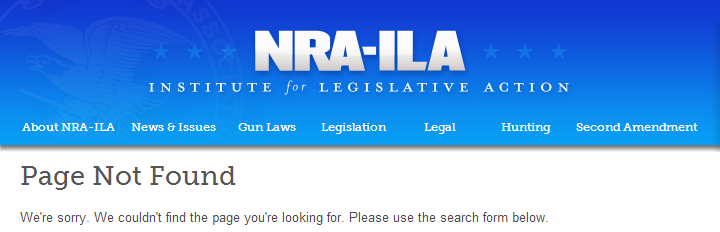
The links provided for each cartoonist were provided by the article on Comics Alliance, and are super useful. Unfortunately, the link they provided for the NRA-ILA’s blacklist was much less useful. The problem is that the link [which you can check here] does not work, by no means due to the fault of the comics news site. It turns out that whoever runs the site has since taken it down.
But wait, there’s more!
Luckily for me [and, consequently, you], Internet Archive exists. By taking the dead-end link and throwing it into their “Wayback Machine,” I was able to retrieve the list, available for your viewing pleasure:
Does anyone else find it disconcerting that a) an organization that is known for promoting the right to tote firearms has a blacklist of any kind, or b) that they’ve since taken down this page due to it receiving media attention?
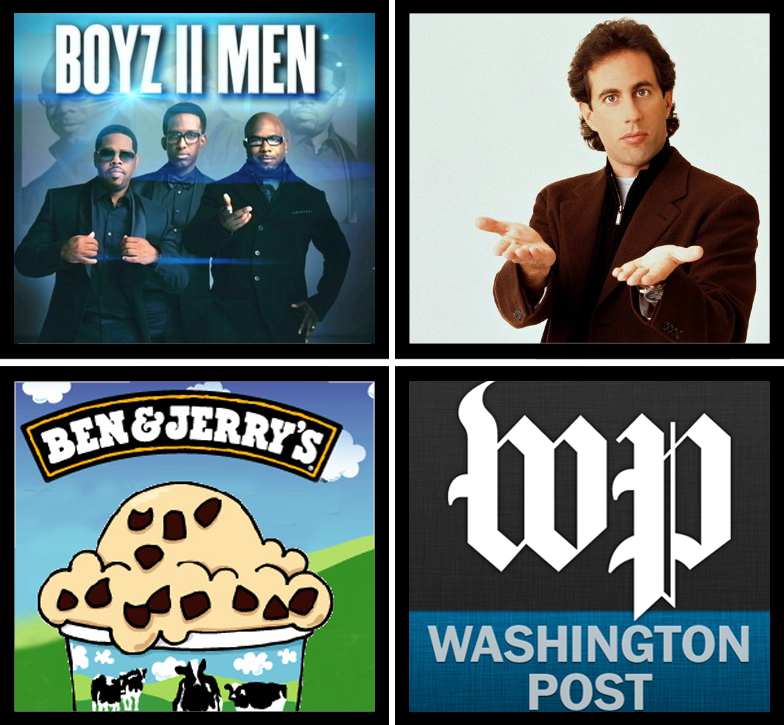
Since the NRA considers gun ownership to be a civil right they have dubbed themselves the “largest and oldest civil rights organization in the United States.” I’m not at all implying that there’s anything inherently menacing or threatening about their list, I’m questioning their transparency. If there’s nothing wrong with the list, then why take it down? Was it to hide the fact that there could exist a list so ridiculous that it lumps together R&B group Boyz II Men, actor Jerry Seinfeld, Ben & Jerry’s Homemade, Inc., and the Washington Post?
I’m not sure why it happened, but I’m letting you know that it did; what you do with this information is entirely up to you. It also has to do with comics on some level, which you know I can’t not write about.
The dearth of creativity that went into titling this post aside, I thought I’d tackle yet another double standard that appears to exist in our culture. To begin with, let me refer you all to my primary example, Season 4 Episode 5 of Top Chef: Masters, “Holly Madison’s Pool Party.”
In this case, the background behind the show itself is pretty inconsequential: 12 award-winnings chefs compete against each other to raise money for charity, et cetera. On this season the chefs spent the vast majority of their time in Sin City [Las Vegas, aka where Gordon resides] and rubbed shoulders with quite a few celebrities. The superstar for this episode was Holly Madison, of Playboy’s “The Girls Next Door” fame, and their task was to cater her pool party.
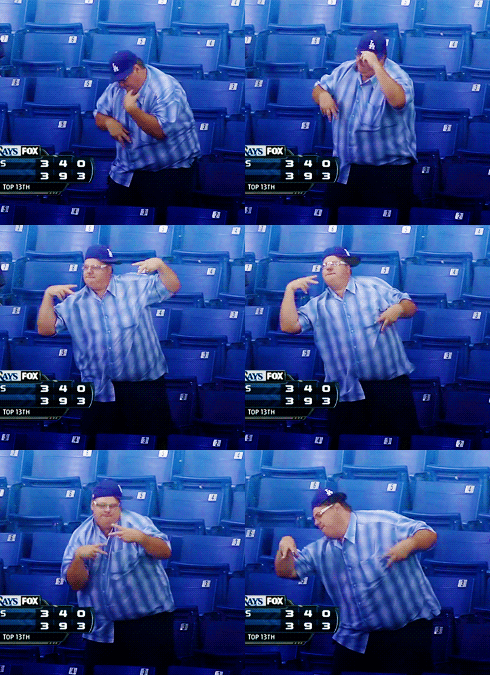
Enter James Oseland, editor of Saveur and one of the show’s judges. At the party musclebound hunks abound, and after one is encouraged to sit next to the critic he somehow manages to ask “how are you guys gonna like, keep the, this thing [abs], going with, wha- all this food.” As he refers to the man’s midsection he gives it a few pats, prompting responses like the following [which I found on The A.V. Club, of course]:
And Larrybaby’s points are all incredibly valid. Thankfully the guys and girls who peruse the TV Club reviews weren’t the only ones to notice this, and celebrity chef website [yes, it is a real thing] The Braiser did a short bit on the episode. Oseland’s antics are described there as follows:
So, naturally, the daytime cocktails start flowing, the croque madames sizzle on the griddle, and James Oseland starts giddily stripping pool boys. Wait, what?! Yes, Saveur editor-slash-very esteemed and shmancy Top Chef: Masters judge James Oseland gets a little on the trashed side of tipsy at brunch and takes matters into his own hands when a cluster of bikini-clad women fail to get a pool boy to take his shirt off.
James marches right on over to the ripped hunk of manflesh (née “Warren”) and strips his shirt right off. And then he grabs another equally buff guy and steals his shirt, too! James Oseland is shameless, you guys.
Of course, the article then goes on to describe how they’d love Oseland to be their celebrity BFF, but we won’t go into that. The point I’m trying to make is that this man, who, yes, is a homosexual, acted in a way that was inappropriate. More than that, he wasn’t stopped but was actually encouraged by those around him with cheers.
I’m not saying that I dislike watching homosexual characters on television, or that they make me uncomfortable; far from it. Max is easily my favourite part of the sitcom Happy Endings, and his adventures in romance are both engaging and hilarious. I’m still waiting [and I know I’m not the only one] for Raj on The Big Bang Theory to come out of the closet, and more and more I’m realizing that it really is just art imitating life. Living in Toronto I’m very aware that there’s a gay population out there, and it just so happens that TV has finally gotten around to representing them.
What I don’t want to see is gay people, men or women, being handsy when they shouldn’t be. I don’t really appreciate it in heterosexuals, and the same extends to all other orientations. If James Oseland thinks a pool boy is cute that is fine. If he wants to touch him, that is also fine. If he touches him in front of others and without the permission of said pool boy, to flirt openly in a physical way, that is not fine. It’s kind of gross.
There’s not much more I can add to what larrybaby said, because he [or she, I don’t know] sums it all up really well. I’m not a homophobe by any means, but I’d like the world as a whole to keep people to the same standards. Let’s not cheer someone on when they paw at another person they’re attracted to. If we’re going to acknowledge homosexual urges and relationships as on par with heterosexual ones let’s treat them the same way.
I end with another comment highlighting the actions of both Oseland and his fellow critics [context: the hunks were asked about sit-ups, and one actually did push-ups for the critics’ benefit a little later]:
EVAN: The particular topic of discussion that comes to us today is more one that finds itself passed back and forth within Christian circles, and that is: “Why is Christian media so bad?”
GORDON: I think the problem is self-imposed by the religion (I use the term loosely) itself. We’re not talking about a lack of funding (we’ve got plenty of good low-budget films), or a lack of good directors (there’s plenty of decent talent out there), we’re talking about an issue that runs right down the core of it all.
“Christian” media can’t just be media- they have to drag in everything that goes with it.
EVAN: So basically what you’re saying, and we talked about this a little earlier, is that Christian media more often than not has an agenda, correct?
GORDON: I’d say plenty of it has an agenda, but no, I don’t think that’s the core issue- there’s plenty of other preachy movies out there.
EVAN: So what are you saying, exactly?
GORDON: I’m saying that “Christians” can’t make good media because they won’t allow themselves to. Every protagonist has to fit the moral code to a tee, so that they wind up as either Aslan 2.0 or the epitome of Christian morality: John Smith, the middle class suburban, patriotic family man. Which is why I keep putting “Christian” in quotation marks.
We’re not talking about Catholic peasants in El Salvador or the East Orthodox Church in Ethiopia.
EVAN: Okay, I like that a lot, this idea that those creators of Christian media [and primarily I think we’re talking about films] box themselves in. They’re telling the same sorts of stories to who they perceive to be their audience [and they’re not wrong]: white suburban middle class families.
To sort of break this up a little, I actually saw a Christian film that was reasonably passable at some point last summer.
GORDON: Was it related in any way to Steve Taylor?
EVAN: Is that any way related to “End of the Spear”? It was not, if that’s what you’re referring to.
GORDON: Steve Taylor is the only good Christian musician who ever has or ever will have existed.
But anyway, what was the movie you saw?
EVAN: It was called “To Save a Life,” and it stood out for a couple of reasons:
1) The cinematography was shockingly good for something produced and made by Christians. You can tell which movies they are within the first few seconds.
2) The “villain” of the piece was actually the pastor’s kid. Which was- refreshing, and kind of nice.
It kind of broke out of the whole stereotype you introduced earlier.
GORDON: Huh- interesting. I’ll have to check out the trailer. But let me ask you this:
Can a Christian make a James Bond movie?
EVAN: You mean a movie starring a suave, debonair British man who beds women and guns down henchmen as naturally as he dons his suit jacket every morning?
I’d say no, probably not.
GORDON: I think that’s the problem. It’s not just that you can’t have any explicit sex or graphic violence or excessive profanity (which are overused and abused as is), you can’t have anything even remotely sensual or rough or crude. It rips away reality and humanity in the name of not stepping on anyone’s toes.
Self-imposed legalism.
EVAN: Well, I’d say the difference is that you can’t have a protagonist who glorifies such things as wanton sexuality-
I say that Christian filmmakers will never produce anything like James Bond because of who the character is.
GORDON: Did you like the movie “Fight Club”?
EVAN: I liked it a fair amount.
GORDON: Did you like “Ocean’s 11” or “Snatch”?
EVAN: I haven’t seen the latter, but I very much enjoyed the former.
GORDON: Did you like “Superbad”? “Kick-Ass”? “Ironclad”?
But I think you’re going to have to get to your point-
GORDON: Could a Christian make any of these movies?
EVAN: I think a Christian could, yes. In relation to “Fight Club”, at least, Christian author Ted Dekker has penned novels [sold both in and out of Christian bookstores] which offer a fairly decent psychological thriller aspect to the reader.
GORDON: Ah, Dekker. The whole reason he stands out as an exception is- I believe- that he grew up among Indonesian headhunters, and not in Middle America. Again, it’s about having that different perspective on life.
EVAN: And I think what he’s realized, as a creator of the arts, as someone who has a hand in shaping Christian media, is that you can have these other sorts of exciting, thrilling stories told with a faith-built worldview. People of every religion want a little excitement.
GORDON: Of that there’s no question. The heavy use of the video library at our school stands in testament to that.
But again I think the issue is that “Christian” self-imposed isolation inevitably leads to the vast majority of their work winding up as “White People Problems” or “Chronicles-of-Narnia-minus-the-good-stuff”…
EVAN: Or “Lord-of-the-Rings-but-way-more-heavy-handed.”
GORDON: Exactly.
EVAN: I mean, we’ve talked a little bit about why Christian media can be bad [terrible production values, cookie-cutter story lines, sheer absurdity], but how could it be better [to harken back a little to our last talk]?
GORDON: They have to stop being terrified of the big bad world. They have to realize they can show characters with flaws- real flaws- not drunkard stereotypes and the occasional swear word.
Saying this will get you expelled from Liberty, Pensacola, and BJU
EVAN: I mean, a deeply flawed person who finds redemption is a much more compelling story than a white bread sort of guy with his middle class problems.
And they have to stop coddling their audience. Yes, Christians turn to Christian media for “better alternatives,” but the odd cuss word won’t negate an overall positive message; neither will a fight scene, or two guys sitting around enjoying a beer.
GORDON: There’s this one scene in a (Christian) movie Steve Taylor directed:
A character hurts his hand loading something into the back of van. He lets loose a cuss word and his buddy chides him for it, saying “God don’t like it when we cuss.”
Later on in the film, the buddy hangs his head and apologizes, saying “I’m sorry. I was upset that you cussed- I should’ve just been upset that you hurt your hand.”
EVAN: Wow. That is very, very good.
GORDON: That right there is the problem not just with Christian media, but with the whole religion.
EVAN: Misplaced priorities.
GORDON: More obsessed with present clean-cut paragons of middle class etiquette than anything really real.
That’s why we turn to “secular” movies for actual substance. The struggle for identity in “Fight Club”, the heroism in “Kick-Ass”, the friendship in “Superbad.”
EVAN: I think what’s really ironic is that Christian media-makers have a Christian-made work out there that’s immensely popular. “The Hobbit: An Unexpected Journey” came out just this past December.
GORDON: I again reference an (alleged) quote by Steve Taylor.
“I’m not a Christian artist- I’m an artist who is Christian- it affects what I do.”
EVAN: Really well-put. And something that a lot of us [I speak for many in our graduating class] as writers, musicians, artists, et cetera would benefit from keeping in mind.
And that puts us more than a little overtime.
GORDON: Well, people, you know what that means. Time to vote on our subject for next week.
EVAN: My contribution this time around is . . . wow, I never think ahead . . . masculinity. You’ve done a post about “Manly Culture” in the past, but I want to talk about what it is at present, and how we feel about the shifts and trends and things.
GORDON: Interesting subject. I submit we speculate on the upcoming Star Wars movies.
EVAN: If you think you’re up for it, then yeah, cool. I’ve read quite a few of the post-original-trilogy books, so I know a reasonable amount about the subject.
GORDON: Nerd.
And with that witty response, we’re out! Have a good night, everyone.
To begin with, I’m not a huge fan of Glee. I am a man who can say with confidence how much he loves musicals and acapella arrangements, but the show’s claim to be a melting pot of diversity [a place where Black people, Asians, homosexuals, and the disabled can belt it out to their hearts’ content] is not one I find myself agreeing with. But that’s the topic of another post.
The issue being that Coulton released his own version of the song in 2006, which you can check out [and should, for comparison’s sake] here:
If you really want to scrutinize the two side by side, there’s a track on Soundcloud that simply places both tracks on top of one another [and an in-depth audio analysis, for those of you into that]. Coulton’s issue isn’t simply that Glee seems to have stolen his arrangement, but did so to the point where unique elements he added were copied as well. A duck quack is used to censor an expletive, and [this is practically impossible to ignore] the lyric “Mix-a-Lot’s in trouble” is replaced with “Johnny C’s in trouble” in both versions.
As he has kept the blog post constantly updated, four days ago he announced that having gotten in touch with the people at Glee, the following information was relayed to him:
They also got in touch with my peeps to basically say that they’re within their legal rights to do this, and that I should be happy for the exposure (even though they do not credit me, and have not even publicly acknowledged that it’s my version – so you know, it’s kind of SECRET exposure). While they appear not to be legally obligated to do any of these things, they did not apologize, offer to credit me, or offer to pay me, and indicated that this was their general policy in regards to covers of covers.
While Coulton is unsure of his exact copyright claim to the track, he had obtained a Harry Fox license to release it on an album alongside his own original music. His response is, refreshingly, a mature one in response to this whole ordeal.
In his interview with Wired magazine Coulton shared a very simple solution for the show that spends millions per episode. He suggests that “they could offer to pay artists whose arrangements they use the same amount of money they would otherwise pay a musical arranger,” and that “if they opened with that, I’m sure a lot of artists would jump at the chance.”
Somehow, this isn’t the first time this has happened. Singer-songwriter Greg Laswell’s cover of a song made famous by Cyndi Lauper, “Girls Just Wanna Have Fun”, was also seemingly ripped off for an episode in November 2011. I’ve embedded the two songs for you to compare once again [and because I’ve gotta break up this wall of text somehow]:
It remains to be seen whether or not Coulton’s lawyers will be able to take legal recourse, but for the time being I’m happy that the show is finally being taken to task by those who believe that creativity should be rewarded and acknowledged, not plundered.
First and foremost, apologies about the state of the blog next week. E> was postponed ’till tomorrow due me forgetting about it completely and watching a movie/drinking with my cousins last night. This morning’s replacement was delayed due to my being sick all day today.
The following contains spoilers to films you should’ve seen by now.
The first and third films in the franchise concerned the Ark of the Convenant and the Holy Grail, respectively. Both are Judeo-Christian relics, and both are shown to have a great deal of power in the series; the former melts the face off of a bunch of Nazis and the latter brings Henry Jones Sr. [Sean Connery] back to full health from grievous wounds. Which is great.
Then take into account the second film, Indiana Jones and the Temple of Doom. The Hindu goddess Kali is introduced, who is pretty into human sacrifice. This movie’s relic is actually five relics, sacred Sankara stones that do . . . something. All I’m really sure of is that Indy says things and they get super hot and burn the guy who says “kali ma shakti de” and pulls out another dude’s heart.
The first three movies of the franchise make a lot of sense in context with the protagonist’s profession, that of archaeologist. The main issue here is that the Holy Grail and Ark of the Covenant are shown to draw their powers from the Judeo-Christian God, father of Jesus Christ, et cetera. High priest Mola Ram [Mr. Kali Ma] finds his supernatural abilities in Kali, I assume. This can be explained away with the following-
“Kali” and the source of her powers originate in the demonic. This resolves the idea of an actual healing Holy Grail existing in the same universe as magical burning stones. God and Kali are essentially just opposite sides of the same coin, the divine and the diabolic. Which is great. We’ve reconciled the two, fantastic.
Enter Indiana Jones and the Kingdom of the Crystal Skull. The relic: the skull of a genuineextraterrestrial. The source of its powers: genuine extraterrestrials. Which leaves us- where?
As an audience we’re left to believe that a divine Jesus Christ, death goddess Kali, and aliens all co-exist on some level. The addition of that last source of otherworldly power really throws a wrench into the works.
Sure, I guess we could say that the source of both the divine [for both Judeo-Christian and Hindu faiths] is in the extraterrestrial, that these aliens seeded the world with their technology or power or however else you want to say it, but really? There’s a definite stretch to suspend disbelief on the part of the audience. I mean, sure, we can accept face-melting Arks, but aliens?
And that’s the problem that, I personally, have with the fourth Indiana Jones movie.
What it does is speak volumes for the game’s publisher, Deep Silver, and those it hired to advertise the game. There was an emphasis placed on the feelings of terror and loss and the need to protect one’s family; it sought to set itself apart from other zombie games [of which there are so many]. Unfortunately the game turned out to be your fairly standard run-of-the-mill zombie hack and slash, but that’s not the point here.
The point is that this trend was actually continued in the promotion of the game’s sequel, Dead Island: Riptide, the trailer of which can be viewed here. The tone is once again consistent with that of the first, highlighting the terrors of a vacation gone horribly, horribly wrong. Which is great. And which is why the following seems so shockingly out of place.
“We deeply apologize for any offense caused by the Dead Island Riptide “Zombie Bait Edition”, the collector’s edition announced for Europe and Australia. Like many gaming companies, Deep Silver has many offices in different countries, which is why sometimes different versions of Collector’s Editions come into being for North America, Europe, Australia, and Asia.
For the limited run of the Zombie Bait Edition for Europe and Australia, a decision was made to include a gruesome statue of a zombie torso, which was cut up like many of our fans had done to the undead enemies in the original Dead Island.
We sincerely regret this choice. We are collecting feedback continuously from the Dead Island community, as well as the international gaming community at large, for ongoing internal meetings with Deep Silver’s entire international team today. For now, we want to reiterate to the community, fans and industry how deeply sorry we are, and that we are committed to making sure this will never happen again.”
So no harm now foul, right? Dead Silver took back their horrible statuette and we can chalk another victory up for the internet! But why exactly were people upset? An article on Rock, Paper, Shotgun which I linked to but will link to again said this about it:
This is beyond disgusting. It’s as if someone were attempting to demonstrate the most misogynist idea that could possibly be conceived, in an attempt to satirise the ghastly trend. A text book example of the most extreme ends of misogynist fantasy, a woman reduced to nothing but her tits, her wounds hideously depicted in gore, jutting bones, and of course barely a mark covering her globular breasts.
It’s very prevalent in a lot of zombie imagery you can find nowadays, and it’s certainly present in this picture of a zombified Snow White on the left. Her body is mutilated [appropriately so, for a zombie] but her breasts remain completely untouched. There’s this sense of the grotesque from the image as a whole, but her chest remains an object of potential titillation.
I don’t think I have to say too much about how grossly sexist this is, and how prevalent it is in the society we live in. What I am going to say is thank God that on some level we can make enough of a public outcry to stop stuff like this before it happens. The bottom line is this: if we as a community [on the internet or otherwise] care enough about something, we really can do something about it. Even if it’s just stopping the production and sales of a tasteless statue.


 Since the NRA considers gun ownership to be a civil right they have dubbed themselves the “largest and oldest civil rights organization in the United States.” I’m not at all implying that there’s anything inherently menacing or threatening about their list, I’m questioning their transparency. If there’s nothing wrong with the list, then why take it down? Was it to hide the fact that there could exist a list so ridiculous that it lumps together R&B group Boyz II Men, actor Jerry Seinfeld, Ben & Jerry’s Homemade, Inc., and the Washington Post?



 The first and third films in the franchise concerned the Ark of the Convenant and the Holy Grail, respectively. Both are Judeo-Christian relics, and both are shown to have a great deal of power in the series; the former melts the face off of a bunch of Nazis and the latter brings Henry Jones Sr. [Sean Connery] back to full health from grievous wounds. Which is great.


 Culture War Reporters
More Writing On Sexual Standards
The dearth of creativity that went into titling this post aside, I thought I’d tackle yet another double standard that appears to exist in our culture. To begin with, let me refer you all to my primary example, Season 4 Episode 5 of Top Chef: Masters, “Holly Madison’s Pool Party.”
In this case, the background behind the show itself is pretty inconsequential: 12 award-winnings chefs compete against each other to raise money for charity, et cetera. On this season the chefs spent the vast majority of their time in Sin City [Las Vegas, aka where Gordon resides] and rubbed shoulders with quite a few celebrities. The superstar for this episode was Holly Madison, of Playboy’s “The Girls Next Door” fame, and their task was to cater her pool party.
Enter James Oseland, editor of Saveur and one of the show’s judges. At the party musclebound hunks abound, and after one is encouraged to sit next to the critic he somehow manages to ask “how are you guys gonna like, keep the, this thing [abs], going with, wha- all this food.” As he refers to the man’s midsection he gives it a few pats, prompting responses like the following [which I found on The A.V. Club, of course]:
And Larrybaby’s points are all incredibly valid. Thankfully the guys and girls who peruse the TV Club reviews weren’t the only ones to notice this, and celebrity chef website [yes, it is a real thing] The Braiser did a short bit on the episode. Oseland’s antics are described there as follows:
Of course, the article then goes on to describe how they’d love Oseland to be their celebrity BFF, but we won’t go into that. The point I’m trying to make is that this man, who, yes, is a homosexual, acted in a way that was inappropriate. More than that, he wasn’t stopped but was actually encouraged by those around him with cheers.
I’m not saying that I dislike watching homosexual characters on television, or that they make me uncomfortable; far from it. Max is easily my favourite part of the sitcom Happy Endings, and his adventures in romance are both engaging and hilarious. I’m still waiting [and I know I’m not the only one] for Raj on The Big Bang Theory to come out of the closet, and more and more I’m realizing that it really is just art imitating life. Living in Toronto I’m very aware that there’s a gay population out there, and it just so happens that TV has finally gotten around to representing them.
What I don’t want to see is gay people, men or women, being handsy when they shouldn’t be. I don’t really appreciate it in heterosexuals, and the same extends to all other orientations. If James Oseland thinks a pool boy is cute that is fine. If he wants to touch him, that is also fine. If he touches him in front of others and without the permission of said pool boy, to flirt openly in a physical way, that is not fine. It’s kind of gross.
There’s not much more I can add to what larrybaby said, because he [or she, I don’t know] sums it all up really well. I’m not a homophobe by any means, but I’d like the world as a whole to keep people to the same standards. Let’s not cheer someone on when they paw at another person they’re attracted to. If we’re going to acknowledge homosexual urges and relationships as on par with heterosexual ones let’s treat them the same way.
I end with another comment highlighting the actions of both Oseland and his fellow critics [context: the hunks were asked about sit-ups, and one actually did push-ups for the critics’ benefit a little later]:
Rate this:
2 Comments
Posted in bizarreness, lgbt, media, sex, television
Tagged abs, comments section, double standards, flirting, gay, Holly Madison, Holly Madison's Pool Party, homosexuality, hypocrisy, J Mann, James Oseland, larrybaby, physicality, pool boy, push-ups, S4E5, Saveur, sexual standards, television, the A.V. Club, Top Chef: Masters, touching, TV Club