Gordon’s absence has forced me to dedicate yet another Fame Day to a man in the comic book industry [a post on a woman is in the near future] to join the ranks of Anka, McDuffie, and Fraction.
Introducing the Editor in Chief of Marvel Comics, Axel Alonso. Interviewed by FOX News Latino [which I didn’t even know was a thing], he was asked the question: “Is that a new initiative at Marvel Comics is doing? We’re going with the Latinos now?”
This question was in response to a few “new” characters appearing in the publisher’s titles, with Miss America being one of them. First featured in Marvel Mystery Comics #49 in November 1943, Miss America was originally another embodiment of the United States in World War II, a star-spangled powerhouse punching out Nazis. Now, in 2013, Miss America is the moniker for America Chavez, a Latina teenager and new member of the Young Avengers [one of Marvel’s bestselling new titles]. Also mentioned was the new Blatino Ultimate Spider-Man, who has already been covered on this site.
From left to right: Miss America Chavez, Miles Morales [Ultimate Spider-Man]
Alonso, a Mexican-American himself, replied:
“I’d be lying if I said I wasn’t motivated, on a personal level, to have Hispanic characters represented in comic books, but this isn’t some PC initiative, [this is] capitalism.”
He acknowledged that a growing range of people read comics, and that as a publishing company it is their “responsibility to make them feel included.” Going back to his comment about “capitalism,” the fact of the matter is that as a company it’s in their best interest to create a product that appeals to the fastest growing demographic in America.
While Alonso agrees that comic books have not always treated minorities with due respect, he also acknowledges that stereotypes are more complex then they might first appear. He took part in helping to create Mexican heroes the Zapata Brothers, who were based on his cousins in Mexico. The two wear full luchador regalia, and while this may be perceived by some as racist, Alonso would argue otherwise. “Is that a little stereotypical?” he says, “Yeah, but it’s also fun and a part of our culture.” Growing up watching these wrestling matches growing up they struck him as being an important part of his culture.
When asked why Latino characters haven’t achieved the same status and notoriety of heroes like Batman and Wolverine, his response was “Why haven’t they become that yet?” His opinion is that, with America’s ever-shifting cultural landscape, it’s an inevitability. You can’t force an audience, or simply make a character big, it just evolves and happens naturally.
Unfortunately, fellow member of “The Big 2” DC declined to be interviewed for this piece. While Marvel has its fair share of seemingly racist characters [Mexican villain/anti-hero Armadillo] DC has a large mark of shame in Extraño, a “gay Latino magician who had HIV and referred to himself as ‘Auntie.’” That being said, it’s a shame that they didn’t offer a means of looking forward through heroes such as Blue Beetle [Jamie Reyes] and Vibe [Paco Ramone] who has his own new title.
Alonso is a man who realizes that comic books are a business, and one that needs to make money and that has an impact on its readers. His joy that Miles Morales exists as a character is in “knowing that there would be a child out there who would see Spider-Man peel back that mask to see a different face and a face that resembled their own.” He understands that, and that’s worth giving him credit for.
I am a dude who loves video games. I’ve played so much Team Fortress 2 in the past few weeks that it’s essentially become a ritual for me, something to do while and after I eat dinner. What I don’t always love are the business practices these companies engage in.
The image I Photoshop’d together depicts the EA [Electronic Arts] logo because they’re a company that I’m positive some of the blame lies with when it comes to generally being horrible to its employees.
I was turned onto this flagrant abuse of humanity through a webcomic Scott Kurtz [of PvP] and Mike Krahulik and Jerry Holkins [of Penny Arcade] put together. The comic, titled The Trenches, follows the life of a QA [quality assurance] guy whose name escapes me at the moment. The important part is that below the comic is a feature called Tales From The Trenches, which catalogues nightmare stories from those who toil within in the industry.
Below is one of my favourites, entitled “Weekend Funtimes.” My favourite not in that I enjoy reading it, but in that it encapsulates some of the horror of working for large corporations:
We were about two months into “crunch” when they decided to up our hours AGAIN, taking us to over 80/week. The only available day to squeeze these extra hours in? Sunday!
I arrive at the building Sunday morning, only to find it locked—no other businesses had Sunday hours. I call my supervisor, who proceeds to fuss at me about interrupting his “family” time. My team had all arrived for work by that point, which just seemed to make him angrier. He tells me he is on his way and hangs up.
Flash forward ten minutes. We’re all still freezing (it was winter and -10 windchill) when we see his car come around the corner at the end of the block. He drives up the road, rolls his window down, and THROWS the office key at me—all without ever slowing down.
He calls me twenty minutes later to make sure we had gotten in, then informed me we would have to make up the time we had “wasted” waiting on him. He ended the call telling me to never interrupt his family time again.
That’s fairly despicable, and definitely up there among the worst of them. It was posted last month, and while it’s unknown when the event actually happened there is a date we can pinpoint: November 10th, 2004. The date that “EA: The Human Story” was posted to LiveJournal by user “EA Spouse.”
The post is a thorough examination of EA’s policies, especially regarding the infamous “crunch time” that its employees have to go through as the game nears its impending launch. She writes with a genuine, heartfelt voice that stems from being the wife of an EA employee. This is definitely present in the penultimate paragraph of her piece:
If I could get EA CEO Larry Probst on the phone, there are a few things I would ask him. “What’s your salary?” would be merely a point of curiosity. The main thing I want to know is, Larry: you do realize what you’re doing to your people, right? And you do realize that they ARE people, with physical limits, emotional lives, and families, right? Voices and talents and senses of humor and all that? That when you keep our husbands and wives and children in the office for ninety hours a week, sending them home exhausted and numb and frustrated with their lives, it’s not just them you’re hurting, but everyone around them, everyone who loves them? When you make your profit calculations and your cost analyses, you know that a great measure of that cost is being paid in raw human dignity, right?
Better known by her blogging handle, little did Erin Hoffman know what sort of action her post would lead to. In part it resulted in the filing of three class action lawsuits against EA and the beginning of many changes within the industry. Her post inspired another entitled “Why Crunch Modes Doesn’t Work: Six Lessons” which garnered a fair amount of attention within the online community.
That being said, Tales From The Trenches continues on into 2013, and it’s undeniable that many are slaving away in gaming companies because they love the final product. Their devotion to video games means that they’re stuck in jobs where they’re treated poorly by anyone and everyone a rung above them on the corporate ladder. Yes, this can be said of many work environments, but few have the same number of young, eager individuals so passionate to take part in what they’ve enjoyed their entire lives.
So shame on EA, and shame on any and all video game companies that treat their employees like dirt. No one said starting a career was easy, but no one should have to toil away thanklessly for an abusive system, either.
There’s a common misconception that Communism is about an all-powerful government controlling the economy. In reality, nothing could be further from the truth. Despite our railing against Ayn Rand and laissez-faire economics, the end-boss that Marx actually described was the inevitable merger of big business and big government into one inbred monster. The whole point of the glorious people’s revolution was to get rid of both the plutocrat and the politician, though obviously between Stalin, Pol Pot, and Joe McCarthy, things all went terribly wrong. “Marxism” became a buzz-word for the very things it was opposed to, and the whole movement got set back a century. It’s not easy being red.
Even so, every once in a while, we manage to chalk up a point for the good guys.
This particular victory comes to us from Fort Collins, Colorado, where it was announced yesterday that the New Belgium Brewing Company has become 100% worker owned!
ARISE YE WORKERS FROM YOUR SLUMBER! ARISE YE PRISONERS OF WANT!
That’s right- owned and democratically run by the people who actually do the work. Behold the nefarious Communist agenda for America!
Now in case you’re wondering exactly who these guys are, there’s a chance you might be more familiar with some of their products- such as Blue Paddle, Snow Day (seasonal), and their most famous, Fat Tire.
This is a really, really good beer…
Now in addition to being a much needed triumph for the proletariat, New Belgium has plenty more commendable points worth mentioning.
For example:
These guys are as green as they are red, using a combination wind-power, methane, and ingenious energy-efficiency techniques to reduce power consumption.
All workers receive a free bike after one year of service.
We live in a world full of vile contemptible companies who do vile contemptible things and never get the derision and disgust that they so richly deserve (cough, Nestle, Coca-Cola, Monsanto, Nike, Caterpillar, Unilever, Marks & Spencer, cough). If those evil dirtbags can’t be publicly condemned, then perhaps we can at least swing to the other side, and offer some well-earned praise to people doing it right.
EVAN: This week on E> we take a break from scrutinizing film to look back about seven or so months to a different time of our lives: college. Now that we’ve both graduated we find ourselves in a different stage of life, and it begs the question of what those four years did for us, and whether or not that’s what we wanted or expected.
GORDON: Throughout my college career, especially towards the end, I heard a recurring argument:
“College is a scam,” they said, “It’s a trap or, at very best, a waste of money. You don’t learn anything you can actually translate into a job, so either drop out while you can or don’t sweat the grades and party your buns off.”
EVAN: Wait, who is the “they” that was saying this?
GORDON: I’ve read it in various Cracked articles, I’ve seen it covered in webcomics and in comments, I’ve heard it on the radio. Not always the same tone, but it always boiled down to that essential idea. “College doesn’t teach you what you really need to know, it just puts you in debt and wastes your time.”
EVAN: Well, I guess that really begs the question of “What is it that we’re really supposed to know?” If college is the great institution to prepare us for our lives, what should it have taught us?
GORDON: Some would argue that technical and vocational skills are what we really need. Stuff that’s meant to train us for jobs. Wrenches, not Whitman.
EVAN: Which is the sort of thing you see advertised on television late at night or in the middle of the day; schools for electricians and dental assistants and plumbers and what have you.
GORDON: Which always come across as propaganda films from a dystopic alternate timeline. They can claim to be breaking the mold all they want- I’ll still always just see Orwellian Factory-Schools designed train the subservient masses for laboring in name of supreme leader and glorious fatherland.
EVAN: Heh heh.
The contrast to this idea you brought up when first introducing this topic, that the two sides could be seen as college prepping us for our careers or making us more well-rounded individuals.
There’s obviously more to it than that, but how would you boil the latter option down to its essence?
GORDON: I’d probably cite our own alma mater’s (for me more just “mater”) slogan of “global mindedness.” The idea is to create people who are, first and foremost, thinkers. Logical and critically minded thinkers with strong creative abilities and appreciation for art and wonder. A noble enough sentiment to be sure.
EVAN: To really engage with this topic I feel like we should have equal footing, and I’ll have to give our readers a little bit of context-
I’m currently unemployed, and chose to live the latter part of 2012 living with and taking care of my grandfather, whose wife [my grandmother] passed away in September. My job hunt has only very recently started up again.
I say that because as it stands one of us is currently working and knows how his education has aided him and the other is not.
GORDON: I, unlike my Canadian counter-part, am currently employed, having worked two jobs simultaneously for a while there. Having vainly searched for a job the entire summer and most of the fall, I am now working a job helping unemployed people find work, the irony of which is not lost on me.
EVAN: And did you, my Employed-American friend, find that a degree helped you in your search for work?
GORDON: In all honesty, I’m not sure.
On one hand, I can say that certain classes I brought definitely assisted me in securing a job, but those classes really more on the whole “applied” spectrum of education. I definitely didn’t need to go to a top 3% college. People, it turns out, don’t give a crap about where you went.
EVAN: Again, I can’t comment from experience, but I’d like to say that it depends on the job.
GORDON: This is probably true. However, if you were looking for a job, which is gonna look better on a resume? Four years of college, or four years of experience in that field? From everything that I’ve seen, I’d take experience every time.
EVAN: And I agree with that entirely. I can’t count the number of want ads I’ve seen [and this is for stuff like janitorial work, and dishwasher] that require “minimum 2 years work experience.”
It’s like, heck, what was I doing in school when I could’ve been out working this whole time?
GORDON: But of course, that brings up the first question: what’s the point of college? Are we expected to choose a career path and be trained like the mindless, dehumanized proles that we are?
EVAN: Well, for me personally my career goals were more tailored to an academic setting. My personal interest in writing and editing is definitely something that can and is fostered in that environment.
That being said, if I had skipped my four years of college to simply freelance as hard as I could out there in the real world, would I be a better writer today? I honestly couldn’t tell you.
GORDON: The problem is that both sides have really, really big flaws.
On the one hand, turning college into a simple vocational training course does truly rip the soul right out of academia. It makes it just the place you go to get a desk job instead of a manual one.
On the other hand, college as it is now, while fostering intellect and creativity, is as unhelpful as it is expensive. Why put yourself over a hundred thousand dollars in debt to not get employment?
EVAN: I guess in the bigger picture, what is it that we want to do with our lives?
There are plenty of jobs out there that don’t require a college education, and that certainly benefit from hard work at an early stage.
On the flip-side, there are jobs that you simply can’t get without a degree.
GORDON: We also can’t imagine that we can simply get any job we want to begin with. It’s all a gamble. I can get a degree in biology, but that doesn’t at all mean I’m gonna get a job in biology- heck, I’d probably be lucky if I got something even close!
EVAN: Like a janitor in a pharmaceutical company. Or the guy who delivers mail to a biology professor’s house.
GORDON: Exactly. So is that it, then? It’s the whole dang system?
EVAN: I mean, yeah. I feel like more often than not that’s all it really boils down to.
GORDON: So let’s talk about an ideal universe. Or at least one that ain’t quite so screwed up. What’s college look like? Give me your take.
This does not count as an ideal college…
EVAN: It’s tricky, man- Because I would like everyone to be well-read individuals who think about the media that they access and have a fuller understanding of what makes us who and what we are as a culture, I mean, that’s the dream-
But at the same time I acknowledge that there are people who don’t care a whit about any or all of that.
And with so many people who enjoy poetry and the arts, while those are debatably important parts of society, what happens when they need to find work? How many playwrights can any single country sustain?
GORDON: My response would be “how many playwrights are there actually out there?”
EVAN: I think there’s a difference between the actual number, and how many individuals would actually like to be a part of that number.
GORDON: Touché, but we can blame certain jobs being glorified and others suffering from unwarranted contempt.
But let’s move on. College. Your college- what’s it look like?
EVAN: A thorough exploration of the ideas that created Western civilization, the one most of us live in today, because it’s extremely important to observe our origins before we can look at our present and then ahead, after that.
A strong emphasis on writing with the reason that without the ability to properly communicate our thoughts how can we even really fully think them to begin with.
GORDON: Sounds to me that you’re still leaning more towards the side of academia.
EVAN: Well, like we’ve discussed, I have a slight bias. And I suppose we haven’t really defined the question as far as the purpose of college.
GORDON: My take would a combination of both sides, with the end goal being application. We’re talking about the study of English for the purposes of applying the principles in same, either in writing or screenplays or entertainment or communication of some kind.
I feel this would allow for all the creative and academic elements while keeping the whole process grounded. No ivory towers.
EVAN: I don’t think my take discounts the possibility of lining up with what you said, but that’s a really good description of how college could and maybe should be.
That being said, we are actually overtime.
GORDON: You wanna talk about drugs and culture next time?
EVAN: I think at some point we could hand this back to the viewers, actually. We’ve really gotten a handle on this whole E>. I’m just not sure when or how to do so.
GORDON: The readers are slack-jawed cattle who would eat their own shoes if we told them to.
EVAN: I should probably edit that out of the final post.
GORDON: Nah, we can let ’em vote. My subject would be Drugs and Culture.
EVAN: Mine would be . . . um . . . huh. About SNL. How to fix SNL.
GORDON: Nice. Let it be so.
EVAN: Tell the nice people to have a good Wednesday, Gordon.
GORDON: Have a good Wednesday, Gordon.
EVAN: And don’t forget to vote, readers! Thanks for putting up with my co-writer!
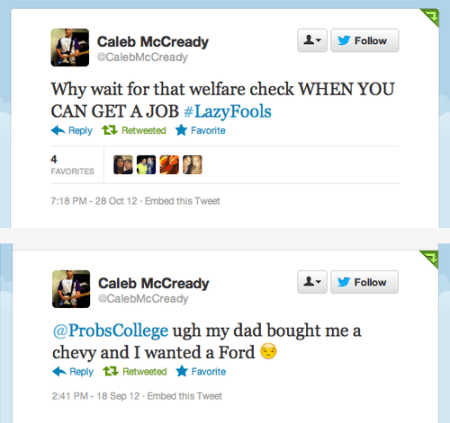
I started retweeting people complaining about welfare, food stamps, etc. and then following it up with a previous tweet of theirs that makes them look hypocritical/dumb/etc. I discovered that as I would retweet these, my followers would start @replying these people and let them know they were idiots. They would then delete their offending tweet. Well, I couldn’t let that happen. So, I screenshot away.
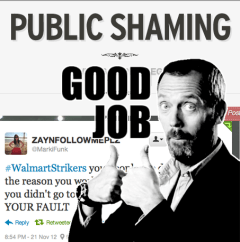
What Binder is very aware of is that Twitter is, by and large, a public forum. Anything that you tweet, unless your privacy settings are changed, can be read by anyone and everyone; my local Metro, and other newspapers around the world, have a section dedicated to them. This is something that people like Donald Trump often forget. As he mentions, once the tweets draw enough attention they are normally taken down. While this is unfortunate, screencaps serve to archive these tweets, and I’ve embedded a few for your viewing pleasure. The first two are a few of the more relevant ones, and the last is a wonderful showcase of hypocrisy:
In response to Korean pop artist PSY closing the American Music Awards.
Regarding a few Mexican high school marching bands and dancers marching in the Macy’s Thanksgiving Day Parade.
Just one of the many, many tweet comparisons that highlight the plight of the privileged.
A lot of the “tweets of privilege” happen to be teens and twenty-somethings writing about employment and the economy. There’s a definite trend of people saying that the jobless are lazy, when only months before they were complaining about being unemployed. What Matt Binder is doing with his blog is exposing hypocrisy where it so often festers [the internet], while also helpfully reminding everyone out there to watch what they say. If you stick your foot in your mouth out loud, there’s a chance someone will hear it, but less that someone will actually record it. On the other hand, making a tweet in poor taste about someone’s dead brother online is really all it takes to get on the news. So let’s give a round of applause for this Tumblr and its creator, and for what it is on the internet: a shining light that unveils the words of the wealthy and unwise. You can follow Matt Binder on Twitter at, easily enough, @MattBinder.
I’ve begun seeing trailers on TV, and apparently it hit theatres two days ago, so I figure now’s as good a time to talk about Red Dawn as any.
For those of you who don’t know, Red Dawn is a remake of the 1984 film of the same name. In the original the United States is invaded by both the Soviet Union and its Cuban allies. A group of plucky high schoolers bands together to form a guerrilla fighting force, named the Wolverines after their high school mascot.
In remaking the film the studio, Metro-Goldwyn-Mayer (MGM), realized that they needed to modernize the invaders in light of the current political climate, and chose China. Keep in mind that in the original film that country was apparently America’s only ally, with the following exchange taking place:
“…Well, who is on our side?” “Six hundred million screaming Chinamen.” “Last I heard, there were a billion screaming Chinamen.” “There were.”

 Gordon’s absence has forced me to dedicate yet another Fame Day to a man in the comic book industry [a post on a woman is in the near future] to join the ranks of Anka, McDuffie, and Fraction.
![From left to right: Miss America Chavez, Miles Morales [Ultimate Spider-Man]](https://culturewarreporters.com/wp-content/uploads/2013/02/asdgasdga.png)
 While Alonso agrees that comic books have not always treated minorities with due respect, he also acknowledges that stereotypes are more complex then they might first appear. He took part in helping to create Mexican heroes the Zapata Brothers, who were based on his cousins in Mexico. The two wear full luchador regalia, and while this may be perceived by some as racist, Alonso would argue otherwise. “Is that a little stereotypical?” he says, “Yeah, but it’s also fun and a part of our culture.” Growing up watching these wrestling matches growing up they struck him as being an important part of his culture.



 EVAN: This week on E> we take a break from scrutinizing film to look back about seven or so months to a different time of our lives: college. Now that we’ve both graduated we find ourselves in a different stage of life, and it begs the question of what those four years did for us, and whether or not that’s what we wanted or expected.






 Culture War Reporters