Category Archives: lgbt

One Christian’s Views on Same-Sex Marriage

To begin with, yes, I am a Christian. I read the Bible and I go to church, and brushing aside such things that can be construed as “appearances only” I also believe that Jesus was God’s only begotten son sent to Earth for the salvation of mankind, and in the inerrancy of Scripture.

I am a Christian and I am okay with same-sex marriage.

Yesterday I had a debate on Facebook that lasted for literally hours on this subject. I was simply going through my newsfeed when an article popped up titled “Inter-Racial Marriage and Same Sex Marriage.” I didn’t even have to open it up to read it to know I disagreed, because the friend who posted it decided to also quote the last paragraph:

“The real question here, it seems to me, is whether marriage has an essence or is merely a social construct akin to driving on the right- versus left-hand side of the road. Those who espouse same-sex marriage want to deconstruct marriage so that what counts as marriage is just a matter of convention. Once we start down that route, anything goes: a man and two women, a man and a child, two men and a goat, etc. I see no reason at all to start down that road.”

Which prompted my response, on the left, and the decision  to embark on a discussion that would last from roughly 1 to 6 p.m. and leave me emotionally, more than mentally, exhausted. I soldiered on, however, because within that paragraph is a very common argument in the Christian community that I simply cannot agree with. It’s a go-to response for many regarding same-sex marriage, and one that follows a particular line of logic. Continue reading

Pride Weekend: Now and The Future

The CN Tower, putting on a special light show for Pride Week.

Imagine my surprise when I realized that this upcoming weekend is a long one due to Canada Day [July 1]. Imagine my continued surprise when I found out that not only is this weekend Pride Weekend, but that it actually coincides with the national holiday more often than not.

I’ve been in Toronto for the past six or so summers, and it really has taken it this long for the latter to dawn on me; that’s in spite of the fact that this city hosts one of the largest gay pride festivals on the planet. We have an entire week dedicated to celebrating LGBT people, an event that has one of the most user-friendly websites I have ever laid eyes on. Continue reading

Evan and Gordon Talk: Homosexuality in Television

GORDON: Ladies and gentlemen, welcome back to Evan and Gordon Talk after our long absence; try to contain your tears of joy.

CONTAIN THEM!

Now our subject for tonight is something Evan and I have had multiple conversation on over the past year or so: homosexuality in television.

EVAN: If you’ve been keeping up with these weekly installments for the past year or so, it should be no mystery what our stance is on homosexuality in general. I like to think that our opinion of what Orson Scott Card chooses to do with his money make this apparent. Continue reading

You Are Not The Flag You Wave, Or “Enough with the Equal Signs for Profile Pics”

Yesterday, I saw a picture of Kabul, taken in what must have been the late 70s or early 80s. It was either in or near a university- I recall there being a stone courtyard with tall, shady trees and an ornate water fountain. There were also a couple of young women, wearing short sleeves and pants, carrying their books. The comment section for this picture was awash with sighs about “how beautiful Afghanistan had been” once upon a time and “what a shame it was that religion had come along and messed it all up!”

I was, needless to say, a little ticked off by the responses to the picture. While there were a few people who managed to point out that Islam didn’t one day appear in Afghanistan and wipe out every last vestige of modernism (and that a major Soviet invasion may have played a part as well), for the most part it was all comments on the terrible threat to civilization religion plays. Continue reading

Shame Day: Microaggressions

A few weeks ago I stumbled onto a website called The Microaggressions Project and then promptly forgot about it. Returning to it tonight I looked over the “About” page, which had the following paragraph at the top:

This project is a response to “it’s not a big deal” – “it” is a big deal. ”It” is in the everyday. ”It” is shoved in your face when you are least expecting it. ”It” happens when you expect it the most. ”It” is a reminder of your difference. ”It” enforces difference. ”It” can be painful. ”It” can be laughed off. ”It” can slide unnoticed by either the speaker, listener or both. ”It” can silence people. ”It” reminds us of the ways in which we and people like us continue to be excluded and oppressed. ”It” matters because these relate to a bigger “it”: a society where social difference has systematic consequences for the “others.”

A little later on they define what “microaggressions” are, a term that was originally coined to speak about racial experiences. From the essay “Racial microaggressions in everyday life: implications for clinical practice,” which appeared in American Psychologist, Vol. 62, No.4:

“Racial microaggressions are brief and commonplace daily verbal, behavioral, or environmental indignities, whether intentional or unintentional, that communicate hostile, derogatory, or negative racial slights and insults toward people of color.”

One example of this could be a White couple walking down the street and having a Black man pass by them on the sidewalk. The woman clutches her purse tighter against her body, the subconscious idea being, of course, that Black men are prone to crime and should not be trusted.

As an Asian-Canadian I’ve experienced microaggressions plenty of times. I’ve had someone ask me if I was half-White [I am clearly not] with their rationale being that my “English was very good.” It can be an everyday occurrence for non-White people [I deign to use the word minorities, since I do believe that balance is turning the other way], and begs the question: “Why is this such a big deal?”

Writer of the aforementioned article and author of Microaggressions in Everyday Life: Race, Gender, and Sexual Orientation, Derald Wing Sue, PhD, has observed that microaggressions have actually been found to: “(a) assail the mental health of recipients, (b) create a hostile and invalidating work or campus climate, (c) perpetuate stereotype threat, (d) create physical health problems, (e) saturate the broader society with cues that signal devaluation of social group identities, (f) lower work productivity and problem solving abilities, and (g) be partially responsible for creating inequities in education, employment and health care.”

In other words, a Black or Latino man being stopped for a “random vehicle check” by police could be upset, and may even be accused of overreacting. Maybe they should simply be used to this and not let it bother them. The truth is that it makes them feel, even if only subconsciously, like second-class citizens. It’s true in a case as blatant as this one, and in an as subtle an action as hanging a Confederate flag or  having a Native American stereotype as a high school mascot.

To broaden this to the scope that The Microaggressions Project seeks to attain, microaggressions can include people saying to a person with Asperger’s, with no ill-intent whatsoever, “That you seem so normal!” It can be a 17-year-old girl being told by her gynecologist that just because she has access to birth control pills doesn’t mean she can just sleep around.

Microaggressions work in every direction. It’s like going to a Vietnamese restaurant and being given a fork and spoon instead of chopsticks because you’re White and not Asian. Microaggressions are built on assumptions and can make people painfully aware of who they are. They are rarely meant to offend, but often do. 

It truly is a shame that so much of the time we send out microaggressions without so much as a second thought, and then defend ourselves by deeming the offended to be “too sensitive.” While we won’t always be aware of how our words or actions can harm others, we can at the very least listen to the people being hurt, and in doing so try to lessen the presence of microaggressions in our society.

Fame Day: American Horror Story

americansdoghasdToday, I’d like to tip my hat to one of my favorite shows, a young series by the name of American Horror Story.

Now it’s no secret that the horror genre is universally despised, being seen by many as being lower on the totem pole than even toilet-humor comedies or the most saccharine romances out there. I could probably spend an entire post speculating on why exactly horror flicks are treated with such little respect (a lot of it is probably due to the genre’s inbred cousin, the “teen scream” flick), but that’s another topic for another time. I’m here to simply showcase the series and highlight a few of its key strengths and accomplishments that I think make it worthy of a Fame Day.

Each season of the show (the second has just concluded, and a third has been greenlit) is a separate story, made up of the horrific lives of the characters as they struggle with their pasts, their inner demons, and some ever-present terror always lurking just beyond the shadows. It essentially cashes in on the initial charm that LOST had before it jumped the polar bear.
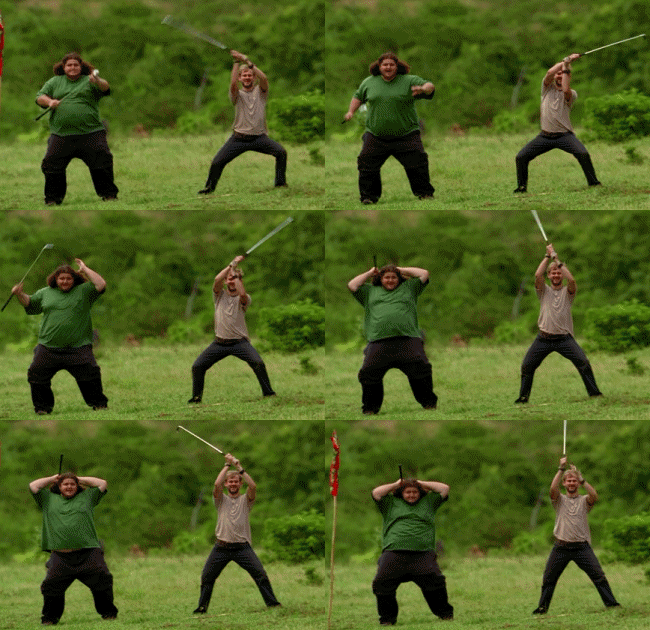
Guilt and shame are themes that play heavily into the series as a whole (or at least, the past two “stories”), giving even the most heinous characters a degree of sympathy. Again, similar to LOST at its best, the constant shifting of the story from one perspective to the next prevents the series from ever being boring. Granted, the madcap pacing doesn’t always work (especially in the first story), but for the most part, the audience is always kept interested.

And that brings us to the first key accomplishment of the series:

Popularity

As I stated above, horror is simply not popular- at least, not in any mainstream way. Tim Burton’s lighter works are really the closest most people get to anything remotely macabre, and the fact that the series has continually drawn in high ratings (to say nothing of critical acclaim) is nothing short of amazing. And we’re not talking about a series that is eerie or has a handful of jump-scares, we’re talking about truly unsettling elements here. I’m certainly not alone in hoping that that AHS‘s continued success serves to begin building bridges between mainstream entertainment and horror subculture; heaven knows both could benefit from some fresh perspective.

And even in the subculture, AHS is playing a pretty major role. It’s…

Raising the Bar

As a result of the genre’s (comparative) isolation, quality in horror is typically pretty rare. When you can’t secure funding for special effects, good equipment, or even B-level actors, chances are your product isn’t going to be all that good. Of course, when you have a built in audience who would pay money to watch Dwayne Johnson protect an orphanage from chupacabras, why would you even bother trying?

I would actually probably watch that…

I’ve seen my fair share of (decent) horror movies, and I can count on one hand the films that had even passable cinematography. AHS, as a series that actually has some decent funding and actually puts effort into creating tense atmospheres and believable effects, is raising the bar for the entire industry. When AHS is the basis for most people’s experience with the genre, there’s going to be pressure on the rest of the industry to meet and excel the expectations the mainstream audience is going to have. Furthermore, AHS‘s star-studded cast (including Zachary Quinto, Ian McShane, James Cromwell, and, I kid you not, Adam Levine) is hopefully going to make the horror genre more inviting to high-caliber actors who can actually sell the audience on the direness of the situation and maintain interest without having to drag in a bunch of fornicating teenagers.

The series is actually one of the few I’ve ever seen that actually gives teens any credit or respect…

And perhaps most importantly, it comes down to this:

Depth

While the stories are good, as are the actors (Jessica Lange being easily more frightening than the goriest bits of the series), it’s some of the basic discussions held during the stories that really hit home. Oppression of women and the dark history of psychology are topics repeatedly brought up, and dealt with both in a historically accurate and totally visceral manner. Perhaps the most disturbing thing I’ve yet seen in the series hasn’t been any of the monsters or murders- it’s been a demonstration (scaled back for TV, even) of the psychological “treatment” given to people “suffering from homosexuality,” seen at the time as a mental disease. Those five minutes alone were more frightening than anything else in the story- and it was amazing. Amazing to see some serious and deep social commentary made, and to see the brutality and insanity some people had to undergo actually presented in a way that’s going to resonate with the audience. You will be a better human being for having watched that scene.

Though in the spirit of honesty, your view of nuns will probably diminish a bit…

When’s the last time you could say that about a rom-com?

American Horror Story, keep up the good work.
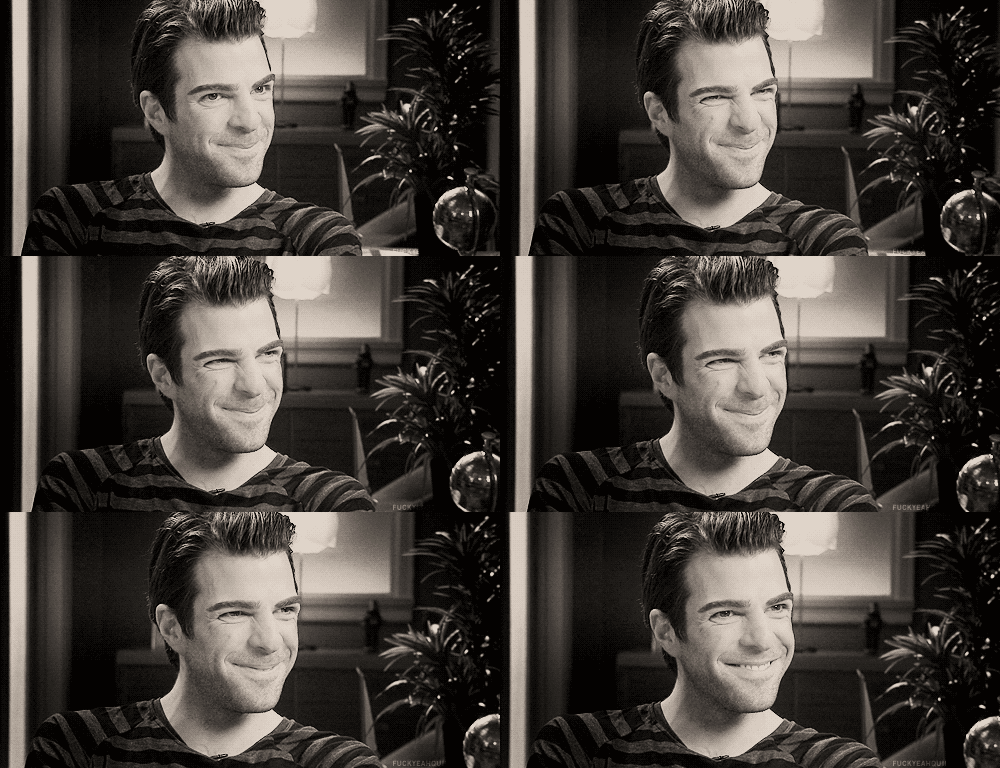
A final note. I would’ve included more gifs, but (1) I didn’t want to spoil anything and (2) easily 90% of all AHS images are of Evan Peters, who is apparently just the bee’s knee’, if the series’ female fans are to be believed.