EVAN: The particular topic of discussion that comes to us today is more one that finds itself passed back and forth within Christian circles, and that is: “Why is Christian media so bad?”
GORDON: I think the problem is self-imposed by the religion (I use the term loosely) itself. We’re not talking about a lack of funding (we’ve got plenty of good low-budget films), or a lack of good directors (there’s plenty of decent talent out there), we’re talking about an issue that runs right down the core of it all.
“Christian” media can’t just be media- they have to drag in everything that goes with it.
EVAN: So basically what you’re saying, and we talked about this a little earlier, is that Christian media more often than not has an agenda, correct?
GORDON: I’d say plenty of it has an agenda, but no, I don’t think that’s the core issue- there’s plenty of other preachy movies out there.
EVAN: So what are you saying, exactly?
GORDON: I’m saying that “Christians” can’t make good media because they won’t allow themselves to. Every protagonist has to fit the moral code to a tee, so that they wind up as either Aslan 2.0 or the epitome of Christian morality: John Smith, the middle class suburban, patriotic family man. Which is why I keep putting “Christian” in quotation marks.
We’re not talking about Catholic peasants in El Salvador or the East Orthodox Church in Ethiopia.
EVAN: Okay, I like that a lot, this idea that those creators of Christian media [and primarily I think we’re talking about films] box themselves in. They’re telling the same sorts of stories to who they perceive to be their audience [and they’re not wrong]: white suburban middle class families.
To sort of break this up a little, I actually saw a Christian film that was reasonably passable at some point last summer.
GORDON: Was it related in any way to Steve Taylor?
EVAN: Is that any way related to “End of the Spear”? It was not, if that’s what you’re referring to.
GORDON: Steve Taylor is the only good Christian musician who ever has or ever will have existed.
But anyway, what was the movie you saw?
EVAN: It was called “To Save a Life,” and it stood out for a couple of reasons:
1) The cinematography was shockingly good for something produced and made by Christians. You can tell which movies they are within the first few seconds.
2) The “villain” of the piece was actually the pastor’s kid. Which was- refreshing, and kind of nice.
It kind of broke out of the whole stereotype you introduced earlier.
GORDON: Huh- interesting. I’ll have to check out the trailer. But let me ask you this:
Can a Christian make a James Bond movie?
EVAN: You mean a movie starring a suave, debonair British man who beds women and guns down henchmen as naturally as he dons his suit jacket every morning?
I’d say no, probably not.
GORDON: I think that’s the problem. It’s not just that you can’t have any explicit sex or graphic violence or excessive profanity (which are overused and abused as is), you can’t have anything even remotely sensual or rough or crude. It rips away reality and humanity in the name of not stepping on anyone’s toes.
Self-imposed legalism.
EVAN: Well, I’d say the difference is that you can’t have a protagonist who glorifies such things as wanton sexuality-
I say that Christian filmmakers will never produce anything like James Bond because of who the character is.
GORDON: Did you like the movie “Fight Club”?
EVAN: I liked it a fair amount.
GORDON: Did you like “Ocean’s 11” or “Snatch”?
EVAN: I haven’t seen the latter, but I very much enjoyed the former.
GORDON: Did you like “Superbad”? “Kick-Ass”? “Ironclad”?
But I think you’re going to have to get to your point-
GORDON: Could a Christian make any of these movies?
EVAN: I think a Christian could, yes. In relation to “Fight Club”, at least, Christian author Ted Dekker has penned novels [sold both in and out of Christian bookstores] which offer a fairly decent psychological thriller aspect to the reader.
GORDON: Ah, Dekker. The whole reason he stands out as an exception is- I believe- that he grew up among Indonesian headhunters, and not in Middle America. Again, it’s about having that different perspective on life.
EVAN: And I think what he’s realized, as a creator of the arts, as someone who has a hand in shaping Christian media, is that you can have these other sorts of exciting, thrilling stories told with a faith-built worldview. People of every religion want a little excitement.
GORDON: Of that there’s no question. The heavy use of the video library at our school stands in testament to that.
But again I think the issue is that “Christian” self-imposed isolation inevitably leads to the vast majority of their work winding up as “White People Problems” or “Chronicles-of-Narnia-minus-the-good-stuff”…
EVAN: Or “Lord-of-the-Rings-but-way-more-heavy-handed.”
GORDON: Exactly.
EVAN: I mean, we’ve talked a little bit about why Christian media can be bad [terrible production values, cookie-cutter story lines, sheer absurdity], but how could it be better [to harken back a little to our last talk]?
GORDON: They have to stop being terrified of the big bad world. They have to realize they can show characters with flaws- real flaws- not drunkard stereotypes and the occasional swear word.
Saying this will get you expelled from Liberty, Pensacola, and BJU
EVAN: I mean, a deeply flawed person who finds redemption is a much more compelling story than a white bread sort of guy with his middle class problems.
And they have to stop coddling their audience. Yes, Christians turn to Christian media for “better alternatives,” but the odd cuss word won’t negate an overall positive message; neither will a fight scene, or two guys sitting around enjoying a beer.
GORDON: There’s this one scene in a (Christian) movie Steve Taylor directed:
A character hurts his hand loading something into the back of van. He lets loose a cuss word and his buddy chides him for it, saying “God don’t like it when we cuss.”
Later on in the film, the buddy hangs his head and apologizes, saying “I’m sorry. I was upset that you cussed- I should’ve just been upset that you hurt your hand.”
EVAN: Wow. That is very, very good.
GORDON: That right there is the problem not just with Christian media, but with the whole religion.
EVAN: Misplaced priorities.
GORDON: More obsessed with present clean-cut paragons of middle class etiquette than anything really real.
That’s why we turn to “secular” movies for actual substance. The struggle for identity in “Fight Club”, the heroism in “Kick-Ass”, the friendship in “Superbad.”
EVAN: I think what’s really ironic is that Christian media-makers have a Christian-made work out there that’s immensely popular. “The Hobbit: An Unexpected Journey” came out just this past December.
GORDON: I again reference an (alleged) quote by Steve Taylor.
“I’m not a Christian artist- I’m an artist who is Christian- it affects what I do.”
EVAN: Really well-put. And something that a lot of us [I speak for many in our graduating class] as writers, musicians, artists, et cetera would benefit from keeping in mind.
And that puts us more than a little overtime.
GORDON: Well, people, you know what that means. Time to vote on our subject for next week.
EVAN: My contribution this time around is . . . wow, I never think ahead . . . masculinity. You’ve done a post about “Manly Culture” in the past, but I want to talk about what it is at present, and how we feel about the shifts and trends and things.
GORDON: Interesting subject. I submit we speculate on the upcoming Star Wars movies.
EVAN: If you think you’re up for it, then yeah, cool. I’ve read quite a few of the post-original-trilogy books, so I know a reasonable amount about the subject.
GORDON: Nerd.
And with that witty response, we’re out! Have a good night, everyone.
If it isn’t, then you probably aren’t familiar with the series (and should count yourself truly fortunate), so for you blissfully innocent, here’s the basic run-down.
The Left Behind series is based on the book of Revelation in the Bible, as well as certain (delectably) apocalyptic verses in Old Testament books. I say “based on”, but that’s more to demonstrate the authors’ intentions. Left Behind is “based on” the book of Revelation in the same way that Teenage Mutant Ninja Turtles is based on Vasari’s biographies of Italian Renaissance artists.
In the sixteen-novel series, all true (cough, Protestant, cough) Christians have been “raptured” (removed from the world and taken directly to the after life), leaving behind the unsaved protagonists of the story who find themselves contending with the oncoming “tribulations” (the host of hardships and catastrophes marking the end times) and the rise of the antichrist, who walks the earth in the form of a Romanian politician who takes control of the UN (because, you know, there’s no one more powerful than the UN).
Things more powerful than the UN: The Student Government of MLK Jr. Middle School, A Junior Sales Rep from Prescott Pharmaceuticals, Paris Hilton’s Chihuahua
Needless to say, I don’t think very highly of the series. But hey, if we’re looking for badly written fan-fiction, why not haul Twilight to the guillotine?
It’s because of the fan part. That’s what really gets me. We’re not talking about someone fawning over the idea of stalker-veggie-sparkle-vampires, we’re talking about someone fawning over the idea of millions- billions– of human beings undergoing agonizing deaths. Think I’m reading into things? Take a look at this passage from the series:
The riders not thrown leaped from their horses and tried to control them with the reins, but even as they struggled, their own flesh dissolved, their eyes melted, and their tongues disintegrated. As Rayford watched, the soldiers stood briefly as skeletons in now-baggy uniforms, then dropped in heaps of bones as the blinded horses continued to fume and rant and rave.
Seconds later the same plague afflicted the horses, their flesh and eyes and tongues melting away, leaving grotesque skeletons standing, before they too rattled to the pavement.
You might say “Sure, that’s violent, but that isn’t exactly glorifying it, is it?”. Let me continue on.
…Jesus nudged His magnificent white charger and descended to the top of the Mount of Olives.
As He dismounted, Carpathia shrieked out his final command, “Attack!” The hundred thousand troops followed orders, horsemen at full gallop firing, foot soldiers running and firing, rolling stock rolling and firing.
And Jesus said, in that voice like a trumpet and the sound of rushing waters, “I AM WHO I AM.”
At that instant the Mount of Olives split in two from east to west, the place Jesus stood moving to the north and the place where the Unity Army stood moving to the south, leaving a large valley.
All the firing and the running and the galloping and the rolling stopped. The soldiers screamed and fell, their bodies bursting open from head to toe…
So much for turning the other cheek, eh?
And here’s what gets me about the series. It’s not the generally bad writing or the twisted theology- it’s just how freakishly popular the series is. Popular enough not to spawn just one movie attempt, but two. It’s hard enough for good stories to get a second chance at something like that, let alone this junk. And it’s the implication of that popularity which gnaws at me. There are people out there- a lot of people- who genuinely look forward to this supposed apocalyptic scenario, or an apocalyptic scenario, anyhow. People who fully expect the end of the world to be a plague and hellfire ridden Armageddon, complete with WWIII and genocide of unheard of proportions. People who look forward to this- and not in a “in the sweet by and by” way, I’m talking about a “I love the smell of napalm in the morning” kind of way.
You can’t deny that this blood-thirsty anticipation does exist. If you’re even only vaguely familiar with the Christian (American-Christian, more on that in a second) subculture, you’ll almost have certainly run into this. There’s plenty of other lousy Armageddon fantasies out there.
And what makes it all the worse is just how utterly undeserved all this hidden vitriol is. This vengeful glee isn’t coming from people who have been mercilessly persecuted for their faith. This isn’t coming from the families of martyrs or the congregations of assassinated priests and pastors in the third world. The churches of Africa, Asia, and South America have enough problems combating war, poverty, and disease to be drooling over prophesied war, poverty, and disease. No, this is the bitter vindictiveness that only comfort and safety can breed. All this body-bursting leering isn’t a result of imprisonment (not that it would be justified there either), it’s a result of being snubbed by Bill Maher or portrayed as yokels on some sitcom.
That’s just messed up.
Now this isn’t Shame Day, but that doesn’t mean we can’t all gather ’round and ruthlessly mock something that so richly deserves it, and if this drivel doesn’t deserve it, I don’t know what does.
GORDON: Ladies, gentlemen, voices I hear in my head during the dark, long hours of the night, we’re going to deviate from our past record of discussing television to talk about creating a new literary genre.
EVAN: Which is a daunting task, to say the least. I mean, genres have gotten ridiculously specific as of late. There’s a “gay horror” genre now. It’s not something to spook homophobes, it’s literally horror fiction for homosexuals.
GORDON: There are so many terrible, ignorant jokes I wanna make right now, but I’m not going to. But I agree- we can’t just slap two genres together. Poe is credited with inventing the deective novel- is there a particular profession that hasn’t really been explored much?
EVAN: Hm . . . Everything dramatic and even slightly connected to death is out. That includes forensic scientists, doctors or any sort, lawyers, etc. And the thing is, a genre that revolves around a profession requires an exciting one.
GORDON: Would it count if we revived the explorer/exploration novel?
EVAN: Not if the title of this post is “Evan and Gordon Talk: New Lit. Genre.”
GORDON: Touché. Here’s an idea: a “Nietzschean” novel.
EVAN: Go on-
GORDON: Well, to brutally simplify the philosophy, the only “bad guys” are the people who aren’t doing anything. Otherwise it’s more like an epic tale of colliding forces all of whom technically could be the protagonists and antagonists.
EVAN: That’s an interesting direction, but I suppose my issue is how alternatingly broad and specific it is- So in these novels you’re proposing, the only villains are the idle?
GORDON: the idle, the apathetic, those trapped by their antiquated sense of morality, and those enslaved to their brute instincts and empty rationality.
EVAN: I suppose it works, but have difficulty seeing it as the header to a shelf in a bookstore. Which is sort of what I was envisioning we would do in creating our new genre.
GORDON: Huh. What’s your idea?
EVAN: Well, this isn’t my idea, but I recently came across this brilliant new novel put together by Ryan North, creator of the webcomic Quantz.
GORDON: Go on.
EVAN: He Kickstarted it and it made like, twenty times what they asked for, but basically it’s Hamlet, but a Choose Your Own Adventure story. And it’s for various characters, too- like, you can read as Hamlet’s father, who eventually must die to become a ghost, et cetera.
GORDON: Huh. If we’re going down that track, how about a novel written in such a way where you can rip out certain sections, rearrange ’em, and wind up with a completely different story?
EVAN: It would work, but sounds exceedingly difficult to pull off. I’m trying to think of how exactly one would go about writing one . . .
I think, keeping in discussing literature, we could devise a new medium of sorts- it would be a marriage of the graphic novel and the traditional novel. Heavy on both text and imagery, a seamless integration that showcases both the artist and the author.
GORDON: That’s sounds like your average Alan Moore book.
EVAN:The Watchmen comes close to it, but it’s ultimately still a graphic novel which prioritizes that sort of storytelling over the bits of prose sandwiched in between the panels.
How about we look at steampunk, and see if we can branch out from it? That seems to be the newest sort of genre out there nowadays.
GORDON: Fair enough. I’m just struggling to figure out an era of technology to “punk.” After all, steam power was really the first major leap in technology.
EVAN: And “cyberpunk” is already a thing as well.
GORDON: This is true. But what else is there? Modern tech? “Modpunk”?
EVAN: Well, we don’t necessarily need to “punk” something. We just need to look at what makes/made steampunk so popular and work off of that-
GORDON: It’s the art, the world, the fancy suits. But yeah, it’s the rich world that’s created; it appeals to us.
EVAN: It’s also a union of history junkies and the sci-fi/fantasy crowd, I think that’s a pretty large aspect of it.
Are there two sort of interest groups that we can intertwine? I mean, it’s already been done with horror and romance, long before Stephenie Meyers ever came along.
GORDON: Huh. I’ll admit, I’m having trouble trying to think of one that hasn’t already been covered. As of yet, I think my Nietzschean idea was the strongest lead we yet have.
What if went down that route? Trying to twist philosophies into narratives- the allegory of the cave would make a good story.
EVAN: I think the main issue is how broad it could get- though I suppose it could just be “Philosophical Fiction.” That I could see in a bookstore.
GORDON: That’d be cool. I mean, it all appeals to the questions and struggles we already have. Yet barring Rand (may raccoons urinate on her grave) and LeGuin, I can’t think of any explicitly “philosophical” novels.
EVAN: That may speak for their effectiveness/popularity.
I was thinking about taking a genre that’s immensely popular to this day, and smashing it together with another one. Self-help books.
GORDON: Heh.
EVAN: People eat ’em up.
GORDON: I’m just imagining a really sarcastic self-help book.
EVAN: Comedy and self-help has probably been done . . . hm . . . I would love to see a whole line of books that masqueraded as self-help books that you could gift to the naive.
GORDON: Heh, that’d be cool.
EVAN: They’d be excessively over the top, but just believable enough for people to [literally] buy them.
GORDON: That’d be funny, but it’s really not a genre.
EVAN: I think if self-help books are a genre then fake self-help books would be as well.
GORDON: It’s really more of a gag.
EVAN: Yeah, I suppose you really couldn’t have that many of them.
How about an exaggeration of the choose your own adventure book?
GORDON: Like forcing you to branch out into multiple novels?
EVAN: Ooh, that’s an idea! So your choices would determine what novels you get next; that’s brilliant.
GORDON: Ain’t it? You’re welcome, America.
EVAN: And Canada. And the world. Let’s open up our borders here.
GORDON: Except Luxembourg. **** you guys.
EVAN: You don’t even know anyone from Luxembourg.
GORDON: Exactly- what makes ’em think they’re so good they don’t talk to me?
EVAN: We are going to lose the viewership of an entire country because of you.
GORDON: Boo hoo.
EVAN: All . . . possibly one of them.
GORDON: Hey, Luxembourg! Andorra called, they want their quaint charm and history back!
EVAN: And with the slamming of an entire nation done, and with a few very decent ideas about exciting places literature could go, we should look forward to what we talk about next-
GORDON: New film style?
EVAN: Seems like we’d be following very closely the same sort of conversation. Not to mention really most of what can be done has been done.
GORDON: This is true.
EVAN: Hm . . . How about . . . nerd culture, just in general- The Big Bang Theory, the current conversation about “nerd girls,” the whole shebang.
GORDON: Sure thing.
EVAN: Okay, that fully wraps up our time. Say good-bye to the nice people, Gordon.
Not “frightening stuff,” mind you- horror. There’s a distinction, you see.
Fright is the simple biological jolt you get when something startles or surprises you- a door being slammed, a discordant note blaring out of nowhere, and so on. Tragically, the title of “horror” gets slapped on things (typically movies) that merely have “jump-scares.” Horror on the other hand, is anticipation and dread at the perception of something threatening on a fundamental level.
So why talk about this? Because despite the outcry of some, horror- especially horror movies- holds a special place in our culture. Indeed, horror holds a special place in all cultures, and has since the first Cro-Magnons huddled around some arctic fire and whispered about strange and terrible things lurking just outside the circle of light. What we’re afraid of tells just as much about us as what we admire; a perfect example being Evan’s post on the remake Red Dawn. Evan cites that one of the reasons the new version doesn’t work is because the concept of the US being invaded is today laughable (especially by North Korea, whose entire population could fit into LA county with room to spare), whereas in the 1980s, the fear was far more realistic, or at least, believable.
Now I’m not here to analyze the past decade’s better horror movies and tell you what it is that we seem to be afraid of (not right now, anyways). In this post I’ll just be breaking down the three basic kinds of horror we seem to be responding to.
Fear For Self
First, we have the fear that attacks our egos- not “egos” as in pride, but “egos” as in the psychological term for you. This fits into the greater psychological element of “external anxiety,” meaning the stress we feel as a result of outside factors, such as school, our jobs, hunger, pain, and so on. When we’re afraid for our safety, or empathizing with characters in a movie or TV series who are fearing for their physical safety, we’re looking at this “fear for self” kind of horror. A good example would be any serial killer or monster movie- Psycho or Jaws being the best examples. Now usually we tend to botch this kind of horror, because the protagonists in movies or stories do things we would never do (blonde female college camper running through the woods at night, I’m talking about you). However, when it’s pulled off well, it leaves a noticeable mark on us. It has been said that Jaws created a significant drop in beach-goers after it was released, and you are a dirty liar if you say you’ve never once looked behind the curtain when you go into the bathroom.
Fear Of Self
Just as we have anxieties that stem from external factors, we have stresses and fears that come from within us: “Internal anxiety.” It was theorized by early psychologists, Freud in particular, that our mental issues were a result of us denying or repressing elements within us, most notably the “id”- that part of our mind with all the bloody, vicious, sexual animalistic drives that typically didn’t mesh well with Victorian (or any) society. As with the ego, horror works on this pathway as well- our fear of ourselves. All that madness and evil that we, for the most part, pretend isn’t there. The most obvious examples of this would be werewolf movies and vampire movies (obligatory “**** you, Twilight“) and most any film depicting a change or evolution the protagonist- see Dr. Jekyll and Mr. Hyde, The Wolfman, Dorian Grey, etc.
Fear Of No Self
Lastly we have stress and anxiety attacking (or coming from, depending on how you look at it) the “superego”- that element of our mind consisting of our real or imagined nobility, propriety, decency, etc. Here we encounter “existential horror,” more often called “cosmic horror.” This particular form of horror can be found in movies where the protagonists are fighting a losing battle against some massive, all powerful being- typically otherworldly in nature. Alien invasions and zombie uprisings are both good examples. Here we’re confronted with the fear that we are, in spite of all of our strength, morality, charity; in spite of our humanity, we are actually inconceivably small and insignificant. Ants who have just become aware that there are beings in the universe of incomprehensible magnitude whose simple existence negates everything about them. That unique feeling of powerlessness is separated from “ego fear” in that this form has a distinct hopelessness, rather than helplessness, attached to it.
Of course, every horror story has all three of these elements in it, but what kind of horror story it winds up being depends entirely on what is emphasized. Take AMC’s The Walking Dead– you’ve got your physical fear of the zombies, your id-based fear at what this new world is bringing out in you, and the general horrific despair at the absolute hopelessness of your situation, both in the face of zombies and the truth of human nature. What you wind up being afraid of depends on which element really gets pushed (survival, rationality, hope) and of course, what you individually, and we as a society, find most terrifying.
So what do we fear as a society right now?
Well, with the rampant popularity of zombie stories, and “disaster” films such as Cloverfield, Skyline, and even the whole “Slenderman” craze; it seems to me that we’re torn between physical and existential horror. And perhaps in an economic depression, that’s understandable- after all, we’re confronted with the physical job of keeping afloat in a rough time, and as the crisis drags on and on, the general feeling of hopelessness with regards to our general situation. We respond to characters whose immediate needs are threatened and characters who are struggling to maintain themselves in the face of cosmic nothingness.
At least, that’s my take on it. Feel free to debate me in the comments, and stop by tomorrow for another Shame Day installment.
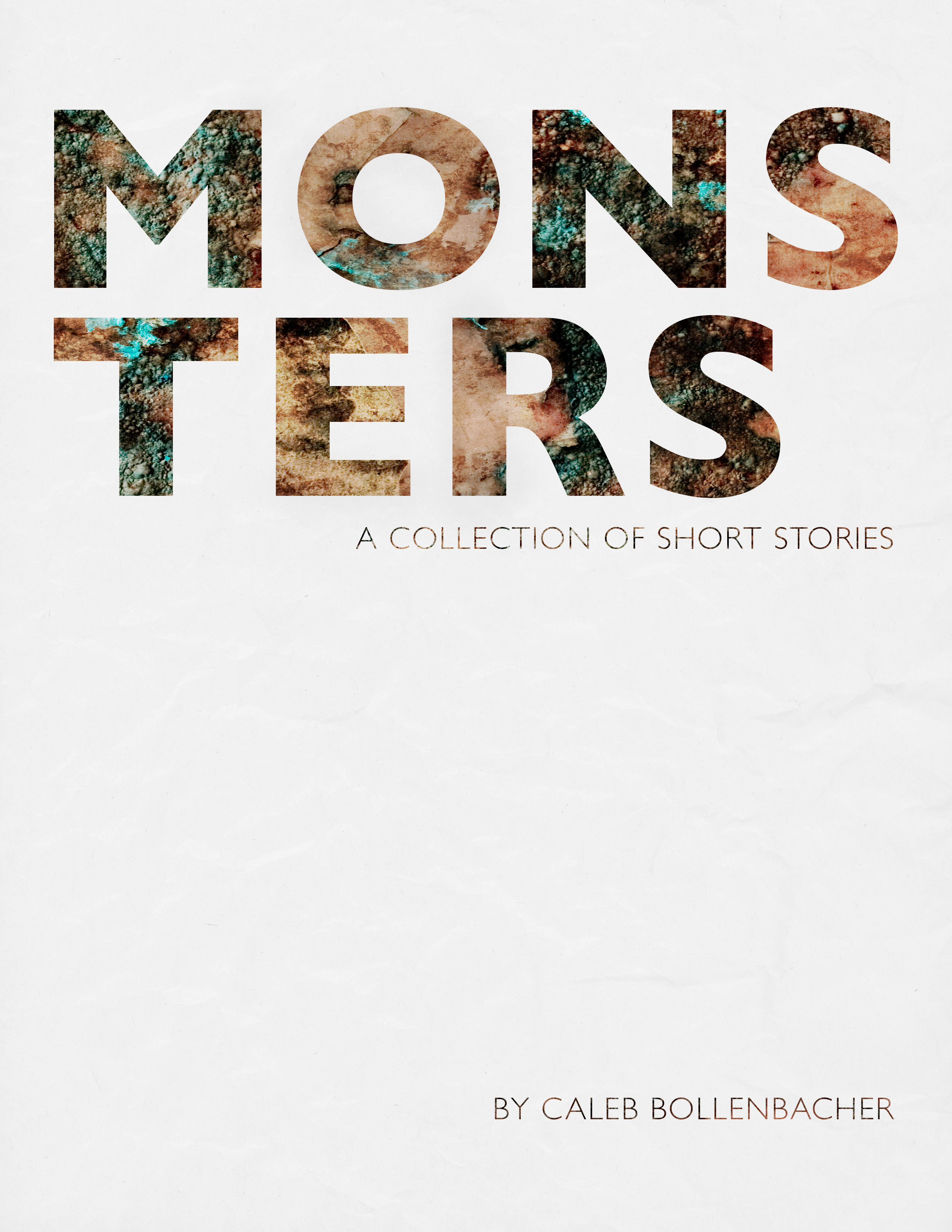
I don’t normally review books in soft-copy. It’s difficult to read from a computer screen for that amount of time, and I find it easier to relate to a book’s solid permanence; if I can pick it up to hold and read, maybe you can [and should] too. That aside, I agreed to review something a friend had written, so here it is in all its candidness.
Monsters: a collection of short stories is exactly that, seven tales penned by Caleb Bollenbacher, a 2011 graduate from Baylor University. Only available on Amazon for the Kindle, an excerpt of the book’s description is as follows:
Nobody yearns to be a monster. But sometimes it works out that way.
Sometimes you merely find yourself looking into the face of one.
Sometimes that face is your own. Continue reading →





 Today, I’m going to talk about horror.




 Culture War Reporters