Category Archives: race

Django and the N-Word

Let me begin by explaining that this is not a review of the simultaneously acclaimed and decried 2012 Tarantino blood-fest. You want to hear one of those, I’d recommend clicking over to Spill or The Escapist’s “Escape to the Movies.” No, what I want to talk about are some specific elements and segments of the film which have become points of contention, controversy, and debate in the past weeks.
Let’s start with the most obvious:

I. Saying “Nigger” Every Other Word

I won’t claim to know your stance on the word “Nigger”- heck, I’m not even sure of my own stance. Perhaps you view the term as so degrading and reprehensible as to merit burning it from spoken language. Perhaps you believe that appropriating and using the word strips it of its power to even be used as an insult. Maybe you see it as being purely contextual- a term of address with audience and a terrible insult with another.

It’s all Elmo ever thinks about

There are probably strong points to be made on all sides, but perhaps the stance you cannot take is that the use of the word “nigger” was inappropriate for the movie.

Now before you take up the battle-cry of “Tarantino is just trying to shock us!” or “Tarantino uses the word excessively in his other movies!” I have to say this.

You’re right.

It’s Tarantino; that’s not an excuse, that’s a fact. You wanna take up his use of the word in other films, then that’s part of the whole debate mentioned above. Simple truth of the matter is that this use of the word “nigger” would still be controversial if the film had been made by anyone else. So let’s talk about it.

Let’s assume that this movie, with selfish or noble intent, is trying to demonstrate a glimpse of the world in question; the use of that word is almost bound to come up. I might throw out the example of Mark Twain’s classic novel Huckleberry Finn, and while by sheer volume Django probably has Huck beat for use of the word, by percentage I’d posit the two are pretty evenly matched. The escaped slave Jim is repeatedly and almost exclusively referred to as “Nigger Jim,” as are the other black characters in the book. Now Twain was anti-slavery and used that word to demonstrate the dehumanization of African Americans (which is why taking the word out of versions of the book is so dumb), as well as reflect the general use of the word. Now I’m admittedly no historian, but if the writings of Twain and other authors are any indication of the times, I wouldn’t say the film is quite so far off as some critics might suggest.

And speaking of historical accuracy…

II. The KKK, or Lack Thereof

There is a scene in the film during which a group of men wearing white sacks over their heads attempt to stage an attack on Django and Schultz. New Yorker contributor Jelani Cobb writes “Tarantino depicts the K.K.K. a decade prior to its actual formation in order to thoroughly ridicule its members’ (literally) veiled racism.” While that scene was (in my own opinion) side-splittingly hilarious, Jelani, and many others, are dead wrong in assuming that this scene depicted historical inaccuracy.

Take this section from Huckleberry Finn:

Why don’t your juries hang murderers? Because they’re afraid the man’s friends will shoot them in the back, in the dark — and it’s just what they WOULD do.

“So they always acquit; and then a MAN goes in the night, with a hundred masked cowards at his back and lynches the rascal. Your mistake is, that you didn’t bring a man with you; that’s one mistake, and the other is that you didn’t come in the dark and fetch your masks.

Again, this is a Tarantino movie set in a Tarantino universe. That’s not a defense, simply, as I’ve already stated, a fact. If you’re looking for a historical account of the pre-war South, a spaghetti-western revenge flick probably ain’t the best place to look for it. There are going to be certain inaccuracies, and there are going to be things the filmmaker has to get right- but all of that is beside the point (which we’ll get to in a minute). All of that’s to say if you’re gonna try to criticize (or praise) the movie’s deviation from historical truth, make sure you’re (1) doing it for the right reason and (2) that you’re critique is actually right.

III. Samuel L. Jackson as Uncle Tom

In Django, Samuel L. Jackson plays the role of the villain’s head-slave Stephen, who isn’t so much a character as a caricature of the most groveling, snivelling Uncle Tom you will ever see or even imagine. This guy makes Uncle Ruckus look like Eldridge Cleaver.

You are guaranteed one genuine Gordon hug if you know who Eldridge Cleaver is.

I’ve heard people call this portrayal offensive, bordering on “black-face” in its depiction of stereotypical “black” mannerisms. It’s exactly for that reason that I didn’t have a problem with the character.

I really have no reason for putting this gif in here…

See, the entire point is to make fun of the guy- and not just him, but the quisling slaves that did indeed exist. I don’t think that this portrayal robbed the film of the gravity of slavery anymore than Bugs Bunny foiling a cartoonized Hitler robbed WWII of it’s gravity.

Now let’s get right to it-

IV. The Horror, The Horror

LA Times journalist Erin Aubry Kaplan said this of Django’s depiction of slavery: “It is an institution whose horrors need no exaggerating, yet Django does exactly that…”

This is a flat-out falsehood.

If Django Unchained exaggerated the horrors of the slavery, if the film depicted one one-hundredth of the horrors of slavery, I will never write again. Despite the allegations of this critic, the truth of the matter is that we could depict the institution of slavery for a century and be no closer to depicting an ounce the inhumanity of it all than when we first started. Does the film exaggerate slavery? Absolutely not. Does it make light of it? Certainly this was a concern of mine going into the movie, but having seen it, I really don’t think it can be faulted there either. The film does, I believe, make a distinct effort to show slavery as brutish and ugly as possible. Or, at the very least, the slavery scenes; this is, after all, a revenge movie first and foremost.

V. The Point

That’s the thing I feel most people are missing here. This ins’t a movie about slavery, this is a movie with slavery in it. It’s a revenge film in which one sorely persecuted character dispenses well-deserved justice upon his persecutors and we all nod our heads in approval and feel a sense of pride and joy well up as we look into this fantasy where the bad guy does get what’s coming to him. Slavery is the backdrop, not the subject, of the movie, but it’s just such a major issue that most of us are getting hung up on it. The equivalent might be bashing a western on the basis that the actual “wild west” was pretty peaceful- factually true, but still missing the goal of the story.

No, this is not a historically accurate film. No, it doesn’t capture the horror of slavery. No, it doesn’t even try to wrestle with it. No, it’s not a discussion of our checkered heritage. No, it’s not the film to drag that dark, bloody history out into the light of day.

But damn it, it’s a start.

Slavery and Movies

I recently had a chance to see The Man with the Iron Fists, a gritty Kung-Fu-Spaghetti-Western-70s-Exploitation mash-up film presented (of course) by Quentin Tarantino. I say presented by Tarantino; the creation of the film itself is owed largely to The RZA of the former (and still awesome) Wu-Tang Clan. In addition to co-writing and directing the film, the RZA stars in the epic slug-fest itself, serving as the narrator and titular character.

Now I went into this film simply suspending my disbelief. I assumed all the nonsensical elements in the film would simply be loving jabs at the old-school kung-fu and action movies that Tarantino and Roth grew up on. That’s why Russel Crowe’s character has a gun-scissor-knife weapon, or why (and here’s the big thing) the blacksmith in this fictional Chinese village is black. Much to my surprise however, the movie began offering explanations (though not to the gun-scissor-knife). The blacksmith is, in a flashback, shown having grown up on a plantation and receiving his freedom from his dying master. Despite having papers declaring him a free man, he is continually treated as a slave- in one scene he is told by a couple of dandies that there’s no way he can read, and therefore understand what’s written on his documents. The two men crumple up his paper and proceed to slur and shove him until he fights back, inadvertently killing one of them. He flees west, and after his ship is wrecked, finds himself in China.

Now obviously that whole last bit about him running so far he winds up in the far east is obviously just the movie shifting back into fantasy, but what really got me was the depiction of slavery. Not prejudice, not segregation- slavery. When’s the last time you can actually say you saw a film deal with that? Glory in 1989? Some Little House on the Prairie episode sometime in the 70s? It simply isn’t done (and that one episode of The Boondocks doesn’t count).

And that’s what I want to talk about. Our depiction, or lack of depiction, of slavery. For all our grand talk of freedom, liberty, and American “exceptionalism,” we do tend to gloss over the uglier elements of our history, such as Manzanar, Wounded Knee, and perhaps most notably, slavery. It brings up all sorts of uncomfortable, and frankly unresolved conflicts. It throws a dark shadow over all of our self-reported greatness. Nevertheless, we really can’t shove it under the carpet, and it looks like, at long last, it’s starting to all come out.

AMC’s Hell on Wheels takes place during the years following the close of the Civil War, and like The Man with the Iron Fists is one of the few depictions of slavery I’ve ever seen on film or TV. In addition to its frank depiction of slavery, I want to take a moment to give the show some applause for the historical accuracy it had in general, depicting Northern racism towards the ex-slaves, as well as the racism inflicted to (and by) the Irish immigrants- another nasty little thread in American heritage you won’t find in most history books.

Of course, beyond that, there’s the highly anticipated Tarantino film Django Unchained, which we’re all expecting to be jaw-dropping in how good or bad it turns out to be. Unlike the previous two examples, which depicted slavery only briefly, this is a movie set completely in the antebellum South. That’s another hefty jump, though again, how well this is going to be executed is still very much up in air.

Now I’ve been struggling all night to come up with a conclusion for all of this, but I’m really not sure what to say. I can’t say why we’re suddenly interested in a subject we’ve been ignoring for the past century and a half. I can’t quite figure out if this is some little trend or the awakening of some part of our culture that’s been dormant so long we’ve forgotten it. I can’t pinpoint what’s causing this. I can’t tell you where it’s all going. I can tell you, however, where I hope it goes.

I hope this is the beginning of something that might pass for maturity in our culture or our generation. I hope that movies depicting the reality of slavery become a thing. I hope that they open up the doors for the rest of our small-pox-infected, witch-burning, Japanese-interning, waterboarding history. I hope we can actually learn something from all of this once it’s out there, and hey, maybe we can actually get some racial diversity in our movies for a change.

Maybe.

P.S. I haven’t seen Abraham Lincoln, Vampire Hunter or Lincoln yet, so I can’t say how they deal with it in there.

Fame Day: Public Shaming

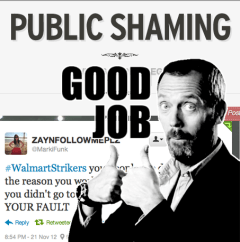
I was going to write about comics helping people, or about how a Swedish toy catalogue acknowledged that girls can play with Nerf guns too, but I ultimately decided to focus on a wonderful Tumblr account I found recently. It’s called Public Shaming, with the subtitle “Tweets of Privilege.” Creator Matt Binder sums up the gist of his blog with the following:

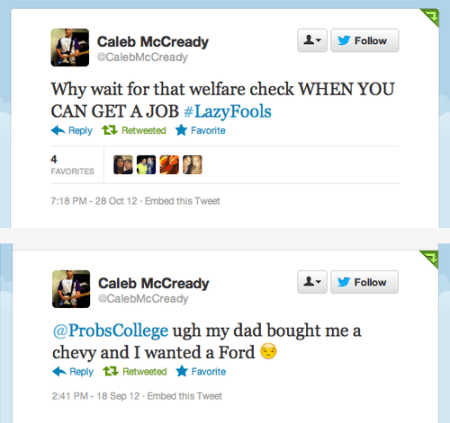
I started retweeting people complaining about welfare, food stamps, etc. and then following it up with a previous tweet of theirs that makes them look hypocritical/dumb/etc. I discovered that as I would retweet these, my followers would start @replying these people and let them know they were idiots. They would then delete their offending tweet. Well, I couldn’t let that happen. So, I screenshot away.

What Binder is very aware of is that Twitter is, by and large, a public forum. Anything that you tweet, unless your privacy settings are changed, can be read by anyone and everyone; my local Metro, and other newspapers around the world, have a section dedicated to them. This is something that people like Donald Trump often forget. As he mentions, once the tweets draw enough attention they are normally taken down. While this is unfortunate, screencaps serve to archive these tweets, and I’ve embedded a few for your viewing pleasure. The first two are a few of the more relevant ones, and the last is a wonderful showcase of hypocrisy:

I actually tried pretty hard to find a tweet without a bunch of profanity.

In response to Korean pop artist PSY closing the American Music Awards.

“WTF. WHEN DID AMERICA BECOME A SHOWCASE OF DIVERSITY?!” My personal favorite. -Matt Binder

Regarding a few Mexican high school marching bands and dancers marching in the Macy’s Thanksgiving Day Parade.

Just one of the many, many tweet comparisons that highlight the plight of the privileged.

A lot of the “tweets of privilege” happen to be teens and twenty-somethings writing about employment and the economy. There’s a definite trend of people saying that the jobless are lazy, when only months before they were complaining about being unemployed. What Matt Binder is doing with his blog is exposing hypocrisy where it so often festers [the internet], while also helpfully reminding everyone out there to watch what they say. If you stick your foot in your mouth out loud, there’s a chance someone will hear it, but less that someone will actually record it. On the other hand, making a tweet in poor taste about someone’s dead brother online is really all it takes to get on the news. So let’s give a round of applause for this Tumblr and its creator, and for what it is on the internet: a shining light that unveils the words of the wealthy and unwise. You can follow Matt Binder on Twitter at, easily enough, @MattBinder.

Shame Day: Nationalism

Imagine for a moment, the existence of two mythical lands: Acirema and Adanac. Imagine that you are a citizen of Acirema, living in a little town bordering Adanac. Despite your isolation, you’re just as patriotic as any another Acireman. You wave the Acireman flag, salute it, pledge your undying allegiance to the homeland, and swear to defend her against all attacks. You cheer on your Acireman compatriots competing in the Olympics. You stand up and applaud when they win, and howl with despair when they lose. As far as you are concerned, you are a proud Acireman, a citizen of the greatest nation on earth; you love your country just as every red-blooded Acireman is expected to.

And then it is discovered in an old, forgotten document that a century earlier your far-off neck of the woods was actually purchased by Adanac from some forgettable Acireman president. All this time the Acireman-Adanacian border was actually twenty miles further south, making your town and everyone in it Adanacian. What do you do? You were born in another country, making you a citizen from a country that has until now been foreign to you. Do you still salute the Acireman flag? Do you still cheer for the Acireman athletes? Do you still decry the metric system as a tool of the devil?

You probably get the point by now.

Nationalism, boiled down to its most basic components, is the idea that borders matter. That being born on one side of an imaginary line fabricated by affluent racists a few centuries ago should make you a different person than if you were born a few miles north/south/east/west of it.

Now we’re not exactly caught up in some series of Napoleonic conflicts, so why bring up nationalism as the topic for this week’s shame day?

It’s because of this quote by President Obama:

“America remains the one indispensable nation, and the world needs a strong America, and it is stronger now than when I came into office…”

Now let’s take a few minutes to reflect on the sheer arrogance of that statement.

Done?

Good, now let’s break it down.

According to the president, America, and only America, is the one necessity in the world. Brazil, we’re ok if that goes away. The UK can sink into the ocean. China, Russia, Nigeria, Japan,  Italy, Laos- these places are “dispensable.” They don’t serve an important function like America does. America is “indispensable”- the one indispensable nation.

Now if this quote came from some goose-stepping splinter cell in Nowhere, Arkansas, we could probably ignore this. However, as it came from the single most powerful man on the planet, we’re probably not crazy for raising some concerns.

I mean, let’s assume the guy is right- America’s existence is the cornerstone of all stability and decency in the universe, and it is simply more important and valuable than all the other nations of the earth. Shouldn’t we then be concerned about damaging this sole stitch in the fabric of civilization? Puerto Rico, a US territory, is currently petitioning to become a state. If it does, will the America that Obama calls indispensable change in such a way as to unravel all of that? What about selling an acre of land in the south to Mexico, would that shift in the border constitute a change to this indispensable nation?

Or maybe it has nothing to do with borders- maybe America’s indispensable nature has to do with its people. Obviously to protect this, we must maintain things the way they are, and keep any immigrants from entering into the nation, or any Americans from immigrating out, lest we screw up the quota that makes us us. Or maybe it’s not about borders or people- maybe America’s unique nature as “indispensable” comes from its values- that’s why we need to never add or abolish any laws or rules or alter our culture or worldview in any way.

Let’s be realistic here. I’m an American, and I am not exceptional. God Almighty does not smile more upon me for have been born in square A than in square B. My blood is not somehow more precious than that of someone who lives a few feet across an imaginary line in the dirt. If a Mexican, a Canadian, and I were drowning in the ocean, you would not be more obligated to rescue me for either of them. I am not any less dispensable than any other human being on the planet by virtue of my passport or my heritage. This idea that we are somehow inherently divided as human beings on the basis of where we were born is unspeakably stupid. There’s nothing wrong with liking the unique things about the place where you live, or the good and courageous things that are being done, or have been done, or the noble values that your countrymen hold. But ranking these things- the unique things, the good and courageous actions, the noble values- as being less or more important on the basis of their proximity to you is just a flipping shame.

Re: Where I Try To Explain Red Dawn

I don’t normally get that angry about things. Disappointed, sure. Upset, often enough. But really, truly angry? That emotion is normally reserved for pure, undistilled racism.

Yesterday I wrote about the production history of Red Dawn, and mostly talked about how the plot was immensely improbable and how the film industry is all about money, et cetera. What I did not at all dwell on was the potential of the film to bring out racism in people, similar [but not at all comparable] to the abuse of Middle Eastern Americans after what happened on 9/11.

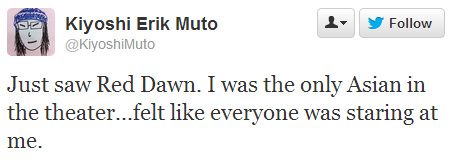
On Facebook Racebending.com directed me to Tumblr user manilaryce, who compiled a number or racist tweets by people who had just watched Red Dawn. I have embedded the image below and on the right.

The following are a few of the tweets that particularly stood out to me:

Kinda wanna kill some Asians right now and defend the homeland, thank you Red Dawn for sparking some patriotism in me

The only reason Im going to see red dawn is cause there’s sexy ass guys running around with guns killing Asians my type of movie;)!

I now hate all Chinese, Japanese, Asian, Korean people. Thanks. #reddawn #amazingmoviedoe

Red dawn was sickkk..just another reason why to hate asians.

This is like when racist Hunger Games fans tweeted about how the casting of a character as Black ruined the movie for them. The difference between that situation and this one is that I feel directly targeted.

One of the tweets, by @elysse223, reads “I usually love Asians, but in Red Dawn I found them terrifying.” After reading that I almost immediately felt worse, like both me and everyone else like me had been transformed into inhuman movie monsters.

The only consolation I can take in all this is that the film is being almost universally panned. Liam Lacey, reviewing the film for The Globe and Mail, says “Red Dawn panders to the worst kind of racist and jingoist impulses, though the movie is so preposterously insincere, it feels like those adjectives should be in air quotes.” Over at Indiewire Gabe Toro describes the film as “stitched together with scotch tape and falling apart at the seams, letting casual racism and misanthropy to spill out the sides.”

I honestly don’t have a lot to say except that I’m angry, hurt, and somewhat unsurprised that this is what audience members all over America are choosing to take away from this movie. I am Asian and I am not evil. I do not want to take over America. I do not want to ever feel like this:

Where I Try to Explain Red Dawn

I’ve begun seeing trailers on TV, and apparently it hit theatres two days ago, so I figure now’s as good a time to talk about Red Dawn as any.

For those of you who don’t know, Red Dawn is a remake of the 1984 film of the same name. In the original the United States is invaded by both the Soviet Union and its Cuban allies. A group of plucky high schoolers bands together to form a guerrilla fighting force, named the Wolverines after their high school mascot.

In remaking the film the studio, Metro-Goldwyn-Mayer (MGM), realized that they needed to modernize the invaders in light of the current political climate, and chose China. Keep in mind that in the original film that country was apparently America’s only ally, with the following exchange taking place:

“…Well, who is on our side?”
“Six hundred million screaming Chinamen.”
“Last I heard, there were a billion screaming Chinamen.”
There were.”

Production was going smoothly until the summer of 2010 when the Global Times, a Chinese state-run newspaper, got a hold of leaked excerpts of the script. This prompted such headlines as “U.S. reshoots Cold War movie to demonize China” and “American movie plants hostile seeds against China.” In early 2011 the LA Times reported that the film’s villains were changed from Chinese to North Korean to “[maintain] access to the Asian superpower’s lucrative box office.Continue reading