Category Archives: race

How Hollywood is Foretelling the Future While Still Falling on the Wrong Side of History

No one wants to be “on the wrong side of history”.

No one wants to be wrong, period, and even those of us who raise their hackles at being described as “progressive” fear that those words, when leveled against them, might come true. To hear that phrase is to be threatened, told that you’re a dinosaur; except without any of the perks like monstrous size and claws and teeth, more the being pushed out by newer lifeforms and soon to be extinct. The message is, essentially, to keep up or be left behind.

To be asked whether you want to be “on the wrong side of history” is only hypothetical as far as what your choice will be. That the world will actually be changing is not the question; it’s being stated as a direct fact.

Almost two years ago to the day I wrote about film producer Avi Arad, who has been responsible for the past five [an absurd amount even for me, who considers him my favourite superhero] Spider-Man films. In particular I called attention to his response regarding whether the White Peter Parker would always be the one donning the webbed tights [“Absolutely”] and his response to whether or not the lack of diversity in comic book movies an issue [emphasis mine]:

“But I think we are finally becoming more of one world, and you’re going to see more and more diversity in the selection of characters. [. . .] It’s all going to change. I think sometimes we consciously look at it. We would love to have a superhero, we would love Marvel to create a superhero — We can create villains, but we’d love to have a Chinese superhero with something that is really interesting and how they got here, and what is their issue, and so on. But it’s coming. And it’s inevitable. It’s really inevitable. But it didn’t come naturally to comics in the days that no one was aware that there were actually other countries and other people.

aviaradkenjenningsI prefaced that article with a short bit of fiction in which Arad awakens in a cold sweat, realizing that the world he had once foretold had finally come to pass. By saying that these changes are “inevitable” he acknowledges that they are the impending future. By stating in direct terms that as long as he’s involved Spider-Man will never be Miles Morales, an Afro-Latino teen who has carried the title for years now, he both outlines the two camps [those who will, and won’t, be on the wrong side of history] and which side he will find himself in. Continue reading
The State of the Revolution

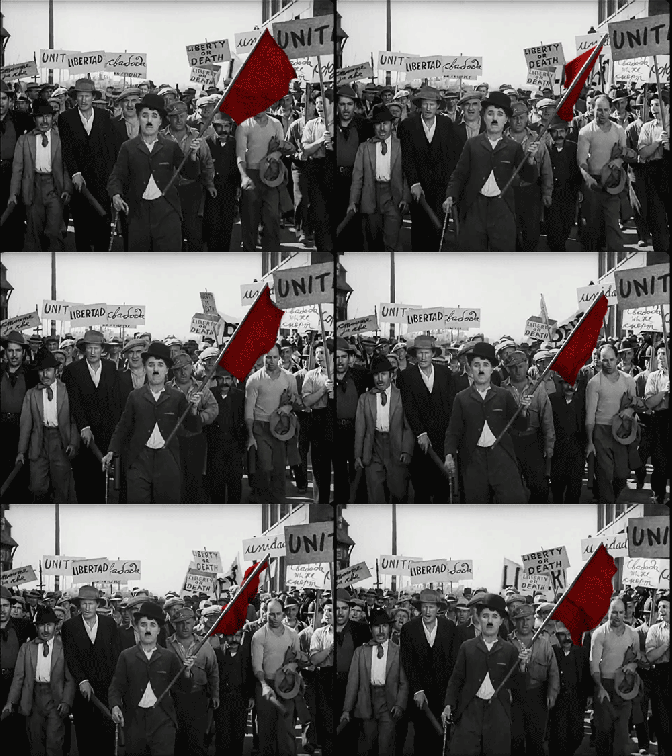
Well comrades, it’s that time of year again! Deck your union halls with black and crimson bunting and gather around the tree for the redistribution of wealth! It’s May at last, and revolution is in the air!

tumblr_n4v8f3dzfg1sq4ug3o1_500

Image retrieved via Tumblr, fair use

Or is it?

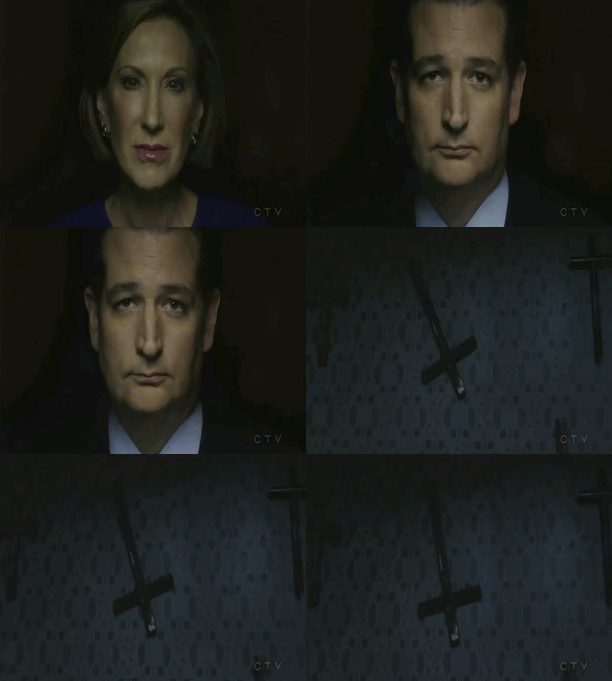
The seeds that were planted during the Arab Spring are far from dead, but no one can say that they’re flourishing. Europe has seen (as predicted by yours truly) a massive rise in openly Fascist parties, rising to power on a tide of xenophobia and racism. A similarly ugly nationalist movement has catapulted Donald Trump to the forefront of the Republican party- and lest anyone think that he’s an insane outlier, second in the race is Tea-Party darling Ted Cruz, another depraved bigot who’s even been called “Lucifer in the flesh” by high-ranking members of his own party.

tumblr_o6ex2mp3zj1sh261fo1_400

Which I will never not find funny

And that’s accompanied by a nationwide assault on the BDS Movement, with universities across the country making a concerted push to ban the organization under flimsy (and utterly false) accusations of antisemitism.

So yeah, things could be better.

tumblr_o61sq2quna1s6zpepo1_250

“But what about Sanders?”, you ask.

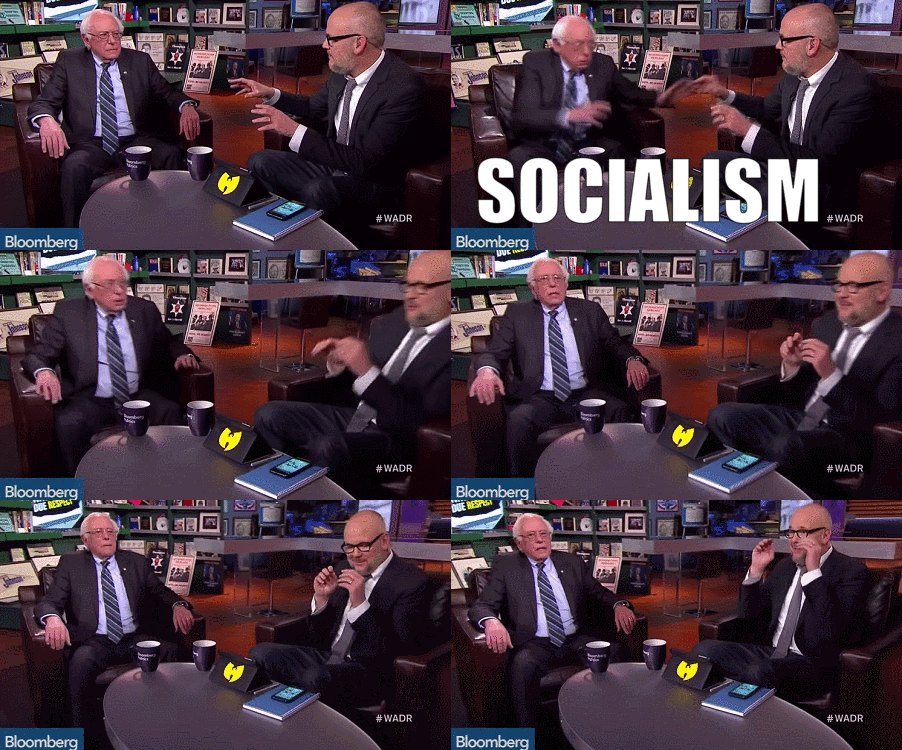
Sanders isn’t a socialist.

giphy

“…by which I mean heavy state subsidies of public services and increased regulation, but let’s not go crazy here.” | image retrieved via giphy, fair use

Continue reading

Free State of Mind: Andrew Govender Discusses Acting, Tradition, and Religion

Free-State-Updated-PosterThis is the third and final installment of “Free State of Mind”, a series of Q&As with the cast and crew of a South African film currently making the rounds at film festivals. You can read my review here, find out more about its creation from producer Terwadkar Rajiv here, and get some insight on how co-lead Nicola Breytenbach’s prepared for her role here.
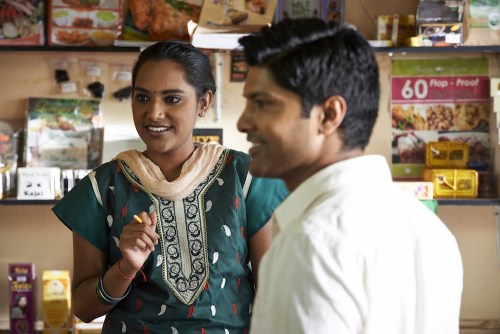
Today’s interview is with Andrew Govender, who plays Ravi, the other half of the couple at Free State‘s core. Another former model like his co-star, he began his career at just sixteen-years-old. Being crowned Mr. South Africa in 2012 is only one of his many achievements, which include creating the Andrew Govender Book Club with the Nelson Mandela Foundation and being involved in various awareness campaigns.

Given that their characters share a few interesting parallels Govender answers a number of the same questions that Breytenbach did, with a few that are unique to Ravi himself.


An arranged marriage is the biggest barrier that Ravi faces in his relationship with Jeanette. How would you say he views that tradition and what it means for his future?

I think he respects it and accepts it. He was brought up in a traditional Indian family and those are Indian traditions. However, when he gets to meet his arranged wife he realises that he doesn’t have much in common with her. That’s when he meets Jeanette and falls madly in love. He knows that he shouldn’t be pursuing a relationship with her because it’s illegal during that time for inter-racial relationships. However, he can’t help himself and that results in detrimental consequences.

ravisister

Ravi makes it clear that he’s concerned about his sister’s safety, but what does he ultimately think about what his family does under cover of darkness?

He understands that they are doing it for a greater cause and he respects that. However, he does care deeply for them and doesn’t want anything to happen to them when they go on these missions. He’s close to his family and wants to protect them.

From what I can tell this is your first role in a feature film. How was that experience, especially with it being a South African production instead of a big Hollywood movie?

It was an incredible experience. I got the opportunity to work with some really talented South African actors. I learnt a lot by being on set and having these actors mentor me throughout the filming process.

Our director Sallas de Jager was also really supportive and helped me to give the best performance I could. Even though this was a South African film, the production standards on the movie were really high. That can be attested to with all the international awards that the movie has won. I really hope that I will have the opportunity to work on more films both in South Africa and Hollywood. Acting is really something that I enjoy immensely.

How much did you know about South Africa’s Immorality Acts before signing on to this film?

Not a lot. I grew up post Apartheid, so most of what I knew was from what I heard, not what I could have experienced. It was quite eyeopening to learn more about that time in South Africa’s history and how Indian people were treated. I gathered as much information as I could from my parents about their experiences during that time. I also was really fortunate that my acting teacher had been in an inter-racial relationship and she was able to help me understand my character better.

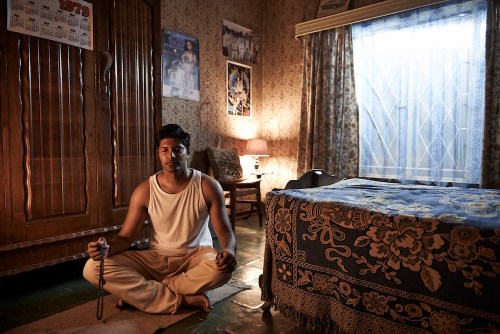
meditation

Religion plays a large part in Free State for both Ravi and Jeanette’s families. Did you come from a religious background, and did this have any affect on how you played the role?

Yes, I did. I grew up in a conservative traditional Indian family so religion was important to us. My character was also brought up with the same core values and so religion would have been important to him too. There’s a scene in the movie where my character meditates and also seeks relationship advice from a guru. So we are aware that he relies on religion to guide him in the choices that he makes.

“Kimmy Goes to a Play” as a Conversation Between Tina Fey and Asian American Activists

The culture war is a conversation.

While it is ultimately a conflict, more often than not this takes the form of ideas and criticism being slung back and forth across the trenches. To be heard is a minor success, but to be actually understood is victory.

Within this conversation it’s undoubtedly artists, especially those who have garnered celebrity status, who have the most powerful voices.


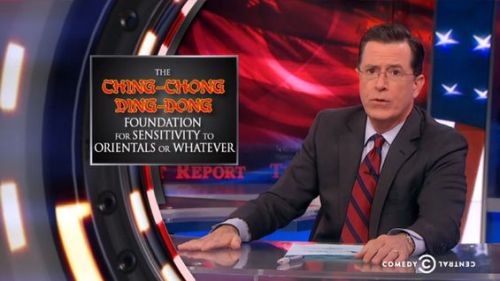
In 2014 the eponymous host of The Colbert Report featured a segment on his show about “The Ching-Chong Ding-Dong Foundation for Sensitivity to Orientals or Whatever”. Given his popularity it reached far and wide, and was eventually viewed by a Twitter activist who created the hashtag #CancelColbert in response.

chingchongcolbert

As it was meant to call attention to and ridicule the outrageous fact that a national sports team is named after an ethnic slur the response was out of line. It was a classic case of [obvious] satire being taken the wrong way, but by inadvertently contributing to what has been dubbed “a fake year of outrage’ this person’s misstep resulted in others who campaign for better representation and the like being worse than silenced, which is to say, ignored.

Despite calling out from what is ostensibly the same side, the misstep of a single loud voice meant that others were unheard.


The exchange between artist and critic is rarely ever an even one, and only becomes more difficult given the sensitivity surrounding such personal creative endeavours.

Lena Dunham is the star and creator of HBO’s Girls, and received enough disapproval about the lack of diversity in a show set in New York City that she was asked about it by NPR. She responded that “[she takes] that criticism very seriously,” and that very same year had Donald Glover playing Hannah’s Black boyfriend on the show.

While the presence of Sandy on the dramedy was a beneficial one, with arguments between the two capturing the tension that can be present in interracial relationships [including such exchanges as: “I never thought about the fact that you were black once.” / “That’s insane. You should, because that’s what I am.”], Glover’s character faltered in that he was very much a response to criticism. Continue reading

Can Casting Choices Promote Global Cultural Dominance? A Possible Explanation for Whitewashing in Cinema

This is a weird, random, and controversial thought, but….

I wonder if this consistent pattern of replacing Asian characters with White actors (even with more and more Asian actors getting more screen time [at least on TV] and all these articles highlighting whitewashing) is a subtle and unconscious battle of cultural and racial dominance? If it stems from a fear-based place of “if you put more Asians as leads in mainstream, worldwide entertainment, then it removes some of the cultural dominance of the status quo”.

I’m really not trying to bash White people, but you really can’t argue that White people overall have more privileges than any other race. And White men are the heads and execs at basically every major company in Europe and North America. And in entertainment, which has major worldwide influence, White people and predominately men are the execs, directors, writers, producers, and agents. Ironically, they welcome foreign money with open arms from Chinese to Middle Eastern investors.

Asians, population-wise, are more than 50% of the world; China and India have enormous populations with a lot of spending power. Asian countries have created very popular forms of entertainment with anime, manga, and video games. They frequently feature characters of Asian descent. Japan has always been a powerhouse country, but their status as an Axis power in World War II has set them up historically as a bad guy. Then their strength in electronics and cars in the 90’s set them up as the “competition” (i.e. not American and not us). And Chinese is ALWAYS the bad guy in the news. “We can’t have factories in China. The Chinese are gonna take over.” There’s a history of US vs THEM. Besides the military, the only industry of world dominance that White America has complete control over is the entertainment industry. American movies make so much internationally. Ironically, the US entertainment industry depends on the income from the foreign markets, but cater very little to their populations by representing them on screen. They know that the foreign populations will come see their movies no matter what, because they aren’t doing huge budget CGI movies where they are. Continue reading

My Problem With Ghost in the Shell (In A Nutshell)

I don’t think there’s anyone here who’s unfamiliar with the term “whitewashing” at this point.

It’s been a frequent topic of conversation here on Culture War Reporters, and while certainly not a new issue, it has been gaining wider and wider attention in recent years…


Most recently, the problem reared its ugly head in the form of Scarlett Johannson being cast in the live-action remake of anime classic Ghost In A Shell. Once again we’re seeing a traditionally non-white (in this specific case, Japanese) role being given to a white actor out of fear that audiences won’t watch movies with non-white leads. And if that were the only issue, I might have stuck with my usually political tirades and left this topic alone. But in the past few days, a shocking development has emerged in the story. Allegations have surfaced that the remake’s producers (and I quote) “Tested Visual Effects That Would Make White Actors Appear Asian“.

Or, as my best friend and this blog’s editor recently put it on Facebook:

“We think so little of you that we’d consider changing a White person’s appearance before entertaining the thought of casting an actual Asian.”

So yeah, I’m feeling compelled to write about this…

tthpnha

And let me tell you what really convinced me to submit the following rant. Continue reading