Tag Archives: America

Django and the N-Word

Let me begin by explaining that this is not a review of the simultaneously acclaimed and decried 2012 Tarantino blood-fest. You want to hear one of those, I’d recommend clicking over to Spill or The Escapist’s “Escape to the Movies.” No, what I want to talk about are some specific elements and segments of the film which have become points of contention, controversy, and debate in the past weeks.
Let’s start with the most obvious:

I. Saying “Nigger” Every Other Word

I won’t claim to know your stance on the word “Nigger”- heck, I’m not even sure of my own stance. Perhaps you view the term as so degrading and reprehensible as to merit burning it from spoken language. Perhaps you believe that appropriating and using the word strips it of its power to even be used as an insult. Maybe you see it as being purely contextual- a term of address with audience and a terrible insult with another.

It’s all Elmo ever thinks about

There are probably strong points to be made on all sides, but perhaps the stance you cannot take is that the use of the word “nigger” was inappropriate for the movie.

Now before you take up the battle-cry of “Tarantino is just trying to shock us!” or “Tarantino uses the word excessively in his other movies!” I have to say this.

You’re right.

It’s Tarantino; that’s not an excuse, that’s a fact. You wanna take up his use of the word in other films, then that’s part of the whole debate mentioned above. Simple truth of the matter is that this use of the word “nigger” would still be controversial if the film had been made by anyone else. So let’s talk about it.

Let’s assume that this movie, with selfish or noble intent, is trying to demonstrate a glimpse of the world in question; the use of that word is almost bound to come up. I might throw out the example of Mark Twain’s classic novel Huckleberry Finn, and while by sheer volume Django probably has Huck beat for use of the word, by percentage I’d posit the two are pretty evenly matched. The escaped slave Jim is repeatedly and almost exclusively referred to as “Nigger Jim,” as are the other black characters in the book. Now Twain was anti-slavery and used that word to demonstrate the dehumanization of African Americans (which is why taking the word out of versions of the book is so dumb), as well as reflect the general use of the word. Now I’m admittedly no historian, but if the writings of Twain and other authors are any indication of the times, I wouldn’t say the film is quite so far off as some critics might suggest.

And speaking of historical accuracy…

II. The KKK, or Lack Thereof

There is a scene in the film during which a group of men wearing white sacks over their heads attempt to stage an attack on Django and Schultz. New Yorker contributor Jelani Cobb writes “Tarantino depicts the K.K.K. a decade prior to its actual formation in order to thoroughly ridicule its members’ (literally) veiled racism.” While that scene was (in my own opinion) side-splittingly hilarious, Jelani, and many others, are dead wrong in assuming that this scene depicted historical inaccuracy.

Take this section from Huckleberry Finn:

Why don’t your juries hang murderers? Because they’re afraid the man’s friends will shoot them in the back, in the dark — and it’s just what they WOULD do.

“So they always acquit; and then a MAN goes in the night, with a hundred masked cowards at his back and lynches the rascal. Your mistake is, that you didn’t bring a man with you; that’s one mistake, and the other is that you didn’t come in the dark and fetch your masks.

Again, this is a Tarantino movie set in a Tarantino universe. That’s not a defense, simply, as I’ve already stated, a fact. If you’re looking for a historical account of the pre-war South, a spaghetti-western revenge flick probably ain’t the best place to look for it. There are going to be certain inaccuracies, and there are going to be things the filmmaker has to get right- but all of that is beside the point (which we’ll get to in a minute). All of that’s to say if you’re gonna try to criticize (or praise) the movie’s deviation from historical truth, make sure you’re (1) doing it for the right reason and (2) that you’re critique is actually right.

III. Samuel L. Jackson as Uncle Tom

In Django, Samuel L. Jackson plays the role of the villain’s head-slave Stephen, who isn’t so much a character as a caricature of the most groveling, snivelling Uncle Tom you will ever see or even imagine. This guy makes Uncle Ruckus look like Eldridge Cleaver.

You are guaranteed one genuine Gordon hug if you know who Eldridge Cleaver is.

I’ve heard people call this portrayal offensive, bordering on “black-face” in its depiction of stereotypical “black” mannerisms. It’s exactly for that reason that I didn’t have a problem with the character.

I really have no reason for putting this gif in here…

See, the entire point is to make fun of the guy- and not just him, but the quisling slaves that did indeed exist. I don’t think that this portrayal robbed the film of the gravity of slavery anymore than Bugs Bunny foiling a cartoonized Hitler robbed WWII of it’s gravity.

Now let’s get right to it-

IV. The Horror, The Horror

LA Times journalist Erin Aubry Kaplan said this of Django’s depiction of slavery: “It is an institution whose horrors need no exaggerating, yet Django does exactly that…”

This is a flat-out falsehood.

If Django Unchained exaggerated the horrors of the slavery, if the film depicted one one-hundredth of the horrors of slavery, I will never write again. Despite the allegations of this critic, the truth of the matter is that we could depict the institution of slavery for a century and be no closer to depicting an ounce the inhumanity of it all than when we first started. Does the film exaggerate slavery? Absolutely not. Does it make light of it? Certainly this was a concern of mine going into the movie, but having seen it, I really don’t think it can be faulted there either. The film does, I believe, make a distinct effort to show slavery as brutish and ugly as possible. Or, at the very least, the slavery scenes; this is, after all, a revenge movie first and foremost.

V. The Point

That’s the thing I feel most people are missing here. This ins’t a movie about slavery, this is a movie with slavery in it. It’s a revenge film in which one sorely persecuted character dispenses well-deserved justice upon his persecutors and we all nod our heads in approval and feel a sense of pride and joy well up as we look into this fantasy where the bad guy does get what’s coming to him. Slavery is the backdrop, not the subject, of the movie, but it’s just such a major issue that most of us are getting hung up on it. The equivalent might be bashing a western on the basis that the actual “wild west” was pretty peaceful- factually true, but still missing the goal of the story.

No, this is not a historically accurate film. No, it doesn’t capture the horror of slavery. No, it doesn’t even try to wrestle with it. No, it’s not a discussion of our checkered heritage. No, it’s not the film to drag that dark, bloody history out into the light of day.

But damn it, it’s a start.
Shame Day: Nationalism

Imagine for a moment, the existence of two mythical lands: Acirema and Adanac. Imagine that you are a citizen of Acirema, living in a little town bordering Adanac. Despite your isolation, you’re just as patriotic as any another Acireman. You wave the Acireman flag, salute it, pledge your undying allegiance to the homeland, and swear to defend her against all attacks. You cheer on your Acireman compatriots competing in the Olympics. You stand up and applaud when they win, and howl with despair when they lose. As far as you are concerned, you are a proud Acireman, a citizen of the greatest nation on earth; you love your country just as every red-blooded Acireman is expected to.

And then it is discovered in an old, forgotten document that a century earlier your far-off neck of the woods was actually purchased by Adanac from some forgettable Acireman president. All this time the Acireman-Adanacian border was actually twenty miles further south, making your town and everyone in it Adanacian. What do you do? You were born in another country, making you a citizen from a country that has until now been foreign to you. Do you still salute the Acireman flag? Do you still cheer for the Acireman athletes? Do you still decry the metric system as a tool of the devil?

You probably get the point by now.

Nationalism, boiled down to its most basic components, is the idea that borders matter. That being born on one side of an imaginary line fabricated by affluent racists a few centuries ago should make you a different person than if you were born a few miles north/south/east/west of it.

Now we’re not exactly caught up in some series of Napoleonic conflicts, so why bring up nationalism as the topic for this week’s shame day?

It’s because of this quote by President Obama:

“America remains the one indispensable nation, and the world needs a strong America, and it is stronger now than when I came into office…”

Now let’s take a few minutes to reflect on the sheer arrogance of that statement.

Done?

Good, now let’s break it down.

According to the president, America, and only America, is the one necessity in the world. Brazil, we’re ok if that goes away. The UK can sink into the ocean. China, Russia, Nigeria, Japan,  Italy, Laos- these places are “dispensable.” They don’t serve an important function like America does. America is “indispensable”- the one indispensable nation.

Now if this quote came from some goose-stepping splinter cell in Nowhere, Arkansas, we could probably ignore this. However, as it came from the single most powerful man on the planet, we’re probably not crazy for raising some concerns.

I mean, let’s assume the guy is right- America’s existence is the cornerstone of all stability and decency in the universe, and it is simply more important and valuable than all the other nations of the earth. Shouldn’t we then be concerned about damaging this sole stitch in the fabric of civilization? Puerto Rico, a US territory, is currently petitioning to become a state. If it does, will the America that Obama calls indispensable change in such a way as to unravel all of that? What about selling an acre of land in the south to Mexico, would that shift in the border constitute a change to this indispensable nation?

Or maybe it has nothing to do with borders- maybe America’s indispensable nature has to do with its people. Obviously to protect this, we must maintain things the way they are, and keep any immigrants from entering into the nation, or any Americans from immigrating out, lest we screw up the quota that makes us us. Or maybe it’s not about borders or people- maybe America’s unique nature as “indispensable” comes from its values- that’s why we need to never add or abolish any laws or rules or alter our culture or worldview in any way.

Let’s be realistic here. I’m an American, and I am not exceptional. God Almighty does not smile more upon me for have been born in square A than in square B. My blood is not somehow more precious than that of someone who lives a few feet across an imaginary line in the dirt. If a Mexican, a Canadian, and I were drowning in the ocean, you would not be more obligated to rescue me for either of them. I am not any less dispensable than any other human being on the planet by virtue of my passport or my heritage. This idea that we are somehow inherently divided as human beings on the basis of where we were born is unspeakably stupid. There’s nothing wrong with liking the unique things about the place where you live, or the good and courageous things that are being done, or have been done, or the noble values that your countrymen hold. But ranking these things- the unique things, the good and courageous actions, the noble values- as being less or more important on the basis of their proximity to you is just a flipping shame.

Re: Where I Try To Explain Red Dawn

I don’t normally get that angry about things. Disappointed, sure. Upset, often enough. But really, truly angry? That emotion is normally reserved for pure, undistilled racism.

Yesterday I wrote about the production history of Red Dawn, and mostly talked about how the plot was immensely improbable and how the film industry is all about money, et cetera. What I did not at all dwell on was the potential of the film to bring out racism in people, similar [but not at all comparable] to the abuse of Middle Eastern Americans after what happened on 9/11.

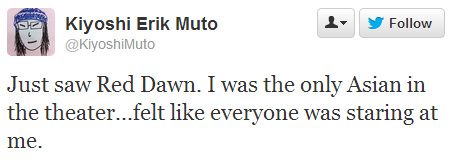
On Facebook Racebending.com directed me to Tumblr user manilaryce, who compiled a number or racist tweets by people who had just watched Red Dawn. I have embedded the image below and on the right.

The following are a few of the tweets that particularly stood out to me:

Kinda wanna kill some Asians right now and defend the homeland, thank you Red Dawn for sparking some patriotism in me

The only reason Im going to see red dawn is cause there’s sexy ass guys running around with guns killing Asians my type of movie;)!

I now hate all Chinese, Japanese, Asian, Korean people. Thanks. #reddawn #amazingmoviedoe

Red dawn was sickkk..just another reason why to hate asians.

This is like when racist Hunger Games fans tweeted about how the casting of a character as Black ruined the movie for them. The difference between that situation and this one is that I feel directly targeted.

One of the tweets, by @elysse223, reads “I usually love Asians, but in Red Dawn I found them terrifying.” After reading that I almost immediately felt worse, like both me and everyone else like me had been transformed into inhuman movie monsters.

The only consolation I can take in all this is that the film is being almost universally panned. Liam Lacey, reviewing the film for The Globe and Mail, says “Red Dawn panders to the worst kind of racist and jingoist impulses, though the movie is so preposterously insincere, it feels like those adjectives should be in air quotes.” Over at Indiewire Gabe Toro describes the film as “stitched together with scotch tape and falling apart at the seams, letting casual racism and misanthropy to spill out the sides.”

I honestly don’t have a lot to say except that I’m angry, hurt, and somewhat unsurprised that this is what audience members all over America are choosing to take away from this movie. I am Asian and I am not evil. I do not want to take over America. I do not want to ever feel like this:

Shame Day: Black Friday

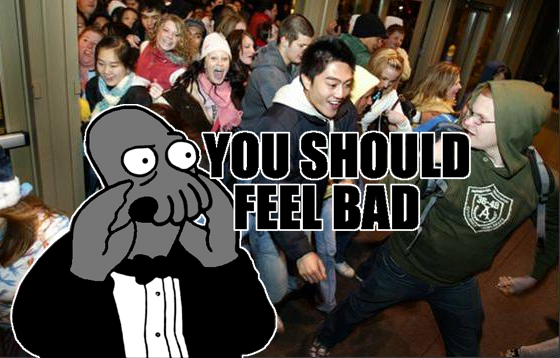
I almost don’t feel like I should have to explain this post. Look at that image on the right, look at that wave of flesh and hunger, which I can only compare to the somewhat recently released World War Z trailer. They move like an organism, a living being that flows into each store, ravenously grabbing at whatever they can.

For the non-Americans among you, Black Friday is the day after American Thanksgiving, which sets off the Christmas shopping season. Last year at this time a few pretty significant events happened, none of which I can say are positive.

The first recorded death from the event happened in 2008, when an employee, once again at Walmart, was literally trampled to death by a wave of shoppers. The stampede could not be halted when other employees tried to help their coworker, and even police who arrived at the scene were shoved and pushed back.

Honestly, I don’t even know what else to say.

Every year the sale begins earlier and earlier, and for a while it was normal for shops to open at 6:00 am. Last year many retailers opened at midnight for the first time. Now, on Black Friday 2012, Walmart [again] and several other superstores have announced that they will be opening their stores at 8:00 pm Thanksgiving Day. This has prompted a very understandable call for a walkout among workers.

If the trend continues this image won’t even make sense anymore.

As a Canadian I’ve celebrated American Thanksgiving only once. It was a time that I spent with a loving family, where copious amounts of food was served and the itis was experienced by many. It was a time of relaxation and enjoying each other’s company, not camping outside superstores in the freezing cold or trampling the meek and lowly [see: Walmart employees] underneath our feet.

All I can say is Happy Thanksgiving, Americans. If you care about at least one retailer [Target] respecting a national holiday, you can sign a petition here. Enjoy your turkey.

Shame Day: Concerned Women for America

“Concerned Women for America.”

It sounds almost like a cartoonish satire of the kind of people who storm into PTA meetings demanding to know why their children have been
“exposed to filth” after discovering a copy of Catcher in the Rye, Slaughterhouse Five, or Harry Potter in their kids’ assigned reading list. The kind of people who warn about the corrosive and unwholesome messages hidden in rock songs, or who sit horrified in front of the TV as some sensationalist dead-inside “journalist” warns about the latest secret teenager trend that’s sure to kill them/get them pregnant.

And as much as it sounds like something that’s ripped out of Footloose, Concerned Women for America is very real.

And that is an absolute shame.

Let’s take a look at some of the bilge that these guys are producing.

What caught my eye was a recent article of theirs on Malala Yousafzai, a heroic Pakistani girl and women’s rights and peace activist. In this post, the authors launch a vicious attack on Islam as being an inherently barbarous and misogynistic religion with a murderous agenda for any who dare oppose it. As the article states

“Malala questioned the station of women under Islam’s oppressive thumb, and the Taliban tried to put her six feet under the ground.”

This, quite simply, is a lie.

Yes the Taliban tried to kill Malala, and yes, Malala questioned the station of women-but what the authors of the article neglect to mention is that Malala Yousafzai is a Muslim herself.

Apparently it’s not enough that this fifteen year old girl (and she is fifteen, not fourteen, as the CWA article wrongly states) has to deal with the threat of violence and murder- she now has to endure her activism being hijacked by the “Concerned Women for America” bent on turning her sacrifice into a smear campaign against her own religion, which they claim is both “false” and “hate-filled.”

But why stop there?

The “Concerned Women for America” are also turning their ignorant ire against the “Slut Walks,” which for those of you who may be unaware, are parades of women wearing clothes of different degrees of modesty or exposure to make the point that it doesn’t matter how you’re dressed- one’s wardrobe is never an “invitation to rape” as some sex-offenders have tried claiming.

Being the moral, upstanding people that they are, CWA has sent up a howl of protest against these walks, declaring:

“The latest desperate bid for attention by the publicity-starved feminists is to sponsor SlutWalks — events where scantily clad women take to the streets en masse to claim their “right” to dress and behave however they want or to go anywhere at any time without the risk of being sexually assaulted or deemed streetwalkers.”

“They propose somehow to make the point that even if what they wear, their drunken state, or their presence alone in a very vulnerable place might indicate their willingness to participate in a sexual free-for-all, women should not be subject to lewd propositions or be at risk of being raped.”

Now I could leave it right there- those two statements alone are enough to demonstrate without a shred of doubt just what vile, reprehensible misogynistic scum the CWA is made of, but just to hammer in a few more nails for safe measure, here are some of there other quotes.

Here’s a lovely little comment regarding the Russian punk-rock protest group “Pussy Riot,” recently sentenced to two years in prison for singing an anti-government song in a cathedral.

Their formal statements about the incident reveal their utter lack of morality, embrace of a “blame-everyone-but-us” ideology, and disdain for capitalism and individual responsibility. Like their U.S. counterparts, they want “human rights, civil and political freedoms” for themselves but not for Christian believers or anyone else with different beliefs… Christians around the world are facing intolerance of their beliefs and sometimes violence as well. In spite of the Constitution, religious liberty is under attack in the United States, with the federal government telling religious institutions that they must violate their beliefs and support homosexual “marriage,” homosexual adoptions, contraception, and abortion or face penalties.

Really? A handful of women sing a song in a church decrying the increasingly totalitarian state, get the ridiculous sentence of two years prison for doing so (the same action in the US would merit a fine, if that) and it’s you who are the persecuted ones.

Here’s another good one- outrage that a Macy’s employee was fired for confronting a transgender person for using the women’s dressing room.

Transgender?  Give me a break!  First of all, there is no such thing; it is a choice of behavior.  And hope as we might, our desire to behave in a certain way does not legitimize a chosen behavior.  It certainly does not entitle them to circumvent the rights of society and our moral tenets in order for them to “have their way.”  Natalie Johnson, the employee in question, was quoted in an ABC interview, “I refuse to comply with this policy,” and “There are no transgenders in the world.  A guy can dress up as a woman all he wants.  That’s still not going to make you a woman.”

An easy call? Certainly not, but this self-righteous outrage is just plain stupid. What if the person in question had been born a hermaphrodite? How would he or she be treated then? Would that kind of ambiguity have justified the guy/gal being denied service? If that’s our logic, why not deny service to people in wheelchairs for not conforming to the societal norm? That logic just doesn’t hold up.

End of the day, “Concerned Women for America” is what cancer would look like if it were an social movement. Shame on this vile organization.

Evan and Gordon Talk: The Greatest Flaw of This Generation [Continued]

EVAN: Last week Gordon and I discussed the greatest flaw of this generation, and discussed apathy, laziness, entitlement, and creative bankruptcy. Deciding that we had much more to work with, Gordon left us with this question last week, which heads this continuation of the topic:

““Do we want to be good, or do we just want to look good?”

GORDON: I’m not entirely sure I can come up with any swift dismissal of this possibility, I mean- look at the world we live in. Do we believe in being environmentally and socially conscious? Absolutely. But to what extent? I mean, we’ll chuck our soda cans in the recycling, but are we gonna picket Monsanto?

Are we really just observing these “little” things because they’re expected of us? Do we actually care one way or another?

EVAN: As far as recycling goes, we do that in Canada because it’s the law. Looking good only has so much to do with it.

If we want to go with the example of, say, giving a few dollars towards an environmental organization [or maybe because the fundraiser was cute], that works a little more maybe. It at least contrasts with picketing/protesting. I think we care, but maybe not enough? That’s if we’re quantifying “care” now by the actions that it results in.

GORDON: Is it, perhaps, that we’re cynical? Do we as a generation ultimately despair of the effectiveness of any method of change? Is the reason we’re unable to really go the distance when it comes to our causes because we think it’s all just in vain?

EVAN: Do we think it’s all futile? I mean, we’re certainly led to believe that to some extent. To focus on environmentalism, the extent of the destruction to this earth is growing ever closer to irreversible, and we’re made aware of this.

As far as documentaries and the like go, however, we are told over and over that what we do does indeed matter. Being conscious about how we spend our money and that sort of thing.

GORDON: That’s what we’re told, but then again, the creators of such documentaries are overwhelmingly members of older generations.

Look at the Occupy Movement, for example.

People were there from all demographics, but more than anyone else it was the youth- our generation. Despite massive popularity, that venture ultimately met its death under the boot heels of riot cops and a fog of pepper spray.

It’s been about a year since it all started, and the situation is the same, yet there’s really no push for any resurrection of the movement or even for any major protest at all. Have we given up? We’re all the same people- we have all the same drives and values- have we simply despaired of peaceful protest?

EVAN: It’s funny you should say that, since just yesterday former protesters gathered in a park in Toronto to call attention to the movement that happened a year ago.

That aside, maybe you can explain what exactly happened as the movement petered out. It’s somewhat well-known that the weather was a large contributor to those occupying various streets and cities, but what else led to its collapse. Was it simply fatigue?

GORDON: I’d blame massive crackdowns on the part of the mayors of the occupied cities- let’s not forget that mayor Jean Quan pretty much turned Oakland into a warzone. Injured a protesting war vet so badly most folks thought he was going to become the first casualty of the movement (he pulled through, fortunately).

EVAN: This sort of all falls back to a point I made in relation to apathy our first attempt at this topic. That people care, but simply don’t feel like stepping outside their comfort zones. I realize that this may seem like a ludicrous thing to say in the face of the Occupy Movement, but I feel that the vast majority of youth, our generation, don’t want to do what it takes.

They, we, value comfort too much.

GORDON: I’m gonna have to second that theory.

I remember back when I was in college, going door-to-door trying to get students to boycott various unethical companies [Coca-Cola, Nike] doing business on campus. I was amazed at how many people would nod their heads and smile and agree with each and every word out of my mouth until I called on ’em to stop buying those companies’ products.

Guts. We got none. Difficulty with the concept of actual sacrifice, you know?

EVAN: And the refreshing taste of Coca-Cola is the very basest of comforts. If we can’t part with a caffeinated beverage we’re into, then what can we do?

I’ve joined in your personal boycott of the company, and although it can be a little difficult, it’s certainly nothing compared to being beaten by batons as I march on Parliament.

GORDON: Is that it then? Are our values just skewed ever so slightly in favor of immediate gratification? Do we prefer keeping our skulls in once piece over bread and freedom?

EVAN: History would say: yes. At least until things reach a certain point. Until we realize that being comfortable doesn’t outweigh what we put up with to get that comfort.

GORDON:  So what’s the word for this?

EVAN: To put it simply would be “laziness,” and we both know it’s more than that.

GORDON: “Over-Attachment,” perhaps?

EVAN: “Comfort-Loving”?

GORDON: “Hesitation”? “Looking back towards Sodom”?

EVAN: Looking back towards Sodom assumes that they’re actually doing something.

GORDON: It’s a fear- a very specific kind of fear. The kind where you “choke” just before doing something major.

EVAN: I’m going to say there’s probably something in French or German for that, but since we’re writing this in English we’re pretty limited in our options.

GORDON: Can we make one up?

EVAN: Heh. I don’t see why not.

How about . . . “Statusquophilia.”

GORDON: “Fluxophobia”?

EVAN: Haha, I like how we went different directions with our Greek roots.

GORDON: As do I. Shall we have the readers vote?

EVAN: Sounds good to me, and we should be wrapping things up anyway. Want to summarize how we got here?

GORDON: Ultimately, o readers, it all comes down to this. The great and terrible flaw of our generation- from what we’ve discussed- is not a sin of commission. We are not entitled, we are not lazy, we are not without our values. Our fault is in what we lack the guts to be good, the balls to be bad. In short, the unwillingness to part with what we have for the chance to attain something more. We’re trapped in a dance with the devil we know.

EVAN: Vote for the terminology you like more. “Statusquophilia,” meaning a love for things as they are, or “Fluxophobia,” meaning, in this case, a fear of sacrifice.

GORDON: For next week’s topic, we’ve got: Zombies- Are We Beating a Dead Horse At This Point?

EVAN: Or what is going on with all the wars on television? I’m referring to programs like “Storage Wars” and the like. Real wars are happening, I realize this.

GORDON: And with that, people of the interwebs, we are out of time- make sure to vote for your preferred word as well as the topic for next week, and be sure to check out our new “Fame/Shame Day” feature!