Tag Archives: art

Evan and Gordon Talk: Piracy

EVAN: Ladies and gentlemen, children with surprisingly discerning taste, Gordon and I have managed to look past the weariness of a day of work to bring you a new installment of Evan and Gordon Talk.

Today’s topic: Piracy.

GORDON: That’s right- having not actually received any suggestions on time last E&G Talk, we’ve resorted once again to choosing for ourselves. Let this be a warning to you.

EVAN: This topic arose organically, actually, due to a few posts by Gordon on piracy and my not being able to fully agree with them.

And no, it’s not that kind of piracy, though we did start a new pirate-themed D&D game just this past Sunday.

GORDON: And it shall be awesome- but back to the subject at hand. I’m going to start with some full disclosure:

I am not of the mind that piracy is, in and of itself, a great and noble thing. Any indication or implication of this on my part is usually just in reaction to the mainstream media’s portrayal of piracy as a crime on par with defacing priceless art, grand theft auto, and punching old ladies in the face.


EVAN:
 And in all fairness from my part, I will admit that I’m no saint when it comes to piracy. I stream a plethora of shows for my viewing pleasure, though I have [and this is likely the voice of Justification speaking] sworn off downloading full-length films, music, books, etc.

GORDON: And Evan, I will attest, is not some twisted chaos-worshiping miscreant devoid of honor or humanity, as the major media industries would have you believe. Well, not entirely, anyways.

Now, Evan, one of the justifications I’ve heard you use in the past is that you’re living in Canada. Many- if not all- US shows are simply unavailable outside of the States through any conventional means.

EVAN: This is true. And while I resided in the States for my post-secondary education I made frequent use of the free streaming service Hulu. I even watched, and somewhat enjoyed, the ads.

In Canada we cannot even watch the episodes on the channels’ respective websites [NBC.com, CBS.com, etc.]

GORDON: And you’re certainly not alone in that. The vast majority of the world is in the same boat, forced to choose between piracy or waiting a few years for the DVDs to come out and then pay an exorbitant fee plus crazy shipping costs. Better hope your purchase isn’t damaged en-route.

EVAN: Since we have been so good about being fair, I will point out that there are options- many television episodes are available to buy via Amazon, online. Before you ask why you should pay for something you would otherwise get for free I’d point out that you pay for these shows by watching ads, and that as someone not in the States you would not “otherwise get it for free” to begin with.

GORDON: And that’s something I can actually tolerate. In spite of my muting ads and/or talking back to them while giving the corporate pigs the finger, I’m perfectly willing to subject myself to ’em if it means cheap and convenient access.

EVAN: If I recall our time together in college correctly [which we both know I can, and do], I distinctly remember you blocking said ads with Adblock.

GORDON: Even though it meant the waiting time was ultimately longer.

EVAN: Which is besides the point. But let’s continue onwards: is piracy damaging?

GORDON: The continued existence of Hollywood, as well as the ever increasing budget of films, would seem to indicate otherwise.

There are people out there who might try to argue that piracy hurts new musicians, who can’t afford to lose profits like big businesses can, but that’s a flawed argument. Truth is, musicians only get a sliver of the profits they generate, and wind up losing the rights to their own songs in the process. Working independently with the consumer is generally a safer and more profitable move.

EVAN: I will not argue with what you have said about musicians for a second. The amount they make through selling single tracks on iTunes is deplorable.

What I will point to, however, are the other areas where piracy can [and does] occur. Television series live and die based on their ratings, and buying them does nothing to help what’s perfectly good [if not great] television. Similarly, if only 1,000 people decided to download a new issue of a comic book instead of simply paying the three or four dollars, that could mean the end of that series; titles that dip below 20,000 are typically cancelled soon afterwards.

GORDON: I agree wholeheartedly. But I think that speaks the whole reason piracy exists- not malice, but rather cost and convenience. These people- especially television producers- have got to understand that their old metrics for measuring the popularity of shows are dead.

It’s the equivalent of saying communication isn’t popular because house phones are dying out. No, we’re just turning to new, cheaper, and more convenient methods. Piracy could be dealt a deathblow if these major industries would just step up their game, rather than trying to use lobbies and buy off politicians to keep us dancing to their tunes.

EVAN: The thing is, I think in arguing for “cost and convenience” you run the risk of defending those who just a) want to get quality products for free b) whenever they want.

It’s not just that people want ease in accessing what they love, the truth is that when given the choice between paying and not paying people will always opt for the latter.

GORDON: I agree such people exist.

EVAN: As I stated in your Shame Day post about the internet providers and their lobbying group, if people really love something they should be willing to sacrifice both time and money. Maybe that means working around an 8 pm show if it truly means that much to them, or paying for a copy of Captain Marvel.

Not to bring it back to comic books [who am I kidding, it’s what I do], but you putting down a few dollars means that a talented writer or artist is able to keep on doing what they do: providing you with high-quality stuff. That’s an actual case where piracy can severely jeopardize both artists and their art.

GORDON: Again, I agree. I do believe in paying for what I love. My record collection stands as a testament to this, as does my choice to spend a few extra bucks buying beer produced by one of the few ethical companies on this blighted earth.

Tell me this- you like the show New Girl, right?

EVAN: Immensely.

GORDON: Would you pay fifty bucks American to watch the show at 4:12 (and ONLY at 4:12) in the afternoon?

EVAN: I would not.

GORDON: How ’bout ten cents to watch it whenever you so desire?

EVAN: Yes indeed.

GORDON: You and millions others, am I right? Ten cents for a crisp, working copy rather than some choppy, blurry pirated version where the sound and video are out sync?

EVAN: Oh, I stream at only the highest quality.

GORDON: That’s my point, I guess. Yeah, there will always be people out there who don’t want to pay the ten cents, but overwhelmingly, that kind of price and convenience will make such a minority negligible.

I assert again that piracy doesn’t exist because millions of people are art-hating maniacs, but because the business plans of these networks and companies are painfully obsolete and short-sighted, especially in regards to the international market. Heck, I’d say such changes could ultimately lead to these companies turning a healthy profit- especially if they just included some advertising à la early Hulu.

EVAN: Here’s the thing, the US already has a working model of what you just said. As I mentioned you can purchase episodes of stuff on Amazon, and I’m talking $2 an episode. That is reasonable. I don’t think your average American would look at that price and think, “There’s no way in Hades I am spending two dollars on a 45-minute episode of television that I can keep forever.”

Yet in spite of that, people in America still download TV shows all the time. If it doesn’t work for them, what makes you think they can extend something like that to the rest of the world?

GORDON: Firstly, I disagree that 2 bucks is reasonable for an episode. That’s the cost of an entire dinner right there. How much more so is that going to be true for the rest of the world, who have even less?

I mean, we’re not talking about a book or a record which goes through an intensive manufacturing process for each copy- we’re talking digital here. Every man, woman, and child on Earth could be given every book, movie, song, and piece of art on earth if the masters so chose…

EVAN: Gordon. It’s two dollars. The average American does not spend that much on a full meal, they spend that much on stuff they don’t need, like gum or coffee or inane tabloids. As a country America is more than able to pay that paltry amount and yet they do not. My point stands.

I’d further argue that since it’s digital that ease of access adds, not detracts, from its value. You can watch it whenever and wherever you want.

GORDON: What I mean about it being digital is that it doesn’t cost money (anything noticeable) to reproduce it, unlike hard copies of things such as books or art. With that mind, charging two bucks an episode seems to me to be unreasonable. I’d cite the fact that for 20 dollars you can get a season of a show with (at least) 20 episodes as proof of this. The cost can, and should, be lowered for great consumption.

EVAN: Like I said, we’re adding availability as a variable. Sure, you can pay 20$ for a full season of a show, but that’s waiting a year or however long it takes for it to come out. People are also paying for the availability of getting it when or soon after it airs.

GORDON: That’s gonna be different from company to company, but for the most part, that’s true. But I’d jump back to my complaint about how little the actual artists get in all this. If anyone- anyone– is gonna set a price, let it be the ones producing the work.

EVAN: Honestly, though, that’s an entirely different argument.

The fact of the matter is that if a writer/artist wanted to print their own comic book there’s no way they’d be able to do it on any significant scale on their own, the cost of printing alone would wreck them.

Different industries pay those who work in them different amounts, and it’s not the topic of our conversation this week.

GORDON: Again, my issue isn’t with the fact that we must pay; we can all get behind this. My issue is with the terms and conditions we’re subjected to- especially when big companies start throwing their weight around to slow progress.

If piracy is the rampant issue that they say it is- and I seriously contest that- then I submit that the fault is on their part for adopting inconvenient, pricey, and exclusionary policies. Let me put it this way:  If you say apples can only be purchased by people who’ve climbed Mount Everest, you’re gonna create a lot of apple thieves.

EVAN: We’ve left you a lot to think about, even if you’re not someone who refreshes a website over and over waiting for a new episode of 2 Broke Girls to pop up [did you know I review that show?].

So with that ladies, gentlemen, and genius babies, we bid you a happy Wednesday. We came up with this week’s topic, but you can decide if next week we talk about . . . um . . . Dungeons & Dragons. How we’ve chosen to play it and why we think it works [better?].

GORDON: Alternatively, you may vote that we discuss the role of religion in our (relatively) secular society.

EVAN: Thank you, as always, for reading, and please vote!
 

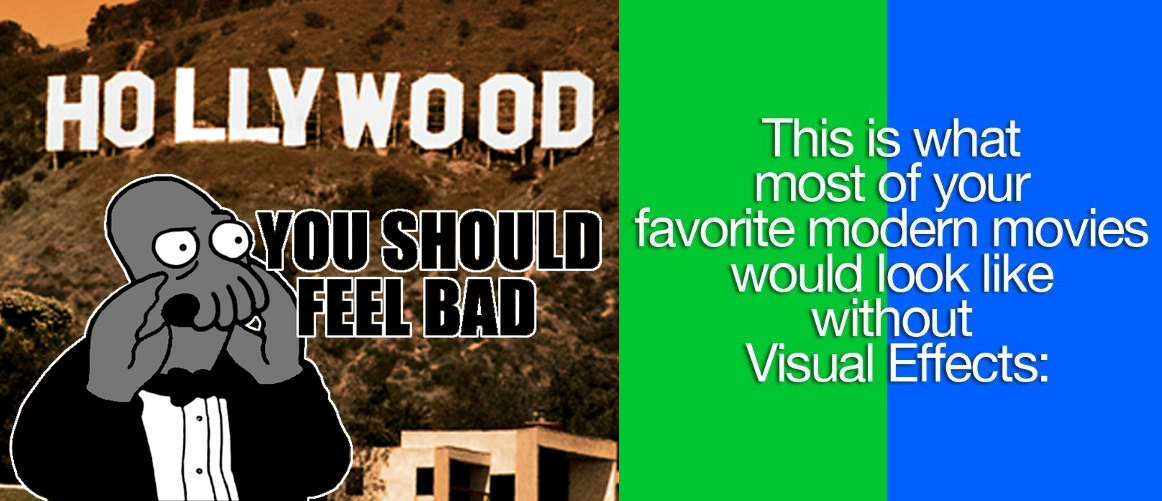
Shame Day: Hollywood and the VFX Industry

Let me begin this by saying that I did not watch the Oscars on Sunday night. I made a little joke on Facebook about how I didn’t have to because everyone else was doing it for me, and 14 people liked it, so I’m pretty funny. Anyway, let’s move this along.

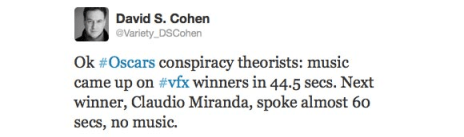
Ang Lee’s adaptation of the Yann Martel novel Life of Pi won the award for best VFX [visual effects], which I can only imagine was deserved because, well, I have not seen it. Bill Westenhofer, the VFX supervisor for Rhythm and Hues Studios, was giving his acceptance speech when he was cut off by music, as pointed out by Variety’s David S. Cohen:

Word on the street is that this is because of what he was about to talk about. See, it would be wonderful for Rhythm and Hues that they received so much promotion due to winning an Academy Award if they weren’t bankrupt. Westenhofer had planned on addressing the crisis within the industry during his speech, and was thankfully able to voice his thoughts afterwards to writer Bill Desowitz for his blog, where he said:

At a time when visual effects movies are dominating the box office, that visual effects companies are struggling.  And I wanted to point out that we aren’t technicians.  Visual effects is not just a commodity that’s being done by people pushing buttons.  We’re artists, and if we don’t find a way to fix the business model, we start to loses the artistry.  If anything, Life of Pi shows that we’re artists and not just technicians.

During his acceptance speech for best director Ang Lee forgot to thank his VFX collaborators at Rhythm and Hues, which prompted a letter from Phillip Broste, the lead compositor at Zoic Studios. It’s quite long, but I feel like quoting two of the last few paragraphs, because they really say quite a lot:

Mr. Lee, I do believe that you are a thoughtful and brilliant man. And a gifted filmmaker.  But I also believe that you and everyone in your tier of our business is fabulously ignorant to the pain and turmoil you are putting artists through.  Our employers scramble to chase illegal film subsidies across the globe at the behest of the film studios.  Those same subsidies raise overhead, distort the market, and cause wage stagnation in what are already trying economic times.  Your VFX are already cheaper than they should be.  It is disheartening to see how blissfully unaware of this fact you truly are.

By all accounts, R+H is a fantastic place to work; a truly great group of people who treat their employees with fairness and respect.  Much like Zoic Studios, the fabulous company that I am proud to work for.  But I am beginning to wonder if these examples of decency will be able to survive in such a hostile environment.  Or if the horror stories of unpaid overtime and illegal employment practices will become the norm, all because you and your fellow filmmakers “would like it to be cheaper.”

It’s no mystery that most summer blockbusters these days are built on the backs of animators, artists who spend hours upon hours trying to perfect the texture of wood grain or the way light reflects off of the ocean. Rhythm and Hues won two awards for Life of Pi, both the Academy Award and the BAFTA Award for Best Special Effects; they won both awards in 2007-2008 for The Golden Compass. This studio going bankrupt is like . . . . well . . . . an award-winning studio running out of money because they weren’t getting paid enough.

Untitled-1

People who work in VFX are just as much artists as painters, musicians, and photographers, and all have the right to be fairly compensated for their work. Good art takes time and effort, and if Hollywood refuses to give those in VFX the respect and money that they deserve then we need to let them know how wrong they are. Tell people about what’s happening, tweet with the hashtag #VFXprotest, check out VFX Solidarity International, and don’t be okay with Samuel L. Jackson talking over Robert Downey Jr. just because you like the guy as an actor:

Evan and Gordon Talk: The Purpose of College

EVAN: This week on E&GT we take a break from scrutinizing film to look back about seven or so months to a different time of our lives: college. Now that we’ve both graduated we find ourselves in a different stage of life, and it begs the question of what those four years did for us, and whether or not that’s what we wanted or expected.

GORDON: Throughout my college career, especially towards the end, I heard a recurring argument:

“College is a scam,” they said, “It’s a trap or, at very best, a waste of money. You don’t learn anything you can actually translate into a job, so either drop out while you can or don’t sweat the grades and party your buns off.”

EVAN: Wait, who is the “they” that was saying this?

GORDON: I’ve read it in various Cracked articles, I’ve seen it covered in webcomics and in comments, I’ve heard it on the radio. Not always the same tone,  but it always boiled down to that essential idea. “College doesn’t teach you what you really need to know, it just puts you in debt and wastes your time.”

EVAN: Well, I guess that really begs the question of “What is it that we’re really supposed to know?” If college is the great institution to prepare us for our lives, what should it have taught us?

GORDON: Some would argue that technical and vocational skills are what we really need. Stuff that’s meant to train us for jobs. Wrenches, not Whitman.

EVAN: Which is the sort of thing you see advertised on television late at night or in the middle of the day; schools for electricians and dental assistants and plumbers and what have you.

GORDON: Which always come across as propaganda films from a dystopic alternate timeline. They can claim to be breaking the mold all they want- I’ll still always just see Orwellian Factory-Schools designed train the subservient masses for laboring in name of supreme leader and glorious fatherland.

EVAN: Heh heh.

The contrast to this idea you brought up when first introducing this topic, that the two sides could be seen as college prepping us for our careers or making us more well-rounded individuals.

There’s obviously more to it than that, but how would you boil the latter option down to its essence?

GORDON: I’d probably cite our own alma mater’s (for me more just “mater”) slogan of “global mindedness.” The idea is to create people who are, first and foremost, thinkers. Logical and critically minded thinkers with strong creative abilities and appreciation for art and wonder. A noble enough sentiment to be sure.

EVAN: To really engage with this topic I feel like we should have equal footing, and I’ll have to give our readers a little bit of context-

I’m currently unemployed, and chose to live the latter part of 2012 living with and taking care of my grandfather, whose wife [my grandmother] passed away in September. My job hunt has only very recently started up again.

I say that because as it stands one of us is currently working and knows how his education has aided him and the other is not.

GORDON: I, unlike my Canadian counter-part, am currently employed, having worked two jobs simultaneously for a while there. Having vainly searched for a job the entire summer and most of the fall, I am now working a job helping unemployed people find work, the irony of which is not lost on me.

EVAN: And did you, my Employed-American friend, find that a degree helped you in your search for work?

GORDON: In all honesty, I’m not sure.

On one hand, I can say that certain classes I brought definitely assisted me in securing a job, but those classes really more on the whole “applied” spectrum of education. I definitely didn’t need to go to a top 3% college. People, it turns out, don’t give a crap about where you went.

EVAN: Again, I can’t comment from experience, but I’d like to say that it depends on the job.

GORDON: This is probably true. However, if you were looking for a job, which is gonna look better on a resume? Four years of college, or four years of experience in that field? From everything that I’ve seen, I’d take experience every time.

EVAN: And I agree with that entirely. I can’t count the number of want ads I’ve seen [and this is for stuff like janitorial work, and dishwasher] that require “minimum 2 years work experience.”

It’s like, heck, what was I doing in school when I could’ve been out working this whole time?

GORDON: But of course, that brings up the first question: what’s the point of college? Are we expected to choose a career path and be trained like the mindless, dehumanized proles that we are?

EVAN: Well, for me personally my career goals were more tailored to an academic setting. My personal interest in writing and editing is definitely something that can and is fostered in that environment.

That being said, if I had skipped my four years of college to simply freelance as hard as I could out there in the real world, would I be a better writer today? I honestly couldn’t tell you.

GORDON: The problem is that both sides have really, really big flaws.

On the one hand, turning college into a simple vocational training course does truly rip the soul right out of academia. It makes it just the place you go to get a desk job instead of a manual one.

On the other hand, college as it is now, while fostering intellect and creativity, is as unhelpful as it is expensive. Why put yourself over a hundred thousand dollars in debt to not get employment?

EVAN: I guess in the bigger picture, what is it that we want to do with our lives?

There are plenty of jobs out there that don’t require a college education, and that certainly benefit from hard work at an early stage.

On the flip-side, there are jobs that you simply can’t get without a degree.

GORDON: We also can’t imagine that we can simply get any job we want to begin with. It’s all a gamble. I can get a degree in biology, but that doesn’t at all mean I’m gonna get a job in biology- heck, I’d probably be lucky if I got something even close!

EVAN: Like a janitor in a pharmaceutical company. Or the guy who delivers mail to a biology professor’s house.

GORDON: Exactly. So is that it, then? It’s the whole dang system?

EVAN: I mean, yeah. I feel like more often than not that’s all it really boils down to.

GORDON: So let’s talk about an ideal universe. Or at least one that ain’t quite so screwed up. What’s college look like? Give me your take.

This does not count as an ideal college…

EVAN: It’s tricky, man- Because I would like everyone to be well-read individuals who think about the media that they access and have a fuller understanding of what makes us who and what we are as a culture, I mean, that’s the dream-

But at the same time I acknowledge that there are people who don’t care a whit about any or all of that.

And with so many people who enjoy poetry and the arts, while those are debatably important parts of society, what happens when they need to find work? How many playwrights can any single country sustain?

GORDON: My response would be “how many playwrights are there actually out there?”

EVAN: I think there’s a difference between the actual number, and how many individuals would actually like to be a part of that number.

GORDON: Touché, but we can blame certain jobs being glorified and others suffering from unwarranted contempt.

But let’s move on. College. Your college- what’s it look like?

EVAN: A thorough exploration of the ideas that created Western civilization, the one most of us live in today, because it’s extremely important to observe our origins before we can look at our present and then ahead, after that.

A strong emphasis on writing with the reason that without the ability to properly communicate our thoughts how can we even really fully think them to begin with.

GORDON: Sounds to me that you’re still leaning more towards the side of academia.

EVAN: Well, like we’ve discussed, I have a slight bias. And I suppose we haven’t really defined the question as far as the purpose of college.

GORDON: My take would a combination of both sides, with the end goal being application. We’re talking about the study of English for the purposes of applying the principles in same, either in writing or screenplays or entertainment or communication of some kind.

I feel this would allow for all the creative and academic elements while keeping the whole process grounded. No ivory towers.

EVAN: I don’t think my take discounts the possibility of lining up with what you said, but that’s a really good description of how college could and maybe should be.

That being said, we are actually overtime.

GORDON: You wanna talk about drugs and culture next time?

EVAN: I think at some point we could hand this back to the viewers, actually. We’ve really gotten a handle on this whole E&GT. I’m just not sure when or how to do so.

GORDON: The readers are slack-jawed cattle who would eat their own shoes if we told them to.

EVAN: I should probably edit that out of the final post.

GORDON: Nah, we can let ’em vote. My subject would be Drugs and Culture.

EVAN: Mine would be . . . um . . . huh. About SNL. How to fix SNL.

GORDON: Nice. Let it be so.

EVAN: Tell the nice people to have a good Wednesday, Gordon.

GORDON: Have a good Wednesday, Gordon.

EVAN: And don’t forget to vote, readers! Thanks for putting up with my co-writer!

Fame Day: StarCrafts

gjscStarCraft, undoubtedly one of the best and most important games of all time, at least according to Wikipedia. This is an RTS [real time strategy game] that commands legions of fans, and its sequel, which launched in 2010, now commands many of the same legion of fans.

But the competitive online scene for any game is not an exceptionally friendly place. There’s the stress and pressure of playing against other players to achieve ranks, and that’s not at all helped by players who are BM (bad manner[ed]). This rudeness can even be found among pro-gamers themselves (see: many of IdrA’s interactions with other players).

Enter Jonathan Burton, also known as “Carbot” and the creator of the YouTube StarCrafts. Set entirely in the world of StarCraft II each episode presents various units from the Terran, Protoss, and Zerg races engaging in a battle that is, in a word, adorable.

Here is an artist’s rendition of the Zergling as it appears in-game:

And this is a gif of what the Zerglings look like in StarCrafts:

And they’re more than just heartwarmingly lovable, they’re also hilarious. Anyone with even the slightest familiarity with the game will lose it when they see a Zealot dancing from side to side to defend a choke, and people who didn’t understand what any of those words meant are still going to chuckle when they see the baby-like Marines running [almost always away from something]. Add to that the fact that almost all of the soundbites used are from the game itself and you have a very impressive piece of work on your hands.

The following is probably the best entry into the series, and it showcases the dangers of letting yourself get . . . overzealous. Cue classic CSI scream.

What’s really great though, is how I don’t even really have to be writing this post. StarCrafts has received the recognition it so greatly deserves, and episodes have been featured fairly often on the Blizzard [the game’s creator] site. What’s even more exciting is how they were also aired during game breaks at the first ever BWC [Battle.Net World Championship] in China. A special episode was also created for NASL [North American Star League].

I strongly encourage all of you to check out a few episodes. Even if StarCraft II isn’t your thing [and really, it’s not for everybody] maybe this can help you relate just a little to all the die-hards out there. At the very least, you’ll have spent a few minutes watching an excellently produced video by a very talented man.

YouTube Channel: youtube.com/user/CarbotAnimations
Facebook Page: facebook.com/CarbotAnimations
Twitter: @CarbotAnimation
Personal Site: carbotanimations.com
Updates every Saturday

Shame Day: Greg Land

As you probably know by now, comics are very important to me. It’s good art and good writing coming together as one, the creation of a medium that’s unique among all others. The ideal combination is a skilled creative writer coupled with a hard-working, attentive artist. This pairing doesn’t always happen, though. Sometimes a writer is forced to work with Greg Land.

If you type “Greg Land” into Google the second search result that comes up is the site known only as “LAAND!“, though the name of the url more than makes up for the possible vagueness. The site is a tumblr dedicated to the man’s “generally bad artwork and the sexist ethical repercussions to hiring him nowadays.”

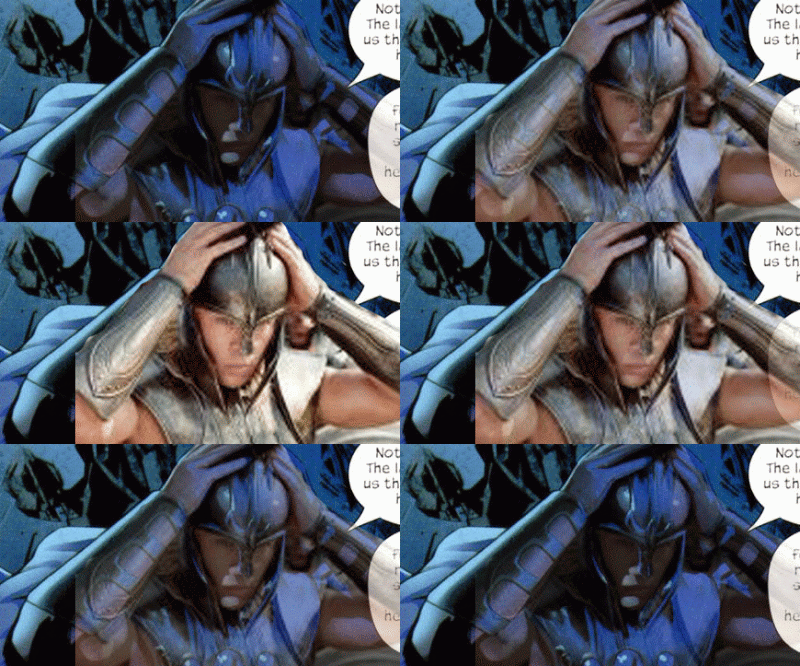
To put it plainly, Greg Land doesn’t draw, he traces. This isn’t all the time, but the fact of the matter is that he does it so blatantly and conspicuously that it is impossible to ignore. The following gif will do more to convince you of this than a thousand pages of my writing.

There is seriously no ignoring that. Clicking the image links to the blog JIMSMASH!!! which catalogues many, many more instances of his copycatting. Another fantastic gif’d example is one where, and this is practically mindblowing, Land rips off of himself. The image on the right transitions back and forth between Jean Grey and Black Canary, both drawn by Land [and for competing companies, too].

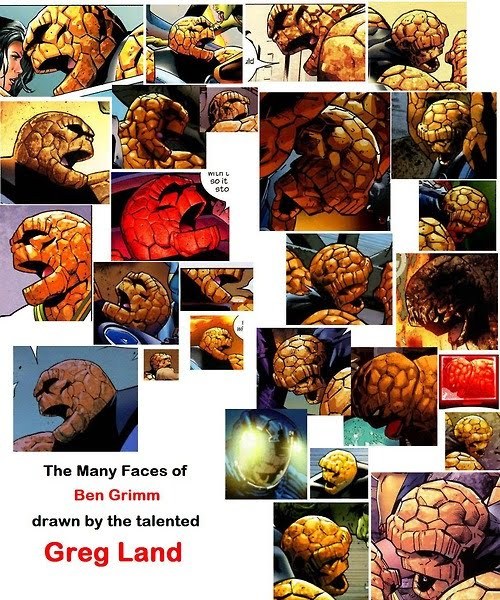
Here’s a pretty great image. It’s “The Many Faces of Ben Grimm drawn by the talented Greg Land.” He is a man who knows how to recycle.

Now all that I’ve mentioned is pretty atrocious, but here’s where it gets unbelievably worse. Observant comic fans have noticed that a lot of his references appear to be directly taken from porn films. There isn’t an argument more convincing than this picture:

What’s most upsetting [and there is a lot to get upset about] is that Greg Land continues to get work.

Marvel NOW! is the company’s decision to take their best titles and switch around talented writers and artists, creating combinations that will take their characters in new and exciting directions. Somehow Greg Land was assigned to Iron Man with writer Kieron Gillen who had this to say about him: “That’s the thing with Greg Land: his photorealistic style really pops and it’s a glamorous book in that way.”

That’s the thing, Kieron. They look photorealistic because he has traced actual photographs.

And right away, with our first look at the book’s interiors, we can already see that Land has ripped off of photos of a cosplayer, and from actually talented artist Adi Granov.

The saddest part is, Greg Land doesn’t even really know how to draw people anymore. His knowledge of anatomy is paltry at best, as helpfully illustrated in the post “Hips Don’t Lie: Pelvis? What Pelvis?” He may have been a legitimate artist once, but he’s traced so much and so often that when he does draw something freehand he can barely recall how to.

I understand that deadlines need to be made, and that in the world of comics this is not always easy to do. That should be taken into account, but this has gone on for so long it hardly stands as a defence. Greg Land should feel bad. His work is absolutely nothing to be proud of.

Fame Day: Kris Anka

Today’s Fame Day post is dedicated to the artistic genius of Kris Anka. I’ve been following his work on the superhero redesign blog Project : Rooftop for some time, and was thrilled to see him get the recognition he deserves on ComicsAlliance yesterday.

Apparently Anka had been hired by Marvel to design the costumes for the new Uncanny X-Force series, and he puts his own spin on the new roster of Storm, Psylocke, Spiral, Puck, Lady Fantomex, and their nemesis Bishop.

The biggest changes are in Psylocke losing the unitard for more of a full body suit, and Storm reverting to her 90s look with a fantastic-looking mohawk. Utility was definitely prioritized, and story as well. Working with Uncanny X-Force writer Sam Humphries it was decided that the grey in Spiral’s outfit should be opaque. This fit with the knowledge that Spiral was a character was “a little more confident in her sexuality,” without making the costume’s raciness over-the-top .

Anka’s design philosophy for the team is as follows:

The costume themes were something from the very beginning that I wanted to strive for. I felt that every costume should not only highlight the personality of the character it is wrapped around, but also of the function that the costumes will serve towards. At the end of the day, these costumes have to look like they can get into a tussle, and actually be able to handle it.

This certainly translates over to the many other redesigns that can be found on his various art blogs, and one I want to highlight is his version of the  Avengers.

From left to right: Iron First and Crystal, Ares and Ms. Marvel, Iron Man and Venus, Bucky (Winter Soldier) and Thor.

In another illustration, entitled “avengers – dont f-ck with us,” the entire team is explained in the description, with the idea that he wanted his Avengers to be “a family first off.” Ms. Marvel acts as leader, Venus as a strategic asset, Ares carries Stark-designed weapons that can collapse in on themselves. Every design point has a reason, and it all adds up to clean, recognizable  costumes.

His redesigns for DC’s trinity [Superman, Batman, and Wonder Woman] are images I go back to over and over. His vision of the the Last Son of Krypton shows that you can do away with the red shorts over blue tights, provided you break it up with a little bit of colour [the yellow buckle, the red lines on the side]. I’m looking at you, costume designer for Snyder’s Man of Steel.


All in all, Kris Anka is a name to look out for. In the ComicsAlliance interview Humphries admits that “My only wish is that we could keep going until we redesigned the entire Marvel Universe!” If only that were true.

You can find Kris Anka on various places on the internet:

deviantART: http://anklesnsocks.deviantart.com
Blogger: http://anklesnsocks.blogspot.ca/
tumblr: http://kristaferanka.tumblr.com/
twitter: https://twitter.com/kristaferanka

And don’t forget to search for his stuff on Project : Rooftop!