Tag Archives: asian

Black, Yellow, Brown, Or Normal

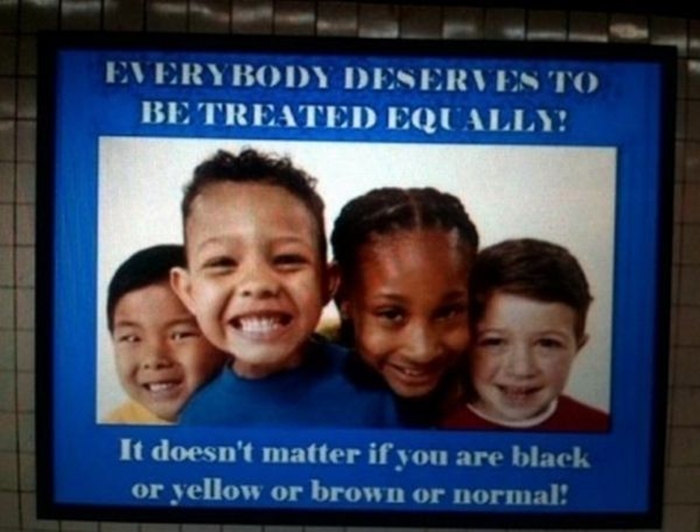
The title of this post comes from the image below, which I see floating around the internet from time to time. It might’ve been from one of Cracked’s PhotoShop contests, I really have no idea.

ornormal

The reason I’m bringing this to your attention is to underscore the fact that, by and large, “White” really does equal “normal,” at least in North America. You don’t really have to search hard to stumble across that fact, either. Think about how it works when you recount stories to other people-

Imagine you’re talking about this weird dude who sat down next to you on the subway. If he was White, would you bother mentioning that? How about if he was Black, or Asian, or Latino?

The terminology used in this gif aside, you probably never make reference to a White person’s ethnicity.

Continue reading

Evan and Gordon Talk: The Confederate Flag

GORDON: Today, we’re going to be touching on a nerve that’s still pretty raw in the US, even after a century and a half.

Specifically, we’re going to be talking about the ol’ stars and bars- the flag of the former Confederate States of America.

EVAN: I’d like to remind everyone reading this that I am a Canadian. The most experience I have with the Confederate flag is in seeing it on the top of the General Lee from the remake of, and not the original, Dukes of Hazard.

That being said, Gordon directed me towards an article written not too long ago on BBC, and there is an incredible amount of divisiveness regarding it as a symbol. Continue reading

World War Z Doesn’t Take Place In A World I Live In

Newer readers may not know this, but this is actually the third post about World War Z on this blog. I first wrote about the way the film was to deviate from the book back in 2011, while former CWR writer [who I dearly miss] Elisa briefly explored their prevalence in pop culture the year after.

So two days ago I saw the movie, and I’m not going to write the logical continuation of my first post, complaining about how the movie could have been “so much better if only. . .”

What I’m going to write about how I wasn’t in the movie.

I drew this over two years ago for an all-comics weekly publication I used to run.

And no, I don’t mean why wasn’t there a zombified version of me in the movie, because seriously if you guys didn’t know I am deathly terrified of any sort of biting reanimated corpse. What I mean is why, when I watched this movie, weren’t there any dang Asians.

Spoilers follow. Kind mild, kinda not. Continue reading

“Asian-Americans,” Admission, and Assimilation

As some of you know, I review the CBS sitcom 2 Broke Girls every Monday night. I do so mostly because The A.V. Club has dropped it from its reviewed shows, and partly because it brings in the hits. This past episode featured the following exchange between Korean diner owner [he’s Korean, the diner is not] Han Lee, played by Matthew Moy, and casting director Tom, played by Eddie Shin:

Before you ask, yes, I put the video together myself.

The reason this struck me is that it highlights a humorous turn of events that I’ve observed more than once. As I mentioned in my review, Shin’s character’s response echoes, almost word for word, that of Howling Commando Jim Morita, played by Kenneth Choi in Captain America: The First Avenger:

Yes, I put that clip together as well. Sorry for the out-of-sync sound. Continue reading

Shame Day: Microaggressions

A few weeks ago I stumbled onto a website called The Microaggressions Project and then promptly forgot about it. Returning to it tonight I looked over the “About” page, which had the following paragraph at the top:

This project is a response to “it’s not a big deal” – “it” is a big deal. ”It” is in the everyday. ”It” is shoved in your face when you are least expecting it. ”It” happens when you expect it the most. ”It” is a reminder of your difference. ”It” enforces difference. ”It” can be painful. ”It” can be laughed off. ”It” can slide unnoticed by either the speaker, listener or both. ”It” can silence people. ”It” reminds us of the ways in which we and people like us continue to be excluded and oppressed. ”It” matters because these relate to a bigger “it”: a society where social difference has systematic consequences for the “others.”

A little later on they define what “microaggressions” are, a term that was originally coined to speak about racial experiences. From the essay “Racial microaggressions in everyday life: implications for clinical practice,” which appeared in American Psychologist, Vol. 62, No.4:

“Racial microaggressions are brief and commonplace daily verbal, behavioral, or environmental indignities, whether intentional or unintentional, that communicate hostile, derogatory, or negative racial slights and insults toward people of color.”

One example of this could be a White couple walking down the street and having a Black man pass by them on the sidewalk. The woman clutches her purse tighter against her body, the subconscious idea being, of course, that Black men are prone to crime and should not be trusted.

As an Asian-Canadian I’ve experienced microaggressions plenty of times. I’ve had someone ask me if I was half-White [I am clearly not] with their rationale being that my “English was very good.” It can be an everyday occurrence for non-White people [I deign to use the word minorities, since I do believe that balance is turning the other way], and begs the question: “Why is this such a big deal?”

Writer of the aforementioned article and author of Microaggressions in Everyday Life: Race, Gender, and Sexual Orientation, Derald Wing Sue, PhD, has observed that microaggressions have actually been found to: “(a) assail the mental health of recipients, (b) create a hostile and invalidating work or campus climate, (c) perpetuate stereotype threat, (d) create physical health problems, (e) saturate the broader society with cues that signal devaluation of social group identities, (f) lower work productivity and problem solving abilities, and (g) be partially responsible for creating inequities in education, employment and health care.”

In other words, a Black or Latino man being stopped for a “random vehicle check” by police could be upset, and may even be accused of overreacting. Maybe they should simply be used to this and not let it bother them. The truth is that it makes them feel, even if only subconsciously, like second-class citizens. It’s true in a case as blatant as this one, and in an as subtle an action as hanging a Confederate flag or  having a Native American stereotype as a high school mascot.

To broaden this to the scope that The Microaggressions Project seeks to attain, microaggressions can include people saying to a person with Asperger’s, with no ill-intent whatsoever, “That you seem so normal!” It can be a 17-year-old girl being told by her gynecologist that just because she has access to birth control pills doesn’t mean she can just sleep around.

Microaggressions work in every direction. It’s like going to a Vietnamese restaurant and being given a fork and spoon instead of chopsticks because you’re White and not Asian. Microaggressions are built on assumptions and can make people painfully aware of who they are. They are rarely meant to offend, but often do. 

It truly is a shame that so much of the time we send out microaggressions without so much as a second thought, and then defend ourselves by deeming the offended to be “too sensitive.” While we won’t always be aware of how our words or actions can harm others, we can at the very least listen to the people being hurt, and in doing so try to lessen the presence of microaggressions in our society.

Shame Day: Porn and Racism

Let’s be honest, porn is not the highest art form to begin with. That being said, it’s 2013, people. It is the 21st century and I expect better from all of us, even those in San Fernando Valley [lovingly dubbed “Porn Valley” by those in the industry].

glenntwdNow, I’m going to assume that most of you are familiar with AMC’s The Walking Dead [I’d be surprised if you weren’t, really]. If not, what you need to know is that it features among its core cast Glenn, who is played by Korean-American Steven Yeun]. A cast member of the original comic book series, Glenn makes his entrance by saving Rick, the protagonist of the series, and goes on to be an all-around successful human being [which, in a zombie apocalypse, equates to being a badass]. So that’s what you have to know about that.

What you also have to know, if you weren’t aware, is that porn studios churn out parodies like nobody’s business. They’ve parodied everything from beloved childhood cartoons [The Flintstones: A XXX Parody] to a 1976 DC/Marvel comic books crossover event [Superman vs Spider-Man XXX: An Axel Braun Parody]; nothing is sacred. It should come as no surprise, then, when they decided to take a stab at adapting AMC’s The Walking Dead [if you watch it, you’d know why I have to write it out like that].

Porn star Danny Wylde was cast to play Glenn in the as-of-yet untitled film. In it, he will be appearing as follows:

Continue reading