I don’t normally get that angry about things. Disappointed, sure. Upset, often enough. But really, truly angry? That emotion is normally reserved for pure, undistilled racism.
Yesterday I wrote about the production history of Red Dawn, and mostly talked about how the plot was immensely improbable and how the film industry is all about money, et cetera. What I did not at all dwell on was the potential of the film to bring out racism in people, similar [but not at all comparable] to the abuse of Middle Eastern Americans after what happened on 9/11.
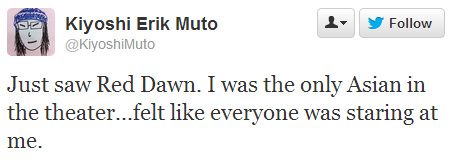
On Facebook Racebending.com directed me to Tumblr user manilaryce, who compiled a number or racist tweets by people who had just watched Red Dawn. I have embedded the image below and on the right.
The following are a few of the tweets that particularly stood out to me:
Kinda wanna kill some Asians right now and defend the homeland, thank you Red Dawn for sparking some patriotism in me
The only reason Im going to see red dawn is cause there’s sexy ass guys running around with guns killing Asians my type of movie;)!
I now hate all Chinese, Japanese, Asian, Korean people. Thanks. #reddawn #amazingmoviedoe
Red dawn was sickkk..just another reason why to hate asians.
One of the tweets, by @elysse223, reads “I usually love Asians, but in Red Dawn I found them terrifying.” After reading that I almost immediately felt worse, like both me and everyone else like me had been transformed into inhuman movie monsters.
The only consolation I can take in all this is that the film is being almost universally panned. Liam Lacey, reviewing the film for The Globe and Mail, says “Red Dawn panders to the worst kind of racist and jingoist impulses, though the movie is so preposterously insincere, it feels like those adjectives should be in air quotes.” Over at Indiewire Gabe Toro describes the film as “stitched together with scotch tape and falling apart at the seams, letting casual racism and misanthropy to spill out the sides.”
I honestly don’t have a lot to say except that I’m angry, hurt, and somewhat unsurprised that this is what audience members all over America are choosing to take away from this movie. I am Asian and I am not evil. I do not want to take over America. I do not want to ever feel like this:
I’ve begun seeing trailers on TV, and apparently it hit theatres two days ago, so I figure now’s as good a time to talk about Red Dawn as any.
For those of you who don’t know, Red Dawn is a remake of the 1984 film of the same name. In the original the United States is invaded by both the Soviet Union and its Cuban allies. A group of plucky high schoolers bands together to form a guerrilla fighting force, named the Wolverines after their high school mascot.
In remaking the film the studio, Metro-Goldwyn-Mayer (MGM), realized that they needed to modernize the invaders in light of the current political climate, and chose China. Keep in mind that in the original film that country was apparently America’s only ally, with the following exchange taking place:
“…Well, who is on our side?” “Six hundred million screaming Chinamen.” “Last I heard, there were a billion screaming Chinamen.” “There were.”
EVAN: Today’s topic is something that I hold very near and dear to my heart. Years of research on the topic has made me witness to all of the arguments that can be used against needing to have racially accurate casting, and because of this I’m going to propose something a little different
GORDON: Namely?
EVAN: That I switch sides for this conversation, and speak out against it.
GORDON: Intriguing. Mind starting us off with the first salvo?
EVAN: Statement: Racially accurate casting is not important. The most talented actor should be the one who gets the role.
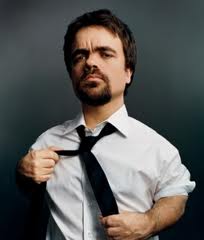
GORDON: Doesn’t appearance play a key role in what makes an actor good? Peter Dinklage is good, but you wouldn’t really find him believable playing Abraham Lincoln or Kareem Abdul Jabbar.
EVAN: In this case his stature, not his race, is what would keep him from playing either role in a convincing manner.
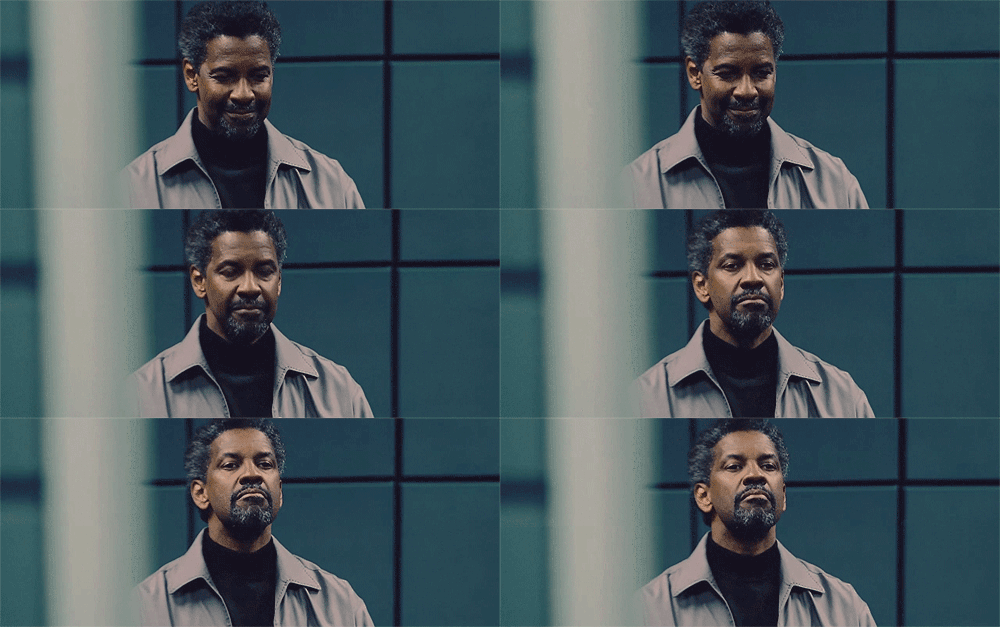
GORDON: But isn’t that essentially the same issue? Imagine the great Denzel Washington playing Lincoln- you’d be sitting there the entire time, no matter how much of a powerhouse Washington would be, taken out of the film because you have to deal with a black guy playing a white guy during the height of the civil war.
In any piece of film where you’re expecting realism, you’re going to expect the actors to conform to the styles and facts of the time. If you portray Georgia in the 1960s, you’re obviously not going to have a largely black cast portraying the upper class or if you were to set the scene in early 1900s Ghana you wouldn’t have a cast comprised of Caucasians. It wouldn’t make sense, no matter how good they are.
EVAN: If anything, Cloud Atlas at least proves that a talented actor can portray whoever they like, given an adequate amount of makeup. Halle Berry plays a Korean Man in the film, and does so in a convincing fashion that doesn’t at all take viewers out of the film in the least.
GORDON: I haven’t seen that film, so I can’t speak to the use of the actors for the parts they play. From my understanding that was a work of fantasy (or science fiction, I’m only going off what I can gather from the trailers). And in one or two movies, it’s probably not a big deal. After all, Cate Blanchett played Bob Dylan.
But imagine this applied to each and every movie, it simply wouldn’t work. Realism would deteriorate- and this would be especially detrimental in a film trying to deal directly with race relations.
EVAN: I personally feel that allowing any race to play any other speaks much more in terms of race relations. That’s a world where colour is a non-issue because it shouldn’t be.
EVAN:I’m dying, Gordon. My life force is seeping out of me.
GORDON: Try to stick with it…
GORDON: And while it’s true that race ought to be a non-issue, that’s simply not how things are or have been in the past. Using black actors to play black characters and white actors to play white characters is fundamental to demonstrating past inequity and injustice with American racism and segregation. And that’s just one element.
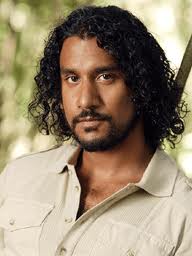
Let’s talk about Indians playing Arabs. It happened in Lost and it happened in Community (with multiple actors), but Arabs look nothing like Indians. Indian actors are used simply because they fit the stereotype of what most people think an Arab looks like. It perpetuates an inaccuracy.
EVAN: Isn’t the fact that the role is an Arab important a large enough step? This is a minority with a major role on a TV show, and an opportunity for minority actors to step up, which they have in both cases.
GORDON: Barring Monk and Arrested Development, when’s the last time you saw an Arab actor? I’m not trying to argue against Indian actors, or actors of Indian heritage getting roles, but for the purpose of portraying the world as it is (or at least with some realism) we should have actors with some vague resemblance to the people they’re portraying on film.
After all, would you not be thrown off by guys with German accents playing French resistance fighters during WWII?
EVAN: If they had German accents then they simply wouldn’t be right for the role, which brings me back to my first point.
GORDON: Which, by proxy, brings us back to my first response. Ethnicity (depending on the situation) is just as valid an element of a guy’s candidacy for a role dealing directly with ethnicity as accents, or height, or any other factor (actual talent, of course, being the most important).
Vincent Cassel should probably not play Malcolm X. Adrien Brody should probably not play the Queen of England, though that would be pretty funny.
EVAN: If we’re going to stick with believability, than why is it so important that Indians not play Arabs? No one has ever made a big deal out of this, so clearly people believe that they are what their role calls them to be-
Likewise a Korean can to play a Chinese person can play a Japanese person. Audiences can’t tell the difference and believe that they are whatever the role is, and that’s okay.
GORDON: But Koreans do not look Chinese, Chinese people don’t look Japanese, and Arabs and Indians certainly don’t look like each other. The only reason this happens is because most people either don’t know (partly due to this inaccurate casting) or don’t care (in other words, all non-whites are basically one homogenous mass.
If all your life, you had seen black men and been told “these are Uzbekistanis,” then you’d go your whole life simply assuming that Uzbekistanis are, in fact, indiscernible from guys from Benin.
Your ignorance should not dictate which actors get which parts. Further, no Uzbekistan could really ever get a chance to play and Uzbekistani because of the years of misinformation.
EVAN: But there is a huge difference between a black person and an Uzbekistani. The examples I made have similarities that the example you used clearly does not.
To be such a stickler for accuracy is the other extreme, and just as wrong. You wouldn’t get someone with mental problems to accurately portray a character with mental problems, that just doesn’t make sense. Race should matter if it is noticeable, and like I said in the case of shows like Lost it is not.
EVAN: The logic above was used against me by someone in a thread on Reddit You can check out our exchange here.
GORDON: Granted, my example was extreme, but that doesn’t change the point. Even though a Thai guy and a Japanese guy share more similarities than a Beninese guy and an Uzbekistani guy, there are still distinct differences between people from Thailand and people from Japan.
With regards to being a stickler- I admit, as I have previously, that you don’t have to have an exact replica of the character you’re trying to portray. Jet Li, I imagine, is doing pretty well for himself, and I still wouldn’t doubt his ability to portray a poor man very well. However, while you don’t need to be point for point, you do need to have some general similarity. That’s why we don’t have Emma Stone portraying Fidel Castro.
EVAN: I feel like the extremeness of your examples is damaging your point. If we’re sticking with race we should do that, and not bring in gender.
GORDON: It’s to demonstrate the underlying point in all of this: Verisimilitude. Realism. Accuracy.
EVAN: And since you said “you don’t have to have an exact replica of the character you’re trying to portray” why isn’t it okay to have Naveen Andrews play Sayid Jarrah on Lost?
GORDON: But the distinction is great enough. The accent is Indian, not Iraqi. Naveen does not look Iraqi. When an actor neither looks nor sounds like the character he is meant to portray, we have a problem.
EVAN: So if Jarrah had managed to sound Iraqi, would that have helped?
GORDON: It would’ve added to the realism and accuracy, yes. But that doesn’t change the fact that he’s very clearly Indian, not Arab.
EVAN: Clear to a very select few. As mentioned, people didn’t seem to notice for the most part.
GORDON: Clear to a very select few. As mentioned, people didn’t seem to notice for the most part.
Most people don’t know what an Arab looks like. Do they know that Monk is Lebanese? That Cousin Maeby is Iraqi? Most do not. Ignorance is not an excuse for inaccurate casting.
EVAN: And that brings our exhausting exchange to an end. Trying to argue for something I so strongly disagree was one of the more difficult things I’ve ever done. I hope that in reading this you were able to see the holes in my argument and the truth in Gordon’s.
GORDON: Booyah.
The past few paragraphs alone have had the same effect on Evan as that life-sucking device in the Princess Bride. Commend him for biting the bullet.
And as for our discussion next time, your options are: What do we make of the upcoming Star Wars sequel?
EVAN: And. . . how about . . . How much artistic merit is there in a show like Adventure Time?
GORDON: I like it.
And to our beloved and devoted followers (who would organize into a vicious and unholy army of darkness if we ever were to ask it of ’em), feel free to suggest your own topic down in the comments section.
Despite our focus on American issues, we here at Culture War Reportersrecognize that in our world of ever-shrinking borders, there’s plenty more out there than just the cloudless skies of Nevada or the homeless-packed streets of Toronto (Evan, seriously- if the healthcare system’s so good, why does Canada have so many crazy people?).
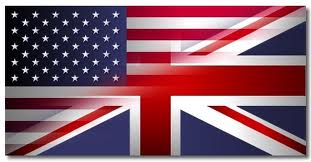
Today we turn our attention to our pasty cousins across the pond, more specifically, their TV, excuse me, “Telly” (this is why you lost your empire- well, this and genocide), and how it stacks up next to ours.
CGI and Production Values
Now I have to admit- I haven’t extensively researched British and American television financing, nor have I had a chance to compare the two, taking into consideration differences in the economy and advertising fees over the past couple decades.
What I’m saying is- I’m not an expert.
That said, I don’t need to be an architect to tell you that chances are pretty good that a lot less money was put into making a tent than a condo. British TV shows, put bluntly, just seems to be vastly less funded than their American counterparts. Just take a look at this scene from America’s Battlestar Galactica.
Pretty intense, right? If there’s any poor-quality, it’s probably from the YouTube video, rather than the actual series.
Now look at this clip from Britain’s Doctor Who.
Way worse. And oddly enough, Doctor Who has a bigger fanbase than Galactica, and despite it’s ever-increasing popularity, still has to deal with props dug out of someone’s kitchen drawers. I’m not saying Doctor Who is bad- it’s not. It’s really good- only it’s tough to really feel the full effects of a horrific reveal when the monstrous alien that’s been lurking the shadows until now makes your sock-puppets look scary by comparison. I can’t claim to know the reason for it, and I’m not putting the Brits down for it- I’m simply saying that funding- especially in CGI- appears to be a significant difference between the worlds of British and American TV.
Pretty Faces
You’ve probably heard jokes cracked about this. Not the “British are ugly” or the “British have bad teeth” jokes- the fact that the people on British television have the audacity to look like the people you’d see on the street.
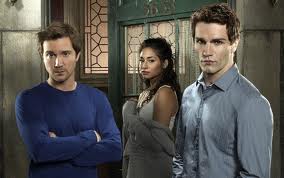
That’s not to say the Brits don’t share the American weakness for fantasizing and glamorizing each and every facet of life, but it’s pretty clear that it’s nowhere near on the scale we have here in the US. Here- take a look at the leading characters of the American version of Being Human.
The guy on the left is decently attractive, as is the girl, and the guy on the right looks more or less like a life-sized Ken doll. Idealized people- no question about it. Now look at the same characters in the British original:
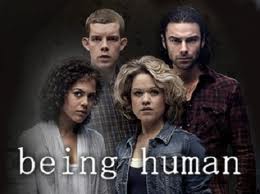
There’s not a huge difference between the girl (the blonde girl is another character- ignore her), and the dark haired guy certainly isn’t his American counterpart and stop looking at that guy’s ears! Yes, they’re huge- they’re gargantuan– and no, this isn’t just an unflattering photo- they actually are trying to escape his head in the first three seasons.
The point is, when it comes to their actors, the British are- well, appear to be- considerably less shallow. They don’t need a couple of supermodels to tell a compelling story of murder, secrecy, and perversion- and speaking of which…
Raunch Codes
Watch this clip- but before you do, get all children and Weslyans out of the room.
Pretty nasty stuff, right? Don’t say we didn’t warn you!
People complain that American media is nothing but sex and violence, but believe me- those Axe commercials are prudish compared to the Brits (and indeed- most of Europe). We may give the Brits a run for their money when it comes to blood and gore but never will we compete with them when it comes to explicitness of this degree. It’s almost to the point where it’s not even repulsive- you’re just impressed at how logic-deafeningly far they take it.
But only almost.
The Dying and the Dead
It’s been said that the difference between British comedies and American comedies is that American comedies begin with everything going wrong and end with everything being fixed, while British comedies begin with everything going right and end with everything falling apart. I wouldn’t call a story where everyone dies of scurvy at the end a comedy, but then again, I don’t whittle my life away on a miserable island full of alcoholics and skinheads.
I can say that because the only people who hate the British more than the Irish, the Kenyans, the Indians, the Chinese, the Australians, the New Zealanders, Iranians, and the Egyptians are the British themselves.
The simple fact of the matter is that there is this viciously self-deprecating mentality that pervades every element of British culture (barring fox hunts, which are just weird) that couldn’t be further removed from the general sense of optimism that you tend to find in America. Just take a look at British crime series.
Now I’ve seen quite a few, and while this certainly isn’t universally true, what I’ve typically found is that British murder mysteries focus on the whole “Whodunnit?” element, whereas American murder mysteries either have a “How’d he do it?” or a drive to keep the murderer from murdering again. Gross over-generalizations, I know, but it does seem to be true that American crime series episodes end with the detectives patting each other on the back for having done justice, while British crime series episodes end with the detective giving some despairing monologue about the tragic depravity of all mankind.
Because that’s a very depressing (and therefore, British) way to end the post- allow me offer this:
To say I’ve been ragging a bit on the British would be an understatement, and no- despite our attempts to be unbiased, we here at Culture War Reporters don’t care much for contemporary English culture. That established, there may very well be something to be said for the Brit’s here. Is it pretty? Not remotely, but for all the weirdness (from our perspective) that British TV has to offer, it can’t be denied that it’s simply more “real” than American TV. The sets aren’t shiny, the people aren’t (exclusively) gorgeous, and a stories of sin and murder actually recognize human suffering. There’s certainly a lot from British TV that merits imitation here in America.
Except for sexually explicit sausage commercials. **** that.
This is part of a multi-blog series about Race and Comic Books put together by RodtRDH. Justin Tiemeyer has written the first of many such posts [about black comic book characters] on his blog, Cavemen Go.
One of my favourite blogs [you can see it in the sidebar] featured an article sometime ago titled “On Marvel, Mandarin, and Marginalization.” The gist of said article asking why an Asian villain like the Mandarin is being portrayed before any Asian American lead heroes. I’m going to start my defence with the quotes racebending.com used:
“There are certain fears and certain strengths the character evokes that are applicable, but of course you have to completely remove any of that short sighted cultural ignorance that leads to any sort of bigotry in the storytelling. That isn’t to say those fears and shortcomings of Iron Man as relating to that character aren’t relevant…He was based in China which was then mysterious because it was Red China. Today China is mysterious in other ways because it’s Global China.”
– Jon Favreau, director of Iron Man and Iron Man 2 to CHUD in 2006
“You have to do The Mandarin. The problem with The Mandarin is, the way it’s depicted in the comic books, you don’t want to see that.”
I’m not going to skirt around the fact that the character was indeed rooted in the “yellow peril” that was rampant at the time of his inception, but the following images should paint a picture of his evolution since that time.
From left to right: The Mandarin as he first appeared in the 60s, then the 90s, and the present day.
So Kim Jung Il has died, purportedly, and I have no other choice but to write about it. Not really as a political analyst (okay not at all as a political analyst), but just as someone who kind of watches world events like sports, in a nihilistic sort of way.
Right around 10:20pm EST the Associated Press announced that North Korea said that Kim Jong-il was dead. ABC and the NYT quickly reported the story, saying that Korean Central TV reported: “Our great leader Comrade Kim Jong-il passed away at 8:30 a.m. on Dec. 17.” 8:30am in North Korea translates to 6:30 pm EST on Friday.
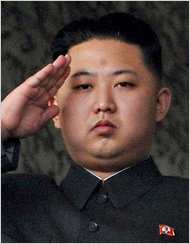
Kim Jong-un, the cheerful new dictator of North Korea
So what on Earth is going to happen to North Korea? Will the dictator’s death grip on the media continue? Kim Jong-il did some crazy things – Kijong-dong, for one, which was an entire empty city built in view of South Korea in the 50s to encourage defection. There was the claim that he was born under a double rainbow, that he scored 38 below par on his first golf game (and then promptly retired), and that he was a “worldwide fashion icon”. The idea of truth coming out of North Korea is roughly equivalent to tactful and thoughtful speech coming out of Rush Limbaugh. The whole event of Kim’s death and the transfer of power to Kim Jong-un is steeped in uncertainty. Heck, even the New York Times doesn’t know exactly how old Kim Jong-un is.
So the world is just kind of freaking out this morning. China’s pretty nervous. Everyone’s wondering what the long-oppressed people of North Korea are going to do – is the regime’s cult so ingrained in people’s heads that they will complacently move right on to Kim Jong-un as the most handsome and benevolent evil dictator ever? This event passing with no unrest in North Korea would be the most depressing thing ever.
Of course, this event causing violence between the North and South Koreas which ended up in someone (North Korea, the US…) using an atomic bomb would also be pretty depressing. The US, China, Japan, and Europe are all kind of staring at North Korea the way one would stare at a baby that just picked up a carving knife. North Korea test-fired missiles right before they announced Kim Jong-il’s death, so that’s not exciting at all. Stocks in China fell significantly. South Korea placed all of its military units on alert.














 Culture War Reporters