Tag Archives: comedy

Evan and Gordon Talk: Stand-up Comedy, How Far Is Too Far?

EVAN: Hey, readers. Welcome back to yet another segment of “Evan and Gordon Talk.” This week we’re going to be discussing the limits of stand-up comedy, specifically in terms of crassness. How far, exactly, is too far?

GORDON: I’m gonna come on out swinging say that there’s really no such thing as “limits,” just inappropriate timing and venue.

EVAN: Alright, well, let’s take an example and see if you can provide an appropriate time and venue. To retread some well-worn territory, how about rape jokes?

GORDON: Before our readers jump to conclusions, please here me out-

Rape jokes aren’t alone in being terrible things. We have murder, the Holocaust, disease, Darfur- you name it. Yet we set rape aside. My best estimation for why that is for us (in the west) is that it’s a clear and present issue- as opposed to starvation and disease. It is, therefore, something that’s close to home- something that we don’t typically joke about on the grounds that it’s, well, “real,” for lack of a better term.

Now I’d be hard pressed to imagine a scenario in which a rape joke would be okay. But then again, if I were living in the late 1940s, I believe I’d be just as hard pressed to imagine a situation in which a Holocaust joke would be funny.

EVAN: I’m still waiting for an answer to the question.

I’ve got a video that my brother is quite fond of where Ricky Gervais jokes about Hitler and Nietzsche, and it’s actually quite funny, and does involve the Holocaust. I suppose it could be argued that time has allowed us to not turn to the oft-used cry of “too soon.” But, again, I am interested to know about a way rape jokes might be considered not extremely inappropriate.

GORDON: My point is- I can’t see the future; none of us can. The fact that I can’t imagine a venue in which such a thing would be funny doesn’t mean that it, like the Holocaust or any terrible event, won’t be joked about years from now and be just as funny as that Ricky Gervais bit.

You see what I’m saying?

EVAN: I think what needs to be discussed is the difference between funny and appropriate.

GORDON: Touché. But before we get into that, let’s clarify our terms here.

We’ve been saying “rape joke,” but the truth of the matter is, we’re not talking about “rape jokes”- we’re talking about ones specifically pertaining to women, aren’t we? I mean, how many “Don’t drop the soap!” jokes do we hear and think nothing of?

*For clarification to our readers- what got Evan and I thinking about this was a Tosh scandal– look it up.

EVAN: Okay, so specifically jokes regarding male on female rape, to clarify. Go on.

GORDON: Well- doesn’t that force us to rethink the entire question? With that in mind, do we have to ask rather “Who can be joked about?”

EVAN: I think that’s a pretty vague question. We can joke about a lot of people: kids, politicians, Americans-

There’s a difference between a priest walking into a bar and a woman who’s been sexually assaulted.

GORDON: Let me offer you this, for clarification. There’s a bit by (awesome) comedian Aziz Ansari which includes a rape joke. In this case the “victim” in the situation is a man. There was no outrage.

Contrast this with the outrage that surrounds rape jokes regarding women. Why is there this difference in public reaction?

EVAN: Again, what I’m asking is to specifically discuss an appropriate time and venue for the type of joke already clarified. To explore the difference is to go back to what you said earlier, that rape for us in the West is more “real” than genocide or drought, etc.

You explained it yourself fairly quickly, I think. For most of the public rape of men is not as “real” as the rape of women.

GORDON: Then, as awful as it sounds to us now, isn’t it possible that in a world where female rape is as “real” as the Holocaust (or any of the other stuff terrible stuff we joke about today) it’d be just as tame as the aforementioned jokes?

EVAN: But all you’re saying is that there’s a possible future in which rape jokes are acceptable. As an “appropriate time and venue” the same can be said of everything from cannibalizing your own children to bestiality.

I’d also argue that the aforementioned jokes aren’t classified as “tame” even today. Just less sensitive.

GORDON: Fair enough. I guess I should restate my position.

The issue isn’t with what gets put into a joke, so much as who or what is being mocked. Mocking a victim- be it a murder victim, rape victim, holocaust victim- that’s not cool.

EVAN: Agreed.

GORDON: But mocking murder? Mocking racism? (I refer you all back to an earlier discussion of ours on “ironic racism.”) You get what I’m saying here?

EVAN: Let me try to reiterate what you’re saying- We can mock an action, just not the victim?

GORDON: Absolutely- as we wound up concluding in our discussion of “ironic racism,” the point is to satirize/mock/etc. racism for the hideous and idiotic thing that it is.

EVAN: As often exemplified by comedians such as Russell Peters and Dave Chappelle.

GORDON: Exactly.

I could cite similar jabs at that Arch-Dirtbag Todd Akin by political comedians and satirists who used rape NOT to make fun of rape, but to make fun of Todd Akin’s mind-boggling moronic views on the very same subject, and NOT to make fun of rape victims.

EVAN: That’s a really great way of putting it.

And I think this is the first time we’ve actually really broken down a topic, instead of following rabbit trails and culminating with me mocking you for your human failings.

GORDON: You’re just losing your touch.

EVAN: Hey, this has been a fairly deep and legitimate conversation.

GORDON: That it has.

EVAN: And we are now reaching the end of our allotted 45 minutes. The two choices for next week’s topic are:

GORDON: What’s the greatest flaw of our generation?

EVAN: And “Television Wars.” i.e. all of the shows that feel the need to just slap words in front of the word “wars” and have at it.

Once again, thank you all for reading. Feel free to stick around and check out other posts, and definitely come back next Wednesday for our next installment.

British Television VS American Television

Despite our focus on American issues, we here at Culture War Reportersrecognize that in our world of ever-shrinking borders, there’s plenty more out there than just the cloudless skies of Nevada or the homeless-packed streets of Toronto (Evan, seriously- if the healthcare system’s so good, why does Canada have so many crazy people?).

Today we turn our attention to our pasty cousins across the pond, more specifically, their TV,  excuse me, “Telly” (this is why you lost your empire- well, this and genocide), and how it stacks up next to ours.

CGI and Production Values

Now I have to admit- I haven’t extensively researched British and American television financing, nor have I had a chance to compare the two, taking into consideration differences in the economy and advertising fees over the past couple decades.

What I’m saying is- I’m not an expert.

That said, I don’t need to be an architect to tell you that chances are pretty good that a lot less money was put into making a tent than a condo. British TV shows, put bluntly, just seems to be vastly less funded than their American counterparts. Just take a look at this scene from America’s Battlestar Galactica.

Pretty intense, right? If there’s any poor-quality, it’s probably from the YouTube video, rather than the actual series.

Now look at this clip from Britain’s Doctor Who.

Way worse. And oddly enough, Doctor Who has a bigger fanbase than Galactica, and despite it’s ever-increasing popularity, still has to deal with props dug out of someone’s kitchen drawers. I’m not saying Doctor Who is bad- it’s not. It’s really good- only it’s tough to really feel the full effects of a horrific reveal when the monstrous alien that’s been lurking the shadows until now makes your sock-puppets look scary by comparison. I can’t claim to know the reason for it, and I’m not putting the Brits down for it- I’m simply saying that funding- especially in CGI- appears to be a significant difference between the worlds of British and American TV.

Pretty Faces

You’ve probably heard jokes cracked about this. Not the “British are ugly” or the “British have bad teeth” jokes- the fact that the people on British television have the audacity to look like the people you’d see on the street.

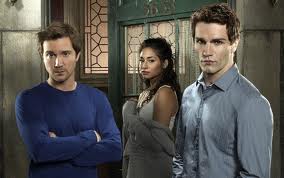
That’s not to say the Brits don’t share the American weakness for fantasizing and glamorizing each and every facet of life, but it’s pretty clear that it’s nowhere near on the scale we have here in the US. Here- take a look at the leading characters of the American version of Being Human.

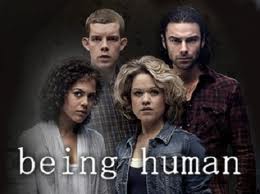
The guy on the left is decently attractive, as is the girl, and the guy on the right looks more or less like a life-sized Ken doll. Idealized people- no question about it. Now look at the same characters in the British original:

There’s not a huge difference between the girl (the blonde girl is another character- ignore her), and the dark haired guy certainly isn’t his American counterpart and stop looking at that guy’s ears! Yes, they’re huge- they’re gargantuan– and no, this isn’t just an unflattering photo- they actually are trying to escape his head in the first three seasons.

The point is, when it comes to their actors, the British are- well, appear to be- considerably less shallow. They don’t need a couple of supermodels to tell a compelling story of murder, secrecy, and perversion- and speaking of which…

Raunch Codes

Watch this clip- but before you do, get all children and Weslyans out of the room.

Pretty nasty stuff, right? Don’t say we didn’t warn you!

People complain that American media is nothing but sex and violence, but believe me- those Axe commercials are prudish compared to the Brits (and indeed- most of Europe). We may give the Brits a run for their money when it comes to blood and gore but never will we compete with them when it comes to explicitness of this degree. It’s almost to the point where it’s not even repulsive- you’re just impressed at how logic-deafeningly far they take it.

But only almost.

The Dying and the Dead

It’s been said that the difference between British comedies and American comedies is that American comedies begin with everything going wrong and end with everything being fixed, while British comedies begin with everything going right and end with everything falling apart. I wouldn’t call a story where everyone dies of scurvy at the end a comedy, but then again, I don’t whittle my life away on a miserable island full of alcoholics and skinheads.

I can say that because the only people who hate the British more than the Irish, the Kenyans, the Indians, the Chinese, the Australians, the New Zealanders, Iranians, and the Egyptians are the British themselves.

The simple fact of the matter is that there is this viciously self-deprecating mentality that pervades every element of British culture (barring fox hunts, which are just weird) that couldn’t be further removed from the general sense of optimism that you tend to find in America. Just take a look at British crime series.

Now I’ve seen quite a few, and while this certainly isn’t universally true, what I’ve typically found is that British murder mysteries focus on the whole “Whodunnit?” element, whereas American murder mysteries either have a “How’d he do it?” or a drive to keep the murderer from murdering again. Gross over-generalizations, I know, but it does seem to be true that American crime series episodes end with the detectives patting each other on the back for having done justice, while British crime series episodes end with the detective giving some despairing monologue about the tragic depravity of all mankind.

Because that’s a very depressing (and therefore, British) way to end the post- allow me offer this:

To say I’ve been ragging a bit on the British would be an understatement, and no- despite our attempts to be unbiased, we here at Culture War Reporters don’t care much for contemporary English culture. That established, there may very well be something to be said for the Brit’s here. Is it pretty? Not remotely, but for all the weirdness (from our perspective) that British TV has to offer, it can’t be denied that it’s simply more “real” than American TV. The sets aren’t shiny, the people aren’t (exclusively) gorgeous, and a stories of sin and murder actually recognize human suffering. There’s certainly a lot from British TV that merits imitation here in America.

Except for sexually explicit sausage commercials. **** that.

“Rape”: A Continuation

The second post I ever wrote on this blog was about the word “rape,” and since then it has not ceased to be an issue. A number of events have occurred in the past couple of months, and re-reading many of them this week has reminded me what a big deal it can be.

About a month ago stand-up comedian Daniel Tosh was doing a show when an audience member commented on the bit he was doing. He had been going on about how hilarious rape jokes were [his position: always], when the woman interrupted him by yelling “Actually, rape jokes are never funny!” She reports that Tosh responded with the words: “Wouldn’t it be funny if that girl got raped by like, 5 guys right now? Like right now?”

John Seavey, one of the writers on Mightygodking, wrote a response to what happened, titled “From the “How To Be A Decent Human Being” File….” In it he decried Tosh’s response to the woman, and basically lay down that freedom of speech or not, threatening someone sexually is not something you ever do.

I talked to Gordon about this yesterday, and not to turn this into another “Evan and Gordon Talk” post, but I had to add just a little of our conclusion to this one:

[after agreeing that probably no one in the audience actually took Tosh’s words “seriously.”]

EVAN: I mean, I guess we can both be on the level that to at least one member involved, Tosh, it was not a threat.

GORDON: Agreed. You also promised to crap in my bed. [I will not deny this -E.]

EVAN: Valid, but 1/5 of all Gordons don’t have their beds crapped in.

Similar to my first post on the word, there are those out there who believe that this is all a matter of sensitivity. Comedians like Louis C.K. have defended Tosh‘s right to free speech. Others on the internet have taken more creative avenues to back up the “rape joke” that was made [warning for language and content]:


The video, for those who don’t feel like or want to watch it, is a press conference with the character “F-ck Bot 5000.” He answers that rape jokes are off limits, while jokes about “9/11,” “dead babies,” and “making fun of autistic children” are perfectly acceptable. The point being, from what I can tell, that people are being overly sensitive about a particular buzzword, but letting these other topics slide completely.

Then, of course, there’s the whole “legitimate rape” thing. On August 19th Todd Akin, Republican nominee for the state of Missouri Todd, told KTVI-TV that “First of all, from what I understand from doctors [pregnancy from rape] is really rare. If it’s a legitimate rape, the female body has ways to try to shut that whole thing down.”

Now I’m no Biology major, but I have friends who are, and none of them can back up his claims. His words have, of course, created quite the uproar on the internet. Jezebel compiled a very thorough “Official Guide to Legitimate Rape,” which compiles the ways in which the word and act have been portrayed in past years. I strongly recommend checking it out.

Finally, game designer James Desborough wrote a post this past June entitled “In Defence of Rape.” After admitting that the title is instigative at best, he, and this is a direct quote, states “Rape or attempted rape is a f-cking awesome plot element, one of many.”

Gordon and I talked about this one as well, and the issue is, at the heart of his argument, not wrong. The gist of what he’s saying is [and I quote Gordon] “Look, rape can be an effective and powerful storytelling element, so long as it isn’t trivialized.” And that’s not something I can disagree with.

What I can disagree with is his statement that “I’m not prepared to take spurious claims about ‘rape culture’ etc at face value without something substantive to back them up.” It’s one that he uses to defend his argument, lumping “rape culture” in with the “‘all men are bastards’ argument.” I don’t see what can be more substantive than the gigabytes of rape porn on the internet. I mean, it’s not like it’s hiding or anything. If some weirdo gets off on The Girl with the Dragon Tattoo then that’s one instance, but the people creating rape porn for a very large audience is not.

Rape is, as ever, a hotly debated issue. While we can always say that people are being too sensitive, the fact is that it is a very real, legitimate act that happens more than once a minute. It’s not something to be made light of, and especially not something to “jokingly threaten” someone with. It is also not something that can simply be thrown around in speech without strong knowledge of what’s being talked about.

Evan and Gordon Talk: Hipster Racism

GORDON: Welcome back, ladies, gentlemen, and persons who defy conventional gender roles, to another edifying episode of Evan and Gordon Talk. Our topic for tonight: Hipster Racism.

Evan- if you’ll offer a quick definition.

EVAN: Uh, I’m going to leave you to that, actually. Gordon sent me this link to check out, and the bit about “hipster racism” is actually quite short [appearing at about 00:00]. The speaker, China Miéville, had a lot of amazing things to say, and I lost it in there somewhere. [I’ll probably be writing more about the lecture on Friday]

GORDON: Essentially, “Hipster Racism” or “Ironic Racism” are jokes or comedy with traditionally racist content, funny not because they put people down, but funny because of how utterly atrocious and ignorant they are. Similar to a dead baby joke.

The question we’ll be dealing with tonight is this: Is ironic racism still just racism?

EVAN: This strikes a similar chord with a conversation I had with . . . a friend of mine, where he called Arab people “towelheads.”

GORDON: Yikes. Continue reading

Good Show! (Or, What’s Wrong With The Simpsons)

Over the past couple days, actors Donald Faison and Zach Braff have been campaigning for Obama here in Vegas. While I’m not a fan of their political stance, I freaking love Scrubs and have been re-watching the show for what must now be about the ninety-billionth time.

It got me thinking about a discussion Evan and I had a while back, in which we concluded after some debate that Scrubs is the best show of all time.

Ok, that’s not going to mean anything to you if you haven’t actually seen Scrubs. If you haven’t, go watch it now.

Now think about it- has there been a bad episode of Scrubs? Has there ever been an even sub-par episode of Scrubs?

There really hasn’t. Not every episode is fun to watch (it’s a hospital- you can’t expect them not to deal with mortality and whatnot)- some episodes are downright depressing and tragic. Even so, there show never fails to have some substance to it and (and this is the big thing) never really diminishes in quality despite having been on air for eight seasons (nobody counts the ninth as cannon).

But more on that in a minute…

See, what makes Scrubs so consistently good isn’t that it’s funny- it is funny, but not every episode, and not every joke in the funny episodes will have you on the floor.

Though most will…

It’s that it’s consistent all the way through. The characters develop, certainly, but they never really shift dramatically or break away from who they were a season ago. JD is always JD, Turk is always Turk, and so on. The wacky, exaggerated universe of the show never strays too much into total realism or too far off into surrealism. In short, and episode seen in the last season of Scrubs is about the same (extremely high) quality that the initial episodes are.

Now I know you’re all saying, “But Gordon, you ruggedly handsome bastion of logic and truth, surely consistency isn’t all there is to it!”, and yes, it’s not just consistency that makes a show good. Comedies need to be funny, dramas need to be agonizing, and so on- nevertheless, these things are dwarfed when it comes to consistency- let me give you an example of this done wrong.

Community. I remember seeing ads for it in my first year of college and thinking “Neat- a show about college. Something I and my demographic can all relate to and get a kick out of. This looks like it’s gonna be good”.

And it was.

(Barring that they had an Indian guy playing an Arab kid because apparently all brown people are the same…)

Really good. In fact, the first season of Community is probably one of the funniest things I’ve ever seen in the couple decades I’ve been alive. But what proceeded the glorious first season was one of the fastest and ugliest burnouts in television history.

You remember how Abed was socially-challenged but ultimately human in his attempts to relate to people and make is father (also played by an Indian actor) proud? Remember how Jeff wanted to get his degree and regain control over his life? Remember how Troy was trying to deal with the loss of his status? How Annie was trying to reinvent herself?

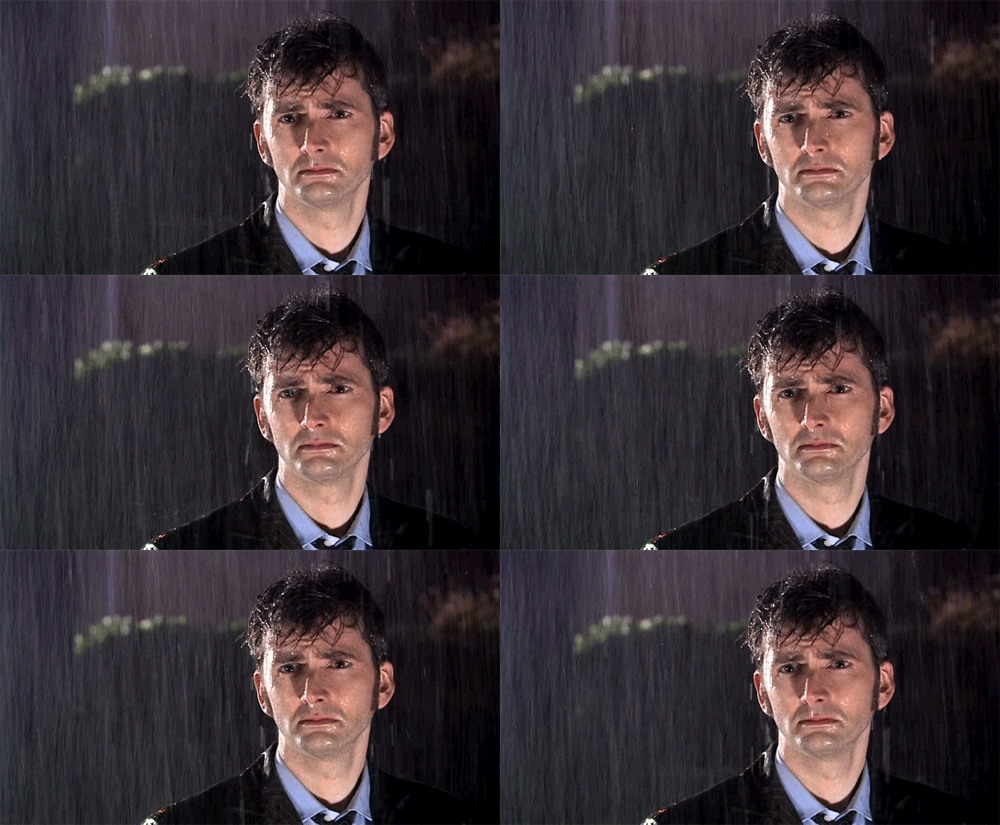
Yeah, all of that went down the toilet in the subsequent season. The motivations that gave the episodes conflict and helped progress the characters and the story as a whole were more or less dropped, and the little quirks that made the characters funny and interested got so blown up that they became the only aspect of the characters. Abed went from movie-geek to schizoid mess, Jeff became charming (and nothing else), Troy became just Abed’s buddy, and Annie was just the sweet naive straight-man (more or less) to the rest of the group. On top of becoming gross caricatures of their former selves, the show stopped dealing with college (which you might recall as being the reason so many people started watching the first place) and became centered entirely on the clownish escapades of the group. Granted, every once in a while you got good episodes, but never on the same level as the first season. Every time I sat down to watch Community the smile faded from my face and I could react in no other way but this:

“But Gordon, you roguish fountain of delight, isn’t this more a warning against being madcap than straying from the characters and story?”

I’d have to concede that, if it weren’t for such shows as South Park and American Dad. Both of these shows have been from their inception pretty surreal, nonsensical, and all-around crazy. Yet both shows have maintained that same level of craziness and remain (more or less) as popular now as when they started.

I admit, these shows are not for everyone…

Again, an excellent example of how shows drifting away from their original material kills them would perhaps the most iconic animated show of all time: The Simpsons.

My old roommate never saw the early Simpsons, and is to this day convinced that the show is side-splitting in its hilarity. And he’s probably right- I stopped watching the Simpsons after my first year of college- I got tired of having my heart broken.

Perhaps it’s best encapsulated in this quote by Lisa Simpson back in Season 2:

I heard you last night, Bart. You prayed for this. Now your prayers have been answered. I’m no theologian. I don’t know who or what God is exactly. All I know is he’s a force more powerful than Mom and Dad put together and you owe him big.

Would you ever hear that from Lisa in one of the later seasons? You would not. Why? Because Lisa has moved from being a brilliantly smart little girl to a pointy-haired midget channeling the whiny liberal indignation of Bill Maher.
Is there anything wrong with Lisa as she is today? Not really, no. If that’s who her character is, then that’s who her character is- only the hitch here is that’s not who Lisa started off as. Had Lisa started off as the yellow counterpart of Brian Griffin, then I wouldn’t have any problem. Had Homer started off as a food-crazed buffoon or Marge as a simple housewife, I’d probably still watch the show. Again, it’s the gradual change from one thing to another that’s responsible for people drifting away from the series. It’s not that shows go stale (not that staleness can’t be a problem- just look at the Gilligan’s Island episode where they’re almost rescued), it’s that they change too much.

And hey, with our ever-shortening attention spans and our rapidly changing culture, maybe that’s not such a bad thing.

Girls: 2 Broke and One New [Pt. 2] – Humour

This is the second part of a three-part series on CBS’ 2 Broke Girls and Fox’s New Girl, both shows that premiered in the fall of 2011. In yesterday’s post I went into some detail about the cast of both shows, and this time I’m going to address the element of both that, hopefully, helps them put the “com” in sitcom.

HUMOUR

2 Broke Girls was created by Michael Patrick King, the openly gay writer whose claim to fame is HBO’s Sex and the City [he wrote all of the season premieres and finales, and was responsible for its adaptation to the big screen], and Whitney Cummings, comedian and star of her own NBC sitcom, Whitney.

Cummings has, for the most part, been preoccupied with her show, and because of that it’s King who takes the onus for much of the show’s writing. Now I do want to save a lot of potential content for tomorrow and the final part of this series, so what I’m going to share are a few of his words about where the show is coming from:

I think our show is a big, ballsy comedy, but it has a bigger heart than it has balls.

I feel that it is broad and brash and very current.

I consider our jokes really “classy-dirty.” They’re high low-brow. I think they’re fun and sophisticated and naughty and I think everybody likes a good naughty joke.

“Ballsy” is a pretty accurate statement for a show on a broadcast network that has, by my count, averaged nearly two rape jokes per episode. It also describes well the decision to include in this week’s episode, “And The Kosher Cupcakes,” a 13-year-old Jewish boy implying he’d soon be receiving oral sex from one of the show’s female leads.

Edginess aside, do I think it’s funny? As evidenced by the video proceeding this paragraph Kat Dennings has her tone down when it comes to delivering dry, deadpan lines. Beth Behrs’ Caroline has a knack for visual humour [see last week’s: “And The Broken Hearts”] and even Oleg, the lascivious fry cook, has his moments where you can’t help but grin at his audacity. Whether it’s funny throughout, however, is a different story.


Continuity and pacing aside, a lot of the times lines fall flat. “And The Broken Hearts” featured a joke between Jennifer Coolidge’s Sophie and Jonathan Kite’s Oleg where the two riffed on the variations on the word “come,” a scene so horrid that I’m cringing as I rewatch it. The show may not shy away from dealing with topics like masturbation and drug abuse, but “shock and awe” doesn’t always equal “amuse” or even “entertain.”

New Girl was and is created, produced, and written by Elizabeth Meriwether; her largest claim to fame is the 2011 Natalie Portman and Ashton Kutcher-driven comedy No Strings Attached.

Now I don’t have the public uproar that surrounds 2 Broke Girls available to create articles about New Girl, so I’m going to have to address its humour with largely my own words. Though the show began with the passable premise that a quirky female teacher moving in with three men was going to create conflict, the show has since moved beyond that in leaps and bounds.

Zooey Deschanel was, without question, the reason many tuned in, but I don’t believe it’s why they return. Jake Johnson’s Nick and Max Greenfield’s Schmidt both own their roles, and are arguably even funnier when clashing with each other. Case in point:


Where King’s show relies on a lot of wordplay and snarky jabs, courtesy of Kat Dennings, Meriwether’s is one that puts the “domestic” and the “comedic” in “dom com.” In addition, the characters all bring their own brand of humour to the table, with Schmidt’s douchiness, Nick’s freakouts [see above], or Jess’, well, Zooey-ness.

It’s not even that the show shies away from sex and the like. An entire episode revolved around Jess seeing Nick’s penis [much to Schmidt’s curiosity], and her willingness to have a threesome is strangely adorable. The difference is that it’s not overly-raunchy or in-your-face; for the show sex is another part of life, and one that’s plainly funny as opposed to darkly so.

I realize that there are significantly more clips from New Girl, but the fact is that I think the show is funnier overall, and you can always look for more stuff from 2 Broke Girls on YouTube if you’d like. As the head writer, King has a pretty decent cast of characters [again, see last post] available to him, and if he wants to give them lots of sarcasm and whatnot that’s entirely up to him. It’s fine to be “ballsy” or “classy-dirty” but the intention should be to have your audience laughing, not shaking their heads and saying “I can’t believe they just said that.”