Tag Archives: marketing

Culture War Correspondence: Valentine’s Day

EVAN: Loved ones, we bring to you this week a special Valentine’s CWC that is very much in the spirit of the season. Similar to how chocolates and pink and red decorations began being sold in late January we are discussing the holiday, if you can call it that, well ahead of the actual date.

KAT: Yes, good old Valentine’s day. Or as I like to call it, Singles Awareness Day.

Before we started our official CWC I was telling Evan how I’ve spent the last few years of S.A.D. dressing in black to protest Valentine’s Day (and the marketing of love). Only last year my protest was ruined by John proposing to me. Go figure.

EVAN: So inconsiderate, that guy.

While I’m sure many people view S.A.D. as the bitter, single person’s response to February 14th, maybe you want to talk a little more about how you used it as a form of protest? I did mention in the intro how it all starts when the stores switch up their stock-

KAT: Since red and pink tend to be the colours associated with Valentines Day, dressing all in black can make you stand out a fair bit. Honestly, I knew it wasn’t going to make a difference to people around me making a Valentine’s Day purchase, but it makes a statement about how you feel about being single. Don’t get me wrong, being in relationship can be amazing (and has been for me), but I wanted to make it clear that a relationship isn’t necessary in order to have a fulfilling life.

Also, I hate pink…

Continue reading

CWR Writers’ Roundtable: Halloween Costumes

EVAN: Loyal readers, and those who don’t have any strong feelings about the blog whatsoever, welcome to an old feature with a fancier name where the three writers get into the holiday spirit.

That holiday is, of course, All Hallows’ Eve, and the topic we will be discussing is the broadest possible one, at least in my opinion: Halloween costumes.

There are a number of different directions we could go with this, so I’m going to start things off light and ask what our ideal Halloween costumes would be, if we were actually going to dress up. Gordon mentioned earlier this week that he tends not to celebrate holidays, so it’s definitely hypothetical. Continue reading

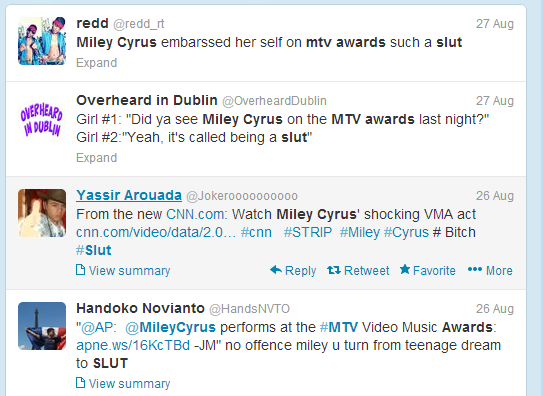
Shame Day: Slut-Shaming Miley

Everyone remember when this happened?

Do you remember how it was followed by a whole lot of this?

slutshaming miley Continue reading

“The Sincerity Wars” or “Hitler Did Nothing Wrong”

Not too long ago, Evan did a Shame Day about 4chan’s semi-joking attempt to wreck a Taylor Swift radio contest by getting some random 39-year-old voted rated as Swifts “biggest fan”. The original post declaring 4Chan’s intentions stated that “Charles Z.” was only in it for a chance to “sniff Swift’s hair” (I can’t speculate on whether or not that’s meant to be a joke) and that it was a chance to crush the dreams of thousands of “whiny teeny boppers.” The campaign was overwhelmingly successful. Charles Z. shot to the first place with a mile-wide margin and the radio station wound up cancelling the whole event.

In spite of Evan’s comments that this was generally a lousy move and a tacit endorsement of sexual harassment, I’m going to have to disagree with him. Firstly, I’m not taking the whole “hair-sniffing” thing as being all that serious, and secondly, I don’t think this really had much of anything to do with Charles Z. or even Taylor Swift for that matter.

It was about sincerity. Continue reading

Some Thoughts On Advertising

There are certain things in life that can be avoided.

For all our howling about vapid, synthetic pop-songs we do, at the end of the day, have the ability to simply turn the radio off. For all our wailing about trashy, stupid television, we have the ability to just point our remote and switch off the TV. Even people who annoy us we can at least avoid.

But that’s not so much true when it comes to advertising. Unless you’re living in an underground bunker somewhere in Colorado, it’s not something you can get away from.

Why you’d even be reading this blog, I don’t know.

Between telemarketers, logos, TV and radio, billboards (including mobile ones, which we have in Vegas), and the internet, there’s really no escaping. Even if you’re sitting alone in your house, it’s all around you. You’ve got company emblems stitched onto your shirts. Manufacturer’s names written on your underwear. Go to your kitchen, and you’ll find advertisements on the back of pasta and cereal boxes.

I’m only here to offer some food for thought; I won’t be taking up myself the war cry that advertisements and commercials always play to the lowest common denominator. Sexuality in the crassest, most objectified form, greed, gluttony, envy, passivity, sloth (not the kind shown above)- it’s all there, and thrown at us every waking minute of every day of our lives. What does that do to us?

Most people who work with this line of thought point to the movie Idiocracy as a dark prophecy of the world to come.

In this movie, a man is (accidentally) cryogenically frozen and awakens in a dystopian future where advertising and trashy TV has resulted in the average human IQ dropping well into the double digits. While it’s not a masterpiece in and of itself, and it’s suggestion that dumb people have inherently dumb kids is just plain wrong, the fact that more and more our society seems to be moving towards Idiocracy is downright eerie.

I will, nonetheless, offer an alternative for you to ponder.

What if advertising is actually raising our BS awareness? Information on the internet is usually either (at best) misrepresented or (at worst) outright falsehood. We don’t seem dumber as a species for it- on the contrary, we seem more skeptical and discerning. Perhaps we are, in fact, becoming tougher to fool. Naturally I can’t point to any cause-and-effect relationship, but it’s certainly something to think about.

Of course, there’s the dark alternative to that as well.

What happens to our psyches and society when we’re constantly on-guard against everything? Is that paranoid cynicism really healthy for us? What does it do to us to hold everything in contempt as just another scheme to take away your money? Even if we tone that down a bit, what does it do to us to walk through life constantly being sold things? Cradle to grave, confronted by sales pitch after sales pitch- how can that be anything but damaging?

Again, this isn’t to simply rail against advertising. There’s plenty that advertising, well, I don’t want to say “does right,” but certainly does “well.” Managing to communicate messages or ideas in the shortest amount of time using the smallest amount of words and images is, well, impressive. The ability to remotely encode associations, emotions, and reactions in the human mind through slogans, catch phrases, campaigns and the like is undeniably clever, even if more than a little Orwellian.

Imagine if all that money, research, and manpower was put towards something actually constructive. Imagine even just a quarter of all advertising dedicated to communicating positive messages. How much more of an intelligent, healthy, compassionate society would we be? If nothing else, it would mean some telemarketers could do something more fulfilling with their lives than shilling out cruises in the Caribbean.

It’s just something to think about.

Obama: the brand

Jim Messina was an undergraduate when he managed his first campaign, and has won every race since then. He’s now manager of the Obama reelection campaign and going to great lengths to maintain his record.

source: huffingtonpostMessina has purportedly read volumes of US election history, but he spent the first months before beginning the Obama campaign in earnest meeting not with successful senators and former campaign managers, but with CEOs and senior execs of Apple, Google, facebook, Zynga, and DreamWorks. While Obama looks for support from left side of the House and Senate, Messina’s also brought Stephen Spielberg and Vera Wang into the campaign. Messina’s campaign, he says, is more based on wunderkind business strategies (Zynga and facebook, for example) than any elections from previous centuries.

The most interesting part to me of Messina’s campaign is the part focused not on intellectual persuasion, but attachment-building via branding. To contrast this with Mitt Romney’s campaign, look at the merchandise pages of each of the candidates’ websites:

Romney’s store has:
2 types of bumper stickers
a window decal
2 buttons
4 different t-shirts (2 of the with just the semi-unrecognizable logo on them)
a baseball cap
a lapel pin, and
(regrettably) a heather grey quarter-zip-up sweatshirt

All of his products are on one page, and most of them look like print-screened logos on shirts from AC Moore.

Obama’s store includes:
iPhone cases,
Earth Day packs,
“I bark for Barack” magnets,
v-neck shirts for women under 45,
calendars,
yoga pants,
a $95 Monique Pean scarf,
a Vera Wang bag, a $95 “Thakoon Panichgul“, whatever that is,
dog bandanas,
dog sweaters,
Joe Biden mugs,
Obama jerseys,
rubber bracelets,
pint glasses,
aprons,
bangles,
cufflinks,
baby bibs,
grill spatulas,
soy candles,
golf divot tools,
and a six-pack cooler.

There’s also about a billion different types of tshirts, buttons, and bumper stickers, and a “for Obama” series: women for Obama, nurses for Obama, veterans for Obama, African Americans for Obama, Latinos for Obama, Hispanics for Obama, Asian American & Pacific Islanders for Obama, and environmentalists for Obama.

Romney’s shirts say, at most, “Romney” or “Believe” – one of Obama’s shirts says “Health Reform Still a BFD.” Granted, Romney is aiming at a different demographic (LL Bean fans, eg), but Obama’s 19 pages of merchandise make Romney’s 1 page look pitiful, from a branding point of view.

The Obama campaign’s brand-focused strategy is closely integrated with its other image-focused tactics: assigning Romney the cold, out-of-touch persona, for example.
While critics of the Bain capital narrative put out by the Obama campaign said that things like negativity and party inconsistency (Bill Clinton’s subsequent praise of Romney’s management skills, eg) rendered the move moot, an article in Bloomberg said that Messina may not have been so concerned about persuasion at that point: “Messina is adamant that the Bain attack succeeded among the uncommitted voters he’s concerned with, who ignore pundits and are only now beginning to form opinions of Romney.”

For a lot of voters, Romney’s business and managing experience are just off the table. The Bain Capital anti-campaign put on by the Obama team wasn’t so much a persuasion for some voters as an excuse to keep holding their current opinion. K street and the hill will argue about the relevance and logical holes in different arguments, and about the influence of different political figures voicing their opinions, but humans decide things more based on instinct than consideration, I think.

David Plouffe, a political strategist, commented: “When people say, ‘How’s the Bain thing playing?’ it doesn’t matter what the set of Morning Joe has to say about it.”

Voters’ behavior and attitudes are hugely dependent on their initial impressions of politicians. People will take things like the Bain story how they want to, based on what they’ve already consciously or unconsciously decided. And some might criticize the Obama campaign for putting a lot of money into what seems like frivilous merchandise, but things like brand and image aren’t meant to persuade – they’re meant to create a stronger identity and community within the already-present supporters. Such branding is what made Facebook, Google, and Apple such monstrosities – and they are precisely where Messina went for advice.