Tag Archives: Tumblr

Can Video Games Make Thoughtful Social Critiques?

Just to be clear, I am not a gamer. The only video game I ever successfully completed was Jill of the Jungle, which we owned on floppy disk when I was a kid.

I’m pretty sure I only liked this game because Jane was a super cool tough girl,

In fact, up until this past year I would have argued that video games don’t really have any redeeming qualities. At worst, they are a hotbed of misogyny and xenophobia, as chronicled by female gamers on websites like Not in the Kitchen Anymore and Fat, Ugly or Slutty. At best, they are like a bottomless pit where the lives of children and adults disappear, never to resurface.

Although I suppose the same could be said about pretty well anything.

This year a good friend convinced me to try a Digital Humanities class at my University. For those of you who haven’t heard of the field before (I hadn’t either), Wikipedia defines it as the “intersection of computing and the disciplines of the humanities”.  If you want to see some examples of the kind of research being done in the field, you could check out two of my past posts describing DH scholar Lisa Nakamura’s guest lectures at my university.

While this class has challenged the way I see technology in general, it has particularly challenged my very negative perception of video games. In fact, Ian Bogost, one of the DH scholars we studied in the course, argues that games can form powerful arguments and unique social critiques. In his book, Persuasive GamesBogost describes arguments made by a game as “procedural rhetoric“, or, more simply as “the art of persuasion through rule-based representations and interactions, rather than the spoken word, writing, images, or moving pictures”.

Below, I’ve included four examples of persuasive games my DH professor shared with the class. Each of these games make relevant and thoughtful arguments that wouldn’t have been as effective if they didn’t appear in their procedural form.

The Parable of the Polygons

Vi Hart and Nicky Case preface their simple browser game by stating that “This is a story of how harmless choices can make a harmful world.” Hart and Case explain that the triangles and squares are “slightly shapist”. This means that the shapes prefer some level of diversity around them, but will become unhappy if they feel isolated in their community. Players are then asked to drag and drop the shapes until all of the squares and triangles are happy with the community of shapes around them.
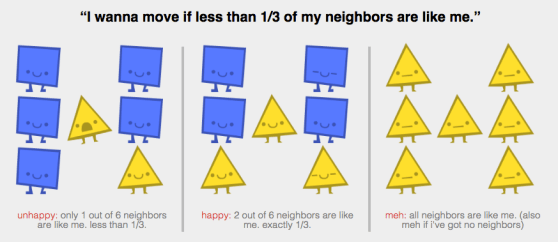
Screen Shot 2015-03-25 at 1.28.02 PM

Click on the image to play the game

Once the player begins moving the shapes, it becomes apparent that even a slight bias will lead to large scale segregation. Continue reading

Tumblr and SJWs: The Difference Between Having a Problem and Being One

So roughly two months ago Gordon said I would be “providing some cutting observations on the state of Tumblr”, and I’ve finally gotten to the point where I’ve done enough research to finally tackle this thing. In this case “this thing” refers to “the internet’s conceptions of Tumblr and its users, specifically those who have been deemed ‘social justice warriors'”. It’s going to be a long one, so sit back, buckle up, and do one other thing you would do when riding in a vehicle.

everybodyhatestumblrEverybody Hates Tumblr

I’m not going to pretend I know where you spend your time on the internet, but chances are that you’ve come across the general sentiment that Tumblr is “all that is wrong with the internet” or “a literal cancer” or some other hyperbole. It’s gotten to the point where just invoking the site’s name in relation to anything can be, and usually is, a damning condemnation.

As far as I can tell, there exists a much stronger bias towards it than even 4chan, with the latter being heralded as the primordial ooze that the vast majority of our memes come from, a primal, unadulterated place that has stood true to its roots. That’s a conversation for another time, but the point is that Tumblr has come to carry more negatie connotations than other social networking sites, with a lot of that having to do with it being the homeland of SJWs, or “Social Justice Warriors”-

What Is A Social Justice Warrior? [Wow, Google Image Search Has Not Been Kind To That Search Term]

This YouTube video is a pretty short, funny breakdown of what one is:

If you didn’t feel like watching it, here’s what the dude defines it as, providing three definitions that get more and more easy-to-understand:

  1. a derogatory term for people who advocate for socially marginalized groups
  2. a bad name for feminists
  3. a bad name for women-are-cool people

Continue reading

Lisa Nakamura Part 2: Navajo Circuits and the “Nimble Fingers” of Asian Women

In my last post, I told you a little bit about Lisa Nakamura, her research, and the talk she gave at my university about Tumblr activism. I also promised to tell you about her second lecture the next time I wrote.

Both of Nakamura’s lectures were about digital media, but unlike her first talk, her second presentation focused on the physical material of digital technology.

Unless you’ve been hiding under a rock, or recently time-travelled to 2015, you probably wouldn’t be surprised to hear that most of your digital hardware came from Asia. You may even be familiar with the way Asian women have been racialized as innately predisposed to factory work because of their “supposed docility, nimble fingers and attention to mind-numbing detail”.

Screen Shot 2015-03-09 at 8.39.54 PM

Click on the image to view the full infographic.

However, you might be surprised to learn that this stereotype has been applied to women of colour ever since the digital revolution. In her paper on “Indigenous Circuits: Navajo Women and the Racialization of Early Electronics Manufacture”  Nakamura examines the way digital factory work is both gendered and racialized. She refers to the work of Karen Hossfeld when she insists that

“…by the eighties in Silicon Valley, electronic assembly had become, not just women’s work but women of color’s work.” (290)

Continue reading

Lisa Nakamura Part 1: Tumblr Activism and This Bridge Called My Back 

On Thursday and Friday UVic hosted Lisa Nakamura, Collegiate Professor from the University of Michigan, to speak about her research on Digital Media and Race, Gender and Sexuality. Nakamura has been writing about digital media since 1994. While she has written several books about race and the internet, some of her shorter pieces focus on things like “The Racialization of Labour in World of Warcraft”. In order to feel qualified to write about platforms like World of Warcraft, she spent hours playing the game herself.

On Thursday, Nakamura’s talk was titled “The Digital Afterlife of This Bridge Called My Back: Women of Color, Feminism and the Internet”. She began by giving a brief overview of the book and explained why it matters so much.

As an anthology that prioritized written work by women of colour, This Bridge Called My Back responded to the whitewashing of feminism long before movements like the #SolidarityIsForWhiteWomen hashtag began to highlight the problem. This book also introduced the concept of intersectionality, which has since become a key element of feminist theory.

Unfortunately, since it’s original publication the groundbreaking collection has struggled to remain in print. According to Wikipedia,

“The anthology was first published in 1981 by Persephone Press, and the second edition was published in 1983 by Kitchen Table: Women of Color Press. The book was out in its third edition, published by Third Woman Press, until 2008, when its contract with Third Woman Press expired and it went out of print.”

The book’s struggle to remain in print made it an “artificially scarce commodity” and drove up the price. At its inflated price, the book’s authors might even have been unable to afford their own work.

Screen Shot 2015-02-22 at 9.48.27 PM Continue reading

The Internet and Mob Justice

On January 16th, a pet supply worker was fired for a racist tirade on a blog. On the 13th of the same month, Iron Mountain Daily News blacklisted a freelance writer after she was revealed using racial slurs. On the 11th of this month, a juvenile justice employ in Kentucky was fired for racist and violent postings on his Facebook wall.

Nothing surprising at first glance.

With ever-increasing social consciousness and public focus on modern-day racism in the past year, it’s nothing shocking that a person would be fired for getting caught making bigoted claims. Only these folks weren’t caught– they were exposed.

Continue reading

3 Things Christians Parents Can Learn From the Death of Leelah Alcorn

On December 28th Leelah (Josh) Alcorn committed suicide. In the Tumblr note she scheduled to upload after her death, Leelah implies that her parents’ strict rejection of her identity was one of the factor that led her to this decision.

I’m not a parent, so I don’t want to ignorantly hand out parenting suggestions. However, I do want to start a dialogue about this story in the Christian community.

Instead of offering my own naive words of advice, I’ve pulled out three quotes from Leelah’s note to focus on. Each of these three points highlight things Leelah seemed to deeply wish that her Christian parents would understand.

1. You can’t force your child to accept your beliefs

They felt like I was attacking their image, and that I was an embarrassment to them. They wanted me to be their perfect little straight christian boy…

– Leelah

I love what Jamie (the very worst missionary) once said on this topic. In her post titled “Not All Pastor’s Kids Are Christian. Sorry.” she talks about her own experience as a pastors wife, parenting a child who now identifies as an atheist. While Jamie expects their children to act respectful towards her and her husband (and their chosen profession), when it comes to their faith she only asks her children to be honest with her in their journey towards truth. She doesn’t ask them to pretend to be something they are not:

“Believing in Jesus? Receiving His redemption? These are not commands to be given by a father and obeyed by a child. They are a loving invitation from God to his people, every last one of His people, and He is patiently awaiting their reply…”

Continue reading