Tag Archives: YouTube

Shame Day II: ISPs and the Six Strike System

Normally, Thursdays here at Culture War Reporters is dedicated to “Fame Day,” in which Evan and I call attention to people, events, or trends we think aren’t getting the attention they deserve.

But not today.

Partly due to my illness, partly due to some unforeseen time constraints, and mostly because of the severity of the issue in question, today there will be no Fame Day.

Instead, we’ll be performing an emergency Shame Day on the subject of yesterday’s terrible news that five major internet service providers (ISPs) will be implementing a “six-strike” system on people suspected of copyright infringement.

Let me break it down for you.

Normally, when you sign up with an internet provider, exactly what you do or don’t do with your connection is entirely and exclusively your business. Whether it’s something as impressive as you doing an electric guitar cover of the hallelujah chorus or as lousy as writing a thousand comments calling that same YouTube video gay is all up to you. What you read, what you write, what you post, what you view- the ISP is simply there (as the name states) to provide internet.

But no longer.

Yesterday, five major ISPs (Verizon, Time Warner, Cablevision, Comcast, and AT&T) announced that they would be participating in this anti-piracy initiative spearheaded by the “Center for Copyright Information” or “CCI”- a lobbyist group for a number of media groups. Quite simply, individual users suspected of “copyright infringement” will be given five warnings, the sixth “strike” resulting in their internet speed being slashed to dial-up quality for an unspecified amount of time.

Now you’re probably thinking “Hey- just don’t pirate stuff and you’ll be fine!” and you know what?

You’re right. You don’t have to pirate.

I’m taking over from this point on for a number of reasons. For the most part because although Gordon had good things to say, he didn‘t necessarily say them well, and in some cases didn’t make very much sense; we’re going to chalk that up to his recent illness. I will be relating to you what points of his that I can, while adding my own.

-Evan.

Gordon’s next point is that for the most part, many people pirate because of time and money. Focusing on time, the truth is that we can’t always guarantee that we’ll be at home on a Thursday night to catch The Office. Maybe we’re working another job [many of us need to], or maybe we just forgot. What options does this leave us?

For those of us in America, Hulu is always an option. The on-demand streaming site once provided a very broad range of TV programming, and Gordon points out that it’s a fantastic resource, or at least used to be. Nowadays, however, it’s a lot more difficult to use than it used to be. Hulu Plus, which requires a subscription, is needed to watch a lot of older shows, sometimes even episodes that aired a month ago, if New Girl is any indication. With one of the most convenient resources made less so, is it any wonder that so many people simply turn to torrents?

Gordon’s next point, and a very valid one, is this issue of the Six Strike System and how it relates to piracy. There’s an issue of what exactly is at stake here. Gordon insists that the answer to that is everything, and while I’m not fully with him on that, there’s some sense to what he’s saying.

The thing is that almost anything can be considered copyright infringement. YouTube covers, memes [which often use screenshots of shows like Futurama {see: our Shame Day image}], Gordon’s beloved gifs, even many of the pictures of this blog, in spite of being Photoshopped, don’t technically belong to us.  Would we have our internet cut because we run this blog? [Answer: I wouldn’t, because I am Canadian.]

To finish off what Gordon wrote earlier today, the issue is that the people in question aren’t being penalized by an international agency, or even the state or federal government. The fact of the matter is that these ISPs are “using their lobbies to persecute and prosecute suspected users without due process” [quoting Gordon]. What truly incensed him more than anything, though, was the way they’re going about it. That they’re holding themselves up as Knights of Good when in reality they’re just proud that they’re “selectively picking off anyone their bosses deem a threat to their unending stream of profit.”

Untitled-2

Piracy is not a subject I agree with Gordon on, and in fact I had a very hard time letting his last piece on the subject be put up on the blog. If people really, truly love art, whether it take the form of television or movies or video games they need to vote with their wallets and know that what they love is worth spending money on.

That being said, I do believe that what these ISPs are doing is wrong, particularly in that they have no one to be accountable but themselves. No business or corporation should have that right. Shame on these ISPs, and shame on the Center for Copyright Information.
Fame Day: Geek Love

It took me some time to think of a Fame Day topic that also intersected with Valentine’s Day [which is today, if you didn’t know], but once I came up with it there was no doubt in my mind that it was the right one.

Featured on the IGN YouTube channel START, Geek Love tracks individuals as they take part in Sci-Fi Speed Dating at New York Comic-Con. The show originally aired in full-length episodes [focusing on more than one person] on TLC, but never got past the first two episodes.

In the pile-on of proper nouns that was that last paragraph, I’ve neglected to define what exactly Sci-Fi Speed Dating is. Sci-Fi Speed Dating is regular speed dating, but at a comic convention, meaning that most of the participants are cosplaying [in costume]. Everyone must involved must be single and interested in members of the opposite sex [they can be interested in the same sex as well, but it must be in addition to that], and, since I don’t want to go through every single rule, it’s hosted by a very large man dressed up as a Jedi; he is hilarious.

To give you a fuller understanding here’s the first episode, “Brony Friend Zone (Alex)”:


It paints a picture of the stereotypical nerd/geek, a bespectacled pudgy young man with chops who lives with his parents. A show’s got to have some variety, though, and Episode 3 stars a girl named Brittany:


For the record, I would go get coffee with this girl in a heartbeat. I don’t even like coffee, but I would order some and drink it if it was something she was into.

Brittany is a person who “likes video games, particularly BioWare, comic books, Marvel, [she likes] the shows Once Upon A TimeLost, Doctor Who,” in case you missed that. She’s also, by most people’s standards, not a physical representation of what a nerd looks like. She’s also friendly and personable, exhibiting none of the tendencies we’ve been expected to observe thanks to shows like The Big Bang Theory.

The reason I’ve decided to spotlight Geek Love today is because it highlights the diversity within the growing community of people who identify themselves as “nerds” or “geeks.” Episode 4 features a guy who cosplays as Jimmy Olsen [“Superman’s Pal”], and basically no one he talks to recognizes him. As a comic-lover it was hard for me not to get upset at them and scream at the screen, “You call yourselves nerds?!” They were, though. They just like different things. Episode 6 follows Mary, who’s primarily a movie buff. That differentiates her from someone who is very into anime, but doesn’t discourage her from “looking for love” at this convention.

As a show Geek Love also serves as a means of discussing how important your personal likes, passions obsessions etc. are in finding a significant other. Over on his blog Mightygodking discussed this in reaction to a story arc of popular webcomic PvP, and while I may not agree with him 100% his discussion on the necessity of shared interests in a relationship is a good one [be sure to check the comments section, too!]. Clearly the people on this show are looking for potential girlfriends and boyfriends at Sci-Fi Speed Dating because finding another person who loves the same things you love is important to them. How high this should be on your personal compatibility list is up to you, but for them its rank is up there.

Geek Love is a pretty fantastic show for people who are interested in comic books, video games, science fiction, and finding a person to share all of that with. It’s also arguably a good show for anyone who wants their perceptions of that particular sub-culture to broaden their views.

YouTube Channel Playlist Page: Geek Love – YouTube
Updated Every Thursday

Fame Day: StarCrafts

gjscStarCraft, undoubtedly one of the best and most important games of all time, at least according to Wikipedia. This is an RTS [real time strategy game] that commands legions of fans, and its sequel, which launched in 2010, now commands many of the same legion of fans.

But the competitive online scene for any game is not an exceptionally friendly place. There’s the stress and pressure of playing against other players to achieve ranks, and that’s not at all helped by players who are BM (bad manner[ed]). This rudeness can even be found among pro-gamers themselves (see: many of IdrA’s interactions with other players).

Enter Jonathan Burton, also known as “Carbot” and the creator of the YouTube StarCrafts. Set entirely in the world of StarCraft II each episode presents various units from the Terran, Protoss, and Zerg races engaging in a battle that is, in a word, adorable.

Here is an artist’s rendition of the Zergling as it appears in-game:

And this is a gif of what the Zerglings look like in StarCrafts:

And they’re more than just heartwarmingly lovable, they’re also hilarious. Anyone with even the slightest familiarity with the game will lose it when they see a Zealot dancing from side to side to defend a choke, and people who didn’t understand what any of those words meant are still going to chuckle when they see the baby-like Marines running [almost always away from something]. Add to that the fact that almost all of the soundbites used are from the game itself and you have a very impressive piece of work on your hands.

The following is probably the best entry into the series, and it showcases the dangers of letting yourself get . . . overzealous. Cue classic CSI scream.

What’s really great though, is how I don’t even really have to be writing this post. StarCrafts has received the recognition it so greatly deserves, and episodes have been featured fairly often on the Blizzard [the game’s creator] site. What’s even more exciting is how they were also aired during game breaks at the first ever BWC [Battle.Net World Championship] in China. A special episode was also created for NASL [North American Star League].

I strongly encourage all of you to check out a few episodes. Even if StarCraft II isn’t your thing [and really, it’s not for everybody] maybe this can help you relate just a little to all the die-hards out there. At the very least, you’ll have spent a few minutes watching an excellently produced video by a very talented man.

YouTube Channel: youtube.com/user/CarbotAnimations
Facebook Page: facebook.com/CarbotAnimations
Twitter: @CarbotAnimation
Personal Site: carbotanimations.com
Updates every Saturday

Free Information Culture

The last of my installments (for now) in looking at these rising alternative cultures is “Free Information Culture,”  which shares the same problem with “science” culture in that there’s really no good name for it yet. I’ve referred to it before as “internet culture,” only the problem with that is that, like “science culture,” it isn’t so much the culture of the thing itself as the culture of the fanbase. In simpler terms, it’s the difference between Hollywood culture and movie-lover culture- it’s the end product that’s valued.
So what’s the internet’s “end product”?

Besides porn and stuff like this…

Free Information.

Whether it’s the news, or Wikipedia, or TED Talks, or Imgur, or anything else imaginable, it’s on the internet for free and public use. It’s something of a great equalizer. No matter where you’re from, what language you speak, what class you hail from- you can create or say anything and then get called gay in the comment section.

And while that last bit is sort of a joke, it does play a role in developing the “free information culture.” Granted, general anonymity can make us vicious and vile people, but it also (to some extent) strips us of our egos. When you make something online, you really don’t get much, if any, credit, but that’s alright since it isn’t the point. It’s just about creating, nothing more or less. Who drew the first rage face? Who started up Bad Luck Brian? Who edited and sourced that one Wikipedia page you used to stitch your last minute term-paper together? Who puts together those monthly fail compilation videos? I don’t know and will probably never know, but I do know that they’ll keep coming because of the simple joy of creating them. I and every other person with a half-decent internet connection.

And all of this simply isn’t understood by some people.

Recall the massive outcry against the SOPA and PIPA bills? What prompted the creation of  these acts was that some people- certain corporations in particular- couldn’t quite wrap their heads around the idea of free and unlimited access. Now maybe you agree with them, and maintain that posting copyrighted material of any kind is piracy and immoral, however, what needs to be understood is that this was viewed as an act on the very nature of the internet and everything it had come to represent.

Again excluding porn and stuff like this…

Now more and more companies are catching on to the idea that it’s wiser to try to work with the faceless and vengeful cat-worshippers of the internet than against them- just look at video game companies that are starting to work in tandem with modders. The game Minecraft in particular is a good example of this, as many of the new aspects of each update to the game coming from the fan-forums themselves. Nevertheless, there are still plenty of people out there (I’m looking at you, Music Industry) who continue to struggle (vainly) against the dissemination of what they view to be the “information wants to be free” crowd.

Again, it all boils down the core of the culture that the internet has produced, gravitating around the concepts of freedom and egalitarianism. Look at Wikileaks founder, Julian Assange.

If he did his work back in the early 90s, we can be pretty sure he’d be viewed overwhelmingly as a candidate for a James Bond villain. But today we (for the most part) view him as being a heroic (or at least positive) figure in a world that’s become increasingly secretive and unequal. Why this dramatic shift in perception? Again, it’s the internet and it’s affect on us. In a time of economic crisis we might not be able to go to the movies, or eat out, or drive for miles to see a friend, but we can watch something online, or browse recipes, or video-chat with the same buddies that you’d otherwise not be able to see. Any threat to your full and unrestricted access to the internet is, by proxy, a threat to some of the last pleasures you have left.

Hence the formation of a culture obsessed with the values of free speech, free access to information, and freedom from censorship. And with every development of the internet or our access to it serving as another leap in the evolution of the culture, it’s safe to say that the howl of anger that the governments of the world met when trying to create such bills as ACTA is only going to intensify.

Culture, Not Criteria

Earlier today Evan sent me a link to a documentary on YouTube dealing with the subject of “hacktivists,” or more specifically, the rise of internet mischief and mayhem group “Anonymous.” For the most part, the movie was decent enough, though of course it wasn’t without its own agenda and a there are a few misconceptions resulting from that. But this post isn’t going to be a review. Rather, it’s going to launch off from an interesting phenomena I saw throughout the documentary- and that was the way people talked about Anonymous.

See, whenever people talk about the group, they usually have to veer off into a parenthetical speech where they try to explain just exactly who these guys are, and how at the same time they can be anybody, because anybody can be “Anonymous.” The end result is that they wind up sounding like a paranoid schizophrenic or conspiracy theorist, and the explanation itself doesn’t sound all that believable. After all, how can any individual or group take on the mantle and conduct whatever hacking or pranking or ranting they do against their enemies without some leadership? How do they do anything if they have no demands or agenda?

The problem here (and elsewhere, but we’ll get to that in a minute) is that a completely wrong lens is being used to look at the group. People are looking for structure or goals- the two things that usually define any collection of people, and that’s where it falls apart. Anonymous isn’t a group, it’s an idea. It’s a culture.

Now that sounds strange, but bear with me here.

What’s a conservative?

You probably have an image in your head right now. You can probably tell me what a conservative would think about a certain issue, or how he or she would act in a certain scenario, or the general value system one might have, but if I really pushed you for criteria, my guess is that you wouldn’t be able to give me one. After all- there are varying ideas of “conservatism,” and no real defined boundaries. You’ll find conservatives who state that the “religious extremists” have a skewed view of conservative values, and those same extremists offer the exact same criticism of those wimpy fiscal conservatives. Regardless of the specifics, once you stand back, both groups do fit neatly into the category of “conservative.”

Now apply the same general lens to Anonymous.

What’s “Anonymous”? It’s not a group with an ideology- it’s an ideology with a group, or rather, a whole bunch of groups. Consensus isn’t made through secretive discussion boards or by a clandestine collective of angry computer-geeks. Consensus isn’t made at all- actions simply stem from a general set of perspectives and ideas (the most major of which is freedom of speech and opposition to censorship) held by the adherents. Anonymous doesn’t exist as a coherent, structured group anymore than any culture or subculture exists as a coherent, structured group. Sure you’ve got your major players, and you’ve got various projects or movements within, but at the end of the day, there’s no list of demands, just a set of values.

The reason I bring this up is that this kind of organic organization is becoming more and more prevalent in our culture, the most notable example perhaps being the “Occupy Movement.” Critics of the movement, in its early days, continually parroted the protest of “But what do they want?“- the issue with that being that there was no, and never could be, any list of demands. Occupy wasn’t a structured or unified group- it was, like Anonymous is, a culture. A massive number of people sharing (and developing) certain common perspectives and values and then taking actions based on those views (those actions further developing those views, and so on ad infinitum). Trying to get demands out of Occupy protestors would’ve been about as fruitful as trying to get demands out of conservatives. You’re going to get conflicting specifics, even if there is a general set of guiding principles.

And of course, there are others out there. Though there’s no real term or name for it yet, there’s a rising “Manly” culture, comprised of elements of survivalists, masculinists, and guys who debate each other on-line about how to build porches and properly maintain classic muscle cars. Now I can’t claim to know the origin of this- perhaps it’s partly a reaction against our increasing dependence on technology, perhaps it stems from our powerlessness in a time of political and economic hardship- but either way, it is a growing culture based in principals of independence, self-sufficiency, self-control.

On the other side of the spectrum, there’s the general philosophies and ideas of the trans-humanists, futurists, utopians, geeks, nerds, and people who worship the ground Bill Nye and Neil DeGrasse Tyson walk on. Those who view technology as being the solution to most, if not all, human ills, and eagerly await the day when you can get a free jet-pack when you go in for your cancer vaccine.

Now why bring any of this up?

Because it’s important.

We’re currently breaking away from the liberal/conservative paradigm, and we’re going to need to understand what else is out there. This isn’t to say that we’ve only had conservative and liberal cultures- that simply isn’t true. But we can’t deny that there has been, over the past decade, developments of new value-systems which are really neither here nor there. New and alternative views for what the world ought to be, and how you ought to be in it. Over the course of the next few weeks, I’ll be focusing on dissecting these various concepts, so be sure to stop by next Monday for my examination of “Manly” culture.

Looking Back at a History of Booze and Bacon

It’s been pretty evident for a while now that a lot of you have gotten here due to a post I wrote almost exactly a year ago, “Epic Meal Time: Leaving Grease Stains on Pop Culture.” In it I extol the internet show and its evolution into something that ultimately rewards long-time viewers, as well as its impact on pop culture.

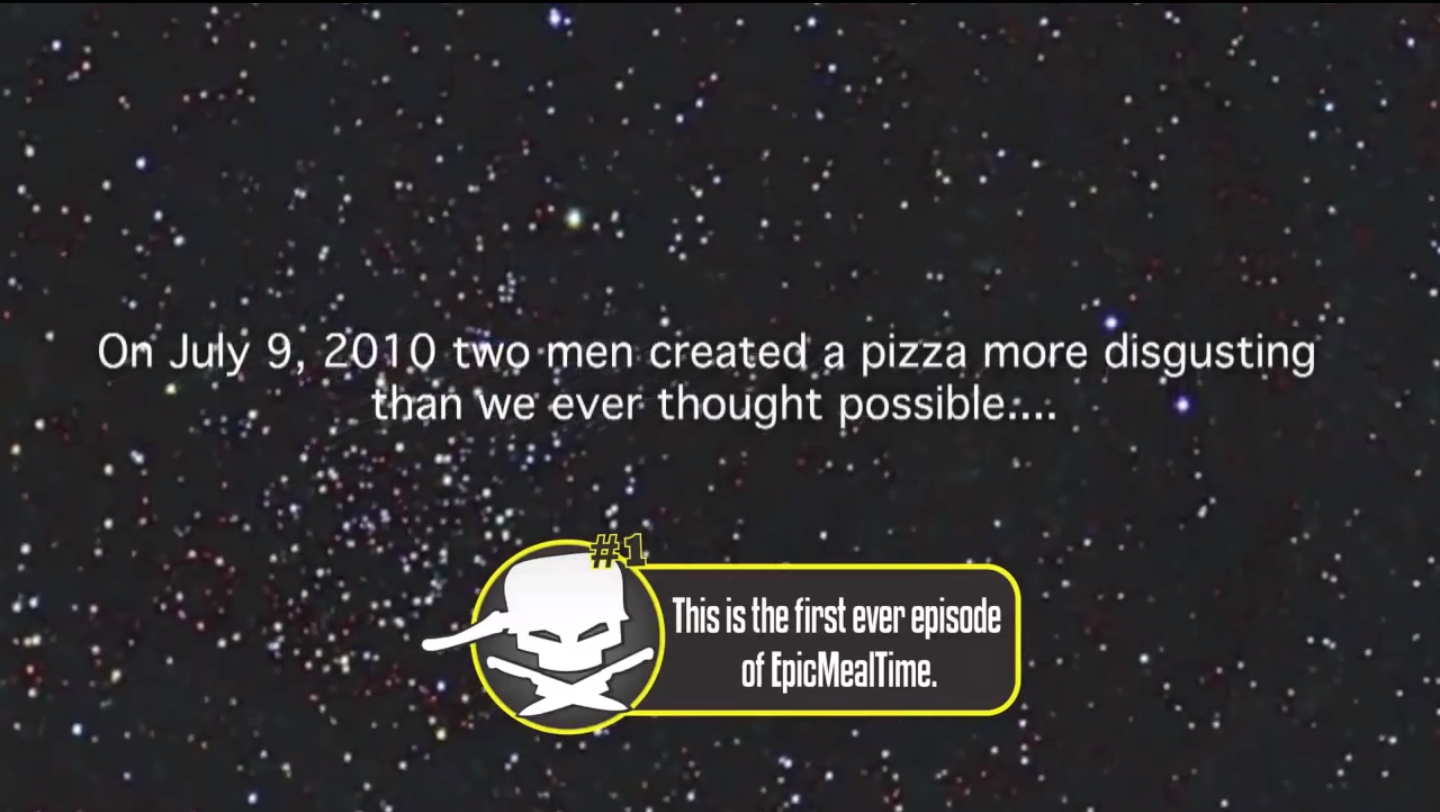
Coinciding with the anniversary of my original EMT post is the show’s second birthday, and a loving tribute to their first episode ever, the Fast Food Pizza. Video below:

While two whole years of epic meals is impressive enough, what got me even more excited is what the crew uploaded yesterday.

The new feature, going by the name “Flashback Friday” is a director’s commentary of sorts, presumably all done by creator and star of EMT, Harley Morenstein. Essentially the entirety of their Fast Food Pizza episode, the main difference takes the form of pop-ups that are very reminiscent of Xbox Live Achievements, or [probably more accurately] VH1’s Pop-Up Video

Additional changes include a bacon strip censor bar for Muscles Glasses’ eyes, as well as vocal distortion. From this point on they moved forward with turning him into a silent, powerful destroyer of fast food and liquor.

What I probably appreciate more than the fact that they made this video is that they haven’t removed the first. There’s a trend on the internet to simply remove or take down earlier work, or whatever you’re not proud of. Both Harley and Epic Meal Time are sticking to their roots in remembering the first video that got them where they are today. And that means not removing this video with Alex Perrault [as you’d call him sans aviators, I suppose], or another where they, believe it or not, actually use vegetables.

EMT announced on its twitter account that if fans liked the video then they’d continue to do more. While not all of the feedback was positive, I for one hope that the likes, and views, continue to multiply. Watching the behind the scenes of almost anything is interesting, even more so learning about the history behind two years of booze and bacon.

EDIT: After their fourth episode on YouTube the EMT guys have decided to move the show over to their own site. You can watch every one of the episodes here, where they continue to be put up every Thursday.