Category Archives: business

Some Thoughts On Advertising

There are certain things in life that can be avoided.

For all our howling about vapid, synthetic pop-songs we do, at the end of the day, have the ability to simply turn the radio off. For all our wailing about trashy, stupid television, we have the ability to just point our remote and switch off the TV. Even people who annoy us we can at least avoid.

But that’s not so much true when it comes to advertising. Unless you’re living in an underground bunker somewhere in Colorado, it’s not something you can get away from.

Why you’d even be reading this blog, I don’t know.

Between telemarketers, logos, TV and radio, billboards (including mobile ones, which we have in Vegas), and the internet, there’s really no escaping. Even if you’re sitting alone in your house, it’s all around you. You’ve got company emblems stitched onto your shirts. Manufacturer’s names written on your underwear. Go to your kitchen, and you’ll find advertisements on the back of pasta and cereal boxes.

I’m only here to offer some food for thought; I won’t be taking up myself the war cry that advertisements and commercials always play to the lowest common denominator. Sexuality in the crassest, most objectified form, greed, gluttony, envy, passivity, sloth (not the kind shown above)- it’s all there, and thrown at us every waking minute of every day of our lives. What does that do to us?

Most people who work with this line of thought point to the movie Idiocracy as a dark prophecy of the world to come.

In this movie, a man is (accidentally) cryogenically frozen and awakens in a dystopian future where advertising and trashy TV has resulted in the average human IQ dropping well into the double digits. While it’s not a masterpiece in and of itself, and it’s suggestion that dumb people have inherently dumb kids is just plain wrong, the fact that more and more our society seems to be moving towards Idiocracy is downright eerie.

I will, nonetheless, offer an alternative for you to ponder.

What if advertising is actually raising our BS awareness? Information on the internet is usually either (at best) misrepresented or (at worst) outright falsehood. We don’t seem dumber as a species for it- on the contrary, we seem more skeptical and discerning. Perhaps we are, in fact, becoming tougher to fool. Naturally I can’t point to any cause-and-effect relationship, but it’s certainly something to think about.

Of course, there’s the dark alternative to that as well.

What happens to our psyches and society when we’re constantly on-guard against everything? Is that paranoid cynicism really healthy for us? What does it do to us to hold everything in contempt as just another scheme to take away your money? Even if we tone that down a bit, what does it do to us to walk through life constantly being sold things? Cradle to grave, confronted by sales pitch after sales pitch- how can that be anything but damaging?

Again, this isn’t to simply rail against advertising. There’s plenty that advertising, well, I don’t want to say “does right,” but certainly does “well.” Managing to communicate messages or ideas in the shortest amount of time using the smallest amount of words and images is, well, impressive. The ability to remotely encode associations, emotions, and reactions in the human mind through slogans, catch phrases, campaigns and the like is undeniably clever, even if more than a little Orwellian.

Imagine if all that money, research, and manpower was put towards something actually constructive. Imagine even just a quarter of all advertising dedicated to communicating positive messages. How much more of an intelligent, healthy, compassionate society would we be? If nothing else, it would mean some telemarketers could do something more fulfilling with their lives than shilling out cruises in the Caribbean.

It’s just something to think about.

Shame Day II: ISPs and the Six Strike System

Normally, Thursdays here at Culture War Reporters is dedicated to “Fame Day,” in which Evan and I call attention to people, events, or trends we think aren’t getting the attention they deserve.

But not today.

Partly due to my illness, partly due to some unforeseen time constraints, and mostly because of the severity of the issue in question, today there will be no Fame Day.

Instead, we’ll be performing an emergency Shame Day on the subject of yesterday’s terrible news that five major internet service providers (ISPs) will be implementing a “six-strike” system on people suspected of copyright infringement.

Let me break it down for you.

Normally, when you sign up with an internet provider, exactly what you do or don’t do with your connection is entirely and exclusively your business. Whether it’s something as impressive as you doing an electric guitar cover of the hallelujah chorus or as lousy as writing a thousand comments calling that same YouTube video gay is all up to you. What you read, what you write, what you post, what you view- the ISP is simply there (as the name states) to provide internet.

But no longer.

Yesterday, five major ISPs (Verizon, Time Warner, Cablevision, Comcast, and AT&T) announced that they would be participating in this anti-piracy initiative spearheaded by the “Center for Copyright Information” or “CCI”- a lobbyist group for a number of media groups. Quite simply, individual users suspected of “copyright infringement” will be given five warnings, the sixth “strike” resulting in their internet speed being slashed to dial-up quality for an unspecified amount of time.

Now you’re probably thinking “Hey- just don’t pirate stuff and you’ll be fine!” and you know what?

You’re right. You don’t have to pirate.

I’m taking over from this point on for a number of reasons. For the most part because although Gordon had good things to say, he didn‘t necessarily say them well, and in some cases didn’t make very much sense; we’re going to chalk that up to his recent illness. I will be relating to you what points of his that I can, while adding my own.

-Evan.

Gordon’s next point is that for the most part, many people pirate because of time and money. Focusing on time, the truth is that we can’t always guarantee that we’ll be at home on a Thursday night to catch The Office. Maybe we’re working another job [many of us need to], or maybe we just forgot. What options does this leave us?

For those of us in America, Hulu is always an option. The on-demand streaming site once provided a very broad range of TV programming, and Gordon points out that it’s a fantastic resource, or at least used to be. Nowadays, however, it’s a lot more difficult to use than it used to be. Hulu Plus, which requires a subscription, is needed to watch a lot of older shows, sometimes even episodes that aired a month ago, if New Girl is any indication. With one of the most convenient resources made less so, is it any wonder that so many people simply turn to torrents?

Gordon’s next point, and a very valid one, is this issue of the Six Strike System and how it relates to piracy. There’s an issue of what exactly is at stake here. Gordon insists that the answer to that is everything, and while I’m not fully with him on that, there’s some sense to what he’s saying.

The thing is that almost anything can be considered copyright infringement. YouTube covers, memes [which often use screenshots of shows like Futurama {see: our Shame Day image}], Gordon’s beloved gifs, even many of the pictures of this blog, in spite of being Photoshopped, don’t technically belong to us.  Would we have our internet cut because we run this blog? [Answer: I wouldn’t, because I am Canadian.]

To finish off what Gordon wrote earlier today, the issue is that the people in question aren’t being penalized by an international agency, or even the state or federal government. The fact of the matter is that these ISPs are “using their lobbies to persecute and prosecute suspected users without due process” [quoting Gordon]. What truly incensed him more than anything, though, was the way they’re going about it. That they’re holding themselves up as Knights of Good when in reality they’re just proud that they’re “selectively picking off anyone their bosses deem a threat to their unending stream of profit.”

Untitled-2

Piracy is not a subject I agree with Gordon on, and in fact I had a very hard time letting his last piece on the subject be put up on the blog. If people really, truly love art, whether it take the form of television or movies or video games they need to vote with their wallets and know that what they love is worth spending money on.

That being said, I do believe that what these ISPs are doing is wrong, particularly in that they have no one to be accountable but themselves. No business or corporation should have that right. Shame on these ISPs, and shame on the Center for Copyright Information.

Shame Day: Hollywood and the VFX Industry

Let me begin this by saying that I did not watch the Oscars on Sunday night. I made a little joke on Facebook about how I didn’t have to because everyone else was doing it for me, and 14 people liked it, so I’m pretty funny. Anyway, let’s move this along.

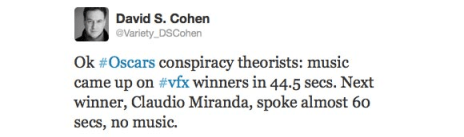
Ang Lee’s adaptation of the Yann Martel novel Life of Pi won the award for best VFX [visual effects], which I can only imagine was deserved because, well, I have not seen it. Bill Westenhofer, the VFX supervisor for Rhythm and Hues Studios, was giving his acceptance speech when he was cut off by music, as pointed out by Variety’s David S. Cohen:

Word on the street is that this is because of what he was about to talk about. See, it would be wonderful for Rhythm and Hues that they received so much promotion due to winning an Academy Award if they weren’t bankrupt. Westenhofer had planned on addressing the crisis within the industry during his speech, and was thankfully able to voice his thoughts afterwards to writer Bill Desowitz for his blog, where he said:

At a time when visual effects movies are dominating the box office, that visual effects companies are struggling.  And I wanted to point out that we aren’t technicians.  Visual effects is not just a commodity that’s being done by people pushing buttons.  We’re artists, and if we don’t find a way to fix the business model, we start to loses the artistry.  If anything, Life of Pi shows that we’re artists and not just technicians.

During his acceptance speech for best director Ang Lee forgot to thank his VFX collaborators at Rhythm and Hues, which prompted a letter from Phillip Broste, the lead compositor at Zoic Studios. It’s quite long, but I feel like quoting two of the last few paragraphs, because they really say quite a lot:

Mr. Lee, I do believe that you are a thoughtful and brilliant man. And a gifted filmmaker.  But I also believe that you and everyone in your tier of our business is fabulously ignorant to the pain and turmoil you are putting artists through.  Our employers scramble to chase illegal film subsidies across the globe at the behest of the film studios.  Those same subsidies raise overhead, distort the market, and cause wage stagnation in what are already trying economic times.  Your VFX are already cheaper than they should be.  It is disheartening to see how blissfully unaware of this fact you truly are.

By all accounts, R+H is a fantastic place to work; a truly great group of people who treat their employees with fairness and respect.  Much like Zoic Studios, the fabulous company that I am proud to work for.  But I am beginning to wonder if these examples of decency will be able to survive in such a hostile environment.  Or if the horror stories of unpaid overtime and illegal employment practices will become the norm, all because you and your fellow filmmakers “would like it to be cheaper.”

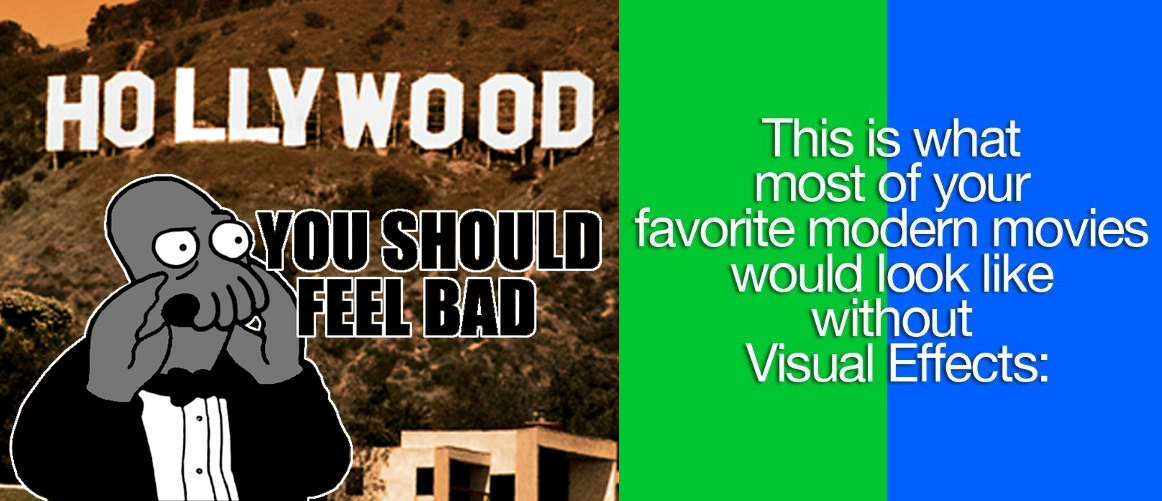
It’s no mystery that most summer blockbusters these days are built on the backs of animators, artists who spend hours upon hours trying to perfect the texture of wood grain or the way light reflects off of the ocean. Rhythm and Hues won two awards for Life of Pi, both the Academy Award and the BAFTA Award for Best Special Effects; they won both awards in 2007-2008 for The Golden Compass. This studio going bankrupt is like . . . . well . . . . an award-winning studio running out of money because they weren’t getting paid enough.

Untitled-1

People who work in VFX are just as much artists as painters, musicians, and photographers, and all have the right to be fairly compensated for their work. Good art takes time and effort, and if Hollywood refuses to give those in VFX the respect and money that they deserve then we need to let them know how wrong they are. Tell people about what’s happening, tweet with the hashtag #VFXprotest, check out VFX Solidarity International, and don’t be okay with Samuel L. Jackson talking over Robert Downey Jr. just because you like the guy as an actor:

February 25: What’s Not Being Talked About In The News

Back on October 15th of last year I ran a little piece on what’s not getting covered [enough] in the media. As I struggle in vain to fend off a nasty cold, I’ll be submitting a similar piece today.

Palestinians and Hunger Strikes

Today marked a massive hunger strike protest by Israeli prisoners, with over 3,000 inmates refusing meals in solidarity with another prisoner allegedly tortured to death. These strikes also call attention to the continued hunger strikes by four Palestinian inmates, the longest of whom has been on intermittent protest for 200 days, and is currently in critical condition.

While this is in the news (depending on the site), the importance of this story is that it marks a continued attempt by these prisoners at nonviolent protest- the kind many in the West proclaim would lead to justice for the Palestinian people if only they would attempt to use it. Well, here it is, and despite the attempts by these prisoners to emulate the tactics of Gandhi and MLK, they remain (surprise, surprise) rotting away in Israeli prisoners under “detainment”- that is, they may be indefinitely held without being charged with any crime. One might imagine that the attempts by the Palestinians to meet the demands of many in the west might merit some more attention.

Coca-Cola Vs Australia and the Environment

Recently in Australia legislation was passed to help meet the growing environmental issue of pollution from discarded soft drink bottles. Essentially the bill adds ten cents to the cost of each bottle, which will be refunded upon the bottle being recycled. Over 40 countries currently maintain such programs, and in Australia this legislation has doubled the local recycling rates. Coca-Cola, fearing that this environmental legislation may hurt its sales, has been campaigned viciously against this legislation and is currently suing the Australian government over it.

Let’s keep in mind here that Coke isn’t paying the ten cents- the Australian government is. Coke is simply that concerned that “tax,” for lack of a better term, is going to somehow hurt their profits.

Coke made 2.79 billion this year. I’m going to posit that 10 cents isn’t going to crush ’em.

Fracking Battle in New York

And to continue on with environmental news not in the news, the battle against fracking rages on in rural New York.

Fracking (see graphic above) is the process of extracting natural gas from the ground by piping in an as-of-yet undisclosed compound into the earth to widen natural fissures in the stones trapping the gas. The issue with this is that the process is pretty dang inaccurate, with gas (as well as the undisclosed chemicals) leaking into the local water supply, resulting in, among other issues, water catching on fire from all the methane in it. Now this is a fairly major issue, and one you’re almost certain to not see in the morning paper or the nightly news.

As before, people, it’s high time that we demand that our journalists actually act like journalists. What do you really want- news about major events affecting your life, or coverage of the academy awards?

Barring the people for whom the two are one and the same, but that’s a post for another time.

Evan and Gordon Talk: Separating Art From Artist

GORDON: Ladies and Gentlemen, boys and girls of all ages, welcome you here to Evan’s Dignity Memorial Art Gallery to view these lovely pictures of houses and flowers and stuff. The artist? Adolf Hitler.

Why, you ask, do we have Hitler’s youthful paintings and sketches? Because tonight we’re going to be talking about separating art from the artist, and whether or not such a thing can be done.

EVAN: To throw out an example, let me refer to the science fiction author Orson Scott Card, a man famous for writing Ender’s Game and for being pretty staunchly opposed to homosexuality in any form.

DC has hired him to pen a new “Adventures of Superman” comic for them, and quite a few stores have decided to boycott this product and not stock them. This being done, of course, as an act of protest.

GORDON: We’re not talking about some latent disapproval of homosexuality people, we’re talking about full blown vitriol on OSC’s part. Here’s a quote from him on the subject:

The dark secret of homosexual society—the one that dares not speak its name—is how many homosexuals first entered into that world through a disturbing seduction or rape or molestation or abuse, and how many of them yearn to get out of the homosexual community and live normally…

OSC straight up declares  in one piece of his, that he will not simply advocate, but will actively engage in the overthrow of the government should it ever attempt to legalize gay marriage:

Regardless of law, marriage has only one definition, and any government that attempts to change it is my mortal enemy. I will act to destroy that government and bring it down, so it can be replaced with a government that will respect and support marriage

EVAN: Which is straight-up reprehensible, which I hope you’ll agree with regardless of your personal stance towards the very loaded topic of gay marriage, etc.

GORDON: Absolutely.

EVAN: On a similar note, we have Frank Miller, a legend in the comics industry.

 The guy penned Batman: The Dark Knight, 300, Sin City, and had a marvelous run on Daredevil that really defined the character. The man’s a legend.

He’s also on record for calling members of the Occupy Movement “nothing but a pack of louts, thieves, and rapists, an unruly mob, fed by Woodstock-era nostalgia and putrid false righteousness.”

The Occupy Movement doesn’t have the same hot button status gay marriage does, and it’s arguable that people are less certain about it, but that doesn’t make the things Miller said any less ignorant or wrong.

GORDON: Again, this is true. But we’re not here to list off the artists and creative minds who have maintained ignorant or bigoted positions over the years.We’re here to talk about separating them from their art, and I’m going to submit that one some fundamental level, it can’t be done.

EVAN: Alright, let’s hear why.

GORDON: I’m going to cite Miller’s iconic work The Dark Knight Returns, which has just recently been adapted as an animated film.

It’s not hard to see Miller’s borderline fascist views bleeding through in the book, as he takes pot shots at “reform not punishment” imprisonment, youth (portrayed as violent, stupid, barely comprehensible thugs that even Alex DeLarge would be creeped out by), and even the latest Robin’s parents being portrayed was whiny, drug-addled liberals.

While I doubt Miller was using much restraint, I’m going to submit that the artist is almost always too close to his or her art for her views not to bleed through.

EVAN: So members of Oprah’s book club who read The Education of Little Tree, by former member of the KKK Forrest Carter, should have been able to pick up on his racial sentiments?

GORDON: I said “almost.” Obviously there are exceptions to the rule.

And this isn’t to say that the work itself is to be shunned; I really and truly enjoy Miller’s work, even though he has a goose-stepping, paranoid Islamophobe.

Because of this, in particular.

EVAN: So we shouldn’t let the beliefs of creators affect our enjoyment of their work?

GORDON: I’d hope not. That would preclude me from liking anything done by Dali, any music written by Wagner, and so on and so forth. My issue isn’t with enjoying something a despicable person has made, my issue is with hiring someone you know is despicable.

Would I listen to “Flight of the Valkyries”? Yes. if Wagner was alive today, would I hire that anti-Semite? No way.

EVAN: That’s a really good point. For example, anyone who buys the new “Adventures of Superman” comic will actually be indirectly funding various anti-homosexual movements that Card himself supports. In this case paying money for his product actually results in an action you probably aren’t okay with.

That doesn’t mean that you couldn’t read his comic and think, “Huh, that is a great take on the Last Son of Krypton,” which is entirely likely since he really is a great writer. His art isn’t necessarily affected by his beliefs, but your buying his art supports them, in a roundabout way.

It’s a metaphor for rejection

GORDON: Despite the counter-arguments in DC’s favor, the simple truth of the matter is people aren’t going to be boycotting these books simply because they’re angry at Card- they were angry at him before- they’re also angry at DC for not having the basic decency to not go into business with a raging homophobe.

EVAN: No matter how good a writer, or any other kind of artist, is, there will always be another who approaches them in talent who doesn’t espouse the negative views that they do. The fact of the matter is that DC has other options.

But going back to the topic at large, we confirmed earlier, in a way, that knowing about an artist’s beliefs after you’ve already appreciated and enjoyed their work shouldn’t rob you of that. If I see a painting and think it’s quite lovely, then find out Hitler painted it, that doesn’t suddenly cause it to become hideous in my eyes. At least, it shouldn’t.

GORDON: And because of the pressure we the audience can put on companies to ensure that bigots and nutcases aren’t given a platform, we should try to keep the artist and their work tied together.

EVAN: Voting with our wallets, which should really be done in every area of our lives [buying ethically produced products, high quality entertainment, etc.].

GORDON: Kinda thrown off by the fact that some wallets are thicker than others. But such is Capitalism. Overthrow the bourgeois. Down with the system.

EVAN: But that is a topic for another day. One that I may or not be hopping on, simply due to a lack of knowledge on the matter.

And it’s also about time we wrapped things up.

GORDON: I submit that next week we discuss poverty, as more and more of the nation (and world) slips into it.

EVAN: And I think that we should talk about Gordon never seems to win these polls.

Ha! Just kidding. We could maybe talk about . . . eh . . . yeah, I got nothing. I’m gonna open up my spot to be viewer submitted, just to see what ideas you have in mind.

GORDON: How gracious of you. Perhaps you’ll even close us out here?

EVAN: Thanks, as usual, for tuning in. If you have anything you want to tell us in general, feel free to email us at culturewarreporters@gmail.com, we’re always happy to hear from you.

A Space Marine By Any Other Name

Space marines. I can’t speak for most people, but when I hear those two words two very distinct images come to mind, which have thankfully been drawn together thanks to this image I found on dorkshelf.com:

On the left, a Terran Marine from the popular Blizzard RTS franchise [real time strategy game] StarCraft. On the right, an Imperium of Man Space Marine from the universe of Warhammer 40,000, by Games Workshop. Yes, the are both traditionally depicted as wearing blue armour. It’s fairly common knowledge that Blizzard owes a great visually creative debt to Games Workshop while still branching out on their own, but that’s not the point.

The point is that author M.C.A. Hogarth wrote a novel called Spots the Space Marine. On January 3rd of this year he received an email from Amazon telling him that they had stopped selling his book due to Games Workshop accusing him of infringement on their trademark of the word “space marine.”

To quickly explain the legal nitty-gritty of all this, in the US Games Workshop owns a trademark on the term that covers “board games, parlor games, war games, hobby games, toy models and miniatures of buildings, scenery, figures, automobiles, vehicles, planes, trains and card games and paint, sold therewith.”

It turns out that in Europe they have a Class 16 trademark, which includes, among a whole slew of other things, “printed matter.”  With that in hand Games Workshop brought their complaint to Amazon Kindle Publishing UK, which then caused Amazon Kindle Publishing US to block the e-book in all countries everywhere. A later update states that since the company has since delved into e-books themselves, they own the trademark in that respect as well.

Now let’s put all this legal business to the side for a while and concentrate on what Hogarth has to say about the term “space marine” means to him personally:

I used to own a registered trademark. I understand the legal obligations of trademark holders to protect their IP. A Games Workshop trademark of the term “Adeptus Astartes” is completely understandable. But they’ve chosen instead to co-opt the legacy of science fiction writers who laid the groundwork for their success. Even more than I want to save Spots the Space Marine, I want someone to save all space marines for the genre I grew up reading. I want there to be a world where Heinlein and E.E. Smith’s space marines can live alongside mine and everyone else’s, and no one has the hubris to think that they can own a fundamental genre trope and deny it to everyone else.

Space marines have been part of the sci-fi cultural landscape for decades at this point, going as far back to Robert A. Heinlein’s 1959 novel Starship Troopers [later adapted into a film in 1997]. While Bungie’s Halo franchise concentrates on their Spartan supersoldiers, fighting alongside these technological titans are members of the UNSC [United Nations Space Command] Marine Corps. In Gears of War the protagonists are infantry soldiers known as Gears, clad in bulky armour and waging war against the same sorts of extraterrestrial terrors the aforementioned servicemen do.

Romeo and Juliet, Act II, Scene 2, lines 43-44:

What’s in a name? That which we call a rose
By any other word would smell as sweet.

Science fiction has long been about exploring what lies beyond the Earth’s gravitational pull, and where there is the unknown there often lies danger. To put together a military force similar to what exists here and now while using the same naming convention simply makes sense.

What Hogarth wants is for science fiction authors, video game creators, etc. to be able to continue use a term that was long made available to everyone. It’s like saying that Blizzard and WarCraft placing a trademark on a term like “paladin” or “shaman,” or Star Wars placing one on “bounty hunter.” Space marines should be free to defend humanity on Tarsonis, Sera, Reach, or Macragge, and go by that title if they wish.