Category Archives: business

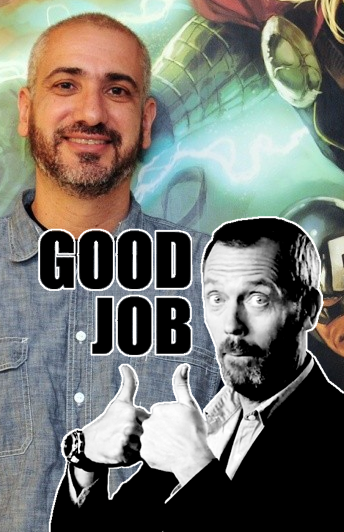
Fame Day: Alex Alonso

alonsoGordon’s absence has forced me to dedicate yet another Fame Day to a man in the comic book industry [a post on a woman is in the near future] to join the ranks of Anka, McDuffie, and Fraction.

Introducing the Editor in Chief of Marvel Comics, Axel Alonso. Interviewed by FOX News Latino [which I didn’t even know was a thing], he was asked the question: “Is that a new initiative at Marvel Comics is doing? We’re going with the Latinos now?”

This question was in response to a few “new” characters appearing in the publisher’s titles, with Miss America being one of them. First featured in Marvel Mystery Comics #49 in November 1943, Miss America was originally another embodiment of the United States in World War II, a star-spangled powerhouse punching out Nazis. Now, in 2013, Miss America is the moniker for America Chavez, a Latina teenager and new member of the Young Avengers [one of Marvel’s bestselling new titles]. Also mentioned was the new Blatino Ultimate Spider-Man, who has already been covered on this site.

From left to right: Miss America Chavez, Miles Morales [Ultimate Spider-Man]

From left to right: Miss America Chavez, Miles Morales [Ultimate Spider-Man]

Alonso, a Mexican-American himself, replied:

“I’d be lying if I said I wasn’t motivated, on a personal level, to have Hispanic characters represented in comic books, but this isn’t some PC initiative, [this is] capitalism.”

He acknowledged that a growing range of people read comics, and that as a publishing company it is their “responsibility to make them feel included.” Going back to his comment about “capitalism,” the fact of the matter is that as a company it’s in their best interest to create a product that appeals to the fastest growing demographic in America.
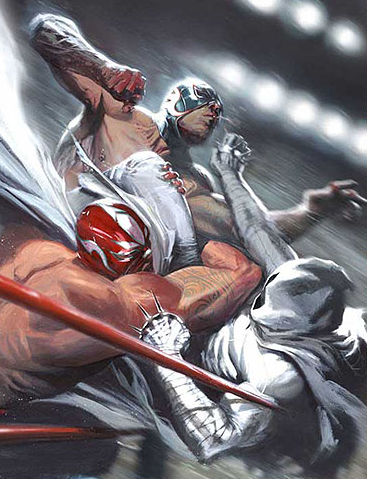
While Alonso agrees that comic books have not always treated minorities with due respect, he also acknowledges that stereotypes are more complex then they might first appear. He took part in helping to create Mexican heroes the Zapata Brothers, who were based on his cousins in Mexico. The two wear full luchador regalia, and while this may be perceived by some as racist, Alonso would argue otherwise. “Is that a little stereotypical?” he says, “Yeah,  but it’s also fun and a part of our culture.” Growing up watching these wrestling matches growing up they struck him as being an important part of his culture.

When asked why Latino characters haven’t achieved the same status and notoriety of heroes like Batman and Wolverine, his response was “Why haven’t they become that yet?” His opinion is that, with America’s ever-shifting cultural landscape, it’s an inevitability. You can’t force an audience, or simply make a character big, it just evolves and happens naturally.

Unfortunately, fellow member of “The Big 2” DC declined to be interviewed for this piece. While Marvel has its fair share of seemingly racist characters [Mexican villain/anti-hero Armadillo] DC has a large mark of shame in Extraño, a “gay Latino magician who had HIV and referred to himself as ‘Auntie.’” That being said, it’s a shame that they didn’t offer a means of looking forward through heroes such as Blue Beetle [Jamie Reyes] and Vibe [Paco Ramone] who has his own new title.

Alonso is a man who realizes that comic books are a business, and one that needs to make money and that has an impact on its readers. His joy that Miles Morales exists as a character is in “knowing that there would be a child out there who would see Spider-Man peel back that mask to see a different face and a face that resembled their own.” He understands that, and that’s worth giving him credit for.
Shame Day: Video Game Companies

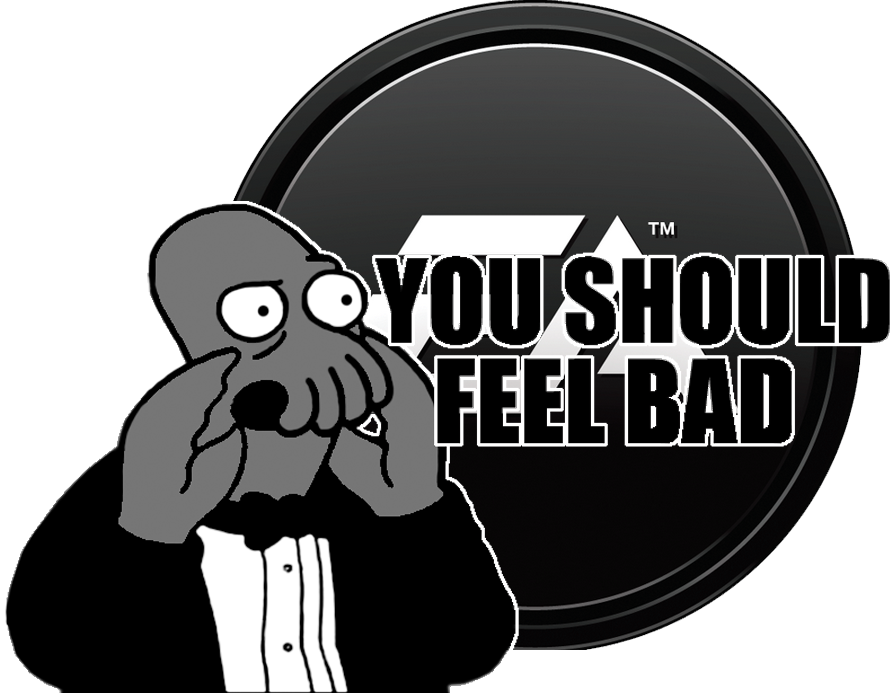
eaeaI am a dude who loves video games. I’ve played so much Team Fortress 2 in the past few weeks that it’s essentially become a ritual for me, something to do while and after I eat dinner. What I don’t always love are the business practices these  companies  engage in.

The image I Photoshop’d together depicts the EA [Electronic Arts] logo because they’re a company that I’m positive some of the blame lies with when it comes to generally being horrible to its employees.

I was turned onto this flagrant abuse of humanity through a webcomic Scott Kurtz [of PvP] and Mike Krahulik and Jerry Holkins [of Penny Arcade] put together. The comic, titled The Trenches, follows the life of a QA [quality assurance] guy whose name escapes me at the moment. The important part is that below the comic is a feature called Tales From The Trenches, which catalogues nightmare stories from those who toil within in the industry.

Below is one of my favourites, entitled “Weekend Funtimes.” My favourite not in that I enjoy reading it, but in that it encapsulates some of the horror of working  for large corporations:

We were about two months into “crunch” when they decided to up our hours AGAIN, taking us to over 80/week. The only available day to squeeze these extra hours in? Sunday!

I arrive at the building Sunday morning, only to find it locked—no other businesses had Sunday hours. I call my supervisor, who proceeds to fuss at me about interrupting his “family” time. My team had all arrived for work by that point, which just seemed to make him angrier. He tells me he is on his way and hangs up.

Flash forward ten minutes. We’re all still freezing (it was winter and -10 windchill) when we see his car come around the corner at the end of the block. He drives up the road, rolls his window down, and THROWS the office key at me—all without ever slowing down.

He calls me twenty minutes later to make sure we had gotten in, then informed me we would have to make up the time we had “wasted” waiting on him. He ended the call telling me to never interrupt his family time again.

That’s fairly despicable, and definitely up there among the worst of them. It was posted last month, and while it’s unknown when the event actually happened there is a date we can pinpoint: November 10th, 2004. The date that “EA: The Human Story” was posted to LiveJournal by user “EA Spouse.”

The post is a thorough examination of EA’s policies, especially regarding the infamous “crunch time” that its employees have to go through as the game nears its impending launch. She writes with a genuine, heartfelt voice that stems from being the wife of an EA employee. This is definitely present in the penultimate paragraph of her piece:

If I could get EA CEO Larry Probst on the phone, there are a few things I would ask him. “What’s your salary?” would be merely a point of curiosity. The main thing I want to know is, Larry: you do realize what you’re doing to your people, right? And you do realize that they ARE people, with physical limits, emotional lives, and families, right? Voices and talents and senses of humor and all that? That when you keep our husbands and wives and children in the office for ninety hours a week, sending them home exhausted and numb and frustrated with their lives, it’s not just them you’re hurting, but everyone around them, everyone who loves them? When you make your profit calculations and your cost analyses, you know that a great measure of that cost is being paid in raw human dignity, right?

Better known by her blogging handle, little did Erin Hoffman know what sort of action her post would lead to. In part it resulted in the filing of three class action lawsuits against EA and the beginning of many changes within the industry. Her post inspired another entitled “Why Crunch Modes Doesn’t Work: Six Lessons” which garnered a fair amount of attention within the online community.

That being said, Tales From The Trenches continues on into 2013, and it’s undeniable that many are slaving away in gaming companies because they love the final product. Their devotion to video games means that they’re stuck in jobs where they’re treated poorly by anyone and everyone a rung above them on the corporate ladder. Yes, this can be said of many work environments, but few have the same number of young, eager individuals so passionate to take part in what they’ve enjoyed their entire lives.

So shame on EA, and shame on any and all video game companies that treat their employees like dirt. No one said starting a career was easy, but no one should have to toil away thanklessly for an abusive system, either.

Shame Day: Glee

shame gleeTo begin with, I’m not a huge fan of Glee. I am a man who can say with confidence how much he loves musicals and acapella arrangements, but the show’s claim to be a melting pot of diversity [a place where Black people, Asians, homosexuals, and the disabled can belt it out to their hearts’ content] is not one I find myself agreeing with. But that’s the topic of another post.

Last week internet sweetheart Jonathan Coulton, known first and foremost for being the composer of “Still Alive”, the song that plays at the end of the game Portal, wrote a blog post in response to last Thursday’s episode of Glee. Specifically, the post was in response to their cover of “Baby Got Back” by Sir-Mix-A-Lot, which you can listen to here:


The issue being that Coulton released his own version of the song in 2006, which you can check out [and should, for comparison’s sake] here:


If you really want to scrutinize the two side by side, there’s a track on Soundcloud that simply places both tracks on top of one another [and an in-depth audio analysis, for those of you into that]. Coulton’s issue isn’t simply that Glee seems to have stolen his arrangement, but did so to the point where unique elements he added were copied as well. A duck quack is used to censor an expletive, and [this is practically impossible to ignore] the lyric “Mix-a-Lot’s in trouble” is replaced with “Johnny C’s in trouble” in both versions.

As he has kept the blog post constantly updated, four days ago he announced that having gotten in touch with the people at Glee, the following information was relayed to him:

They also got in touch with my peeps to basically say that they’re within their legal rights to do this, and that I should be happy for the exposure (even though they do not credit me, and have not even publicly acknowledged that it’s my version – so you know, it’s kind of SECRET exposure). While they appear not to be legally obligated to do any of these things, they did not apologize, offer to credit me, or offer to pay me, and indicated that this was their general policy in regards to covers of covers.

While Coulton is unsure of his exact copyright claim to the track, he had obtained a Harry Fox license to release it on an album alongside his own original music. His response is, refreshingly, a mature one in response to this whole ordeal.

He has re-released his track on iTunes under the new title “Baby Got Back (In the Style of Glee). “ Thanks to using the same license as before, Sir Mix-a-Lot will collect royalties, and all proceeds from the following month will go to charities The VH1 Save the Music Foundation and The It Gets Better Project.

This has, of course gotten its fair share of media attention. From a Facebook status by webcomic artist Rob DenBleyker to posts by Kotaku and The A.V. Club,  the internet appears to have rallied behind one of its own.

In his interview with Wired magazine Coulton shared a very simple solution for the show that spends millions per episode. He suggests that “they could offer to pay artists whose arrangements they use the same amount of money they would otherwise pay a musical arranger,” and that “if they opened with that, I’m sure a lot of artists would jump at the chance.”

Somehow, this isn’t the first time this has happened. Singer-songwriter Greg Laswell’s cover of a song made famous by Cyndi Lauper, “Girls Just Wanna Have Fun”, was also seemingly ripped off for an episode in November 2011. I’ve embedded the two songs for you to compare once again [and because I’ve gotta break up this wall of text somehow]:


Unfortunately, Laswell did not quite have the fan following that Jonathan Coulton does, and as a result this happened more or less without incident. The Hollywood Reporter did a short piece on it the month following, but from what I can tell it didn’t generate much controversy. Similarly, Petra Haden’s arrangement of “Don’t Stop Believin'” may have been appropriated without permission [i.e. stolen] by Glee as well.

It remains to be seen whether or not Coulton’s lawyers will be able to take legal recourse, but for the time being I’m happy that the show is finally being taken to task by those who believe that creativity should be rewarded and acknowledged, not plundered.

A Brief Argument Against Anti-Piracy

Over the past couple years, the issue of regulating the internet has repeatedly arisen, and while there have been many issues contributing to this, there is perhaps none more well known than the contention over copyright infringement and piracy.

Now for  a brief disclaimer.

I am a Marxist. I do not believe in “property” as the word would be recognized today. Every written work, every film, every piece of art belongs to every human being living. The Godfather series is just as much a part of our legacy and inheritance as the Mona Lisa, and as such, access to it should be enjoyed by all.

https://i0.wp.com/gifninja.com/animatedgifs/297918/it-belongs-in-a-museum.gif

This is all to say that I don’t view “copyright infringement” as constituting any true offense. On the contrary, it’s simply the people taking back what was rightfully meant for them to begin with- but I’m not here to talk about that.

No, I’m here to talk about how the music and film industries’ witchhunt for media pirates is doing them (and everyone else) far more harm than good. Let me break it down for you.

I. Some People Will Never Buy

It’s a strange statement, but a true one. There may be a slim minority of people who pirates actually are keeping from the major industries through their cheaper/free service, however it ought to be fairly safe to say that there are plenty of people out there who would not otherwise listen to certain artists or watch certain shows. We’re living in tough times, and with your average movie ticket running at about twenty bucks (to say nothing of the gas getting to the theater and back), for many of us piracy is the only way we’ll see new movies and shows. Assuming there’s a segment of the population who will never, ever pay to see The Godfather, stamping out free avenues- namely piracy- doesn’t save the industry any cash. On the contrary, it just means that those people who don’t get to see the movie because they won’t pay for it aren’t talking about it, and generating buzz that might well attract people who will pay to see the movie. And speaking of them…

II. Some People Will Always Buy

https://i0.wp.com/www.reactiongifs.com/wp-content/uploads/2012/11/take-my-money.gif

Just as some people simply can not or will not pay (such outrageous prices) for entertainment, you will find people who will spare no expense when it comes to it. There are plenty of people who want to see movies on the big screen. There are plenty of people who want to see their band live in concert.The Mona Lisa is a perfect example of this.

No ownership claimed...

You can see pictures of Mona Lisa anywhere; it’s one the most widely recognized images in human history. Because it’s available for free most anywhere, no one will actually go see it, right? After all, it’s been “pirated” to death. Yet that room in the Louvre is packed wall to wall with people who want to see the thing for themselves. Why? Because it’s the original. Doesn’t matter that it’s roped off, or behind glass, or barely visible, or that the guards usher you along after thirty seconds- it’s still wildly popular. The same is true of all media. Some people- plenty of people- will part with their cash to see Avatar in 3D, rather than watching some grainy, laggy version taken on a hand-held video camera in Thailand.

III. Anti-Piracy Hurts the Audience

You may not have experienced this in the states, but there was once a time when DVDs were listed by region codes, and could only be played on players that recognized that region. In other words, a DVD from America couldn’t be played on a DVD player from Europe and vice versa. You were granted a limited number of “switches,” but seeing as how you typically only got seven, it just put off the problem, rather than solving it. The goal (one of ’em, at least) was to prevent international piracy of DVDs through cracking down on how far away they came from, but all that just came down to it being a huge hassle for everyone, regardless whether or not their purchase was legitimate. Imagine all the time, money, and manpower that was invested in that venture that wound up solving nothing and quite possibly leading the industries involved to lose more money over that debacle than they would’ve lost to actual piracy. The same could be said for those hyperbolic ad campaigns comparing piracy to car theft

IV. Anti-Piracy Hurts the Industry

And while we’re talking about the industry shooting itself in the foot, let’s not forget the fact that preventing access to one film will very often lead to prevention of access to another. Quite simply, a person who doesn’t see The Godfather is not likely to go see the sequel, whereas someone who has seen The Godfather has a far better probability of winding up trying to see the sequel, either legitimately or through piracy. Is it a guarantee? No, but it’s still a better chance for the industry to make some cash than by preventing the person from seeing the first film at all.

V. Anti-Piracy Hurts the Environment

Lastly, I have to point out that we have free access to most films, music, and TV shows anyways- down at the local library. Only problem with that is when I drive to the library, I’m spending gas money, creating traffic, and spitting out exhaust fumes. Now I can get most anything down there for absolutely free, and no one complains. But imagine instead that I save on gas money, I keep the streets clear, and I reduce my carbon footprint by staying inside and watching the same movie I would’ve gotten free at the library. Suddenly, I’m a soulless criminal. Does that make sense to you?

https://i0.wp.com/www.reactiongifs.com/wp-content/uploads/2011/09/1239638148802.gif

What’s to be gained from all of this? Despite the doom-and-gloom prophecies of the industries, piracy continues on its merry path and yet we haven’t seen a decrease in the quality or production values of our movies.

Though "quality" is such a tricky word...We have more music artists now than we did a decade ago (at least, more access to them), in spite of piracy, and two of the most popular genres of our generation, techno and dub-step (I will never stop being ashamed of that) is heavily based on remixing and sampling other people’s work, i.e., piracy.

Look- I’m not asking the media giants to be happy about piracy, but at the same time, I have to question whether it’s really even worth it. All that cash being poured into anti-piracy gambits isn’t workingif it doesn’t already outweigh the revenue lost, wouldn’t all that time and effort be better spent elsewhere? Wouldn’t it be more profitable elsewhere?

https://i0.wp.com/media.tumblr.com/tumblr_manlx9hrn71r2sv68.gif

Just sayin’.

Free Information Culture

The last of my installments (for now) in looking at these rising alternative cultures is “Free Information Culture,”  which shares the same problem with “science” culture in that there’s really no good name for it yet. I’ve referred to it before as “internet culture,” only the problem with that is that, like “science culture,” it isn’t so much the culture of the thing itself as the culture of the fanbase. In simpler terms, it’s the difference between Hollywood culture and movie-lover culture- it’s the end product that’s valued.
So what’s the internet’s “end product”?

Besides porn and stuff like this…

Free Information.

Whether it’s the news, or Wikipedia, or TED Talks, or Imgur, or anything else imaginable, it’s on the internet for free and public use. It’s something of a great equalizer. No matter where you’re from, what language you speak, what class you hail from- you can create or say anything and then get called gay in the comment section.

And while that last bit is sort of a joke, it does play a role in developing the “free information culture.” Granted, general anonymity can make us vicious and vile people, but it also (to some extent) strips us of our egos. When you make something online, you really don’t get much, if any, credit, but that’s alright since it isn’t the point. It’s just about creating, nothing more or less. Who drew the first rage face? Who started up Bad Luck Brian? Who edited and sourced that one Wikipedia page you used to stitch your last minute term-paper together? Who puts together those monthly fail compilation videos? I don’t know and will probably never know, but I do know that they’ll keep coming because of the simple joy of creating them. I and every other person with a half-decent internet connection.

And all of this simply isn’t understood by some people.

Recall the massive outcry against the SOPA and PIPA bills? What prompted the creation of  these acts was that some people- certain corporations in particular- couldn’t quite wrap their heads around the idea of free and unlimited access. Now maybe you agree with them, and maintain that posting copyrighted material of any kind is piracy and immoral, however, what needs to be understood is that this was viewed as an act on the very nature of the internet and everything it had come to represent.

Again excluding porn and stuff like this…

Now more and more companies are catching on to the idea that it’s wiser to try to work with the faceless and vengeful cat-worshippers of the internet than against them- just look at video game companies that are starting to work in tandem with modders. The game Minecraft in particular is a good example of this, as many of the new aspects of each update to the game coming from the fan-forums themselves. Nevertheless, there are still plenty of people out there (I’m looking at you, Music Industry) who continue to struggle (vainly) against the dissemination of what they view to be the “information wants to be free” crowd.

Again, it all boils down the core of the culture that the internet has produced, gravitating around the concepts of freedom and egalitarianism. Look at Wikileaks founder, Julian Assange.

If he did his work back in the early 90s, we can be pretty sure he’d be viewed overwhelmingly as a candidate for a James Bond villain. But today we (for the most part) view him as being a heroic (or at least positive) figure in a world that’s become increasingly secretive and unequal. Why this dramatic shift in perception? Again, it’s the internet and it’s affect on us. In a time of economic crisis we might not be able to go to the movies, or eat out, or drive for miles to see a friend, but we can watch something online, or browse recipes, or video-chat with the same buddies that you’d otherwise not be able to see. Any threat to your full and unrestricted access to the internet is, by proxy, a threat to some of the last pleasures you have left.

Hence the formation of a culture obsessed with the values of free speech, free access to information, and freedom from censorship. And with every development of the internet or our access to it serving as another leap in the evolution of the culture, it’s safe to say that the howl of anger that the governments of the world met when trying to create such bills as ACTA is only going to intensify.

Wither Feminism?

This isn’t the first time I’ve lamented about the sorry state of feminism in the culture wars, and it certainly won’t be the last- nevertheless, the time has come for me to really lay out exactly what it is that’s killing feminism.


Sure feminism was necessary at one point, but it’s just not relevant anymore
.

You never hear that stated outright, but it seems to be underlying most responses on why feminism isn’t as major an issue was it was in the 70s or the 60s or the 50s or whenever exactly it was that the last wall of patriarchy supposedly fell.

Let’s face it, women can vote, run for and hold public office, be CEOs or workers, and so on and so forth. Really, shy of being able to serve in combat (American women, anyways), one might argue that all doors are now open. This mentality even seems to be affected most contemporary feminists, who though I am sure have the very best intentions, really can’t find much to rail about themselves. I’ve been through blog post after blog post, article after article, and found that overwhelmingly the subjects being discussed are mostly rants against Todd Akin (not to say that idiot doesn’t deserve it) or retrospectives on the battles of the past. Take a look at the contents of the latest Ms. magazine:

With Wonder Woman at the helm, the issue celebrates 40 years of fearless reporting with 40 Ms. and key feminist moments that shaped our history; birthday letters from dozens of life-long readers; and essays from founding editors Gloria Steinem and Letty Pogrebin, and current Executive Editor Kathy Spillar.

In the special 40th anniversary issue, you’ll also read about:

– What’s at stake for women in the 2012 election

– The significant ballot initiatives in your state

– Record numbers of women running for office

That’s their central points for their fall issue.

Now let’s take a look at Jezebel.

I had a rough time sifting through the articles for one that best demonstrates my point (I know Jezebel isn’t so much a “feminist” website as it is a “women’s interest” one- though exactly what that means I can’t rightly say)- for the most part, they seem tangential at best. “What is it with Women and Law and Order: SVU?”  or “Should Women Run? You’re Damn Right They Should.

That last one’s not talking about running for office- it’s literally about jogging. ‘Cuz apparently there was some blog post asserting that women with a certain body type aren’t cut-out to be runners, and that merited a response. Sure, whoever said that was wrong, but is that what feminists have been reduced to? Chasing down solitary quips of (comparatively) benign misinformation in the ugly bowels of the blogosphere? If that’s the standard for a worthwhile target, Evan and I should be beaten to death for mixing up when the premier of Community is going to be shown.

Please don’t beat us to death…

If this is the substance of the contemporary feminist movement, can you really blame people for feeling that all that’s to be done has been done? Can you really blame people for stereotyping self-proclaimed feminists as just angsty or contrarian? Is feminism just going to wither away?

I hope not- there’s still plenty of work to be done.

See this picture?

It’s from Dove’s “True Beauty” campaign. A series of advertisements aimed at combating anorexic and unrealistic standards of beauty. I’m sure the owners of Dove- a corporation by the name of Unilever- would be proud.

You know what other company Unilever owns?

Yep- these guys.

Now as I have family who read this blog, I’ve got embedded for you below the mildest Axe commercial I can find- be assured that it’s prudish and progressive compared to the rest of ’em.

That’s what we’ve got here- a corporation that on one hand is hawking their products by telling you that you’re beautiful just the way you are, and on the other hand depicting women as mindless dolls in low-cut dresses who can be manipulated with aerosol bottles. The latter alone would be a slap in the face, but that fact that the company is two-faced enough to shamelessly operate both utterly discredits their “True-Beauty Campaign” and exposes the fact that they’re ready, willing, and able to use feminism itself as a vehicle for controlling and objectifying women and perceptions about ’em.

This is Paul Polman, Unilever’s CEO, and he can go **** himself.

See, there’s this offshoot of modern feminism called “Sex-positive feminism” (you might know it by other names), which broken down to its most basic elements asserts that women’s use of their sexuality is empowering- and while no one would deny sexuality as an integral part of any human being- more often than not, this line of thought is used to justify strip clubs, prostitution, pornography, etc. as being actually good for women.

Now I’m not going to start accusing the founders of “Sex-positive feminism” of selling out their own movement- I don’t think that’s what their intention was. But then again, such things are what the road to hell is paved with, and even if the goal of this off-shoot was to make sexuality just as empowering as brains or brawn, the simple truth of the matter is that the prostitute isn’t probably viewed by her client as being a more well-rounded person because of her job. Heck- using this logic, I might argue that a twelve year old Honduran girl whose working for 32 cents an hour in a sweatshop is likewise “empowered”.

Strange how “Dead by 26 feminism” isn’t quite as popular…

Feminism isn’t dead- it’s just got a knife at it’s throat, and if saving feminism from becoming a tool of the very system that it was first established to combat isn’t a worthwhile endeavor- I don’t know what is. To anyone who would complain that all the important battles have been won- I present to you this. “Your solution to saving feminism is by saving feminism?” you might ask- and hey, it’s a valid point. But this isn’t just some circular exercise- this is a struggle for what’s really empowering. It’s a fight over messages- will we be told “These shoes are empowering!” or “No- they are shoes– empowerment comes from how far you walk and how much butt you kick.” Isn’t that worth something?

At the very least it beats writing an angry article about how body shape doesn’t exclude you from jogging.

P.S. I know I should also say some stuff about the “Slut Walks” (“Slutwalks”?, “Slut-Walks”?), the issue of rape, the continued problems of worker-manager ratios, etc. but it’s past 1:30 in the morning- please excuse the narrowness of this post.