Category Archives: Evan and Gordon Talk

Evan and Gordon Talk: Our Ideal Women

EVAN: Welcome, one and all, young and old, to what I am dubbing as the first ever Valentine’s Day Edition of Evan and Gordon Talk!

I had originally come up with this topic to rile my co-writer, but then realized that it fit in perfectly with tomorrow’s holiday.

GORDON: Which isn’t to say that it doesn’t rile me. My vindictive co-writer understands that I am a deeply unemotional individual who knows more about the surface of the moon than human interactions.

EVAN: I had mostly planned on this being me asking Gordon about what traits he appreciates in a woman, and I will start thusly:

Gordon, what is the first thing you notice in a woman, physically [that appeals to you]?

GORDON: You know that I am partial to redheads.

EVAN: Our readership did not. What do you like about them, exactly?

GORDON: No reason springs to mind, I guess it’s just an irrational preference. Similar to your irrational detestation of the ladies of your own ethnicity.

EVAN: Oh, I don’t detest Asian women, I’m just not as attracted to them as almost any other race.  But we’re getting off topic, you can ask me potentially embarrassing questions in a moment.

What woman would you hold up above all others as an ideal example of physical beauty?

GORDON: Beauty is in the eye of the beholder.

This is beautiful to someone. Just not me. Or anyone I know. Or will ever know.

In my case, I’d cite Bryce Dallas Howard or Olivia Wilde as being prime examples. At least of physical attractiveness. 

Obviously there’s plenty more that goes into it.

EVAN: Like what? I mean, I know there’s more, but what else do you think there is to it?

GORDON: Intelligence, obviously, is a major factor.

EVAN: So what’s the standard for your future significant other?

GORDON: I’ve answered quite a few- I’ll let you answer that first.

EVAN: I’d like to be with a lady who reads. Not being able to talk to her about a book [or, let’s be honest, a comic] that I’m reading would be pretty terrible.

So reasonable well-read, I’d say. She doesn’t have to have read Joyce’s Ulysses, but knowing who the Romantics are would be nice.

GORDON: Certainly we can agree on this.

EVAN: Certainly.

I’m going to describe who I’ve always seen you marrying/dating, since I feel like it’ll touch on another area of life you deem very important.

I’ve always imagined you getting together with what you would call “a dirty hippy.” Dreads, doesn’t shower very often, a conscientious consumer in that she pays for products that are ethically produced, someone who goes to rallies but knows what exactly she’s protesting.

GORDON: This is the part where I’d describe who I’ve always thought you’d wind up being only, only I don’t speculate on that because I’m not a pervert.

EVAN: I feel like your skirting around the subject and avoidance of outright denying my speculation gives it validity.

GORDON: Then here is my outright denial: I don’t like hippies. They’re pacifists.

EVAN: Fine, she advocates violence in certain situations.

GORDON: I don’t like vegetarianism or veganism or any of those other affronts to god and nature.

EVAN: So you’re saying being a vegetarian is a deal-breaker for you?

GORDON: Totally. My little sister is a vegetarian, and I am so ashamed of the fact that I just tell people that she’s actually a meth dealer.

If cows had the chance, they’d kill you and everyone you love…

EVAN: While we as an audience are probably relieved that you would never date your sister, I think now would be a great time to list off the [presumably] many deal-breakers you have when it comes to a significant other.

GORDON: Emotions. Talkativeness. A need for companionship or validation of any kind. Playing any music which isn’t heavy metal without earphones. More than three pairs of shoes. Adherence to any political belief that Glenn Beck wouldn’t decry as being forged in the fires of hell.

This could go on, you know this.

EVAN: I’m going to take it from your second deal-breaker that you prefer your women to be seen and not heard. How are our readers supposed to perceive this?

GORDON: The readers can take it any way they want- my own point is that I don’t like people who I hang out with to have to talk, as a baffling number of people on this little blue rock apparently feel obliged to.

EVAN: You live a hard life, Gordon.

GORDON: I truly do.

EVAN: To switch our places while still hopefully making you equally uncomfortable, you can ask me a question about my feelings. My feelings about women.

GORDON: . . . why are you doing this to me?

EVAN: Gordon, I am doing this for our readers.

GORDON: In that case, I guess what the reader apparently wants to know is. . . I have no idea. I have literally no idea. . .

EVAN: Gordon, if a girl wanted to send you a Valentine, what sort of gift/card would you most appreciate?

GORDON: Can cigars count? You can write on the little labels. . .

EVAN: Only if we’re allowed to read something Freudian into your choice.

GORDON: Do I still get cigars?

EVAN: Sure.

GORDON: Then I can live with that.

EVAN: Conversely, what sort of Valentine would you give a girl?

GORDON: . . . Cigars? They’re like chocolate, only they don’t taste lousy and make a mess.

EVAN: Also, they don’t go straight to your thighs.

GORDON: This is true.

EVAN: I’m going to try to come up with one more question you don’t want to answer, and then we can wrap this up. When was the last time you had a crush on someone?

GORDON: Ah, an easy one. Never.

EVAN: The last time you considered a woman you saw to be very attractive [not counting on TV/on the internet]?

GORDON: That’d be when I went to Toronto with you. Though it must be noted that I had been stuck in a tiny college town with the same people for the past four years. So I wouldn’t put much stock in my judgment at that point.

EVAN: The women of Toronto will try not to read too much into your comment. And I suppose that brings this Special Evan and Gordon Talk Valentine’s Day Edition to a close!

GORDON: For next week, I suggest: Drugs, Legalization, and Culture. It won once before, I think it deserves another shot.

EVAN: Oh yeah, it did. I think we talked about Django instead.

I’m so pleased that this talk happened that I’m not really sure what else we could possibly talk about. Maybe separating art from its creator, and whether or not it’s possible [see: People boycotting Orson Scott Card’s new Superman miniseries due to his rampant homophobia].

GORDON: I’d be down with that.

EVAN: Cool stuff. You should end this by telling our readers how you feel about them.

GORDON: You people make me sick. Prying into a dude’s personal life at the cackling delight of Evan. He’s an impressionable child and easily led astray. You should be ashamed of yourselves for encouraging his bad behavior.

EVAN: I think you are all wonderful people, and should consider yourselves lucky to have been privy to Gordon’s life. Tune in next time, as always!

Evan and Gordon Talk: Men and Manliness

GORDON: Moved by your incessant letters, as well as tearful pleas from more than one head of state, yours truly has returned for this and only this installment of Evan and Gordon Talk

You’re welcome, America.

EVAN: Truly, you are too gracious. [Also, we cater to an international readership].

This week the two of us will be discussing men and manliness [or masculinity]. Which makes perfect sense since we are, after all, men.

GORDON: MANLY men. We once made an axe using nothing but things we found in the woods. On the very same day, we built a grave for a drowned beaver.

EVAN: He is not lying. But, moving forward, one of the reasons I brought up this topic is because it’s loaded with possibilities. There’s the idea of the, for lack of a better term, the “Barney Stinson,” the fratbro who watches Spike TV day in and day and out, and this recent ad that appeared in The Times of India due to the gang-rape and murder of a 23-year-old woman [click on the image to visit an article on it].

GORDON: Well, let’s narrow down some the of core qualities that make a man a man. Or at least, commonalities in all cultures and subcultures of what “manliness” is.

EVAN: How about- the ability to provide for one’s family.

GORDON: We’ll take it. Ability to defend oneself, with either words or deeds?

EVAN: I think we could expand that to simply being physically able. Physicality means both being able to defend oneself and loved ones as well as attack others for whatever reason you might have.

GORDON: Assertiveness- that’s it. Not taking guff from any of these swine.

EVAN: Who exactly “these swine” are aside, I’d also like to suggest that, in essentially every culture out there, manliness is directly associated with heterosexuality.

GORDON: The Spartans, actually, were unbelievably gay. Heck, the entire basis of western civilization is pretty gay. I want to strike that one from the record; highly sexual would probably be a better statement.

EVAN: I’m gonna have to stick by it. The majority of cultures out there use the term homosexual derogatorily, I think it’s hard to look past it.

GORDON: I guess I’ll allow it. Tough. A man is tough. Stoic. Potentially emotionless.

EVAN: That sounds pretty good to me. Want to total them up? Really just list ’em all out for us.

GORDON: [AND THEN GORDON LISTEN THEM ALL]

  • A man is tough.
  • A man provides for his family [loved ones].
  • A man doesn’t take **** from anyone.
  • A man gets it on.

Scratch that last one and you have the stereotype of a black woman.

EVAN: Okay, now rate yourself by that list of qualities.

GORDON: I realize that there are billions of people out there who have hellish existences, but taking in what I’ve dealt with in my own life, I’d say I’m pretty tough.

EVAN: You’re definitely pretty emotionless.

GORDON: I don’t have a family, but I certain provide for myself, proud proletarian that I am.

I’ve yet to be in a situation I’ve been unable to diffuse diplomatically, but I certainly have my limits and lines that I will not allow to be crossed.

And I view my sexuality as my own business. I ain’t exactly good with the ladies (see the emotionless bit), but I also think anyone who judges a man’s worth by his sexual activity isn’t worth the time of day anyhow (see the “no taking crap from anyone” bit).

Yeah, I’m a man. Or a woman. It kinda falls apart.

EVAN: A man is tough: I’m a pretty emotional dude. I distinctly remember crying after I saw A Walk To Remember. I was also 13, but I guess that’s neither here nor there.

A man provides for his family: Like you, I don’t have a family. I live with my granddad, though to be fair I do take care of him, so I’m good in that area.

A man don’t take none: I am not a confrontational person. I also can’t say I’ve been in a fight-or-flight situation, though, This remains to be seen, I guess.

A man get it on: Since I live by a certain religious standard, I have not yet gotten it on. See my post on virginity. I am a virgin.

A man don’t take none: I am not a confrontational person. I also can’t say I’ve been in a fight-or-flight situation, though, This remains to be seen, I guess.

So how do we stack up as men by most cultural standards?

GORDON: I think we stack up well, all things considered.

EVAN: Okay, I just remembered why I wanted to discuss this topic in the first place, and it pertains to the last manly attribute on our list [the one that we both happened to fail]:

Yes, this actually happened to me, gaze at it in all its glory.

Click on the image to read it in a new tab.

GORDON: . . .

How exactly does one respond to that?

EVAN: I’d say an ellipsis sums it up pretty well.

GORDON: Yeah, I’m going to call BS on that. I couldn’t begin to list the number of men who were celibate and achieved more in their lives than this guy ever will.

EVAN: Which I agree with completely. It is pretty messed up, though, how many people [guys] live by this rule of thumb.

GORDON: I think the point remains that this isn’t any reasonable way to spend one’s existence. Nikola Tesla accomplished more than a week than I imagine this guy fishing on Omegle will in his lifetime.

EVAN: To take a line from your book, touché.

GORDON: Going back to the original list, the issue is that most of this could just as easily be said of a woman. I work with people who are in pretty rough situations. Many of the women I work with a single mothers, living below the poverty line, struggling to provide for their families. Pride is really the only thing they have left. They don’t take crap from anyone, and they can’t allow themselves to be dragged down by their circumstances. Are they “manly” woman?

EVAN: I’d say that they fit three of the four categories, but it depends largely on how you want to view the word “tough.” I felt like we sort of defined it as having to do with emotions, which, and I don’t think I’m spouting insanity right now, are something that women seem to be pretty in touch with. Which would then put them at 2/4, or half the qualities.

GORDON: Certainly we can agree that these women quietly endure crap that would have most white-collar executives curled up in the shower weeping.

Barring the issue of promiscuity, everything we’ve covered would be- by our standards today and most standards the world over- “womanly” characteristics.

EVAN: Including the predilection towards physicality and violence towards others?

GORDON: You ever fought a woman?

EVAN: You know neither of us have ever fought anyone.

GORDON: Speak for yourself. I studied Judo for five years, and I had my share of matches against female opponents.

EVAN: We’re talking actual fights, though. Not martial arts matches with set rules and moves without the added chaos of scratching and biting [which I would probably carry out with gusto].

GORDON: Believe me, I got my butt handed to me plenty of times. There’s nothing but prejudice keeping women from being just as effective at fighting as men.

EVAN: Right, but that’s not a cultural expectation, is it?

GORDON: Not in this culture, no, but in other cultures this does exist. I’d point to the high numbers of women in the militaries of countries affected by leftist ideology- Nepal, for example

EVAN: We are talking the majority of cultures, though. Just as I don’t think I’d
equate homosexuality with “manliness” because the Spartans [who were very manly] engaged in it, I’m likewise not willing to accept that most societies placed women in that physically aggressive role.

GORDON: Point taken.

EVAN: But I get what you’re saying.

A number of the key qualities we defined as being “manly” are, in general, key qualities of being successful human beings.

GORDON: Exactly.

My entire issue with contemporary feminism is that it tries spin traditionally “feminine” (i.e. submissive, weak, emotional) traits as being equally as healthy- if not more so- than traditionally “masculine” traits rather than trying to divorce itself from the old “feminine” trait set entirely.

I like my women like I like my men: self-assured, tough, and independent. That probably didn’t come out quite the way I intended.

EVAN: Don’t worry, I took it at face value.

And, since we’ve successfully transitioned away from a discussion on masculinity towards more of one discussing feminism, I’m forced to admit that we are well past our time limit.

GORDON: That we can agree on.

Until we get internet, it’s radio silence on my end.

EVAN: So I suppose you’ll have to say good-bye to these nice people until then, while I scramble to maybe find a replacement writer for the next little while.

GORDON: For whenever I get back, I’d recommend that we talk about our generation’s greatest strength or victory, as we spoke a while ago about our generation’s greatest failing.

EVAN: And I am going to recommend . . . okay, this is ridiculous, but our ideal girl. Just because I know your answer is something everyone wants to read.

That is all for today, folks. I’d like to thank Gordon [who left before this conversation could end] for heading over to his grandparents’ and getting online for this, he’s a real champ. Thanks for reading!

Evan and Gordon Talk: Why Christian Media Is So Bad

EVAN: The particular topic of discussion that comes to us today is more one that finds itself passed back and forth within Christian circles, and that is: “Why is Christian media so bad?”

GORDON: I think the problem is self-imposed by the religion (I use the term loosely) itself. We’re not talking about a lack of funding (we’ve got plenty of good low-budget films), or a lack of good directors (there’s plenty of decent talent out there), we’re talking about an issue that runs right down the core of it all.

“Christian” media can’t just be media- they have to drag in everything that goes with it.

EVAN: So basically what you’re saying, and we talked about this a little earlier, is that Christian media more often than not has an agenda, correct?

GORDON: I’d say plenty of it has an agenda, but no, I don’t think that’s the core issue-  there’s plenty of other preachy movies out there.

EVAN: So what are you saying, exactly?

GORDON: I’m saying that “Christians” can’t make good media because they won’t allow themselves to. Every protagonist has to fit the moral code to a tee, so that they wind up as either Aslan 2.0 or the epitome of Christian morality: John Smith, the middle class suburban, patriotic family man. Which is why I keep putting “Christian” in quotation marks.

We’re not talking about Catholic peasants in El Salvador or the East Orthodox Church in Ethiopia.

EVAN: Okay, I like that a lot, this idea that those creators of Christian media [and primarily I think we’re talking about films] box themselves in. They’re telling the same sorts of stories to who they perceive to be their audience [and they’re not wrong]: white suburban middle class families.

To sort of break this up a little, I actually saw a Christian film that was reasonably passable at some point last summer.

GORDON: Was it related in any way to Steve Taylor?

EVAN: Is that any way related to “End of the Spear”? It was not, if that’s what you’re referring to.

GORDON: Steve Taylor is the only good Christian musician who ever has or ever will have existed.

But anyway, what was the movie you saw?

EVAN: It was called “To Save a Life,” and it stood out for a couple of reasons:

1) The cinematography was shockingly good for something produced and made by Christians. You can tell which movies they are within the first few seconds.

2) The “villain” of the piece was actually the pastor’s kid. Which was- refreshing, and kind of nice.

It kind of broke out of the whole stereotype you introduced earlier.

GORDON: Huh- interesting. I’ll have to check out the trailer. But let me ask you this:

Can a Christian make a James Bond movie?

EVAN: You mean a movie starring a suave, debonair British man who beds women and guns down henchmen as naturally as he dons his suit jacket every morning?

I’d say no, probably not.

GORDON: I think that’s the problem. It’s not just that you can’t have any explicit sex or graphic violence or excessive profanity (which are overused and abused as is), you can’t have anything even remotely sensual or rough or crude. It rips away reality and humanity in the name of not stepping on anyone’s toes.

Self-imposed legalism.

EVAN: Well, I’d say the difference is that you can’t have a protagonist who glorifies such things as wanton sexuality-

I say that Christian filmmakers will never produce anything like James Bond because of who the character is.

GORDON: Did you like the movie “Fight Club”?

EVAN: I liked it a fair amount.

GORDON: Did you like “Ocean’s 11” or “Snatch”?

EVAN: I haven’t seen the latter, but I very much enjoyed the former.

GORDON: Did you like “Superbad”? “Kick-Ass”? “Ironclad”?

EVAN: I enjoyed aspects of the first, thought the second was a shaky, though fairly decent adaptation of the source material, and thought the third was pretty unfair in its depiction of “strong female characters.”

But I think you’re going to have to get to your point-

GORDON: Could a Christian make any of these movies?

EVAN: I think a Christian could, yes. In relation to “Fight Club”, at least, Christian author Ted Dekker has penned novels [sold both in and out of Christian bookstores] which offer a fairly decent psychological thriller aspect to the reader.

GORDON: Ah, Dekker. The whole reason he stands out as an exception is- I believe- that he grew up among Indonesian headhunters, and not in Middle America. Again, it’s about having that different perspective on life.

EVAN: And I think what he’s realized, as a creator of the arts, as someone who has a hand in shaping Christian media, is that you can have these other sorts of exciting, thrilling stories told with a faith-built worldview. People of every religion want a little excitement.

GORDON: Of that there’s no question. The heavy use of the video library at our school stands in testament to that.

But again I think the issue is that “Christian” self-imposed isolation inevitably leads to the vast majority of their work winding up as “White People Problems” or “Chronicles-of-Narnia-minus-the-good-stuff”…

EVAN: Or “Lord-of-the-Rings-but-way-more-heavy-handed.”

GORDON: Exactly.

EVAN: I mean, we’ve talked a little bit about why Christian media can be bad [terrible production values, cookie-cutter story lines, sheer absurdity], but how could it be better [to harken back a little to our last talk]?

GORDON: They have to stop being terrified of the big bad world. They have to realize they can show characters with flaws- real flaws- not drunkard stereotypes and the occasional swear word.

Saying this will get you expelled from Liberty, Pensacola, and BJU

EVAN: I mean, a deeply flawed person who finds redemption is a much more compelling story than a white bread sort of guy with his middle class problems.

And they have to stop coddling their audience. Yes, Christians turn to Christian media for “better alternatives,” but the odd cuss word won’t negate an overall positive message; neither will a fight scene, or two guys sitting around enjoying a beer.

GORDON: There’s this one scene in a (Christian) movie Steve Taylor directed:

A character hurts his hand loading something into the back of van. He lets loose a cuss word and his buddy chides him for it, saying “God don’t like it when we cuss.”

Later on in the film, the buddy hangs his head and apologizes, saying “I’m sorry. I was upset that you cussed- I should’ve just been upset that you hurt your hand.”

EVAN: Wow. That is very, very good.

GORDON: That right there is the problem not just with Christian media, but with the whole religion.

EVAN: Misplaced priorities.

GORDON: More obsessed with present clean-cut paragons of middle class etiquette than anything really real.

That’s why we turn to “secular” movies for actual substance. The struggle for identity in “Fight Club”, the heroism in “Kick-Ass”, the friendship in “Superbad.”

EVAN: I think what’s really ironic is that Christian media-makers have a Christian-made work out there that’s immensely popular. “The Hobbit: An Unexpected Journey” came out just this past December.

GORDON: I again reference an (alleged) quote by Steve Taylor.

“I’m not a Christian artist- I’m an artist who is Christian- it affects what I do.”

EVAN: Really well-put. And something that a lot of us [I speak for many in our graduating class] as writers, musicians, artists, et cetera would benefit from keeping in mind.

And that puts us more than a little overtime.

GORDON: Well, people, you know what that means. Time to vote on our subject for next week.

EVAN: My contribution this time around is . . . wow, I never think ahead . . . masculinity. You’ve done a post about “Manly Culture” in the past, but I want to talk about what it is at present, and how we feel about the shifts and trends and things.

GORDON: Interesting subject. I submit we speculate on the upcoming Star Wars movies.

EVAN: If you think you’re up for it, then yeah, cool. I’ve read quite a few of the post-original-trilogy books, so I know a reasonable amount about the subject.

GORDON: Nerd.

And with that witty response, we’re out! Have a good night, everyone.

EVAN: Spend it with better friends than Gordon.

Evan and Gordon Talk: How To Fix SNL

GORDON: …AAAAND LIVE FROM LAS VEGAS, IT’S WEDNESDAY NIGHT! Welcome one and all to this delayed installment of Gordon and Evan Talk. Our subject for tonight: How can we fix SNL.

EVAN: [And Toronto! . . .] Because, well, let’s face it. Saturday Night Live is not as good as it could be.

GORDON: Which is a real shame, considering the talent it produced during it’s early years. Chevy Chase, John Belushi, Dan Akroyd, Andy Kaufman, Steve Martin- I could go on and on until I hit the early 90s.

EVAN: To be fair, I haven’t really watched a lot of the older SNL episodes, and certainly not that far back, but I’ve seen enough glimmers of goodness to know how good the show can be.

And yeah, now that you mention it, SNL used to be a factory that just cranked out the comedy talent. What happened?

GORDON: I really can’t say- I never watched the series religiously enough to be able to point to any specific point or change; I only know that unless you like Adam Sandler (I don’t), by the early 90s the show just wasn’t good anymore- barring the creation of Tina Fey and Amy Poehler, for which we give thanks.

EVAN: And that we do. How about this: before we go forward to how it could be better, what do we like about it now? And there’s gotta be at least one thing.

GORDON: Like “What’s Up With That?” or “Celebrity Jeopardy.” The first time was hilarious. The fortieth time, not so much. I also like Steffan, just for the total surrealism, and the commercials can be pretty good. But those are few and far between.

EVAN: I personally love “What’s Up With That,” and it gets funnier each time for me. Kenan’s enthusiasm compounded by Sudeikis’ dancing and grinning gets me every time. I also, and I know there aren’t a lot who agree with me on this, really like Weekend Update.

And I feel like the Minnesota early morning hip-hop show has a lot of potential.

GORDON: I felt these things may have been funny the first time- heck, the first few times- but I really, really can’t stand ’em now. Minnesota early morning hip-hop radio is funny, but there are only so many times you can say the northern edge of the midwest is cold. I feel like they’re going to take it and run it into the ground, like all their other popular skits.

EVAN: So that seems to be a large problem, here. The skits that are funny don’t show up as much as we’d like to, and they continually run the risk of wringing all the life out of them when they are hits.

GORDON: Is that the fault of the writers?

EVAN: Probably a little, yeah.

GORDON: I also feel that it has the same problems The Simpsons do. Each episode becomes more about showcasing which celebrity and “we-want-to-be-Mumford-and-Sons-so-bad-it-hurts” musical guests.

EVAN: I think that to critique the show we have to leave the musical guests out of it. At this point in time they’re actually leaving that choice up to the fans.

GORDON: Fair enough. But the celebrities. Seems to me that when the show started back in the 70s, the “celebrity” guests were really just there to introduce the show and do a bit of stand-up. Everything else was dedicated to the cast performing skits.

EVAN: The hosts, you mean?

GORDON: Exactly. See- even I get confused about their intent.

EVAN: If you don’t mind me directing this conversation once again, how about comparing SNL to another skit-based show: Key & Peele.

GORDON: Go on…

EVAN: Key & Peele, and I think we can both agree on this, is hilarious.

Not only that, but it’s just two guys who, presumably, do quite a bit of their own writing as well.

GORDON: No doubt.

EVAN: So how could SNL learn from Key & Peele?

GORDON: Maintain a semblance of relevance to the modern world.

Key & Peele is satirical, sarcastic. I watch the show and laugh at it when they take shots at stuff that’s relevant- like fighters trash talking each other prior to a fight.

When’s the last time you watched a show that looked even remotely like “What’s Up With That?” How many of us even know what the Laurence Welk show was?

EVAN: See, I’d say that one of the problems with SNL is that they feel compelled to “stay relevant.” So many of their skits are based on the current news, whatever’s hot right now.

Ex. Lance Armstrong doping, that one guy who got scammed by the fake girlfriend, etc.

GORDON: I wouldn’t say those weren’t funny in and of themselves- I just thought they were lousy as a cold open, and got rehashed in the Weekend Update. Kinda proves the whole “If it’s funny we’ll do it until it isn’t and then for a while longer” strategy SNL employs these days.

EVAN: I think what I like about Key & Peele is that they’re okay with breaking away from current events a little more.

GORDON: Well, we could debate which the more current until the cows come home. Our topic was “how do we fix SNL?”

EVAN: Okay, Way to Fix SNL #1: Don’t drive jokes into the ground. If a skit is recurring, do it maybe four or fives times a year, max.

GORDON: #2: Not every celebrity is funny. Stick with ones who are, and keep their appearances down to the monologue and a few key skits.

EVAN: #3: Find a way to replace Andy Samberg’s Digital Shorts. I know that nothing will truly take their place, but they were what revitalized the show after so many years.

GORDON: #4: Instead of dragging in celebrities who are already popular, go back to giving new comedians a chance- become the talent producing machine that you were in the 70s and 80s.

EVAN: Ooh, I like that one a lot. There’s definitely a conflict between hot fresh names drawing in viewers [Joseph Gordon Levitt], and looking for lesser celebrities, maybe from TV instead of movies [Krysten Ritter from Don’t Trust The B—– In Apartment 23].

I’m not super impressed with the new guy they brought on, but I really like two of the newer girls [Kate McKinnon and Cecily Strong].

GORDON: I agree, for the most part. I simply wish they would actually take some people from the pool- nay, ocean- of raw talent the internet has created.

EVAN: THERE YOU GO. You, sir, are a genius.

GORDON: Imagine SNL written by the guys from Dead KevinBriTANickWKUK, and other internet sketch shows. Imagine all the great new actors and comedians we could get.

EVAN: That’s what we really need.

GORDON: That it is.

EVAN: I mean, the fact that Donald Glover made it from Derrick Comedy, a YouTube comedy show, to being a star on Community and other shows says a lot-

GORDON: That it does.

EVAN: And SNL could be that way of getting this talent out there.

GORDON: Absolutely. Would you watch a show like that? I would. I would watch the crap out of that show.

EVAN: I would watch it all the time without stopping.

GORDON: People would die.

EVAN: Yes they would.

Now that you’ve wrapped up this conversation with that masterful suggestion, though, what are we talking about next week?

GORDON: I’d like to talk about guns and gun control.

EVAN: Heh. Heh heh heh. Okay.

My recommendation is . . . um . . . have you watched a lot of Christian movies?

GORDON: I’ve seen a couple. But it’s okay, I’m better now.

EVAN: I kind of want to talk about that. How Christian media is so substandard and it’s the fault of Christians themselves.

Yours is better, though. I am probably going to vote for it.

GORDON: And I like railing on things- I’ll probably vote for yours.

EVAN: Thanks for reading, you guys, and sorry again for how late this is in coming. As always, this has been Evan and Gordon Talk, be sure to vote below for what you’d like us to discuss next.

Evan and Gordon Talk: The Purpose of College

EVAN: This week on E&GT we take a break from scrutinizing film to look back about seven or so months to a different time of our lives: college. Now that we’ve both graduated we find ourselves in a different stage of life, and it begs the question of what those four years did for us, and whether or not that’s what we wanted or expected.

GORDON: Throughout my college career, especially towards the end, I heard a recurring argument:

“College is a scam,” they said, “It’s a trap or, at very best, a waste of money. You don’t learn anything you can actually translate into a job, so either drop out while you can or don’t sweat the grades and party your buns off.”

EVAN: Wait, who is the “they” that was saying this?

GORDON: I’ve read it in various Cracked articles, I’ve seen it covered in webcomics and in comments, I’ve heard it on the radio. Not always the same tone,  but it always boiled down to that essential idea. “College doesn’t teach you what you really need to know, it just puts you in debt and wastes your time.”

EVAN: Well, I guess that really begs the question of “What is it that we’re really supposed to know?” If college is the great institution to prepare us for our lives, what should it have taught us?

GORDON: Some would argue that technical and vocational skills are what we really need. Stuff that’s meant to train us for jobs. Wrenches, not Whitman.

EVAN: Which is the sort of thing you see advertised on television late at night or in the middle of the day; schools for electricians and dental assistants and plumbers and what have you.

GORDON: Which always come across as propaganda films from a dystopic alternate timeline. They can claim to be breaking the mold all they want- I’ll still always just see Orwellian Factory-Schools designed train the subservient masses for laboring in name of supreme leader and glorious fatherland.

EVAN: Heh heh.

The contrast to this idea you brought up when first introducing this topic, that the two sides could be seen as college prepping us for our careers or making us more well-rounded individuals.

There’s obviously more to it than that, but how would you boil the latter option down to its essence?

GORDON: I’d probably cite our own alma mater’s (for me more just “mater”) slogan of “global mindedness.” The idea is to create people who are, first and foremost, thinkers. Logical and critically minded thinkers with strong creative abilities and appreciation for art and wonder. A noble enough sentiment to be sure.

EVAN: To really engage with this topic I feel like we should have equal footing, and I’ll have to give our readers a little bit of context-

I’m currently unemployed, and chose to live the latter part of 2012 living with and taking care of my grandfather, whose wife [my grandmother] passed away in September. My job hunt has only very recently started up again.

I say that because as it stands one of us is currently working and knows how his education has aided him and the other is not.

GORDON: I, unlike my Canadian counter-part, am currently employed, having worked two jobs simultaneously for a while there. Having vainly searched for a job the entire summer and most of the fall, I am now working a job helping unemployed people find work, the irony of which is not lost on me.

EVAN: And did you, my Employed-American friend, find that a degree helped you in your search for work?

GORDON: In all honesty, I’m not sure.

On one hand, I can say that certain classes I brought definitely assisted me in securing a job, but those classes really more on the whole “applied” spectrum of education. I definitely didn’t need to go to a top 3% college. People, it turns out, don’t give a crap about where you went.

EVAN: Again, I can’t comment from experience, but I’d like to say that it depends on the job.

GORDON: This is probably true. However, if you were looking for a job, which is gonna look better on a resume? Four years of college, or four years of experience in that field? From everything that I’ve seen, I’d take experience every time.

EVAN: And I agree with that entirely. I can’t count the number of want ads I’ve seen [and this is for stuff like janitorial work, and dishwasher] that require “minimum 2 years work experience.”

It’s like, heck, what was I doing in school when I could’ve been out working this whole time?

GORDON: But of course, that brings up the first question: what’s the point of college? Are we expected to choose a career path and be trained like the mindless, dehumanized proles that we are?

EVAN: Well, for me personally my career goals were more tailored to an academic setting. My personal interest in writing and editing is definitely something that can and is fostered in that environment.

That being said, if I had skipped my four years of college to simply freelance as hard as I could out there in the real world, would I be a better writer today? I honestly couldn’t tell you.

GORDON: The problem is that both sides have really, really big flaws.

On the one hand, turning college into a simple vocational training course does truly rip the soul right out of academia. It makes it just the place you go to get a desk job instead of a manual one.

On the other hand, college as it is now, while fostering intellect and creativity, is as unhelpful as it is expensive. Why put yourself over a hundred thousand dollars in debt to not get employment?

EVAN: I guess in the bigger picture, what is it that we want to do with our lives?

There are plenty of jobs out there that don’t require a college education, and that certainly benefit from hard work at an early stage.

On the flip-side, there are jobs that you simply can’t get without a degree.

GORDON: We also can’t imagine that we can simply get any job we want to begin with. It’s all a gamble. I can get a degree in biology, but that doesn’t at all mean I’m gonna get a job in biology- heck, I’d probably be lucky if I got something even close!

EVAN: Like a janitor in a pharmaceutical company. Or the guy who delivers mail to a biology professor’s house.

GORDON: Exactly. So is that it, then? It’s the whole dang system?

EVAN: I mean, yeah. I feel like more often than not that’s all it really boils down to.

GORDON: So let’s talk about an ideal universe. Or at least one that ain’t quite so screwed up. What’s college look like? Give me your take.

This does not count as an ideal college…

EVAN: It’s tricky, man- Because I would like everyone to be well-read individuals who think about the media that they access and have a fuller understanding of what makes us who and what we are as a culture, I mean, that’s the dream-

But at the same time I acknowledge that there are people who don’t care a whit about any or all of that.

And with so many people who enjoy poetry and the arts, while those are debatably important parts of society, what happens when they need to find work? How many playwrights can any single country sustain?

GORDON: My response would be “how many playwrights are there actually out there?”

EVAN: I think there’s a difference between the actual number, and how many individuals would actually like to be a part of that number.

GORDON: Touché, but we can blame certain jobs being glorified and others suffering from unwarranted contempt.

But let’s move on. College. Your college- what’s it look like?

EVAN: A thorough exploration of the ideas that created Western civilization, the one most of us live in today, because it’s extremely important to observe our origins before we can look at our present and then ahead, after that.

A strong emphasis on writing with the reason that without the ability to properly communicate our thoughts how can we even really fully think them to begin with.

GORDON: Sounds to me that you’re still leaning more towards the side of academia.

EVAN: Well, like we’ve discussed, I have a slight bias. And I suppose we haven’t really defined the question as far as the purpose of college.

GORDON: My take would a combination of both sides, with the end goal being application. We’re talking about the study of English for the purposes of applying the principles in same, either in writing or screenplays or entertainment or communication of some kind.

I feel this would allow for all the creative and academic elements while keeping the whole process grounded. No ivory towers.

EVAN: I don’t think my take discounts the possibility of lining up with what you said, but that’s a really good description of how college could and maybe should be.

That being said, we are actually overtime.

GORDON: You wanna talk about drugs and culture next time?

EVAN: I think at some point we could hand this back to the viewers, actually. We’ve really gotten a handle on this whole E&GT. I’m just not sure when or how to do so.

GORDON: The readers are slack-jawed cattle who would eat their own shoes if we told them to.

EVAN: I should probably edit that out of the final post.

GORDON: Nah, we can let ’em vote. My subject would be Drugs and Culture.

EVAN: Mine would be . . . um . . . huh. About SNL. How to fix SNL.

GORDON: Nice. Let it be so.

EVAN: Tell the nice people to have a good Wednesday, Gordon.

GORDON: Have a good Wednesday, Gordon.

EVAN: And don’t forget to vote, readers! Thanks for putting up with my co-writer!

Evan and Gordon Talk: Django Unchained

GORDON: You know what they call a quarter pounder with cheese in France?

EVAN: What?

GORDON: A poor attempt at distracting our readers from the fact that we ain’t gonna be talking about drugs like we said we would.

EVAN: I have seen very few Tarantino films, and only barely recognize the references.

GORDON: You make me sad.

EVAN: I know.

That aside, what we’re going to be talking about today is Django Unchained, a movie I finished watching less than an hour ago and the subject of this Monday’s post [written by Gordon].

GORDON: So what did you think?

EVAN: Initial thoughts are: Very long. Not what I expected. Apparently in Django’s world everyone is a skinbag filled to bursting with blood.

GORDON: Speaking as someone who’s fired black-powder guns, I can actually kinda see something like that happening.

EVAN: That is ridiculous, but interesting to know.

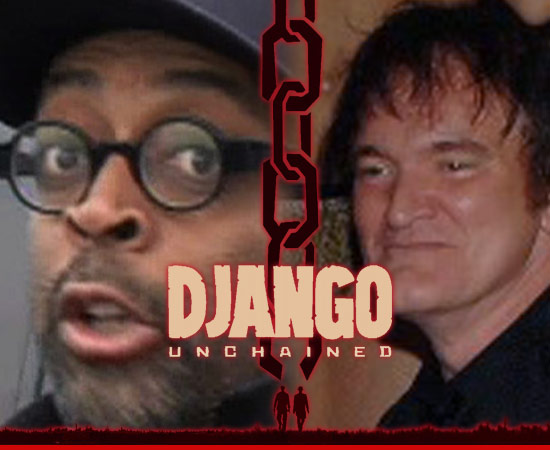
Now if you don’t have anything in particular you wanted to talk about, did you want to maybe address Spike Lee’s reaction to this film really quick?

GORDON: The Lee-Tarantino feud has been going on for a long time now, so I really wasn’t surprised that Lee reacted the way he did. I naturally wish he had at least seen the movie, but I don’t think it would’ve made a difference in his mind.

EVAN: To give readers a little context, director Spike Lee tweeted:

American Slavery Was Not A Sergio Leone Spaghetti Western. It Was A Holocaust. My Ancestors Are Slaves. Stolen From Africa. I Will Honor Them.

He also straight-up said “I cant speak on it ’cause I’m not gonna see it. All I’m going to say is that it’s disrespectful to my ancestors. That’s just me…I’m not speaking on behalf of anybody else.”

GORDON: I get where he’s coming from, but (1) I don’t think the movie dishonors the slaves and (2) I don’t think that there should be any time period off-limits for telling stories.

EVAN: I definitely agree with both points. Tarantino does not disrespect the plight of slaves during the time period, and there are really no eras of history that we shouldn’t be allowed to explore through various media. How it’s done is what matters.

GORDON: It’s Tarantino; you either love him or you hate him. He does a spastic, scatterbrained style of movie which is two parts tense dialogue and three parts references to obscure exploitation flicks. It is what it is.

EVAN: So did you like it?

GORDON: I did, but not as much as his other movies. And not for the subject matter, simply for the storytelling. I felt it was anticlimatic. Especially compared to his second latest, Inglourious Basterds.

EVAN: Very much agreed. You expect [SPOILER ALERT YOU’VE BEEN WARNED] Monsieur Candy to be killed by Django, or at least in a big way, but instead he’s just shot by Dr. Schultz with his sleeve-Deringer.

GORDON: And there’s still plenty left in the film, we just kinda trudge through it. I simply wasn’t impressed. I mean- I ain’t asking for a John Wu fightscene, but something more than [SERIOUSLY YOU GUYS, SPOILERS] Django shooting unarmed people from the top of the plantation stairs.

But as far as the whole thing goes, relatively amusing and a major stepping stone in addressing the subject of slavery.

EVAN: I mean, sort of going back to where Lee was coming from, it’s not a very realistic depiction by any means, a revenge story of this fashion can’t be. That being said, isn’t it the same sort of concept as Inglourious Basterds? Revenge enacted by the persecuted?

GORDON: That’s exactly what it is. A revenge fantasy. Bad guys being killed by the people who they oppressed. It gives us a feeling of divine judgment upon the wicked. Which is a theme a lot of westerns have.

REVENGE.

EVAN: I have seen at least one, and you are not wrong.

GORDON: I think what Lee needs to get is this:

This was not a movie about slavery, this was a movie about revenge set in the world of slavery. This wasn’t- and shouldn’t be- taken as a commentary of any kind about African-Americans anymore than Kill Bill should be taken as a commentary on women.

You wanna pick a fight with Tarantino, do it over something that’s actually there. (And just so everyone knows, I really like Spike Lee’s work and admire the guy as an individual)

EVAN: So you’re saying that slavery must be viewed as a backdrop, and not the subject matter? I know that you wrote your Monday post on this, but we can go over it just a little.

GORDON: That’s exactly it. It’s not a history film, it’s a Tarantino film. Don’t look for realism there, and don’t look for buoyancy in a nightstand; it’s not what either of them are for.

EVAN: I agree with you to a point, in that the exploration of slavery was in no means Tarantino’s intent. It’s just difficult to look past that as subject matter when it permeates the film [what with it opening up on a slave’s scarred back, etc].

GORDON: That is true, and you can question whether or not it’s right for Tarantino to use the subject matter to shock and horrify people and draw in crowds, but from what I saw and understood of the film the scenes of horror inflicted upon the slaves were, what’s the word for this, “respectful?” enough to indicate that even blood-and-guts Quentin wasn’t unaware of what he was dealing with.

EVAN: I can accept that. Two more thoughts as we wrap up this talk: the soundtrack and Samuel L. Jackson as a real life Uncle Ruckus.

GORDON: The soundtrack sucked. We can all agree on this. Usually he can make it work- this time he didn’t.

EVAN: My cousin and I actually really liked it.

GORDON: Really? I couldn’t disagree more. I felt it lacked cohesion, which the soundtracks in his other works normally have. Heck, more often than not it’s the commonalities in the soundtracks trying the whole thing together.

EVAN: I felt like the more contemporary hip-hop rap tracks were a little bit jarring, but thought the other songs overall were good picks.

GORDON: We’ll have to agree to disagree on that one. Let’s move on.

EVAN: Samuel L. Jackson’s character.

If you don’t know who that is on the right you need to start watching The Boondocks right now. Finish this post first, then immediately go find an episode online or something.

GORDON: I thought he knocked it out of the park. Didn’t have any problem with him whatsoever.

EVAN: 1) Did not know Samuel L. Jackson could play such a convincing old man. 2) Sycophants in films are normally played up for comedic value, and that is no less the case here.

GORDON: Let’s not forget that Jackson was not only an active member of the civil rights movement, but even associated with some of its more radical leaders.

EVAN: That is something that I, and presumably our readers, did not know.

To end this off, did you have a favourite moment in the film? [I SHOULDN’T HAVE TO WARN ABOUT SPOILERS, BUT I AM ANYWAY]

GORDON: For me, it would have to be the scene where Christoph Waltz (who really stole the show) was explaining bounty-hunting the Django in the bar. The dude is awesome to watch.

EVAN: Christoph Waltz’s accent was amazing. I could listen to him talk all day.

My personal favourite was the posse getting ready to go kill Django and Schultz and arguing about the masks. The dialogue was hilarious, and Jonah Hill was a nice surprise, too.

GORDON: That was awesome. And speaking of awesome stuff, our discussion topic for next week:

EVAN: Ah man, I kind of just want to talk about movies. Could we somehow generally address the trend towards big budget sci-fi flicks that’s coming about in Hollywood?

GORDON: No. No more movies. We do ’em too much already.

EVAN: Fine, fine. Suggestions?

GORDON: College: what should its purpose be? Careers or Well-Rounded Individuals?

EVAN: Or just in general, I’m not sure it has to go one of two ways. But that’s a good one. I’m on board.

Thanks everyone for reading, and for continuing to unwittingly stumble upon our blog in 2013! Evan and Gordon out.