Category Archives: language

Shame Day: Todd Kincannon

There’s an old supposedly Scottish proverb that goes,

“The only reason some people are alive is because is because it is illegal to kill them.”
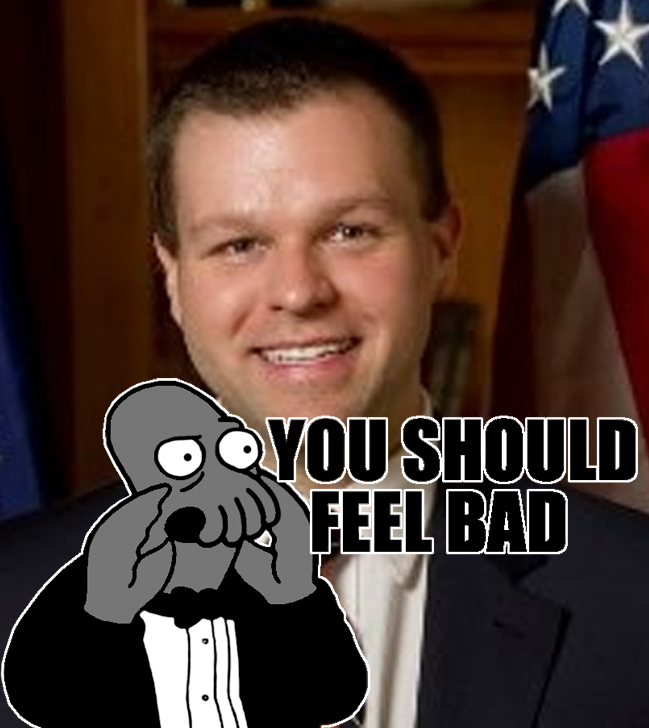
toddkincannon

This is perhaps truer of no one than former South Carolina Republican Party
executive director Todd Kincannon.

Now you’re probably all saying “Whoa there! Ain’t that more than a little harsh?

To which I respond: no.

This is a guy so twisted I feel perfectly comfortable with slapping the label “evil” on him and not losing a moment’s peace of mind. Let me break it down for you.

This guy makes Rush Limbaugh (the guy who came out in support of the genocidal, child-rapist “Lord’s Resistance Army” terrorist group in the Congo) look like Gandhi by comparison. Here’s what Kincannon posted regarding Trayvon Martin during the Superbowl:

And just to be sure there was no confusion as to his meaning, Kincannon continued on to post this:

Yeah, I’m going to give you all a moment to try to wrap your head around just how vile of a thing that was.

Ready?

Well, we’re moving on anyways.

Now I could spend the entire post breaking down Kincannon’s assumption that some high school kid gunned down by a gung-ho neighborhood watchman was a “thug” or that had he grown up, he inevitably would’ve resorted to “sucking dick” for “drug money,” but there’s oh so much more still to see!

Kincannon’s spent the past few days attacking Iraq war veteran Mike Prysner for his views on recently deceased Venezuelan president Hugo Chavez, offering such reasonable and level-headed comments as:

https://twitter.com/ToddKincannon/status/315693128914989056

And:

https://twitter.com/ToddKincannon/status/315697254180728832

Again, it’s kind of hard for me to feel guilty about my statement above when it has to compete with even the mildest of things this guy has to say.

https://twitter.com/ToddKincannon/status/315571885620473856

https://twitter.com/ToddKincannon/status/315673713553059841

https://twitter.com/ToddKincannon/status/315677582668468225

https://twitter.com/ToddKincannon/status/316410543760084992

What makes it all worse is that when this guy is confronted over his statements, he resorts to “free speech” arguments to evade any responsibility. He is correct in that he has the freedom to say whatever he so chooses, just as I have the freedom to stick forks in my own eyes or kick a grizzly bear- just because I have the right to do something doesn’t mean it’s the right thing to do. As far as trying to play off his statements.

In one interview, Kincannon out rightly stated that “If you say something that’s borderline offensive or if it is offensive, the people that attack you and say just the awfulest [sic] things about you, they do the very thing that they accuse you of.”

Evan does try to keep the blog relatively profanity-free, but this was really the only gif I could find that quite captured the feeling…

For anyone wondering, that’s the equivalent of punching a guy and calling him a hypocrite when he punches you back. But there’s more to it than just that.

Even if Kincannon truly does believe he’s nothing more than a witty prankster, he does have a following and his statements do get reactions out of people, including such gems as:

https://twitter.com/lrindl/status/315698741858426881

So we’ve effectively jumped from “This vet deserves to have died for holding political views I disagree with” to “every soldier who has come back alive is a coward and a disgrace to the fatherland.”

Again, if this is all some elaborate prank being played by Kincannon, we can’t ignore that it’s not being taken to lightly by his followers. I don’t think J.D. Salinger should be blamed because a nutcases took Catcher in the Rye to be code for “Kill John Lennon,” but when most everyone reading your work is coming away with homophobic, racist, sexist, and generally reprehensible messages, it’s time to rethink your medium.

https://twitter.com/BlakeHarllee/status/316427102201184257

If Kincannon’s playing some prank. Between you and me, I don’t think this is all that funny:

https://twitter.com/ToddKincannon/status/316410079152857089

What’s there left to say?

Todd Kincannon, you are an evil human being. Shame on you.

Evan, if there was ever a time to break Culture War Reporter’s no-profanity rule, it is now

No Post This Morning [What Does That Mean?]

Hey guys and girls, I really wish there was a more casual way to refer to members of the female gender that was on par with the term “guys.” I mean, honestly, I’m at the point in my life where I’m 22 and I no longer know whether I’m supposed to tell my friends that I saw a girl or a woman on the streetcar earlier in the day.

Anyway, to get to the point, this week has been a kick to the body as far as the blog goes. I’ve had a lot of work to do, and when I wasn’t doing that I’ve been playing through the Heart of the Swarm campaign. So it’s just been a big ol’ kick to the body.

A kick. To the body.

That being said, I haven’t even looked over the posts for this whole week, which I always do to fix all of the typos in Gordon’s posts and making sure he’s tagged them “Gandhi” and not “ghandi.” I will be doing all of that tomorrow, and I will also be finishing up said StarCraft II campaign.

I may have a post up late tomorrow. No promises.

My productivity has bowed before THE QUEEN OF THE BLADES.

Shame Day: Microaggressions

A few weeks ago I stumbled onto a website called The Microaggressions Project and then promptly forgot about it. Returning to it tonight I looked over the “About” page, which had the following paragraph at the top:

This project is a response to “it’s not a big deal” – “it” is a big deal. ”It” is in the everyday. ”It” is shoved in your face when you are least expecting it. ”It” happens when you expect it the most. ”It” is a reminder of your difference. ”It” enforces difference. ”It” can be painful. ”It” can be laughed off. ”It” can slide unnoticed by either the speaker, listener or both. ”It” can silence people. ”It” reminds us of the ways in which we and people like us continue to be excluded and oppressed. ”It” matters because these relate to a bigger “it”: a society where social difference has systematic consequences for the “others.”

A little later on they define what “microaggressions” are, a term that was originally coined to speak about racial experiences. From the essay “Racial microaggressions in everyday life: implications for clinical practice,” which appeared in American Psychologist, Vol. 62, No.4:

“Racial microaggressions are brief and commonplace daily verbal, behavioral, or environmental indignities, whether intentional or unintentional, that communicate hostile, derogatory, or negative racial slights and insults toward people of color.”

One example of this could be a White couple walking down the street and having a Black man pass by them on the sidewalk. The woman clutches her purse tighter against her body, the subconscious idea being, of course, that Black men are prone to crime and should not be trusted.

As an Asian-Canadian I’ve experienced microaggressions plenty of times. I’ve had someone ask me if I was half-White [I am clearly not] with their rationale being that my “English was very good.” It can be an everyday occurrence for non-White people [I deign to use the word minorities, since I do believe that balance is turning the other way], and begs the question: “Why is this such a big deal?”

Writer of the aforementioned article and author of Microaggressions in Everyday Life: Race, Gender, and Sexual Orientation, Derald Wing Sue, PhD, has observed that microaggressions have actually been found to: “(a) assail the mental health of recipients, (b) create a hostile and invalidating work or campus climate, (c) perpetuate stereotype threat, (d) create physical health problems, (e) saturate the broader society with cues that signal devaluation of social group identities, (f) lower work productivity and problem solving abilities, and (g) be partially responsible for creating inequities in education, employment and health care.”

In other words, a Black or Latino man being stopped for a “random vehicle check” by police could be upset, and may even be accused of overreacting. Maybe they should simply be used to this and not let it bother them. The truth is that it makes them feel, even if only subconsciously, like second-class citizens. It’s true in a case as blatant as this one, and in an as subtle an action as hanging a Confederate flag or  having a Native American stereotype as a high school mascot.

To broaden this to the scope that The Microaggressions Project seeks to attain, microaggressions can include people saying to a person with Asperger’s, with no ill-intent whatsoever, “That you seem so normal!” It can be a 17-year-old girl being told by her gynecologist that just because she has access to birth control pills doesn’t mean she can just sleep around.

Microaggressions work in every direction. It’s like going to a Vietnamese restaurant and being given a fork and spoon instead of chopsticks because you’re White and not Asian. Microaggressions are built on assumptions and can make people painfully aware of who they are. They are rarely meant to offend, but often do. 

It truly is a shame that so much of the time we send out microaggressions without so much as a second thought, and then defend ourselves by deeming the offended to be “too sensitive.” While we won’t always be aware of how our words or actions can harm others, we can at the very least listen to the people being hurt, and in doing so try to lessen the presence of microaggressions in our society.

The Good, The Bad, and The Evil

In an early Shame Day post I called a particularly reprehensible political lobby “what cancer would look like if it were a social movement.” While I continue to stand by that statement (this group was pulling the exact same ploy against Muslims that Middle Ages Christians used against Jews), a commenter did assert that I had gone too far, stating “as wicked or wrong as you think these people are, they remain human beings.”

It’s got me back to thinking on a subject that’s long held my interest- namely the issue of evil. You’d think it’d be pretty straight forward- right is right and wrong is wrong- but let me get right into an example.

Was this guy evil?

No question. Hitler and his followers aren’t simply evil- they’re the go-to example of evil. They’re our baseline for evil. Everything vile and nefarious is measured against either Hitler or the Nazis.

So what about this guy?

Columbus’s long-list of achievements (discovering America not being one of them) read more or less as a chronicle of genocide, slavery, and theft. It’s well known, certainly at this point, that Columbus was a greedy, narcissistic, tyrannical, and corrupt man. Even with streets, cities, a holiday, and even an asteroid commemorating him, surely we can all agree that this guy was evil. Not on the level of Nazi Germany, but still indisputably evil.

But what about him?

Yep, that’s Thomas Jefferson. President.  Founding Father. Author of the Declaration of Independence.

Slave owner.

Not just a slave owner, but an abusive one- carrying on an affair with one of his slaves (that slave also being his wife’s half-sister), getting her pregnant multiple times, and then promptly allowing his own children to spend the rest of their lives as slaves.

Pretty depraved, eh? If I did any one of these things, I’d be called out as a first-rate ******* (and rightly so). I’d be called evil, and that would be telling it like it is.

But let’s move on.

Is this guy evil?

That’s J. Edgar Hoover, founder of the FBI, which he oversaw with about the same leadership you’d expect from some Stone Age self-proclaimed god-king. Hoover was an egoistical, jealous, paranoid man who used the FBI to advance his own political agenda. In addition to all of this, Hoover was a rabid racist, and struggled long and hard against the Civil Rights movement, targeting MLK Jr. in particular, as well as spearheading a campaign to undermine the Black Power movement of the 1960s. Would you call this guy evil?

Ok, what about them?

Yes, the average American family (not pictured above), or heck, even just the average American? Our money goes to supporting companies that use sweatshop labor. Our money goes to supporting companies that recklessly destroy the environment. Our money goes to supporting corporations that push objectifying ads (especially, but not exclusively, in regards to women).

Our taxes go to supporting dictatorial regimes (such as former Egyptian president Mubarak), racist and apartheid states (such as Israel), and even states that utilize child soldiers.

Where does that put us?

Now all of that is simply to illustrate the apparent complexity of the issue. Evil is evil, yes, but pinning down exactly who is and isn’t evil becomes a little more complex once we look at someone other than the Nazis. Jefferson was instrumental not only to the founding of this nation, but to the establishment and perpetuation of the core concepts of democracy and human rights- even to the point where Martin Luther King Jr., a man whose ancestors Jefferson owned– wound up quoting him in his iconic I Have a Dream speech.

Likewise, there’s the issue with the average American. Almost none of us would actually be able to manage a sweatshop, or put an assault rifle in a twelve-year old’s hands, at least, not in person. Despite this, our economy is built on the backs of Bangladeshi kids working for twenty-five cents an our. Our security (we are told) is predicated on us coordinated with nations whose human rights records are drenched in blood (*Cough*China*Cough*Saudi Arabia*Cough*Columbia*Cough*). The vast majority of us either don’t know or don’t care; not enough to raise a voice in protest, anyhow. Again, what does that make us? We might not be ourselves actively implementing imperialism and violence and despotism, but we still do rake in the rewards and howl for more.

We could try arguing innocence by virtue of not being the ones pulling the trigger on any of this, but the truth that history has taught us over and over is that simple knowledge of an injustice creates moral culpability. To ignore injustice equates with committing injustice. We simply can’t escape it.

Not without risk of being hunted down by zealously religious Irishmen…

And maybe that’s the answer. Maybe we can’t be so picky about where we draw the line between right and wrong. Maybe the answer is sweeping judgment. That’s not meant to be some fire and brimstone-esque statement, that’s simply a fact of the matter. You’re not good and evil only when you embark on a mission of genocide- you’re a participant in a viciously evil system until such a time as you act otherwise. You’re part of the problem until you’re part of the solution.

That’s not to say that you have to be flawless. You’re not going to be able to do that (neither am I, for that matter)- in part because we’re human, and in part because the world we live in simply isn’t going to cooperate. But people, we can at least try. I don’t think making an effort to not totally **** up the planet and all that’s in it is really all that much to ask, do you?

Shame Day: Sexual Standards

asdfasdI’m double-posting today, so this week’s Shame Day is a little late [I try to update the blog before noon] but is brought to you by a topic I haven’t addressed much as of late: the wonderful world of comics.

Yesterday it was announced by various comic book news outlets that the newest title out of the Marvel NOW! line of books would be X-Men, written by Brian Wood and illustrated by Olivier Coipel. An X-Men title is certainly nothing new, but it is when the entire cast of said title is female.

Wood was interviewed in an article by USA Today, and had the following things today about the characters he’s writing:

Wood also promises to bring a lot of relationships, love and sex into the book, “in the classic X-men way — the way it used to be.”

He wants to challenge the double standards that have been in superhero books for years, where Wolverine can sleep with anybody but if a female character does it twice, she’s promiscuous, which Wood sees constantly online.

“To everybody’s credit, these people are often shot down immediately for being sexist and unfair, but that is a very common thing,” Wood says.

“We’re just going to do it. We’re not going to worry about that. If Kitty or Rogue has basic human bodily urges, tough luck (to those opposed). To me, that’s as much of the X-Men as anything else.”

It is certainly not news that this double standard exists, and I’d been thinking about this for a while due to my having watched most of Season 4 of How I Met Your Mother this past Thursday. It didn’t take more than a few minutes of watching Barney Stinson before it occurred to me that:

Barney Stinson is pretty widely known to be both a prolific and successful womanizer. He sleeps with women the way most people go to work: five times a week, maybe six to get in some overtime. He’s admittedly a painfully funny character, but also one that is congratulated for his sexual prowess.

Now take a female character and put her in Barney’s shoes. Thankfully, times are certainly a’ changin’, and I can actually point to one half of the roommates in Don’t Trust The B—- In Apartment 23, Chloe. She is a person who treats her sexual partners with just about as much respect [if not less] than Barney Stinson, and the show has for the most part done a great job not demonizing her for it.

The fact of the matter is that in most cases Chloe would be dubbed a slut. Is there a male equivalent for the term in the English language? An article I found on The Independent explores this very question, and ends up admitting that words like “roué” or “swordsman” or “playboy” all work as far as describing what I’ve mentioned, but don’t really “convey much sense of moral contempt and several of which are tinged with admiration.”

What I’m pointing an accusatory finger at this Shame Day is the fact that we hold as a culture a sickeningly obvious double standard. I’m not one who particularly praises rampant sexual promiscuity, but I certainly hope that I if I did I would be able to hold both with an equal amount of esteem.

This post is to shame those who give the Chloes of this world the finger with one hand while high-fiving the Barneys with the other. It’s also to give the bit of credit where it’s due to Brian Wood and to all others who realize how it is we view men and women, and who go out of their way to work against that.

As a parting note, it’s nice to know that even the characters within the comics have noticed this:

She-Hulk #17 (Vol. 2). Written by Dan Slott, illustrated by Rick Burchett.

Django and the N-Word

Let me begin by explaining that this is not a review of the simultaneously acclaimed and decried 2012 Tarantino blood-fest. You want to hear one of those, I’d recommend clicking over to Spill or The Escapist’s “Escape to the Movies.” No, what I want to talk about are some specific elements and segments of the film which have become points of contention, controversy, and debate in the past weeks.

Let’s start with the most obvious:

I. Saying “Nigger” Every Other Word

I won’t claim to know your stance on the word “Nigger”- heck, I’m not even sure of my own stance. Perhaps you view the term as so degrading and reprehensible as to merit burning it from spoken language. Perhaps you believe that appropriating and using the word strips it of its power to even be used as an insult. Maybe you see it as being purely contextual- a term of address with audience and a terrible insult with another.

It’s all Elmo ever thinks about

There are probably strong points to be made on all sides, but perhaps the stance you cannot take is that the use of the word “nigger” was inappropriate for the movie.

Now before you take up the battle-cry of “Tarantino is just trying to shock us!” or “Tarantino uses the word excessively in his other movies!” I have to say this.

You’re right.

It’s Tarantino; that’s not an excuse, that’s a fact. You wanna take up his use of the word in other films, then that’s part of the whole debate mentioned above. Simple truth of the matter is that this use of the word “nigger” would still be controversial if the film had been made by anyone else. So let’s talk about it.

Let’s assume that this movie, with selfish or noble intent, is trying to demonstrate a glimpse of the world in question; the use of that word is almost bound to come up. I might throw out the example of Mark Twain’s classic novel Huckleberry Finn, and while by sheer volume Django probably has Huck beat for use of the word, by percentage I’d posit the two are pretty evenly matched. The escaped slave Jim is repeatedly and almost exclusively referred to as “Nigger Jim,” as are the other black characters in the book. Now Twain was anti-slavery and used that word to demonstrate the dehumanization of African Americans (which is why taking the word out of versions of the book is so dumb), as well as reflect the general use of the word. Now I’m admittedly no historian, but if the writings of Twain and other authors are any indication of the times, I wouldn’t say the film is quite so far off as some critics might suggest.

And speaking of historical accuracy…

II. The KKK, or Lack Thereof

There is a scene in the film during which a group of men wearing white sacks over their heads attempt to stage an attack on Django and Schultz. New Yorker contributor Jelani Cobb writes “Tarantino depicts the K.K.K. a decade prior to its actual formation in order to thoroughly ridicule its members’ (literally) veiled racism.” While that scene was (in my own opinion) side-splittingly hilarious, Jelani, and many others, are dead wrong in assuming that this scene depicted historical inaccuracy.

Take this section from Huckleberry Finn:

Why don’t your juries hang murderers? Because they’re afraid the man’s friends will shoot them in the back, in the dark — and it’s just what they WOULD do.

“So they always acquit; and then a MAN goes in the night, with a hundred masked cowards at his back and lynches the rascal. Your mistake is, that you didn’t bring a man with you; that’s one mistake, and the other is that you didn’t come in the dark and fetch your masks.

Again, this is a Tarantino movie set in a Tarantino universe. That’s not a defense, simply, as I’ve already stated, a fact. If you’re looking for a historical account of the pre-war South, a spaghetti-western revenge flick probably ain’t the best place to look for it. There are going to be certain inaccuracies, and there are going to be things the filmmaker has to get right- but all of that is beside the point (which we’ll get to in a minute). All of that’s to say if you’re gonna try to criticize (or praise) the movie’s deviation from historical truth, make sure you’re (1) doing it for the right reason and (2) that you’re critique is actually right.

III. Samuel L. Jackson as Uncle Tom

In Django, Samuel L. Jackson plays the role of the villain’s head-slave Stephen, who isn’t so much a character as a caricature of the most groveling, snivelling Uncle Tom you will ever see or even imagine. This guy makes Uncle Ruckus look like Eldridge Cleaver.

You are guaranteed one genuine Gordon hug if you know who Eldridge Cleaver is.

I’ve heard people call this portrayal offensive, bordering on “black-face” in its depiction of stereotypical “black” mannerisms. It’s exactly for that reason that I didn’t have a problem with the character.

I really have no reason for putting this gif in here…

See, the entire point is to make fun of the guy- and not just him, but the quisling slaves that did indeed exist. I don’t think that this portrayal robbed the film of the gravity of slavery anymore than Bugs Bunny foiling a cartoonized Hitler robbed WWII of it’s gravity.

Now let’s get right to it-

IV. The Horror, The Horror

LA Times journalist Erin Aubry Kaplan said this of Django’s depiction of slavery: “It is an institution whose horrors need no exaggerating, yet Django does exactly that…”

This is a flat-out falsehood.

If Django Unchained exaggerated the horrors of the slavery, if the film depicted one one-hundredth of the horrors of slavery, I will never write again. Despite the allegations of this critic, the truth of the matter is that we could depict the institution of slavery for a century and be no closer to depicting an ounce the inhumanity of it all than when we first started. Does the film exaggerate slavery? Absolutely not. Does it make light of it? Certainly this was a concern of mine going into the movie, but having seen it, I really don’t think it can be faulted there either. The film does, I believe, make a distinct effort to show slavery as brutish and ugly as possible. Or, at the very least, the slavery scenes; this is, after all, a revenge movie first and foremost.

V. The Point

That’s the thing I feel most people are missing here. This ins’t a movie about slavery, this is a movie with slavery in it. It’s a revenge film in which one sorely persecuted character dispenses well-deserved justice upon his persecutors and we all nod our heads in approval and feel a sense of pride and joy well up as we look into this fantasy where the bad guy does get what’s coming to him. Slavery is the backdrop, not the subject, of the movie, but it’s just such a major issue that most of us are getting hung up on it. The equivalent might be bashing a western on the basis that the actual “wild west” was pretty peaceful- factually true, but still missing the goal of the story.

No, this is not a historically accurate film. No, it doesn’t capture the horror of slavery. No, it doesn’t even try to wrestle with it. No, it’s not a discussion of our checkered heritage. No, it’s not the film to drag that dark, bloody history out into the light of day.

But damn it, it’s a start.