First off, let me tell you that I like rap music. As I said in a previous post, I unabashedly love the King Fantastic Remix of “Drive It Like You Stole It.” On the other end of the spectrum, I also have a huge appreciation for artists like Macklemore who use the genre to tackle issues like drug abuse and homosexuality [while sounding good doing it].
EVAN: Ladies and gentlemen, children with surprisingly discerning taste, Gordon and I have managed to look past the weariness of a day of work to bring you a new installment of Evan and Gordon Talk.
EVAN: This topic arose organically, actually, due to a few posts by Gordon on piracy and my not being able to fully agree with them.
And no, it’s not that kind of piracy, though we did start a new pirate-themed D&D game just this past Sunday.
GORDON: And it shall be awesome- but back to the subject at hand. I’m going to start with some full disclosure:
I am not of the mind that piracy is, in and of itself, a great and noble thing. Any indication or implication of this on my part is usually just in reaction to the mainstream media’s portrayal of piracy as a crime on par with defacing priceless art, grand theft auto, and punching old ladies in the face.
EVAN: And in all fairness from my part, I will admit that I’m no saint when it comes to piracy. I stream a plethora of shows for my viewing pleasure, though I have [and this is likely the voice of Justification speaking] sworn off downloading full-length films, music, books, etc.
GORDON: And Evan, I will attest, is not some twisted chaos-worshiping miscreant devoid of honor or humanity, as the major media industries would have you believe. Well, not entirely, anyways.
Now, Evan, one of the justifications I’ve heard you use in the past is that you’re living in Canada. Many- if not all- US shows are simply unavailable outside of the States through any conventional means.
EVAN: This is true. And while I resided in the States for my post-secondary education I made frequent use of the free streaming service Hulu. I even watched, and somewhat enjoyed, the ads.
In Canada we cannot even watch the episodes on the channels’ respective websites [NBC.com, CBS.com, etc.]
GORDON: And you’re certainly not alone in that. The vast majority of the world is in the same boat, forced to choose between piracy or waiting a few years for the DVDs to come out and then pay an exorbitant fee plus crazy shipping costs. Better hope your purchase isn’t damaged en-route.
EVAN: Since we have been so good about being fair, I will point out that there are options- many television episodes are available to buy via Amazon, online. Before you ask why you should pay for something you would otherwise get for free I’d point out that you pay for these shows by watching ads, and that as someone not in the States you would not “otherwise get it for free” to begin with.
GORDON: And that’s something I can actually tolerate. In spite of my muting ads and/or talking back to them while giving the corporate pigs the finger, I’m perfectly willing to subject myself to ’em if it means cheap and convenient access.
EVAN: If I recall our time together in college correctly [which we both know I can, and do], I distinctly remember you blocking said ads with Adblock.
GORDON: Even though it meant the waiting time was ultimately longer.
EVAN: Which is besides the point. But let’s continue onwards: is piracy damaging?
GORDON: The continued existence of Hollywood, as well as the ever increasing budget of films, would seem to indicate otherwise.
There are people out there who might try to argue that piracy hurts new musicians, who can’t afford to lose profits like big businesses can, but that’s a flawed argument. Truth is, musicians only get a sliver of the profits they generate, and wind up losing the rights to their own songs in the process. Working independently with the consumer is generally a safer and more profitable move.
EVAN: I will not argue with what you have said about musicians for a second. The amount they make through selling single tracks on iTunes is deplorable.
What I will point to, however, are the other areas where piracy can [and does] occur. Television series live and die based on their ratings, and buying them does nothing to help what’s perfectly good [if not great] television. Similarly, if only 1,000 people decided to download a new issue of a comic book instead of simply paying the three or four dollars, that could mean the end of that series; titles that dip below 20,000 are typically cancelled soon afterwards.
GORDON: I agree wholeheartedly. But I think that speaks the whole reason piracy exists- not malice, but rather cost and convenience. These people- especially television producers- have got to understand that their old metrics for measuring the popularity of shows are dead.
It’s the equivalent of saying communication isn’t popular because house phones are dying out. No, we’re just turning to new, cheaper, and more convenient methods. Piracy could be dealt a deathblow if these major industries would just step up their game, rather than trying to use lobbies and buy off politicians to keep us dancing to their tunes.
EVAN: The thing is, I think in arguing for “cost and convenience” you run the risk of defending those who just a) want to get quality products for free b) whenever they want.
It’s not just that people want ease in accessing what they love, the truth is that when given the choice between paying and not paying people will always opt for the latter.
Not to bring it back to comic books [who am I kidding, it’s what I do], but you putting down a few dollars means that a talented writer or artist is able to keep on doing what they do: providing you with high-quality stuff. That’s an actual case where piracy can severely jeopardize both artists and their art.
GORDON: Again, I agree. I do believe in paying for what I love. My record collection stands as a testament to this, as does my choice to spend a few extra bucks buying beer produced by one of the few ethical companies on this blighted earth.
Tell me this- you like the show New Girl, right?
EVAN: Immensely.
GORDON: Would you pay fifty bucks American to watch the show at 4:12 (and ONLY at 4:12) in the afternoon?
EVAN: I would not.
GORDON: How ’bout ten cents to watch it whenever you so desire?
EVAN: Yes indeed.
GORDON: You and millions others, am I right? Ten cents for a crisp, working copy rather than some choppy, blurry pirated version where the sound and video are out sync?
EVAN: Oh, I stream at only the highest quality.
GORDON:That’s my point, I guess. Yeah, there will always be people out there who don’t want to pay the ten cents, but overwhelmingly, that kind of price and convenience will make such a minority negligible.
I assert again that piracy doesn’t exist because millions of people are art-hating maniacs, but because the business plans of these networks and companies are painfully obsolete and short-sighted, especially in regards to the international market. Heck, I’d say such changes could ultimately lead to these companies turning a healthy profit- especially if they just included some advertising à la early Hulu.
EVAN: Here’s the thing, the US already has a working model of what you just said. As I mentioned you can purchase episodes of stuff on Amazon, and I’m talking $2 an episode. That is reasonable. I don’t think your average American would look at that price and think, “There’s no way in Hades I am spending two dollars on a 45-minute episode of television that I can keep forever.”
Yet in spite of that, people in America still download TV shows all the time. If it doesn’t work for them, what makes you think they can extend something like that to the rest of the world?
GORDON: Firstly, I disagree that 2 bucks is reasonable for an episode. That’s the cost of an entire dinner right there. How much more so is that going to be true for the rest of the world, who have even less?
I mean, we’re not talking about a book or a record which goes through an intensive manufacturing process for each copy- we’re talking digital here. Every man, woman, and child on Earth could be given every book, movie, song, and piece of art on earth if the masters so chose…
EVAN: Gordon. It’s two dollars. The average American does not spend that much on a full meal, they spend that much on stuff they don’t need, like gum or coffee or inane tabloids. As a country America is more than able to pay that paltry amount and yet they do not. My point stands.
I’d further argue that since it’s digital that ease of access adds, not detracts, from its value. You can watch it whenever and wherever you want.
GORDON: What I mean about it being digital is that it doesn’t cost money (anything noticeable) to reproduce it, unlike hard copies of things such as books or art. With that mind, charging two bucks an episode seems to me to be unreasonable. I’d cite the fact that for 20 dollars you can get a season of a show with (at least) 20 episodes as proof of this. The cost can, and should, be lowered for great consumption.
EVAN: Like I said, we’re adding availability as a variable. Sure, you can pay 20$ for a full season of a show, but that’s waiting a year or however long it takes for it to come out. People are also paying for the availability of getting it when or soon after it airs.
GORDON: That’s gonna be different from company to company, but for the most part, that’s true. But I’d jump back to my complaint about how little the actual artists get in all this. If anyone- anyone– is gonna set a price, let it be the ones producing the work.
EVAN: Honestly, though, that’s an entirely different argument.
The fact of the matter is that if a writer/artist wanted to print their own comic book there’s no way they’d be able to do it on any significant scale on their own, the cost of printing alone would wreck them.
Different industries pay those who work in them different amounts, and it’s not the topic of our conversation this week.
GORDON: Again, my issue isn’t with the fact that we must pay; we can all get behind this. My issue is with the terms and conditions we’re subjected to- especially when big companies start throwing their weight around to slow progress.
If piracy is the rampant issue that they say it is- and I seriously contest that- then I submit that the fault is on their part for adopting inconvenient, pricey, and exclusionary policies. Let me put it this way: If you say apples can only be purchased by people who’ve climbed Mount Everest, you’re gonna create a lot of apple thieves.
EVAN: We’ve left you a lot to think about, even if you’re not someone who refreshes a website over and over waiting for a new episode of 2 Broke Girls to pop up [did you know I review that show?].
So with that ladies, gentlemen, and genius babies, we bid you a happy Wednesday. We came up with this week’s topic, but you can decide if next week we talk about . . . um . . . Dungeons & Dragons. How we’ve chosen to play it and why we think it works [better?].
GORDON: Alternatively, you may vote that we discuss the role of religion in our (relatively) secular society.
EVAN: Thank you, as always, for reading, and please vote!
Normally, Thursdays here at Culture War Reporters is dedicated to “Fame Day,” in which Evan and I call attention to people, events, or trends we think aren’t getting the attention they deserve.
But not today.
Partly due to my illness, partly due to some unforeseen time constraints, and mostly because of the severity of the issue in question, today there will be no Fame Day.
Instead, we’ll be performing an emergency Shame Day on the subject of yesterday’s terrible news that five major internet service providers (ISPs) will be implementing a “six-strike” system on people suspected of copyright infringement.
Let me break it down for you.
Normally, when you sign up with an internet provider, exactly what you do or don’t do with your connection is entirely and exclusively your business. Whether it’s something as impressive as you doing an electric guitar cover of the hallelujah chorus or as lousy as writing a thousand comments calling that same YouTube video gay is all up to you. What you read, what you write, what you post, what you view- the ISP is simply there (as the name states) to provide internet.
Now you’re probably thinking “Hey- just don’t pirate stuff and you’ll be fine!” and you know what?
You’re right. You don’t have to pirate.
I’m taking over from this point on for a number of reasons. For the most part because although Gordon had good things to say, he didn‘t necessarily say them well, and in some cases didn’t make very much sense; we’re going to chalk that up to his recent illness. I will be relating to you what points of his that I can, while adding my own.
-Evan.
Gordon’s next point is that for the most part, many people pirate because of time and money. Focusing on time, the truth is that we can’t always guarantee that we’ll be at home on a Thursday night to catch The Office. Maybe we’re working another job [many of us need to], or maybe we just forgot. What options does this leave us?
For those of us in America, Hulu is always an option. The on-demand streaming site once provided a very broad range of TV programming, and Gordon points out that it’s a fantastic resource, or at least used to be. Nowadays, however, it’s a lot more difficult to use than it used to be. Hulu Plus, which requires a subscription, is needed to watch a lot of older shows, sometimes even episodes that aired a month ago, if New Girl is any indication. With one of the most convenient resources made less so, is it any wonder that so many people simply turn to torrents?
Gordon’s next point, and a very valid one, is this issue of the Six Strike System and how it relates to piracy. There’s an issue of what exactly is at stake here. Gordon insists that the answer to that is everything, and while I’m not fully with him on that, there’s some sense to what he’s saying.
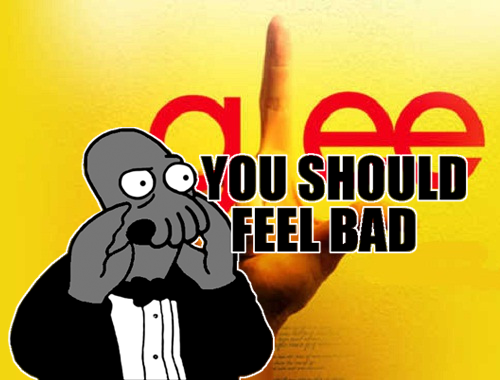
The thing is that almost anything can be considered copyright infringement. YouTube covers, memes [which often use screenshots of shows like Futurama {see: our Shame Day image}], Gordon’s beloved gifs, even many of the pictures of this blog, in spite of being Photoshopped, don’t technically belong to us. Would we have our internet cut because we run this blog? [Answer: I wouldn’t, because I am Canadian.]
To finish off what Gordon wrote earlier today, the issue is that the people in question aren’t being penalized by an international agency, or even the state or federal government. The fact of the matter is that these ISPs are “using their lobbies to persecute and prosecute suspected users without due process” [quoting Gordon]. What truly incensed him more than anything, though, was the way they’re going about it. That they’re holding themselves up as Knights of Good when in reality they’re just proud that they’re “selectively picking off anyone their bosses deem a threat to their unending stream of profit.”
Piracy is not a subject I agree with Gordon on, and in fact I had a very hard time letting his last piece on the subject be put up on the blog. If people really, truly love art, whether it take the form of television or movies or video games they need to vote with their wallets and know that what they love is worth spending money on.
That being said, I do believe that what these ISPs are doing is wrong, particularly in that they have no one to be accountable but themselves. No business or corporation should have that right. Shame on these ISPs, and shame on the Center for Copyright Information.
EVAN: The particular topic of discussion that comes to us today is more one that finds itself passed back and forth within Christian circles, and that is: “Why is Christian media so bad?”
GORDON: I think the problem is self-imposed by the religion (I use the term loosely) itself. We’re not talking about a lack of funding (we’ve got plenty of good low-budget films), or a lack of good directors (there’s plenty of decent talent out there), we’re talking about an issue that runs right down the core of it all.
“Christian” media can’t just be media- they have to drag in everything that goes with it.
EVAN: So basically what you’re saying, and we talked about this a little earlier, is that Christian media more often than not has an agenda, correct?
GORDON: I’d say plenty of it has an agenda, but no, I don’t think that’s the core issue- there’s plenty of other preachy movies out there.
EVAN: So what are you saying, exactly?
GORDON: I’m saying that “Christians” can’t make good media because they won’t allow themselves to. Every protagonist has to fit the moral code to a tee, so that they wind up as either Aslan 2.0 or the epitome of Christian morality: John Smith, the middle class suburban, patriotic family man. Which is why I keep putting “Christian” in quotation marks.
We’re not talking about Catholic peasants in El Salvador or the East Orthodox Church in Ethiopia.
EVAN: Okay, I like that a lot, this idea that those creators of Christian media [and primarily I think we’re talking about films] box themselves in. They’re telling the same sorts of stories to who they perceive to be their audience [and they’re not wrong]: white suburban middle class families.
To sort of break this up a little, I actually saw a Christian film that was reasonably passable at some point last summer.
GORDON: Was it related in any way to Steve Taylor?
EVAN: Is that any way related to “End of the Spear”? It was not, if that’s what you’re referring to.
GORDON: Steve Taylor is the only good Christian musician who ever has or ever will have existed.
But anyway, what was the movie you saw?
EVAN: It was called “To Save a Life,” and it stood out for a couple of reasons:
1) The cinematography was shockingly good for something produced and made by Christians. You can tell which movies they are within the first few seconds.
2) The “villain” of the piece was actually the pastor’s kid. Which was- refreshing, and kind of nice.
It kind of broke out of the whole stereotype you introduced earlier.
GORDON: Huh- interesting. I’ll have to check out the trailer. But let me ask you this:
Can a Christian make a James Bond movie?
EVAN: You mean a movie starring a suave, debonair British man who beds women and guns down henchmen as naturally as he dons his suit jacket every morning?
I’d say no, probably not.
GORDON: I think that’s the problem. It’s not just that you can’t have any explicit sex or graphic violence or excessive profanity (which are overused and abused as is), you can’t have anything even remotely sensual or rough or crude. It rips away reality and humanity in the name of not stepping on anyone’s toes.
Self-imposed legalism.
EVAN: Well, I’d say the difference is that you can’t have a protagonist who glorifies such things as wanton sexuality-
I say that Christian filmmakers will never produce anything like James Bond because of who the character is.
GORDON: Did you like the movie “Fight Club”?
EVAN: I liked it a fair amount.
GORDON: Did you like “Ocean’s 11” or “Snatch”?
EVAN: I haven’t seen the latter, but I very much enjoyed the former.
GORDON: Did you like “Superbad”? “Kick-Ass”? “Ironclad”?
But I think you’re going to have to get to your point-
GORDON: Could a Christian make any of these movies?
EVAN: I think a Christian could, yes. In relation to “Fight Club”, at least, Christian author Ted Dekker has penned novels [sold both in and out of Christian bookstores] which offer a fairly decent psychological thriller aspect to the reader.
GORDON: Ah, Dekker. The whole reason he stands out as an exception is- I believe- that he grew up among Indonesian headhunters, and not in Middle America. Again, it’s about having that different perspective on life.
EVAN: And I think what he’s realized, as a creator of the arts, as someone who has a hand in shaping Christian media, is that you can have these other sorts of exciting, thrilling stories told with a faith-built worldview. People of every religion want a little excitement.
GORDON: Of that there’s no question. The heavy use of the video library at our school stands in testament to that.
But again I think the issue is that “Christian” self-imposed isolation inevitably leads to the vast majority of their work winding up as “White People Problems” or “Chronicles-of-Narnia-minus-the-good-stuff”…
EVAN: Or “Lord-of-the-Rings-but-way-more-heavy-handed.”
GORDON: Exactly.
EVAN: I mean, we’ve talked a little bit about why Christian media can be bad [terrible production values, cookie-cutter story lines, sheer absurdity], but how could it be better [to harken back a little to our last talk]?
GORDON: They have to stop being terrified of the big bad world. They have to realize they can show characters with flaws- real flaws- not drunkard stereotypes and the occasional swear word.
Saying this will get you expelled from Liberty, Pensacola, and BJU
EVAN: I mean, a deeply flawed person who finds redemption is a much more compelling story than a white bread sort of guy with his middle class problems.
And they have to stop coddling their audience. Yes, Christians turn to Christian media for “better alternatives,” but the odd cuss word won’t negate an overall positive message; neither will a fight scene, or two guys sitting around enjoying a beer.
GORDON: There’s this one scene in a (Christian) movie Steve Taylor directed:
A character hurts his hand loading something into the back of van. He lets loose a cuss word and his buddy chides him for it, saying “God don’t like it when we cuss.”
Later on in the film, the buddy hangs his head and apologizes, saying “I’m sorry. I was upset that you cussed- I should’ve just been upset that you hurt your hand.”
EVAN: Wow. That is very, very good.
GORDON: That right there is the problem not just with Christian media, but with the whole religion.
EVAN: Misplaced priorities.
GORDON: More obsessed with present clean-cut paragons of middle class etiquette than anything really real.
That’s why we turn to “secular” movies for actual substance. The struggle for identity in “Fight Club”, the heroism in “Kick-Ass”, the friendship in “Superbad.”
EVAN: I think what’s really ironic is that Christian media-makers have a Christian-made work out there that’s immensely popular. “The Hobbit: An Unexpected Journey” came out just this past December.
GORDON: I again reference an (alleged) quote by Steve Taylor.
“I’m not a Christian artist- I’m an artist who is Christian- it affects what I do.”
EVAN: Really well-put. And something that a lot of us [I speak for many in our graduating class] as writers, musicians, artists, et cetera would benefit from keeping in mind.
And that puts us more than a little overtime.
GORDON: Well, people, you know what that means. Time to vote on our subject for next week.
EVAN: My contribution this time around is . . . wow, I never think ahead . . . masculinity. You’ve done a post about “Manly Culture” in the past, but I want to talk about what it is at present, and how we feel about the shifts and trends and things.
GORDON: Interesting subject. I submit we speculate on the upcoming Star Wars movies.
EVAN: If you think you’re up for it, then yeah, cool. I’ve read quite a few of the post-original-trilogy books, so I know a reasonable amount about the subject.
GORDON: Nerd.
And with that witty response, we’re out! Have a good night, everyone.
To begin with, I’m not a huge fan of Glee. I am a man who can say with confidence how much he loves musicals and acapella arrangements, but the show’s claim to be a melting pot of diversity [a place where Black people, Asians, homosexuals, and the disabled can belt it out to their hearts’ content] is not one I find myself agreeing with. But that’s the topic of another post.
The issue being that Coulton released his own version of the song in 2006, which you can check out [and should, for comparison’s sake] here:
If you really want to scrutinize the two side by side, there’s a track on Soundcloud that simply places both tracks on top of one another [and an in-depth audio analysis, for those of you into that]. Coulton’s issue isn’t simply that Glee seems to have stolen his arrangement, but did so to the point where unique elements he added were copied as well. A duck quack is used to censor an expletive, and [this is practically impossible to ignore] the lyric “Mix-a-Lot’s in trouble” is replaced with “Johnny C’s in trouble” in both versions.
As he has kept the blog post constantly updated, four days ago he announced that having gotten in touch with the people at Glee, the following information was relayed to him:
They also got in touch with my peeps to basically say that they’re within their legal rights to do this, and that I should be happy for the exposure (even though they do not credit me, and have not even publicly acknowledged that it’s my version – so you know, it’s kind of SECRET exposure). While they appear not to be legally obligated to do any of these things, they did not apologize, offer to credit me, or offer to pay me, and indicated that this was their general policy in regards to covers of covers.
While Coulton is unsure of his exact copyright claim to the track, he had obtained a Harry Fox license to release it on an album alongside his own original music. His response is, refreshingly, a mature one in response to this whole ordeal.
In his interview with Wired magazine Coulton shared a very simple solution for the show that spends millions per episode. He suggests that “they could offer to pay artists whose arrangements they use the same amount of money they would otherwise pay a musical arranger,” and that “if they opened with that, I’m sure a lot of artists would jump at the chance.”
Somehow, this isn’t the first time this has happened. Singer-songwriter Greg Laswell’s cover of a song made famous by Cyndi Lauper, “Girls Just Wanna Have Fun”, was also seemingly ripped off for an episode in November 2011. I’ve embedded the two songs for you to compare once again [and because I’ve gotta break up this wall of text somehow]:
It remains to be seen whether or not Coulton’s lawyers will be able to take legal recourse, but for the time being I’m happy that the show is finally being taken to task by those who believe that creativity should be rewarded and acknowledged, not plundered.
GORDON: You know what they call a quarter pounder with cheese in France?
EVAN: What?
GORDON: A poor attempt at distracting our readers from the fact that we ain’t gonna be talking about drugs like we said we would.
EVAN: I have seen very few Tarantino films, and only barely recognize the references.
GORDON: You make me sad.
EVAN: I know.
That aside, what we’re going to be talking about today is Django Unchained, a movie I finished watching less than an hour ago and the subject of this Monday’s post [written by Gordon].
GORDON: So what did you think?
EVAN: Initial thoughts are: Very long. Not what I expected. Apparently in Django’s world everyone is a skinbag filled to bursting with blood.
GORDON: Speaking as someone who’s fired black-powder guns, I can actually kinda see something like that happening.
EVAN: That is ridiculous, but interesting to know.
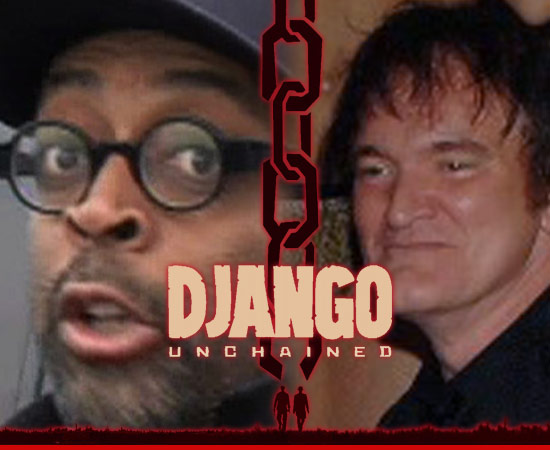
Now if you don’t have anything in particular you wanted to talk about, did you want to maybe address Spike Lee’s reaction to this film really quick?
GORDON: The Lee-Tarantino feud has been going on for a long time now, so I really wasn’t surprised that Lee reacted the way he did. I naturally wish he had at least seen the movie, but I don’t think it would’ve made a difference in his mind.
EVAN: To give readers a little context, director Spike Lee tweeted:
GORDON: I get where he’s coming from, but (1) I don’t think the movie dishonors the slaves and (2) I don’t think that there should be any time period off-limits for telling stories.
EVAN: I definitely agree with both points. Tarantino does not disrespect the plight of slaves during the time period, and there are really no eras of history that we shouldn’t be allowed to explore through various media. How it’s done is what matters.
GORDON: It’s Tarantino; you either love him or you hate him. He does a spastic, scatterbrained style of movie which is two parts tense dialogue and three parts references to obscure exploitation flicks. It is what it is.
EVAN: So did you like it?
GORDON: I did, but not as much as his other movies. And not for the subject matter, simply for the storytelling. I felt it was anticlimatic. Especially compared to his second latest, Inglourious Basterds.
EVAN: Very much agreed. You expect [SPOILER ALERT YOU’VE BEEN WARNED] Monsieur Candy to be killed by Django, or at least in a big way, but instead he’s just shot by Dr. Schultz with his sleeve-Deringer.
GORDON: And there’s still plenty left in the film, we just kinda trudge through it. I simply wasn’t impressed. I mean- I ain’t asking for a John Wu fightscene, but something more than [SERIOUSLY YOU GUYS, SPOILERS] Django shooting unarmed people from the top of the plantation stairs.
But as far as the whole thing goes, relatively amusing and a major stepping stone in addressing the subject of slavery.
EVAN: I mean, sort of going back to where Lee was coming from, it’s not a very realistic depiction by any means, a revenge story of this fashion can’t be. That being said, isn’t it the same sort of concept as Inglourious Basterds? Revenge enacted by the persecuted?
GORDON: That’s exactly what it is. A revenge fantasy. Bad guys being killed by the people who they oppressed. It gives us a feeling of divine judgment upon the wicked. Which is a theme a lot of westerns have.
REVENGE.
EVAN: I have seen at least one, and you are not wrong.
GORDON: I think what Lee needs to get is this:
This was not a movie about slavery, this was a movie about revenge set in the world of slavery. This wasn’t- and shouldn’t be- taken as a commentary of any kind about African-Americans anymore than Kill Bill should be taken as a commentary on women.
You wanna pick a fight with Tarantino, do it over something that’s actually there. (And just so everyone knows, I really like Spike Lee’s work and admire the guy as an individual)
EVAN: So you’re saying that slavery must be viewed as a backdrop, and not the subject matter? I know that you wrote your Monday post on this, but we can go over it just a little.
GORDON: That’s exactly it. It’s not a history film, it’s a Tarantino film. Don’t look for realism there, and don’t look for buoyancy in a nightstand; it’s not what either of them are for.
EVAN: I agree with you to a point, in that the exploration of slavery was in no means Tarantino’s intent. It’s just difficult to look past that as subject matter when it permeates the film [what with it opening up on a slave’s scarred back, etc].
GORDON: That is true, and you can question whether or not it’s right for Tarantino to use the subject matter to shock and horrify people and draw in crowds, but from what I saw and understood of the film the scenes of horror inflicted upon the slaves were, what’s the word for this, “respectful?” enough to indicate that even blood-and-guts Quentin wasn’t unaware of what he was dealing with.
EVAN: I can accept that. Two more thoughts as we wrap up this talk: the soundtrack and Samuel L. Jackson as a real life Uncle Ruckus.
GORDON: The soundtrack sucked. We can all agree on this. Usually he can make it work- this time he didn’t.
EVAN: My cousin and I actually really liked it.
GORDON: Really? I couldn’t disagree more. I felt it lacked cohesion, which the soundtracks in his other works normally have. Heck, more often than not it’s the commonalities in the soundtracks trying the whole thing together.
EVAN: I felt like the more contemporary hip-hop rap tracks were a little bit jarring, but thought the other songs overall were good picks.
GORDON: We’ll have to agree to disagree on that one. Let’s move on.
EVAN: Samuel L. Jackson’s character.
If you don’t know who that is on the right you need to start watching The Boondocks right now. Finish this post first, then immediately go find an episode online or something.
GORDON: I thought he knocked it out of the park. Didn’t have any problem with him whatsoever.
EVAN: 1) Did not know Samuel L. Jackson could play such a convincing old man. 2) Sycophants in films are normally played up for comedic value, and that is no less the case here.
GORDON: Let’s not forget that Jackson was not only an active member of the civil rights movement, but even associated with some of its more radical leaders.
EVAN: That is something that I, and presumably our readers, did not know.
To end this off, did you have a favourite moment in the film? [I SHOULDN’T HAVE TO WARN ABOUT SPOILERS, BUT I AM ANYWAY]
GORDON: For me, it would have to be the scene where Christoph Waltz (who really stole the show) was explaining bounty-hunting the Django in the bar. The dude is awesome to watch.
EVAN: Christoph Waltz’s accent was amazing. I could listen to him talk all day.
My personal favourite was the posse getting ready to go kill Django and Schultz and arguing about the masks. The dialogue was hilarious, and Jonah Hill was a nice surprise, too.
GORDON: That was awesome. And speaking of awesome stuff, our discussion topic for next week:
EVAN: Ah man, I kind of just want to talk about movies. Could we somehow generally address the trend towards big budget sci-fi flicks that’s coming about in Hollywood?
GORDON: No. No more movies. We do ’em too much already.
EVAN: Fine, fine. Suggestions?
GORDON: College: what should its purpose be? Careers or Well-Rounded Individuals?
EVAN: Or just in general, I’m not sure it has to go one of two ways. But that’s a good one. I’m on board.
Thanks everyone for reading, and for continuing to unwittingly stumble upon our blog in 2013! Evan and Gordon out.








 Culture War Reporters