Tag Archives: America

Body Positivity and “Healthy” Double Standards, or Why I Need Fat Acceptance Even Though I’m (Relatively) Thin

The moment you mention “fat” and anything positive in the same sentence you get a response that’s meant to put you in your place. It will usually go something like, “I don’t believe in encouraging unhealthy behaviour” or “I’m all for self-acceptance, but…”.

I certainly do understand this sentiment. I think social stigma can be a powerful way to discourage bad behaviour. Just look at MADD’s entire campaign against drunk driving, for example.

However, I do think there is an unnecessarily strong reaction against Fat Positivity. Below I’ve outlined 3 reasons why I think that reaction is unfair.

1) We overlook healthy individuals with large bodies because they don’t fit our cultural beauty standards 

The number one criticism of fat acceptance is that it encourages unhealthy behaviour. However, there are more and more examples that prove body size doesn’t always dictate health. Olympic hammer-thrower Amanda Bingson encountered this type of assumption when she was kicked off her high school volleyball team for not losing weight. Years later and she has been able to prove that a large body is just as capable of amazing things as a small body. It’s been encouraging to see her featured in this year’s ESPN Body Issue, the magazine’s “annual celebration of athletes’ amazing bodies”.

Another large and healthy individual who has come to my attention is yogi Jessamyn Stanley. I try (emphasis on try) to practice yoga every week, and yoga is, for me, one of the few physical activities I’m actually kind of okay at. That’s why I was stunned to see Stanley doing moves I am still far away from accomplishing. It’s clear to me that Stanley has the kind of core strength that most of the slender yogis in my classes still haven’t managed to build.

I cannot do this pose without assistance. I can maybe do a headstand on a good day, but just on my arms like this? No way.

Examples like Bingson and Stanley aren’t meant to prove that all large people are healthy. Instead, they offer a great reminder that size doesn’t necessarily dictate health. While large individuals are sometimes much more healthy than they look, some slim individuals can be much less healthy than they appear. Continue reading
When Patriots Inflate

Surprise!  There’s not going to be a lot of football in this post.  But I’ll work it in where I can.

I grew up within a thirty minute drive of one of the most deployed military bases in the U.S., so it’s safe to say that I’ve been exposed to just about every brand of hyper-patriotism in existence.  Every house on every street sported an American flag, and Memorial Day was actually more than just “Giant BBQ Day,” because everyone knew/loved somebody who was literally putting their life on the line for their country.  Because of this, there’s almost a sense of urgency to the way people there go about loving their country.  Basically, your friends and family may die for the USA at any point, so you need to love your country to pieces, because otherwise questions about the necessity of their sacrifice will eat you alive from the inside.

And you know what?  I get it.  I really do.  I know people who’ve lost parents, siblings, and spouses in the military.  It’s heartbreaking.  However, emotions only ever get in the way of rationality, and when you take all of that away, I can only reasonably come to the conclusion that patriotism–or at least, the inflated emphasis on it that I encounter daily–is straight up dumb.  I really could go on and on about this, but for now, I’ll sum up my problems with patriotism in a few points.

1. It’s Practically Nationalism.

In most cases I’ve encountered, the two are inseparable.  There’s a reason why synonyms of nationalism include both “flag-waving” and “jingoism.”  Sure, you can argue that the two are distinct; patriotism, at its core, is devoted love of your country, and doesn’t necessarily have to lead to all of the negative “us vs. them” bulls**t we so often see.  I’m not about to go the route of the “slippery slope” argument, but seriously, that’s a fine line to tread.

Most American patriots I know will throw around phrases like “the greatest country on earth” or “the city on a hill.”  It’s sickening, but we put up with it because, in our case, there either aren’t any major negative consequences (yet) or they’re so far removed from us as to be a non-issue (unless you happen to live in a country where we currently have boots on the ground).  It could be worse.  It could be ethnic nationalism, or religious nationalism. The fact is, inflated patriotism generates a pretty prime climate for that sort of nonsense to proliferate.  This would be forgivable if it actually did us any good otherwise, but… Continue reading

Let’s Talk About (Peaceful) Protest

Readers, the reason this post is coming to you so late is largely due to the fact that yours truly, in a rare moment of weakness, opted to keep working on his latest installment of “Explaining American Politics To Americans”. The subject was going to be Democrats, and as the post stands currently, it’s just too…

…well, mean.

Even by my standards.

And this is coming from a guy who has likened certain social groups the human equivalent of cancer…

Now that’s left me with the question of what to cover instead, and as I was browsing the internet, I came across these two images:

Old, definitely, but it reminded me of a topic that I’ve touched on a lot without ever actually covering.

Peaceful Protest

…or is that even a fair thing to call it?

I mean, we praise peaceful dissent practically to the exclusion of all other forms of protest. We idolize figures like Martin Luther King Jr. while reviling folks like Malcolm X or Huey P. Newton, largely on the grounds that they advocated self defense.

Continue reading

Explaining American Politics To Non-Americans – Part I: Why We’re ****ed

It’s been my ambition for some time now to dedicate a series to explaining American politics to our substantial audience of non-Americans. While this blog is comprised 50% of Canadians (our frosty neighbors north of the wall), the simple fact of the matter is that the land-the-free has long been the front line of culture war. What happens here affects the rest of the globe.

With the already hotly contested primaries underway and prospects for the 2016 election being widely debated, what better time could there be than now to explain just why it is that we the people are fundamentally screwed.

Let me break it down here.

I. The Person Who Wins Isn’t Always The Person Who Gets Elected

In spite of our praise for democracy, the American republic does not have a one-man-one-vote policy. Every four years, there’s a decent chance that the candidate with the most votes will still lose to his opponent.

See, we have something called the “electoral college”- a staggeringly complex system that not even this succinct TED video can completely cover. At its simplest, the system boils down to states having “points” assigned to them on the basis of their populations and number of congressmen and senators.

This system means that a political candidate doesn’t necessarily have to get a massive number of people to vote for him- just a majority. So long as he or she gets that majority, no matter how slim, they still takes away as many “points” as if they had won a landslide.

What that means is that a person can get elected president in spite of his or her opponent getting more actual votes. Just look at this image below:

While the majority of votes cast in this example are blue, red still wins by virtue of this system. While supposedly protecting states with smaller populations (preventing them from being drowned out by heavily populated states), the result is that a person’s vote can very well be rendered utterly pointless. Plenty of folks simply don’t even bother voting, especially in states dominated by one party. Alternatively, states with greater electoral power (more points, that is) and a habit of swinging between parties (Ohio and Florida, most famously) get disproportionate amounts of attention.

In spite of being viciously despised by folks on both sides of the political spectrum, there’s really very little hope for any reform on this point. While part of that can be blamed on tradition, plenty of it also boils down to a little thing called- Continue reading

The Black and White of American Sniper [No, This Isn’t About Race]

There were just so many angles from which to approach American Sniper. One of them is, of course, within the context of the Oscars, especially when set in stark contrast with the amount of nominations Selma received [or didn’t receive, as it were]. Another is as the whitewashing of both a man who took great joy in taking lives and the war he fought in. While both are important, the latter more so in my opinion, I will actually be focusing on neither.

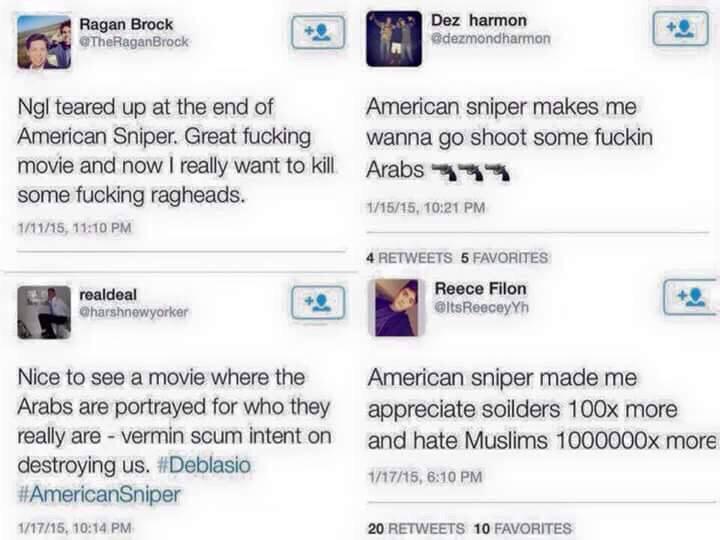
As I so often do on this blog, I will instead be writing on and cataloguing a number of reactions to the film [which I haven’t personally seen], some of which you can see below-

Continue reading

2014’s Cultural Battleground – Gordon’s Account

EDITOR’S NOTE: We end this year by each taking a look back and picking our five best posts, explaining both their importance to us and to the world we currently live in.  Clicking the banner images will link you to each post, so as 2014 comes to a close join us in remembering how far we’ve come, but also how far we still have to go.

christianmartyrsbannerThe rise of ISIS/ISIL/IS/”The Terrorist Organization Formerly Known as Prince” has driven a number of issues to the forefront of public discourse. “After 13 years of continual war, should the US embroil itself in yet another conflict?”, “Is lesser-evilism to be accepted in the form of the Assad regime?”, and perhaps most interestingly, “What should be the Christian response to the slaughter of score upon score of Iraqi Christians?”

It was Kat who actually outlined her take on the response many Christians in the West seemed to have, leading her to question if a kind of masochistic glee was being taken in bloodshed. In response, I argued that this absolutely is the case, and that the blood of the martyrs waters the weeds of self-pity.

deadsoldiersbannerOne of the more divisive stories of the year was the rescue of Sargent Bowe Bergdahl, who hadn’t even set foot in the US again before being lambasted as a traitor and a coward of the worst breed. I argue that, had Bergdahl died in captivity, the very same people who’ve shouted themselves hoarse with accusations would be sobbing and lamenting over his loss. Bergdahl’s sin, like so many American military men and women, is that he survived one of America’s wars, and, in returning, serves as a reminder of the true cost of conflict, sacrifice, and hubris.

donlemonbannerOne of the last posts of the year, I decided to include my tirade against CNN’s Don Lemon not because of what he is now, but what I think he might become. His general obliviousness and gutlessness make him a bad journalist, to be sure, but the streak of relentless pettiness he’s demonstrated (see the aftermath of his Cosby-rape comments or his Reza Aslan interview) make him downright dangerous. Lemon seems to have pattern of grasping for anything to cover his ass when he gets caught in a mistake, often leading him to rely on the worst abuses of his position to defend himself. In the coming year, I can only imagine that Lemon’s “sail-with-the-wind” ethics will make him one of the most negative forces in our culture. If he weren’t so corrosive, I might almost look forward to that.

christiansinpopmediabannerFor all the sins of Western Christianity (and they aren’t few), I truly believe that it has, as both a religion and culture, been ruthlessly strawmanned by its critics over the years. In this post, I attempted to draw up some of the worst (or at least, most popular) stereotypes of Christianity and explain just how wrong and unfair they are. I argue that the general laziness in the portrayals of Christians and Christianity is not only inaccurate, but gives the real issues a free pass. As this culture drifts further and further away from a common religious heritage, I think it’s  more important than ever to ensure that everybody gets a fair break.

surprisewitnessbannerSince most of my posts (okay, all of them) tend to focus on what I don’t like, I figured I’d end on what I do– and that came to us in the form of our new installment “Surprise Witness”. Here, we got to defend an aspect of culture which we think actually has some value, and although Evan and I only tested it out once this year, I’m hoping we can incorporate it a lot more in 2015. With it being so easy to paint things in strokes of only good and bad (and nobody’s more guilty of that than I), being able to glean something decent from our cultural refuse should be a good exercise for us all.


So what’s this all mean for us?

Looking back, it seems that we’re becoming more introspective as a culture. More and more, it seems that we are becoming actively involved in voicing our views and values, and turning criticism inwards on ourselves. How we deal with race, sexuality, power, faith, ethics- these are all rising to the forefront of our discourse. In spite of what some have argued, the Culture Wars are far from over. If anything, they’re just getting started and I, for one, am looking forward to that.

See you in the trenches. Have a good new year.

-Gordon